
William Blake Biography: Introduction
William Blake was a renowned English poet, artist, printmaker, and visionary who became one of the most distinctive figures of the Romantic era. Born on November 28, 1757, in London, England, Blake was known for combining poetry and visual art in ways that were highly unusual for his time. His works explored themes such as imagination, spirituality, innocence, experience, freedom, social injustice, and the human condition, making him an influential figure in both English literature and art.
Throughout his career, William Blake created some of the most celebrated works in English poetry, including Songs of Innocence, Songs of Experience, The Marriage of Heaven and Hell, and the famous poem “The Tyger.” He also developed an innovative form of illustrated printing that allowed him to combine his poems with his own drawings and engravings. Although his ideas and artistic style were not widely appreciated during his lifetime, his unique approach eventually earned him recognition as an important pioneer of Romantic literature and visual art.
William Blake died on August 12, 1827, in London at the age of 69, but his influence continued to grow long after his death. Today, he is remembered as a major English poet and artist whose work continues to be studied, exhibited, interpreted, and celebrated around the world. As preparations continue for the bicentenary of his death in 2027, renewed interest in Blake’s life, writings, artwork, beliefs, and legacy has brought his remarkable story to the attention of new generations.
William Blake Early Life and Education
William Blake was born on November 28, 1757, in Soho, London, England, into a modest middle-class family. He was the third son of James Blake, a hosier and small businessman, and Catherine Wright Armitage Blake. From an early age, Blake showed a strong interest in art and literature, and his family recognized his unusual creative abilities. He reportedly began experiencing vivid spiritual visions as a child, which later became an important part of his artistic and poetic imagination. Rather than attending a conventional school for many years, Blake received much of his early education at home, where he developed his interest in reading, drawing, poetry, and the Bible.
As a young boy, Blake was enrolled at Henry Pars’ drawing school in London, where he received formal training in drawing and developed his understanding of artistic techniques. At around the age of ten, he began studying there, learning to draw from plaster casts and other artistic models. His parents supported his artistic ambitions, and in 1772, when he was 14, Blake was apprenticed to the respected engraver James Basire. During his seven-year apprenticeship, Blake learned engraving and was sent to Westminster Abbey and other historic locations to make drawings of medieval architecture and monuments. This experience had a lasting influence on his artistic style and fascination with history, religion, and symbolism.
After completing his apprenticeship in 1779, Blake continued his artistic education at the Royal Academy Schools in London. There, he studied drawing and developed his skills while becoming increasingly independent in his artistic thinking. Blake did not always agree with the artistic preferences of established figures at the Academy, and he gradually developed a style that emphasized imagination and individual expression. His early experiences as a child, his training as an engraver, and his exposure to religious and historical art all contributed to the distinctive combination of poetry, visual imagery, and spirituality that would define his later career.
William Blake Education
William Blake received much of his early education at home rather than following a conventional academic path. His parents encouraged his interests in reading, drawing, poetry, and religion, and he became particularly interested in the Bible and works of literature from a young age. His early exposure to books and religious ideas helped shape the imaginative and symbolic style that later became a defining feature of his poetry and artwork.
At about the age of ten, Blake began attending the drawing school run by Henry Pars in London. There, he received practical training in drawing and learned to study artistic forms through models and plaster casts. His talent for art became increasingly clear, and in 1772, at the age of 14, he was apprenticed to the engraver James Basire. During his seven-year apprenticeship, Blake developed valuable engraving skills and was given opportunities to study and draw medieval architecture and sculptures, particularly at Westminster Abbey. This experience strengthened his interest in religious art, history, and symbolism.
After completing his apprenticeship in 1779, Blake continued his formal artistic education at the Royal Academy Schools in London. He studied drawing and became familiar with the artistic traditions and techniques valued by the British art establishment. However, Blake increasingly preferred imagination and personal expression over strict adherence to conventional artistic rules. His education, apprenticeship, and independent study ultimately gave him the technical foundation to create the unusual combination of illustrated poetry, engraving, and visual storytelling for which he would later become famous.
William Blake Career
William Blake began his professional career as an engraver after completing his apprenticeship under James Basire in 1779. He worked on a variety of engraving projects and also accepted commissions to support himself financially. In addition to engraving, Blake continued developing his skills as a poet, painter, and illustrator. He became part of London’s artistic community and established relationships with other artists and writers. His early professional experiences allowed him to combine his technical knowledge of engraving with his growing interest in poetry, symbolism, religion, and imaginative art.
One of the most important developments in Blake’s career was his creation of illuminated books, in which he combined poetry, illustrations, typography, and hand-colouring. He used a technique of relief etching that enabled him to produce both text and images on the same copper plates. Among his best-known works from this period were Songs of Innocence (1789), The Marriage of Heaven and Hell (around 1790–1793), and Songs of Experience (1794). His poetry addressed themes including childhood, innocence, experience, social injustice, political freedom, religion, and the power of imagination. Blake’s approach was highly personal and differed considerably from the conventional publishing methods of his time.
During the later part of his career, Blake produced increasingly ambitious poetry and visual art while continuing to work as an engraver. His major works included The Four Zoas, Milton, and Jerusalem, which formed part of an elaborate personal mythology involving figures such as Urizen, Los, and Orc. Blake also produced illustrations for the works of other writers, including John Milton and Robert Blair, and worked with patrons and fellow artists who helped provide him with commissions. Although he struggled financially and received limited recognition during much of his lifetime, his artistic output remained remarkably original. After his death in 1827, his reputation grew substantially, and he came to be recognized as an important poet, artist, and visionary whose work had a lasting influence on English literature and visual art.
Why William Blake Is Trending in 2026
William Blake is attracting renewed attention in 2026 largely because the literary and artistic world is preparing for the 200th anniversary of his death in 2027. Blake died on August 12, 1827, and the approaching bicentenary has encouraged renewed interest in his life, poetry, illustrations, artistic techniques, and unconventional spiritual ideas. Museums, literary organizations, scholars, and Blake enthusiasts are using the upcoming anniversary to highlight his contribution to English literature and art, bringing his work to the attention of both longtime admirers and younger audiences.
Another reason William Blake is trending is the continued interest in his original artwork and illuminated books, particularly works such as Songs of Innocence and of Experience, The Tyger, and Jerusalem. His ability to combine poetry and visual art continues to make his work distinctive in an age when illustrated and digital storytelling has become increasingly popular. Researchers and cultural institutions also continue to study Blake’s surviving manuscripts, engravings, and illustrations, helping audiences understand how his artistic techniques and ideas developed throughout his lifetime.
The preservation of places connected with Blake has also contributed to renewed public interest. In 2026, attention has been drawn to Blake Cottage in Felpham, where Blake lived for a period during the early 19th century, amid efforts to preserve and potentially make the historic property more accessible to the public. Together with preparations for the 2027 bicentenary, these developments have helped bring Blake back into cultural conversations. His combination of poetry, art, spirituality, imagination, and social criticism continues to make him a compelling historical figure more than two centuries after his death.
William Blake Cause of Death and Death
William Blake died on August 12, 1827, in London, England, at the age of 69. The exact medical cause of his death was not recorded with certainty, so it is not considered accurate to attribute his death to a specific disease without qualification. Historical accounts indicate that Blake had become increasingly weak during the final period of his life, although he continued working on his poetry and artwork almost until the end.
On the day of his death, Blake reportedly remained focused on his art and spiritual beliefs. Accounts of his final hours describe him as continuing to work and showing enthusiasm for his artistic creations. His wife, Catherine Blake, was with him during his final period. Despite his later importance, Blake was still relatively unrecognized when he died, and his death did not initially receive the level of public attention that his reputation would eventually attract.
William Blake was buried at Bunhill Fields, a historic London burial ground associated with religious nonconformists and several notable writers. His original burial location was later difficult to identify because of changes to the cemetery, but researchers eventually pinpointed the site using historical burial records and other evidence. Today, Blake’s burial place is commemorated, and his reputation has grown enormously since his death. He is now regarded as one of the most important English poets, artists, and visionary thinkers of the Romantic period.
William Blake Personal Life and Family
William Blake married Catherine Boucher on August 18, 1782, in Battersea, London. Their relationship became one of the most important partnerships in Blake’s personal and professional life. Catherine came from a modest background and had limited formal education when they met, but Blake taught her to read and write and trained her to assist with aspects of his artistic work. Their marriage lasted for the rest of Blake’s life, and Catherine became closely involved in producing and hand-colouring his illuminated books and prints.
William and Catherine Blake did not have any surviving children, and there is no reliable evidence that Blake had a fiancée before his marriage to Catherine. The couple lived in several locations around London during their marriage, including Soho, Lambeth, and later Fountain Court near the Strand. Their household was closely connected to Blake’s artistic activities, and Catherine frequently assisted him in preparing his engravings and illuminated works. Their partnership was especially important because Blake’s unusual printing process required considerable manual work, including colouring and assembling copies of his books.
Blake was also connected to a wider family and artistic circle that influenced different stages of his life. His father, James Blake, was a hosier, while his mother, Catherine Wright Armitage Blake, encouraged the family’s interests and helped create a supportive environment for his artistic development. Blake had several siblings, including his younger brother Robert Blake, who became particularly important to him and whom Blake later remembered as a major influence on his artistic development. Robert’s death in 1787 deeply affected Blake, and Blake later incorporated his brother’s memory into his creative and spiritual worldview. Throughout his adult life, however, Catherine remained Blake’s closest companion and most important family partner.
William Blake Age, Religion, Nationality, Height and Physical Appearance
William Blake was born on November 28, 1757, in Soho, London, England, and died on August 12, 1827, at the age of 69. His life spanned a period of major political, social, and artistic change in Britain, including the American and French Revolutions and the emergence of the Romantic movement. Although Blake was not widely celebrated during his lifetime, his reputation grew significantly after his death.
Regarding religion, William Blake was Christian by cultural and spiritual background, but his personal beliefs were highly unconventional and difficult to place within a single established denomination. He drew extensively on the Bible and Christian imagery, while rejecting several conventional religious doctrines and developing a highly individual vision of God, humanity, good and evil, and spiritual freedom. His writings often challenged organized religion and emphasized imagination and personal spiritual experience.
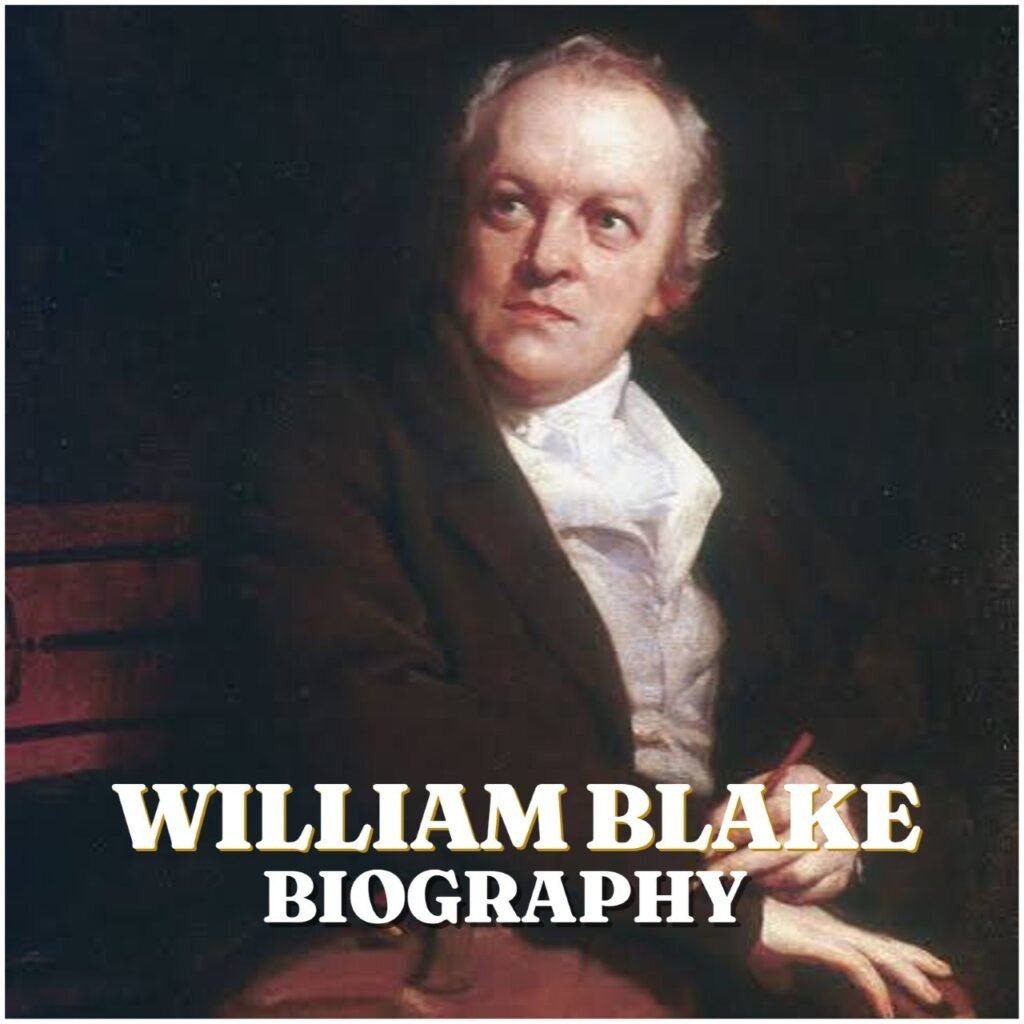
William Blake was English by nationality and spent most of his life in England, particularly in London. His exact height has not been reliably recorded in surviving historical sources, so a specific height should not be presented as fact. Likewise, detailed modern-style physical measurements are unavailable. Contemporary portraits and descriptions generally portray Blake as a relatively slender man with distinctive facial features, light-colored hair in his younger years, and an expressive appearance. Later portraits show him with thinning or greying hair and a more mature face, reflecting his age during the final years of his life.
William Blake Net Worth
William Blake’s exact net worth at the time of his death in 1827 is not known, because there are no reliable financial records that allow his personal wealth to be calculated in modern terms. Unlike many famous artists today, Blake did not become wealthy from his books or paintings during his lifetime. He worked mainly as an engraver, illustrator, poet, and artist, often relying on commissions and support from patrons to maintain his household.
Blake’s income came from several sources, including commercial engraving, book illustration, commissioned artwork, and the sale of his own illuminated books. However, his highly individual artistic style and unconventional poetry attracted only a limited audience while he was alive. His illuminated books were produced in relatively small numbers, and Blake often earned modest amounts from his creative work. His financial circumstances therefore remained relatively limited compared with those of successful artists and writers of his era.
Because no dependable figure exists for William Blake’s personal wealth, any modern net-worth estimate would be speculative. Based on the nature of his career and the limited financial success he experienced during his lifetime, it is reasonable to describe him as having had modest financial means rather than significant wealth when he died in 1827. The enormous monetary value attached to Blake’s original artworks, manuscripts, and books today should not be confused with his personal wealth during his lifetime. His greatest legacy was his artistic and literary influence, which became far more valuable after his death than it had been during his own era.
William Blake Legacy
William Blake left a lasting legacy as one of England’s most original poets, artists, and printmakers. Although he received limited recognition during his lifetime, his reputation grew considerably after his death. His ability to combine poetry, illustration, engraving, and hand-colouring created a distinctive form of artistic expression that challenged the conventional boundaries between literature and visual art. Works such as Songs of Innocence and of Experience, The Marriage of Heaven and Hell, Milton, and Jerusalem have become important parts of English literary and artistic history.
Blake’s influence extends beyond poetry and art because of the powerful ideas expressed throughout his work. He explored imagination, freedom, spirituality, innocence, experience, political oppression, poverty, childhood, and the relationship between humanity and society. His poems, including “The Tyger,” “London,” and “The Chimney Sweeper,” continue to be widely studied in schools and universities. His unusual spiritual mythology and rejection of conventional artistic and religious thinking have also made him an important subject for scholars interested in Romanticism, symbolism, mysticism, and the history of ideas.
Today, William Blake is recognized internationally as a major figure of the Romantic period and an influential precursor to later movements in literature and visual art. His original manuscripts, engravings, paintings, and illuminated books are preserved and exhibited by major cultural institutions, while his poetry continues to inspire writers, musicians, artists, and filmmakers. Interest in his work is expected to receive further attention as the 200th anniversary of his death approaches in 2027, ensuring that Blake’s extraordinary combination of imagination, poetry, art, and spiritual thought continues to reach new generations.
Conclusion
William Blake remains one of the most remarkable and unconventional figures in English literary and artistic history. From his early training as an engraver to his development as a poet, painter, and visionary artist, he created works that challenged traditional ideas about religion, society, imagination, and human nature. Although he experienced limited financial success and recognition during his lifetime, his influence grew greatly after his death in 1827. Today, works such as Songs of Innocence and of Experience, The Tyger, and Jerusalem continue to be studied and admired around the world, securing Blake’s place as a lasting figure of the Romantic era and a pioneer who successfully united poetry and visual art.
Frequently Asked Questions About William Blake
Who was William Blake?
William Blake was an English poet, painter, printmaker, and visionary artist best known for combining poetry and visual art. He is regarded as an important figure of the Romantic era and is famous for works such as Songs of Innocence and of Experience, The Tyger, and The Marriage of Heaven and Hell.
When was William Blake born?
William Blake was born on November 28, 1757, in Soho, London, England.
When did William Blake die?
William Blake died on August 12, 1827, in London, England, at the age of 69.
What was William Blake’s cause of death?
The exact medical cause of William Blake’s death is not known with certainty. Historical records indicate that he became increasingly weak during the final period of his life, but no definitive cause of death has been established.
Who was William Blake’s wife?
William Blake’s wife was Catherine Boucher, whom he married on August 18, 1782. Catherine was an important partner in Blake’s personal and artistic life and assisted him with his printing and colouring work.
Did William Blake have children?
William Blake and Catherine Boucher had no surviving children. They remained together throughout their marriage until Blake’s death in 1827.
What was William Blake famous for?
William Blake was famous for his poetry, paintings, engravings, illustrations, and illuminated books. He is particularly remembered for Songs of Innocence, Songs of Experience, The Tyger, The Marriage of Heaven and Hell, Milton, and Jerusalem.
What religion was William Blake?
William Blake was deeply influenced by Christianity and the Bible, but his personal religious beliefs were highly unconventional. He rejected several aspects of organized religion and developed his own distinctive spiritual and mythological system.
What was William Blake’s nationality?
William Blake was English. He was born in London and spent most of his life in England.
How tall was William Blake?
William Blake’s exact height is not reliably recorded in surviving historical sources. Therefore, a specific height should not be presented as a confirmed fact.
What was William Blake’s net worth?
William Blake’s exact net worth is unknown. He lived relatively modestly and earned money primarily through engraving, illustration, commissioned artwork, and the production of his illuminated books. There is no reliable historical figure for his personal wealth.
Why is William Blake important today?
William Blake is important because he transformed the relationship between poetry and visual art. His innovative illuminated books, imaginative poetry, spiritual ideas, and criticism of social injustice influenced generations of writers and artists. His work remains widely studied and admired more than two centuries after his death.
Why is William Blake trending in 2026?
William Blake is receiving renewed attention in 2026 partly because 2027 marks the 200th anniversary of his death. The approaching bicentenary has encouraged exhibitions, research, preservation efforts, and other cultural activities focused on his life and work.