
Introduction
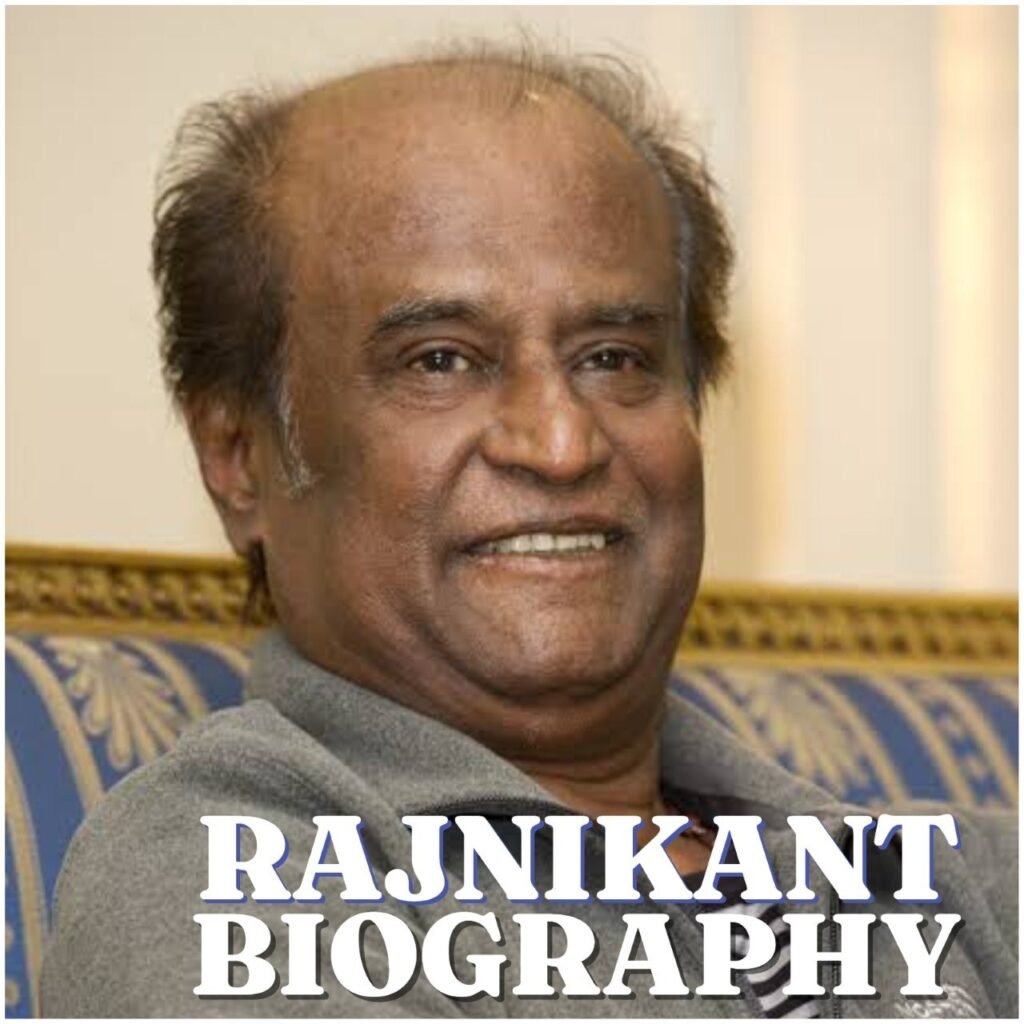
Rajinikanth, popularly known as Superstar Rajinikanth and affectionately called Thalaivar, is one of the most celebrated actors in Indian cinema. Born Shivaji Rao Gaekwad on December 12, 1950, he has built an extraordinary career through his distinctive acting style, commanding screen presence, memorable dialogue delivery and energetic performances. Although he is best known for his work in Tamil cinema, his films have attracted audiences across India and internationally. His popularity has continued for decades, making him a significant figure in Indian entertainment and a cultural icon whose influence extends beyond the screen.
One of the most remarkable aspects of Rajinikanth’s biography is his journey from modest beginnings to becoming a major film star. Before entering the entertainment industry, he worked several jobs, including as a bus conductor in Bengaluru. His interest in acting eventually led him to the Madras Film Institute, where filmmaker K. Balachander recognised his potential and helped introduce him to Tamil cinema. Through persistence, talent and a distinctive personality, Rajinikanth progressed from playing supporting and negative roles to becoming one of the most influential leading actors in the Indian film industry.
Beyond his commercial success, Rajinikanth is known for his spiritual interests, relatively private personal life and enduring relationship with his fans. His filmography includes popular productions such as Baashha, Padayappa, Sivaji: The Boss, Enthiran, Kabali, Petta, Jailer and Coolie. His continued involvement in major film projects demonstrates his ability to remain relevant while the industry evolves around him. In 2026, attention surrounding Jailer 2, his upcoming film Dharman and a planned reunion with Kamal Haasan has kept him firmly in the public conversation.
Early Life and Childhood
Rajinikanth was born Shivaji Rao Gaekwad on December 12, 1950, in Bengaluru, Karnataka, India, which was then part of Mysore State. He was born into a Marathi-speaking family with roots in Maharashtra. His father, Ramoji Rao Gaekwad, worked as a police constable, while his mother, Ramabai, was a homemaker. He was the youngest of four children, growing up alongside his brothers Sathyanarayana Rao and Nageshwara Rao and his sister Aswath Balubhai. His upbringing was far removed from the glamorous lifestyle he would later experience as a famous actor.
Rajinikanth’s childhood included personal challenges, particularly the loss of his mother when he was young. Growing up in a working-class household taught him the importance of discipline, perseverance and responsibility. During his school years, he developed interests in performance and storytelling, although there was little indication that he would eventually become one of India’s most recognisable film stars. His early experiences helped shape the personal outlook that he would later become known for, especially his preference for a comparatively simple lifestyle away from the demands of celebrity culture.
Before becoming an actor, Rajinikanth worked in different occupations to support himself. One of the most frequently discussed periods of his early life was his employment as a bus conductor with the Bangalore Transport Service. The job provided him with a regular income, but his growing passion for acting encouraged him to consider a different future. With support and encouragement from people who recognised his interest in performance, he decided to pursue professional acting training. That decision became the starting point of a journey that would transform his life and establish his place in Indian cinema.
Education and Academic Background
Rajinikanth received his early education in Bengaluru. He attended Gavipuram Government Kannada Model Primary School and later studied at Acharya Pathasala Public School. His academic journey was relatively conventional, and he did not initially follow a path associated with the entertainment industry. Although he completed his schooling, his future direction was shaped increasingly by his interest in acting rather than by further academic study.
After leaving school, Rajinikanth took on several jobs, including employment as a bus conductor. These experiences helped him earn a living while he considered his ambitions. His interest in performance continued to grow, and he eventually decided that he wanted to pursue acting professionally. This was an important choice because it meant leaving behind a more predictable working life to enter a competitive industry where success was uncertain.
Rajinikanth later enrolled at the Madras Film Institute in Chennai to receive formal acting training. His time there helped him develop the performance skills necessary for a professional career and introduced him to people connected with the film industry. It was during this period that director K. Balachander noticed his potential. Balachander’s encouragement played a crucial role in opening the door to Tamil cinema and helping Rajinikanth begin a career that would eventually span more than five decades.
Rajinikanth’s Acting Career and Rise to Stardom
Beginning of His Acting Career
Rajinikanth made his acting debut in the 1975 Tamil film Apoorva Raagangal, directed by K. Balachander. Although his role was relatively small, it gave him an opportunity to enter the film industry and begin building professional experience. His early performances often involved antagonists, supporting characters and morally complicated personalities. His intense expressions, distinctive voice and unusual screen presence helped him stand out, even when he was not playing the central character.
During the early stages of his career, Rajinikanth appeared in films such as Moondru Mudichu and 16 Vayadhinile. These performances allowed him to demonstrate that he could portray challenging characters with confidence and intensity. Rather than immediately becoming a conventional romantic hero, he developed his reputation through roles that required strong emotional expression and a commanding physical presence. His work during this period also gave him the opportunity to learn from established filmmakers and improve his craft.
A major turning point came when directors began casting Rajinikanth in more substantial and sympathetic roles. His performance in Mullum Malarum, released in 1978 and directed by J. Mahendran, demonstrated his ability to portray a complex character with emotional depth. The film helped audiences see him as more than an actor suited to negative roles. As his reputation grew, he gradually moved into leading roles and began establishing the screen identity that would later make him a superstar.
Rise to Stardom in Indian Cinema
Rajinikanth’s popularity increased significantly during the 1980s as he appeared in films combining action, drama, romance and comedy. His characters frequently displayed courage, confidence and the ability to overcome powerful opponents. His dialogue delivery, expressive gestures and distinctive movements became central elements of his performances, allowing him to develop a recognisable identity that audiences could immediately associate with him.
His rise was supported by films that presented him as a larger-than-life hero. His signature gestures, including the way he handled sunglasses and delivered dramatic dialogue, became a defining part of his screen persona. Filmmakers increasingly developed scenes around these characteristics, while fans began imitating his style and repeating his famous lines. This connection between the actor’s personality and the audience’s expectations helped distinguish him from many other leading actors of his generation.
By the late 1980s and throughout the 1990s, Rajinikanth had become one of Tamil cinema’s leading commercial stars. Films such as Thalapathi, Annamalai, Baashha and Padayappa strengthened his popularity. In particular, Baashha became closely associated with his powerful screen image and helped establish the kind of confident, controlled hero that would appear in many of his later films. His popularity also expanded beyond Tamil-speaking audiences through dubbed releases and films distributed in different Indian markets.
Major Movies and Career Achievements
Rajinikanth’s filmography includes action dramas, family stories, comedies, crime films and large-scale commercial productions. Thalapathi demonstrated his ability to combine intensity with emotional vulnerability, while Annamalai and Baashha reinforced his position as a major star. Padayappa, released in 1999, became another important milestone, with its memorable confrontations, family drama and strong performances contributing to its continued popularity.
In the 2000s, Rajinikanth continued to headline films that expanded his commercial reach. Chandramukhi became a major success, while Sivaji: The Boss, directed by S. Shankar, combined social themes, comedy and spectacle. The science-fiction film Enthiran, released in 2010, showcased him in the dual roles of scientist Vaseegaran and robot Chitti. Its sequel, 2.0, further demonstrated the scale of productions built around his popularity and the growing ambitions of Indian commercial filmmaking.
Rajinikanth also continued to work with directors from different generations. Films such as Kabali, Kaala, Petta, Darbar, Annaatthe, Jailer, Vettaiyan and Coolie introduced different approaches to his screen persona. Kabali and Kaala incorporated social themes into stories centred on powerful characters, while Jailer combined family drama, crime and action. These projects helped him maintain a presence in an industry where new stars, changing audience preferences and evolving production techniques continually reshape commercial cinema.
Awards and Recognition
Rajinikanth has received numerous honours for his contributions to Indian cinema. He was awarded the Padma Bhushan in 2000 and the Padma Vibhushan in 2016, two of India’s major civilian awards. These honours recognised his contribution to the country’s cultural and entertainment landscape and reflected the importance of his work across several decades.
In 2014, Rajinikanth received the Centenary Award for Indian Film Personality of the Year at the International Film Festival of India. In 2021, he was awarded the Dadasaheb Phalke Award, India’s highest honour for lifetime achievement in cinema. The award acknowledged his long career, artistic contribution and influence on the film industry.
His recognition also extends beyond formal awards. Rajinikanth’s fans regularly celebrate his birthday and film releases through special screenings, public displays and online tributes. His dialogue, gestures and iconic scenes continue to circulate among audiences, while his films remain an important part of discussions about popular Tamil cinema. The combination of official honours and sustained audience enthusiasm reflects the lasting influence he has built throughout his career.
Trending: Rajinikanth’s Jailer 2, Dharman and Upcoming Reunion With Kamal Haasan
Rajinikanth has remained a major subject of entertainment news in 2026 because of his busy film schedule and the anticipation surrounding his latest projects. One of the most prominent developments has been Jailer 2, the sequel to his 2023 action hit Jailer. Directed by Nelson Dilipkumar, the film brings Rajinikanth back as the character Tiger Muthuvel Pandian. It was scheduled for theatrical release on October 15, 2026, making it one of the major Tamil film releases attracting attention during the year.
The sequel reunites Rajinikanth with director Nelson Dilipkumar and composer Anirudh Ravichander. Several familiar performers return, while new additions have expanded the ensemble cast. The original film’s commercial success helped create strong interest in the sequel, particularly among fans eager to see the return of Muthuvel Pandian. Rajinikanth confirmed in August 2026 that filming had been completed, and the project moved into its final preparations for release.
Another major project generating interest is Dharman, directed by Ashwath Marimuthu and produced by Kamal Haasan’s Raaj Kamal Films International in association with Red Giant. Rajinikanth is reportedly playing a doctor, with Simran, Raashii Khanna, Yogi Babu and other actors associated with the production. The project has attracted attention because it brings the veteran star together with a younger filmmaker and offers an opportunity to see him in a new character.
Rajinikanth has also confirmed plans to reunite on screen with fellow Indian cinema icon Kamal Haasan in a separate project associated with Red Giant Movies. The announcement has generated considerable excitement because the two actors shared the screen in several films during the earlier stages of their careers. Their reunion represents a notable moment for fans who have followed both performers for decades. As of October 2026, the project has been discussed publicly, although its full details and final release plans remain dependent on official announcements.
These developments demonstrate that Rajinikanth continues to pursue major film projects rather than relying solely on his earlier achievements. His work with established collaborators and newer filmmakers reflects the continuing evolution of his career. His latest projects also show how his popularity remains closely tied to audience anticipation, established characters and the promise of seeing him in new roles.
Personal Life and Family
Rajinikanth married Latha Rangachari, popularly known as Latha Rajinikanth, on February 26, 1981. Latha has been involved in educational and charitable activities and has also had connections with the entertainment industry. Despite Rajinikanth’s enormous public profile, the couple have generally maintained a degree of privacy regarding their personal lives. Their long marriage has been an important part of his biography, although Rajinikanth usually prefers to keep public attention focused on his professional work and spiritual interests.
The couple have two daughters, Aishwarya Rajinikanth and Soundarya Rajinikanth, both of whom have worked in the entertainment industry. Aishwarya is a filmmaker who has worked as a director and in other creative roles, while Soundarya has been involved in filmmaking, production and visual design. Their professional activities have helped extend the family’s connection to Indian cinema, while allowing them to establish identities separate from their father’s acting career.
Rajinikanth’s family has also attracted public attention through his daughters’ relationships and children. Aishwarya was previously married to actor Dhanush, and they have two sons, Yathra and Linga. Soundarya was previously married to Ashwin Ramkumar and later married Vishagan Vanangamudi. Although these family matters have occasionally received media attention, Rajinikanth generally maintains a private approach to family life and rarely makes personal matters the main focus of his public appearances.
Age, Religion, Tribe, Nationality, Height and Physical Appearance
Rajinikanth was born on December 12, 1950, making him 75 years old as of October 24, 2026. He will celebrate his 76th birthday on December 12, 2026. His longevity in the entertainment industry has become an important part of his public image, as he continues to participate in major film projects after more than five decades of acting.
Rajinikanth was born into a Hindu family and has frequently expressed an interest in spirituality. His nationality is Indian, and his family background is Marathi. He is commonly described as belonging to a Marathi-speaking family rather than being identified with a specific tribal community. There is no widely established public information confirming that he belongs to a particular tribe, so assigning him a tribal identity without reliable evidence would be inaccurate.
Rajinikanth is commonly reported to be approximately 5 feet 8 inches tall, or around 173 centimetres, although celebrity measurements may vary between published sources. He has a lean build, expressive eyes and distinctive facial features. His hairstyle and appearance have changed over the years, but his confident posture, controlled movements and recognisable gestures remain important parts of his screen identity.
His style is defined by individuality rather than conventional glamour alone. The way he delivers dialogue, handles props and uses pauses has become instantly recognisable to audiences. These characteristics have helped him maintain a consistent identity across different genres and generations of filmmaking. His physical presence and performance techniques have become so closely associated with his name that they remain central to how audiences remember his most famous characters.
Social Media Presence
Rajinikanth’s popularity extends across social media, where updates about his films, public appearances and personal milestones attract significant attention. Film production companies, distributors, co-stars, entertainment journalists and fan communities regularly share material related to his career. His birthday and major film releases are especially popular occasions for tributes, discussions of memorable performances and the circulation of clips from his best-known movies.
Unlike many younger actors, Rajinikanth has not built his public identity around frequent personal social media updates. Consequently, it is important to distinguish official announcements and verified communications from fan-operated accounts that use his name or photographs. His social media presence is often represented through film promotions, news coverage and the activities of fan communities rather than a constant stream of personal posts. Readers should verify any account claiming to be his official profile before treating it as authentic.
His online popularity remains substantial because his films appeal to audiences across different age groups. Clips of his dialogue delivery, action scenes and signature gestures continue to circulate widely, introducing his work to younger viewers while reminding longtime fans of his earlier performances. This digital attention has helped preserve his cultural relevance and strengthened the connection between his classic films and his newer releases.
Rajinikanth’s Net Worth and Sources of Income
Rajinikanth is widely regarded as one of the wealthiest and most commercially successful actors in Indian cinema. His financial position reflects a career spanning more than five decades, during which he has appeared in numerous commercially successful films. Although an exact, independently verified figure for his net worth is not publicly available, various celebrity wealth estimates place his fortune in the tens of millions of US dollars. A figure of approximately US$50 million is sometimes cited, but it should be treated as an unverified estimate rather than a confirmed financial statement.
His principal source of income has been acting. As one of the industry’s major stars, Rajinikanth has commanded substantial remuneration for leading roles in large-scale productions. His compensation for individual films can depend on contractual arrangements, production budgets and other commercial terms. His long record of box-office successes has strengthened his position within the industry, although precise figures for his salary on each project are not consistently disclosed in reliable public records.
Other potential contributors to his wealth include investments, property and commercial arrangements associated with his career. However, the details of his personal assets and financial portfolio are not fully public, making it difficult to establish a precise total. His net worth should therefore be understood as an estimate based on publicly circulated reports rather than an audited figure. Regardless of the exact amount, his lengthy career, high-profile film projects and continuing commercial relevance have established him as one of the most financially successful figures in Indian entertainment.
Legacy and Influence on Indian Cinema
Rajinikanth’s legacy is closely connected to his distinctive screen persona and his ability to build a powerful relationship with audiences. His performances often combine dramatic pauses, confident dialogue delivery, expressive gestures and commanding physical movement. These qualities have influenced the presentation of action heroes in Tamil cinema and helped establish a style that audiences can recognise immediately. His popularity demonstrates how an actor’s personality and performance techniques can become as important to a film’s appeal as its storyline and technical production.
His career is also an example of professional transformation. Rajinikanth began with supporting roles and antagonistic characters before becoming a leading star, and he continued adapting to changing genres, filmmaking styles and audience expectations. His collaborations with directors such as K. Balachander, S. Shankar, Pa. Ranjith, Karthik Subbaraj and Nelson Dilipkumar reflect his work with filmmakers from different generations. These collaborations have allowed him to explore different characters while retaining the distinctive qualities that define his public image.
Beyond the screen, Rajinikanth occupies an important place in Indian popular culture. His fans celebrate his films, reproduce his famous dialogue and organise special screenings around major releases. His popularity has also crossed linguistic boundaries through dubbed films and distribution across different regions. For many audiences, his movies are not simply entertainment but shared cultural experiences that connect people across generations.
Rajinikanth’s life story is frequently cited as an example of determination and the pursuit of ambition. His journey from working as a bus conductor to becoming a celebrated actor has inspired people who admire his professional transformation. At the same time, his success reflects the collaborative nature of filmmaking, with directors, writers, composers, co-stars and technical teams contributing to the productions that shaped his career. His continuing involvement in new films ensures that his influence remains part of Indian cinema’s present as well as its history.
Conclusion
Rajinikanth’s biography is a story of perseverance, reinvention and enduring influence. From his childhood in Bengaluru and his early employment as a bus conductor to his rise as one of India’s most celebrated actors, he has built a career that spans generations. His memorable performances, distinctive style, spiritual interests and devoted fan base have established him as a major figure in Tamil cinema and Indian entertainment. With Jailer 2, Dharman and a planned reunion with Kamal Haasan keeping audiences interested in his next steps, Rajinikanth continues to make headlines in 2026. His journey remains a remarkable example of how determination, talent and a lasting connection with audiences can shape an extraordinary career.
Frequently Asked Questions About Rajinikanth
Who is Rajinikanth?
Rajinikanth is an Indian actor best known for his work in Tamil cinema. Born Shivaji Rao Gaekwad, he is popularly known as Superstar Rajinikanth and Thalaivar. He has appeared in films across several Indian languages and is celebrated for his distinctive acting style and extensive fan following.
What is Rajinikanth’s real name?
Rajinikanth’s real name is Shivaji Rao Gaekwad. He adopted the screen name Rajinikanth when he began his acting career.
How old is Rajinikanth in 2026?
Rajinikanth is 75 years old as of October 24, 2026. He was born on December 12, 1950, and will turn 76 in December 2026.
When was Rajinikanth born?
Rajinikanth was born on December 12, 1950, in Bengaluru, Karnataka, India.
What is Rajinikanth’s nationality?
Rajinikanth is Indian. He was born in Bengaluru and comes from a Marathi-speaking family with roots in Maharashtra.
What is Rajinikanth’s religion?
Rajinikanth was born into a Hindu family and has frequently expressed an interest in spirituality and religious traditions.
Who is Rajinikanth’s wife?
Rajinikanth’s wife is Latha Rajinikanth. They married on February 26, 1981.
How many children does Rajinikanth have?
Rajinikanth has two daughters, Aishwarya Rajinikanth and Soundarya Rajinikanth. Both have worked in the entertainment industry.
What was Rajinikanth’s first movie?
Rajinikanth made his acting debut in the 1975 Tamil film Apoorva Raagangal, directed by K. Balachander.
What are Rajinikanth’s most famous movies?
Some of Rajinikanth’s most famous films include Baashha, Padayappa, Thalapathi, Chandramukhi, Sivaji: The Boss, Enthiran, 2.0, Kabali, Petta, Jailer and Coolie.
What is Rajinikanth’s net worth?
Rajinikanth’s exact net worth has not been independently confirmed. Some entertainment estimates place it at approximately US$50 million, but this remains an unverified estimate.
What is Rajinikanth’s height?
Rajinikanth is commonly reported to be approximately 5 feet 8 inches tall, or around 173 centimetres.
Is Rajinikanth still acting in 2026?
Yes. Rajinikanth remains active in the film industry. His recent projects include Jailer 2, released in October 2026, and Dharman, which is among his upcoming films.
What is Rajinikanth’s latest movie in 2026?
As of October 24, 2026, Jailer 2 is his latest scheduled theatrical release, with its release date set for October 15, 2026. Dharman is another major project in his current lineup.
Why is Rajinikanth called Thalaivar?
Thalaivar is a Tamil word meaning “leader” or “chief.” Rajinikanth’s fans use the title as a sign of respect and affection because of his influence and longstanding popularity in Tamil cinema.
Did Rajinikanth work as a bus conductor before becoming an actor?
Yes. Before entering the film industry, Rajinikanth worked as a bus conductor with the Bangalore Transport Service. He later studied acting at the Madras Film Institute, where filmmaker K. Balachander noticed his potential.
Which major awards has Rajinikanth received?
Rajinikanth has received several major honours, including the Padma Bhushan in 2000, the Padma Vibhushan in 2016 and the Dadasaheb Phalke Award in 2021, recognising his contribution to Indian cinema.