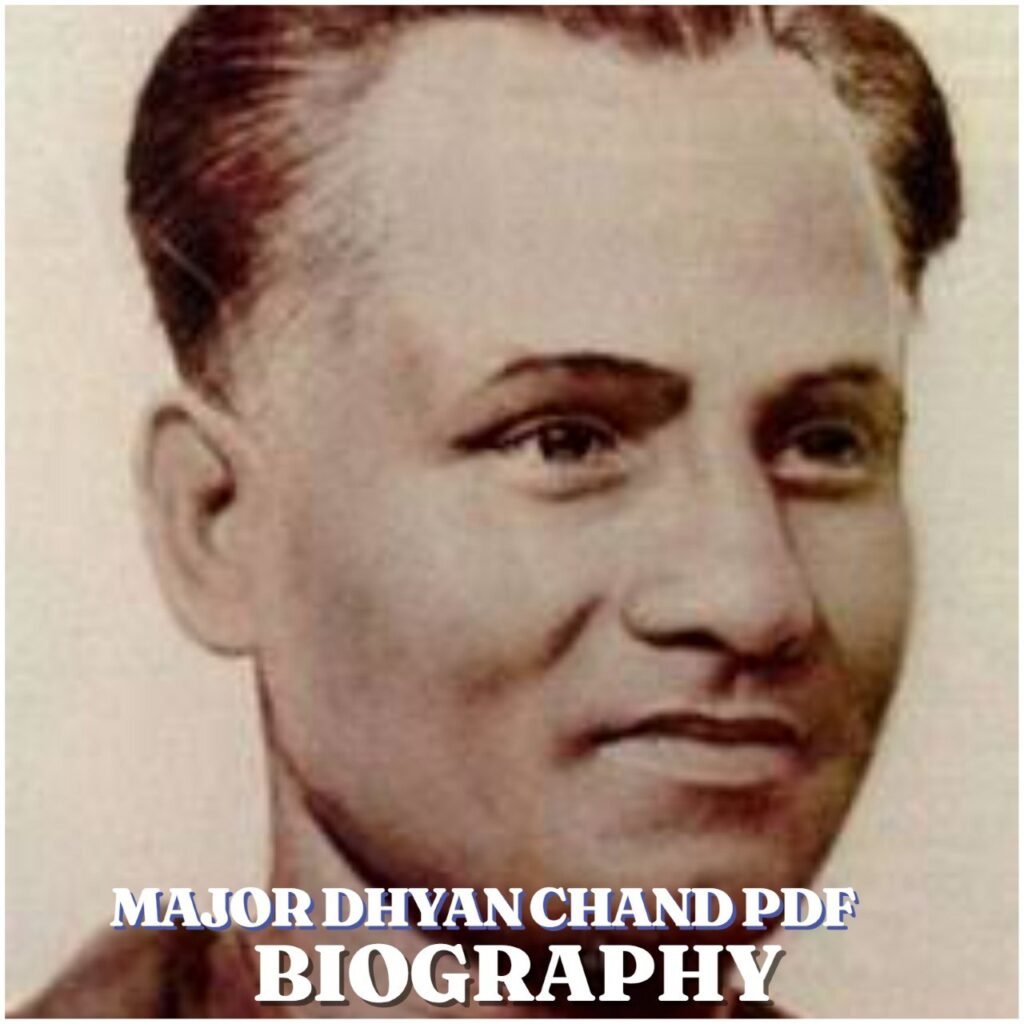

Major Dhyan Chand Biography
Major Dhyan Chand was one of the greatest field hockey players in Indian sporting history and remains a legendary figure whose name is closely associated with India’s golden era of hockey. Born on August 29, 1905, in Allahabad, now known as Prayagraj, Uttar Pradesh, Dhyan Chand developed into an exceptional hockey player whose extraordinary ball control, creativity and goal-scoring ability earned him the famous nickname “The Wizard.” His remarkable career made him a national icon and helped establish India as a dominant force in international hockey during the early 20th century.
Dhyan Chand represented India at three Olympic Games and won three consecutive gold medals in field hockey at the 1928 Amsterdam Olympics, the 1932 Los Angeles Olympics and the 1936 Berlin Olympics. His performances on the international stage helped strengthen India’s reputation as a hockey powerhouse. He also served in the Indian Army, where his sporting career developed alongside his military service. His achievements, discipline and contribution to Indian hockey eventually earned him the Padma Bhushan, one of India’s highest civilian honours, in 1956.
Today, Major Dhyan Chand continues to be remembered far beyond the hockey field. His birthday, August 29, is celebrated as National Sports Day in India, making his legacy an important part of the country’s sporting culture. His life story continues to inspire athletes and sports enthusiasts, while his family legacy also lives on through his son Ashok Kumar, who represented India in international hockey and won an Olympic bronze medal. Dhyan Chand died on December 3, 1979, in New Delhi, but his contribution to Indian hockey remains deeply respected and celebrated decades after his death.
Early Life and Childhood of Major Dhyan Chand
Major Dhyan Chand was born as Dhyan Singh on August 29, 1905, in Allahabad, now known as Prayagraj, in present-day Uttar Pradesh, India. He was born into a Rajput family to Sameshwar Singh, who served in the British Indian Army, and his mother, Sharada Singh. Because of his father’s military service, the family moved to different places during Dhyan Chand’s childhood. These early experiences eventually played an important role in shaping his disciplined and active lifestyle.
As a young boy, Dhyan Chand did not initially show the level of interest in hockey for which he would later become famous. He was more focused on ordinary childhood activities and his education, while his family’s connection with the army exposed him to a structured environment. Dhyan Chand’s formal education was limited compared with his later sporting achievements, and his life took a major turn when he joined the British Indian Army in 1922, at the age of 16. His entry into the army provided him with an environment where his physical abilities, discipline and interest in sport could develop.
It was during his early years in the army that Dhyan Chand’s extraordinary talent for hockey began to emerge. He started playing the sport more seriously and attracted the attention of military officers and fellow players because of his natural ability with the hockey stick. The story behind his famous name is that he practised hockey under moonlight after his military duties, leading fellow soldiers to associate him with the Hindi word “Chand,” meaning moon. Although some details of this popular story have been debated, the name Dhyan Chand eventually became synonymous with Indian hockey and one of the most celebrated sporting careers in the country’s history.
Education of Major Dhyan Chand
Major Dhyan Chand’s formal education was relatively limited because his childhood was influenced by his family’s frequent movements and his father’s career in the British Indian Army. Unlike many modern sporting personalities, Dhyan Chand did not pursue higher education or attend university before becoming famous. His early years were primarily shaped by family life, basic schooling and the disciplined environment associated with military service.
At the age of 16, Dhyan Chand joined the British Indian Army in 1922. His military career became an important part of his development, providing him with discipline, physical training and opportunities to participate in organised sport. While serving in the army, he increasingly devoted himself to field hockey and began developing the exceptional skills that would eventually make him one of the most celebrated hockey players in the world.
Although Dhyan Chand’s academic education was not extensive, his years of military service provided him with another form of education through discipline, training and experience. The army environment helped him develop qualities such as determination, concentration, teamwork and physical fitness, all of which became essential to his hockey career. His story demonstrates that his greatest achievements came not through academic qualifications but through years of practice, discipline and dedication to hockey, eventually leading him to international success and three Olympic gold medals.
Major Dhyan Chand Hockey Career and Achievements
Major Dhyan Chand began his professional journey in the British Indian Army in 1922, when he was only 16 years old. It was during his military service that his talent for field hockey began to attract serious attention. He practised extensively and developed remarkable control, dribbling ability and goal-scoring skills. His dedication to training eventually earned him a place on the Indian hockey team, and he quickly became one of the country’s most important players. His performances also helped establish a reputation for India at a time when international hockey was becoming increasingly competitive.
Dhyan Chand’s international career reached a major milestone when he represented India at the 1928 Amsterdam Olympic Games. India won the gold medal in hockey, beginning a remarkable Olympic run for Dhyan Chand and the Indian team. He continued his success at the 1932 Los Angeles Olympics, where India again won gold. At the 1936 Berlin Olympics, Dhyan Chand captained the Indian hockey team and guided it to another gold medal. His extraordinary performances during these tournaments helped India establish itself as the dominant force in international hockey. Across his career, his exceptional stick work, vision and ability to create scoring opportunities earned him the nickname “The Wizard of Hockey.”
Beyond the Olympics, Dhyan Chand represented India in numerous international matches and tours, including India’s famous hockey tour of New Zealand and Australia in 1932. He continued playing at the highest level while balancing his responsibilities in the army. After retiring from competitive hockey, he remained involved in the sport and contributed to the development of younger players. His career was eventually recognised with the Padma Bhushan in 1956. Dhyan Chand died on December 3, 1979, but his career remains one of the most influential chapters in the history of Indian hockey, and his name continues to be associated with India’s sporting heritage.
National Sports Day 2026: Why Major Dhyan Chand Is Trending Today
Major Dhyan Chand is trending today, August 29, 2026, as India celebrates National Sports Day on what would have been the legendary hockey player’s 121st birth anniversary. The occasion is being observed across the country to honour his extraordinary contribution to Indian hockey and his lasting influence on Indian sport. The Government of India has organised nationwide sporting and fitness activities around this year’s celebrations, keeping Dhyan Chand’s legacy at the centre of the day.
One of the major highlights of today’s celebration is the “Ek Ghanta Khel Ke Maidan Mein” initiative, which encourages citizens, particularly young people, to spend at least one hour participating in sports or physical activity. Union Sports Minister Mansukh Mandaviya led the National Sports Day celebrations at the Major Dhyan Chand National Stadium in New Delhi, where participants took part in football, cricket, tug-of-war and other sporting activities. The event also included a floral tribute to Dhyan Chand, further highlighting his importance to India’s sporting history.
The renewed attention on Major Dhyan Chand today also reflects the enduring importance of his Olympic achievements. He helped India win three consecutive Olympic hockey gold medals in 1928, 1932 and 1936, becoming one of the most celebrated athletes in the country’s history. His birthday has been observed as National Sports Day since 2012, and his name remains strongly connected with India’s sporting honours, including the Major Dhyan Chand Khel Ratna Award. With National Sports Day 2026 bringing his story back into the spotlight, interest in his life, hockey career, Olympic achievements, family and legacy continues to receive renewed attention.
Cause of Death and Death of Major Dhyan Chand
Major Dhyan Chand died on December 3, 1979, at the All India Institute of Medical Sciences (AIIMS) in New Delhi, India, at the age of 74. He had been suffering from liver cancer, which was ultimately reported as the main cause of his death. Contemporary reporting also noted that he had other health complications, including diabetes and kidney problems.
Dhyan Chand had been unwell for some time in his hometown of Jhansi before being taken to Delhi for treatment in November 1979. His son Ashok Kumar was among those present during his final days. Despite medical treatment, his condition deteriorated, and he eventually died at AIIMS in the early hours of December 3.
Following his death, his body was taken to Jhansi, where he was cremated at the Jhansi Heroes ground. His former regiment, the Punjab Regiment, accorded him full military honours. His passing marked the end of the life of one of India’s most celebrated hockey legends, although his influence on Indian sport has continued for generations.
Personal Life and Family of Major Dhyan Chand
Major Dhyan Chand married Janaki Devi in 1936, around the time of his historic participation in the Berlin Olympics. The couple maintained a relatively private family life despite Dhyan Chand becoming one of India’s most celebrated sportsmen. He was known not only for his achievements on the hockey field but also for his disciplined and humble personality. His family remained an important part of his life throughout his years in the army and during his later career as a hockey coach.
Dhyan Chand and Janaki Devi had seven sons: Brij Mohan Singh, Sohan Singh, Raj Kumar, Ashok Kumar, Umesh Kumar, Devinder Singh and Virender Singh. Among them, Ashok Kumar Singh became particularly prominent in Indian hockey, following in his father’s footsteps. Ashok Kumar represented India at the Olympics and is remembered for scoring the winning goal against Pakistan in the 1975 Hockey World Cup final, helping India win the tournament.
Dhyan Chand was also part of a sporting family. His father, Sameshwar Dutt Singh, served in the British Indian Army and played hockey, while his mother was Sharadha Singh. He had two brothers, Mool Singh and Roop Singh, with Roop Singh becoming an accomplished hockey player who represented India alongside Dhyan Chand. The family’s connection with hockey helped create a remarkable sporting legacy that continued through subsequent generations, particularly through Ashok Kumar and other members of the family.
Age, Religion, Nationality, Height and Physical Appearance of Major Dhyan Chand
Major Dhyan Chand was born on August 29, 1905, and died on December 3, 1979, at the age of 74. He was an Indian national and was born in Allahabad, British India, now known as Prayagraj, Uttar Pradesh. His life and sporting career were closely connected with India, both as a hockey player and as an officer in the Indian Army.
Dhyan Chand was Hindu and came from a Bais Rajput family. His father, Sameshwar Dutt Singh, served in the British Indian Army, while his mother was Sharadha Singh. His family background and his father’s military career influenced his upbringing and later contributed to his own decision to join the army at a young age.
In terms of physical appearance, Dhyan Chand was reported to be approximately 169–170 cm (around 5 feet 7 inches) tall. He had an athletic build, which suited his demanding career as an international hockey player and army officer. Historical descriptions and photographs show him as a physically fit sportsman with dark hair and dark-brown eyes. His physical coordination, balance and exceptional control of the hockey stick became some of the defining features of his playing style.
Major Dhyan Chand Net Worth
There is no reliable historical record of Major Dhyan Chand’s exact net worth at the time of his death in 1979. Unlike modern professional athletes, Dhyan Chand earned most of his income through his Indian Army career, while international hockey in his era did not provide the large salaries, endorsement deals and commercial sponsorships that athletes receive today. Official biographical sources confirm that he joined the Army in 1922 and served for 34 years before retiring in 1956.
Because his personal financial records and estate value were not publicly documented, it would be misleading to give a precise figure as his historical net worth. Some later biographical accounts have described his financial circumstances after retirement as modest, including claims that he received a relatively small pension. However, these accounts do not provide enough evidence to establish a dependable rupee figure for his wealth at the time of death.
For a modern biography, a conservative estimated net worth of around ₹1–5 lakh (approximately US$2,000–$10,000 in late-1970s value) can be used only as an estimate based on his long military career, pension and limited commercial opportunities, not as an officially recorded figure. His true financial position remains uncertain. His greatest legacy was never his personal wealth but his three Olympic gold medals, military service and enormous contribution to Indian hockey.
Legacy of Major Dhyan Chand
Major Dhyan Chand left behind one of the greatest legacies in the history of Indian sport. His extraordinary performances helped India dominate international field hockey during the 1920s and 1930s, and he played a major role in India’s three consecutive Olympic gold-medal victories in 1928, 1932 and 1936. His exceptional ball control, dribbling and goal-scoring ability earned him the enduring nickname “The Wizard of Hockey.” Decades after his retirement, he remains widely regarded as one of the greatest hockey players ever produced by India.
His influence extends beyond his Olympic achievements. August 29, his birth anniversary, is celebrated every year as National Sports Day in India, honouring his contribution to the country’s sporting heritage. The government has also named the country’s highest sporting honour, the Major Dhyan Chand Khel Ratna Award, after him. Several sporting institutions and venues have likewise carried his name, ensuring that generations of young athletes continue to encounter his story and achievements.
Dhyan Chand’s legacy has also continued through his family and the athletes he inspired. His son Ashok Kumar, himself an accomplished hockey player, represented India and won an Olympic bronze medal, while other members of the family also remained connected with the sport. More broadly, Dhyan Chand’s life has become a symbol of discipline, dedication, patriotism and sporting excellence. Although he died in 1979, his name continues to inspire Indian hockey players and sports enthusiasts, and his contribution remains an important chapter in the history of Indian sports.
Conclusion
Major Dhyan Chand remains one of the most iconic figures in the history of Indian hockey and international sport. From his early years in the British Indian Army to winning three consecutive Olympic gold medals and becoming known as the “Wizard of Hockey,” his life was defined by extraordinary talent, discipline and dedication. His achievements helped establish India as a dominant force in hockey, while National Sports Day on August 29 continues to keep his memory alive. Although he died in 1979 at the age of 74, Dhyan Chand’s influence continues through his family, the awards and institutions named after him, and the generations of athletes inspired by his remarkable career.
Frequently Asked Questions About Major Dhyan Chand
Who was Major Dhyan Chand?
Major Dhyan Chand was a legendary Indian field hockey player and former British Indian Army officer. He represented India at three Olympic Games and won gold medals in 1928, 1932 and 1936.
When was Major Dhyan Chand born?
Major Dhyan Chand was born on August 29, 1905, in Allahabad, British India, now known as Prayagraj, Uttar Pradesh, India.
When did Major Dhyan Chand die?
Major Dhyan Chand died on December 3, 1979, in New Delhi, India. He was 74 years old.
What was the cause of Major Dhyan Chand’s death?
Major Dhyan Chand died after suffering from liver cancer. He passed away at the All India Institute of Medical Sciences (AIIMS) in New Delhi.
Why is Major Dhyan Chand famous?
Major Dhyan Chand is famous for his extraordinary achievements in field hockey and for helping India win three consecutive Olympic gold medals in 1928, 1932 and 1936.
How many Olympic gold medals did Major Dhyan Chand win?
Dhyan Chand won three Olympic gold medals with India: Amsterdam 1928, Los Angeles 1932 and Berlin 1936.
Why is August 29 celebrated as National Sports Day in India?
August 29 is celebrated as National Sports Day in India because it is the birth anniversary of Major Dhyan Chand, one of India’s greatest hockey players.
What was Major Dhyan Chand’s nickname?
Major Dhyan Chand was popularly known as “The Wizard of Hockey” because of his exceptional stick work, ball control and ability to score goals.
Who was Major Dhyan Chand’s wife?
Major Dhyan Chand married Janaki Devi in 1936. They had seven sons, including the famous Indian hockey player Ashok Kumar.
Who was Major Dhyan Chand’s son?
His best-known son was Ashok Kumar, who followed his father’s path in hockey. Ashok Kumar represented India internationally and was part of India’s 1975 Hockey World Cup-winning team.
What was Major Dhyan Chand’s net worth?
There is no reliable official record of Major Dhyan Chand’s net worth. Unlike modern professional athletes, he earned primarily through his military career, and hockey offered limited commercial income during his playing years.
What awards did Major Dhyan Chand receive?
Major Dhyan Chand was awarded the Padma Bhushan in 1956 for his contribution to Indian sport. His name has also been given to India’s highest sporting honour, the Major Dhyan Chand Khel Ratna Award.
What was Major Dhyan Chand’s nationality?
Major Dhyan Chand was Indian. He was born in Allahabad during the period of British rule in India and later represented India in international hockey.
How tall was Major Dhyan Chand?
Major Dhyan Chand was approximately 169–170 cm (about 5 feet 7 inches) tall, according to commonly cited biographical records.