
Introduction
Kuvempu was one of India’s most celebrated literary figures and a pioneer of modern Kannada literature. A gifted poet, novelist, playwright, essayist and philosopher, he used words to explore some of life’s biggest questions. His writing celebrated nature, challenged social inequality and encouraged people to look beyond the divisions of caste, religion and language. Through his work, he helped transform Kannada literature and gave it a stronger voice across India.
Born Kuppali Venkatappa Puttappa on December 29, 1904, he became famous by his pen name, Kuvempu. His literary journey produced several important works, including the celebrated epic poem Sri Ramayana Darshanam. The work earned him the prestigious Jnanpith Award in 1967, making him the first Kannada writer to receive the honour. His success brought national attention to Kannada literature and established him as one of India’s leading authors.
However, Kuvempu’s influence extended far beyond poetry and storytelling. He was also a respected teacher and academic who served as Vice-Chancellor of the University of Mysore. His philosophy of Vishwamanava, or universal humanity, encouraged people to embrace equality and recognise the dignity of every human being. Decades after his death, his writings and ideas remain an important part of Karnataka’s cultural identity.
Early Life and Family Background
Kuvempu was born on December 29, 1904, at Hirekodige, near Kuppali, in the region now known as Chikkamagaluru district, Karnataka, India. His parents were Venkatappa Gowda and Seethamma. Although his birthplace was Hirekodige, he grew up in Kuppali, a village surrounded by the forests, hills and rivers of the Malenadu region. This beautiful landscape later became a powerful source of inspiration for his poetry and creative imagination.
He grew up in a Kannada-speaking Vokkaliga family with two younger sisters, Danamma and Puttamma. His childhood was closely connected to rural life, local traditions and the natural environment. However, his early years were not entirely easy. His father died when Kuvempu was still young, leaving the family to face the difficulties that followed his loss. Despite this personal hardship, he remained committed to his education and continued developing his interest in books and literature.
The natural world left a lasting impression on him. The forests, mountains, streams and changing seasons of Malenadu became more than familiar surroundings; they shaped the way he understood life. He often used nature to express human emotions, spiritual questions and the connection between people and the world around them. This relationship between humanity and nature became one of the defining features of his literary style.
Education and Early Interest in Literature
Kuvempu began his education at home under the guidance of a private tutor. He later attended school in Thirthahalli before continuing his studies at Wesleyan High School in Mysore. His move from a quiet rural setting to a more developed educational environment exposed him to new ideas, books and intellectual influences. It also gave him opportunities to explore his growing interest in language and literature.
He proceeded to Maharaja’s College in Mysore, where he studied Kannada and graduated in 1929. His university years were particularly important in shaping his literary ambitions. He became interested in poetry, philosophy and the cultural importance of language. His education helped him develop the knowledge and discipline that would later support his work as a writer and academic.
Interestingly, Kuvempu’s earliest literary efforts were written in English. He published an English poetry collection titled Beginner’s Muse before choosing Kannada as the main language of his creative work. He came to believe that writing in Kannada would allow him to communicate more directly with the people and culture he understood so deeply. That decision became a turning point in his career and helped him establish himself as one of the leading voices in modern Kannada literature.
Career and Rise to Fame
The Beginning of His Literary Career
Kuvempu began writing at a time when Kannada literature was entering an exciting period of change. Writers were experimenting with new styles and subjects, combining traditional literary influences with modern ideas. He became one of the leading figures associated with the Navodaya movement, which helped renew Kannada poetry and fiction.
His early Kannada poetry collection, Kolalu, was published in 1930. It introduced readers to a writer with a distinctive imagination and a deep appreciation for nature, human emotions and philosophical thought. His poems often combined beautiful descriptions of the natural world with reflections on morality, identity and the meaning of existence.
Rather than restricting himself to poetry, Kuvempu explored several literary forms. He wrote novels, plays, essays, children’s literature and literary criticism. This versatility helped him reach different audiences and establish a reputation as a writer who could address both everyday experiences and complex intellectual questions.
His Contribution to Kannada Literature
Kuvempu played a major role in expanding the possibilities of modern Kannada literature. His novels examined family relationships, village life, social customs and the challenges faced by individuals living within traditional communities. He had a particular ability to create believable characters while using their experiences to explore wider social issues.
One of his notable novels, Kanooru Heggadithi, published in 1936, presents a detailed picture of rural life in Karnataka. Through its characters and relationships, the novel examines the customs, power structures and social expectations that influence village communities. It offers readers a thoughtful look at a society shaped by tradition and changing attitudes.
His later novel, Malegalalli Madumagalu, published in 1967, is another major work. Set in the Malenadu region, it presents a broad picture of rural society through the lives of different characters. The novel is admired for its detailed storytelling, rich descriptions and portrayal of the many forces that shape human relationships.
His plays also reflected his interest in social reform and human dignity. Works such as Shudra Tapaswi challenged traditional assumptions and encouraged readers to question social divisions. Through these different forms of writing, Kuvempu helped make Kannada literature more expressive, socially aware and intellectually ambitious.
Sri Ramayana Darshanam: His Greatest Literary Achievement
Among Kuvempu’s many works, Sri Ramayana Darshanam is widely regarded as his greatest literary achievement. This ambitious epic poem offers a fresh interpretation of the traditional Ramayana. Instead of simply repeating the familiar story, Kuvempu explored its deeper philosophical and moral questions, using the epic to reflect on human nature, justice, responsibility and spiritual development.
His approach gave the ancient story a distinctive modern perspective. The characters and events became a way to examine the struggles between good and evil, the importance of moral choices and the possibility of personal growth. The work also reflected his belief that literature should encourage readers to think deeply about themselves and the society in which they live.
The poem earned him the Sahitya Akademi Award in 1955 and later brought him the Jnanpith Award in 1967. The latter achievement was historic because he became the first Kannada writer to receive India’s highest literary honour. It also helped introduce his work to a wider national audience and strengthened the position of Kannada literature within Indian literary history.
His Career as a Teacher and Academic
Kuvempu’s influence was not limited to writing. He also devoted much of his life to education and academic service. In 1929, he began his teaching career as a Kannada lecturer at Maharaja’s College in Mysore. He believed education could broaden people’s thinking and help them understand their cultural heritage.
He later taught at Central College in Bangalore before returning to Maharaja’s College. Over the years, he advanced through the academic ranks, becoming a professor and eventually principal of the institution. His work as an educator reflected the same values found in his writing: intellectual curiosity, respect for language and a commitment to social progress.
In 1956, Kuvempu became Vice-Chancellor of the University of Mysore, a position he held until 1960. He was the first graduate of the university to occupy the office. During his tenure, he supported the growth of Kannada studies and promoted the use of Indian languages in education. His leadership helped strengthen the relationship between higher education, regional language development and cultural identity.
The Philosophy of Vishwamanava
One of Kuvempu’s most enduring contributions was his philosophy of Vishwamanava, which means universal human being. The idea encouraged people to rise above divisions such as caste, religion, language and community. He believed that every individual deserved dignity and respect, regardless of their background.
His philosophy was closely linked to his criticism of caste discrimination, social inequality and harmful superstitions. He argued that society could not achieve meaningful progress while people continued to judge one another through narrow identities. Instead, he encouraged a broader understanding of humanity built on equality, compassion and mutual respect.
These ideas gave his writing a social purpose that extended beyond artistic expression. His work invited readers to question unfair traditions and imagine a society in which people could live together without prejudice. The philosophy remains central to how Kuvempu is remembered, especially in Karnataka, where his influence continues to shape discussions about culture, education and social values.
Why Kuvempu Remains Important in Karnataka Today
Kuvempu’s influence is still visible throughout Karnataka. One of his most recognisable poems, Jaya Bharata Jananiya Tanujate, was adopted as the official state anthem. The poem celebrates Karnataka’s land, culture and people while expressing pride in the region’s identity. Its continued use at public and cultural events has introduced his words to generations who may not have read all his literary works.
His birthday, December 29, is observed in Karnataka as Vishwamanava Day. The occasion celebrates his philosophy of universal humanity and encourages people to reflect on equality, tolerance and respect. Schools, universities and cultural organisations mark the day through literary programmes and discussions about his contribution to society.
His name also lives on through Kuvempu University, established in Karnataka in 1987. The institution honours his contribution to education and literature. His ancestral home in Kuppali, known as Kavimane, has also become an important literary and cultural site. These recognitions demonstrate that his legacy is not confined to books; it remains part of Karnataka’s public life and cultural memory.
Personal Life and Family
Kuvempu married Hemavathi on April 30, 1937. Although he became a major public figure through his literary and academic achievements, he maintained a relatively private family life. His marriage and children remained important parts of his personal world, even as his career brought him growing recognition.
He and Hemavathi had four children: two sons and two daughters. Their children were K. P. Poornachandra Tejaswi, Kokilodaya Chaitra, Indukala and Tharini. His son, Poornachandra Tejaswi, later became a respected Kannada writer, environmentalist and photographer. He developed his own literary reputation and shared his father’s interest in nature, creativity and the world around him.
Kuvempu spent much of his later life in Mysore, where his residence was known as Udayaravi, meaning rising sun. He continued to be associated with literature and intellectual life until his final years. He died on November 11, 1994, in Mysore, at the age of 89. His family, writings and influence remain closely connected to Karnataka’s literary heritage.
Kuvempu’s Age, Religion, Ethnicity, Nationality and Appearance
Kuvempu was born on December 29, 1904, and died on November 11, 1994, aged 89. His lifetime covered a period of major change in India, including the final decades of British colonial rule, the independence movement and the early development of modern Indian society.
He was Indian by nationality and belonged to a Kannada-speaking Vokkaliga family from Karnataka. His cultural identity was closely tied to the language, traditions and landscapes of the region. His writings also drew on Indian philosophical and spiritual traditions. However, his most widely recognised personal philosophy was his belief in universal humanity, which placed human dignity above narrow social divisions.
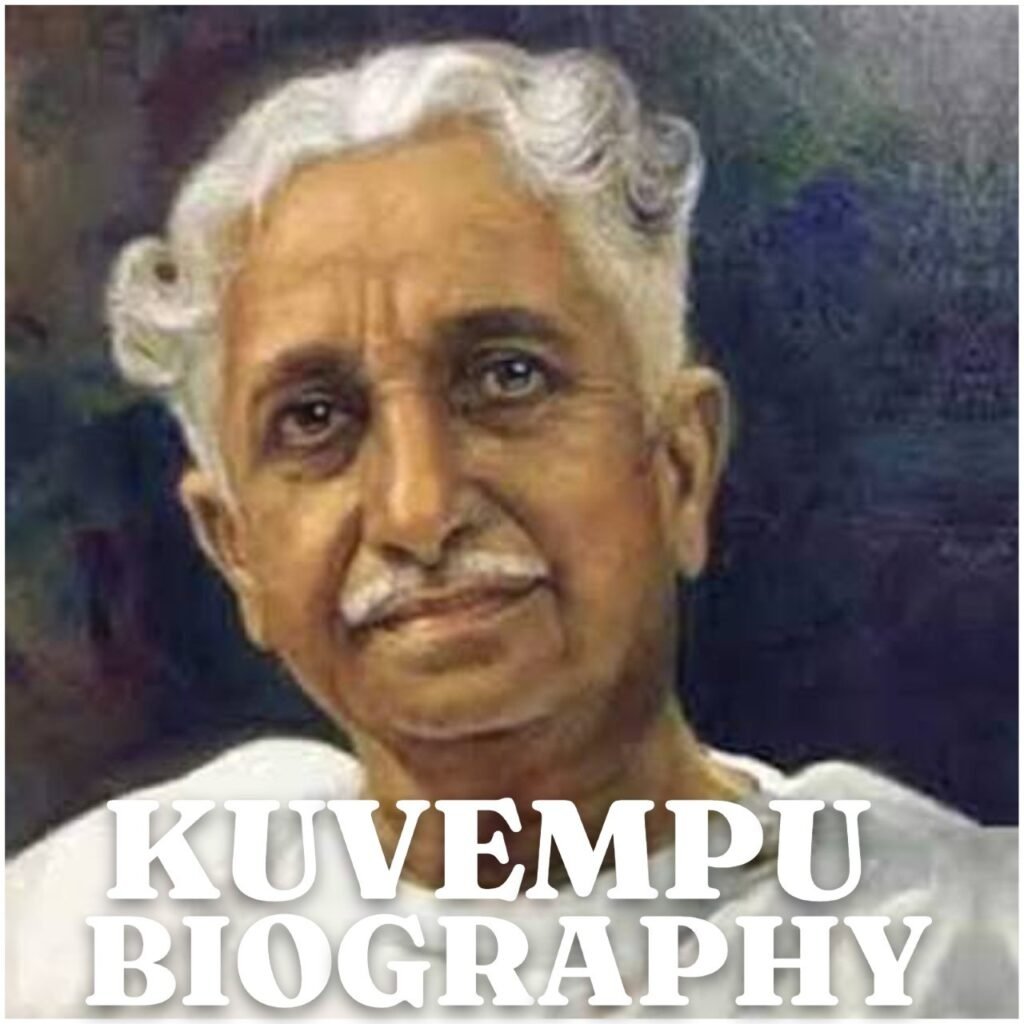
There is no consistently documented public record of his exact height. Photographs of Kuvempu show him wearing spectacles and often dressed in traditional Indian clothing. His thoughtful expression and scholarly appearance became familiar to generations of readers who encountered his portraits in books, schools and cultural institutions.
Kuvempu’s Social Media Presence
Kuvempu died in 1994, before social media became part of everyday communication. He therefore did not have personal accounts on platforms such as Instagram, Facebook, X or YouTube.
Nevertheless, his influence continues to reach new audiences through digital platforms. Readers, schools, universities and Kannada literary organisations share his poems, quotations, photographs and discussions about his work. His birthday and major literary milestones also provide opportunities for people to revisit his ideas and celebrate his contribution to Kannada culture.
Kuvempu’s Net Worth
There is no reliable public record of Kuvempu’s personal net worth. He lived in a period when writers’ private financial information was rarely documented in the way it is today. For this reason, assigning him a specific net worth would be misleading.
His professional life centred on writing, teaching and academic leadership. He spent decades working in education while producing literary works that reached a wide readership. His honours and public recognition reflected the quality and influence of his contributions rather than any publicly established personal fortune.
Kuvempu’s real wealth was the cultural and intellectual legacy he left behind. His books remain important to Kannada literature, his ideas continue to inspire discussions about equality and human dignity, and institutions across Karnataka preserve his memory. His influence has lasted far beyond his lifetime, giving his work a value that cannot be measured in financial terms.
Legacy and Achievements
Kuvempu’s most important legacy is his contribution to Kannada literature. Through poetry, novels, plays and essays, he helped shape modern Kannada writing and demonstrated the language’s ability to explore complex social, philosophical and emotional subjects. His creativity encouraged later writers to experiment with form and subject while remaining connected to their cultural roots.
His achievements received recognition at both national and state levels. He won the Sahitya Akademi Award in 1955 for Sri Ramayana Darshanam and became the first Kannada writer to receive the Jnanpith Award in 1967. The Government of India honoured him with the Padma Bhushan in 1958 and the Padma Vibhushan in 1988. He was also given the title of Rashtrakavi, or national poet, and received the Karnataka Ratna, one of Karnataka’s highest civilian honours, in 1992.
His influence extends well beyond literary awards. His poem Jaya Bharata Jananiya Tanujate remains Karnataka’s state anthem, while his philosophy of Vishwamanava continues to promote equality and shared humanity. Kuvempu University and the preservation of his ancestral home in Kuppali further demonstrate the importance of his contribution. His life stands as an example of how literature can shape a language, influence society and inspire people long after its creator is gone.
Conclusion
Kuvempu was far more than a celebrated poet. He was a novelist, teacher, philosopher and social thinker whose work transformed Kannada literature and influenced the cultural identity of Karnataka. From his childhood in the green landscapes of Malenadu to his historic achievements as a writer and Vice-Chancellor, his life reflected a lasting commitment to education, creativity and human dignity. His epic Sri Ramayana Darshanam, his philosophy of Vishwamanava and his contribution to Karnataka’s state anthem continue to inspire readers today. Although he died in 1994, his words and ideas remain alive, securing his place among India’s most influential literary figures.
Frequently Asked Questions About Kuvempu
Who was Kuvempu?
Kuvempu was an Indian poet, novelist, playwright, essayist and academic. He is regarded as one of the greatest writers in Kannada literature and was the first Kannada author to receive the Jnanpith Award.
What was Kuvempu’s real name?
His real name was Kuppali Venkatappa Puttappa. He became widely known by the pen name Kuvempu, formed from parts of his name and birthplace.
When was Kuvempu born?
Kuvempu was born on December 29, 1904, at Hirekodige, near Kuppali, in present-day Karnataka, India.
When did Kuvempu die?
He died on November 11, 1994, in Mysore, Karnataka, at the age of 89.
What is Kuvempu famous for?
He is famous for transforming modern Kannada literature, writing the epic poem Sri Ramayana Darshanam and developing the philosophy of Vishwamanava. He also wrote Jaya Bharata Jananiya Tanujate, which became Karnataka’s state anthem.
Which award did Kuvempu receive in 1967?
He received the Jnanpith Award in 1967 for Sri Ramayana Darshanam. He was the first Kannada writer to receive the prestigious literary honour.
What are Kuvempu’s most famous literary works?
His best-known works include Sri Ramayana Darshanam, Kanooru Heggadithi, Malegalalli Madumagalu, Kolalu and Shudra Tapaswi.
What does Kuvempu’s Vishwamanava philosophy mean?
Vishwamanava means universal human being. It is the belief that people should look beyond divisions such as caste, religion and language and recognise the shared dignity of all human beings.
Who was Kuvempu’s wife?
Kuvempu’s wife was Hemavathi. They married on April 30, 1937.
How many children did Kuvempu have?
Kuvempu and Hemavathi had four children: K. P. Poornachandra Tejaswi, Kokilodaya Chaitra, Indukala and Tharini.
Was Kuvempu a Vice-Chancellor?
Yes. He served as Vice-Chancellor of the University of Mysore from 1956 to 1960. He was the first graduate of the university to hold the position.
Which poem written by Kuvempu became Karnataka’s state anthem?
His poem Jaya Bharata Jananiya Tanujate became the official state anthem of Karnataka.
What is Kuvempu University?
Kuvempu University is a public university in Karnataka, India. Established in 1987, it was named in honour of the celebrated Kannada poet, writer and academic.