
Introduction
Indira Gandhi was one of the most influential and controversial leaders in modern Indian history. As India’s first and only female prime minister to date, she played a major role in shaping the country’s political direction, international relationships and economic development. Her leadership brought major achievements, difficult political decisions and controversies that continue to generate debate decades after her death.
Born into one of India’s most prominent political families, Indira rose from being the daughter of Jawaharlal Nehru, the country’s first prime minister, to becoming a powerful leader in her own right. She led India during the 1971 war with Pakistan, which resulted in the creation of Bangladesh. Her government also supported agricultural reforms that helped India increase its food production. However, her decision to declare a national Emergency in 1975 remains one of the most controversial episodes in India’s democratic history.
Indira Gandhi’s life ended tragically on October 31, 1984, when two of her bodyguards assassinated her in New Delhi. Yet her influence did not disappear with her death. Her political achievements, family history, leadership style and controversial decisions continue to attract historians, political observers and readers around the world.
Indira Gandhi’s Early Life and Family Background
Indira Priyadarshini Gandhi was born on November 19, 1917, in Allahabad, now known as Prayagraj, Uttar Pradesh, India. She was the only child of Jawaharlal Nehru and Kamala Nehru. Her family was deeply involved in India’s struggle for independence, so politics and national affairs shaped much of her childhood.
Her father, Jawaharlal Nehru, was a close associate of Mahatma Gandhi and one of the leading figures in the independence movement. He later became India’s first prime minister in 1947. Her mother, Kamala Nehru, also participated in the freedom struggle and supported social and political causes. Their home welcomed prominent political figures, making Indira familiar with the people and events shaping India’s future.
Despite growing up in a politically influential family, Indira’s childhood was not always comfortable. Her father was frequently imprisoned by British authorities, while her mother struggled with poor health. Kamala eventually travelled abroad for medical treatment, and Indira sometimes stayed away from both parents. These experiences exposed her to loneliness and uncertainty at an early age. They also gave her a close understanding of the personal sacrifices made by families involved in India’s independence movement.
Indira Gandhi’s Education and Academic Background
Indira Gandhi received her early education at several institutions in India and Europe. She attended schools in Switzerland, Pune, Bombay and Bristol as her family’s circumstances and her mother’s health required frequent changes. These experiences exposed her to different cultures and educational environments.
She later studied at Visva-Bharati University in Santiniketan, an institution founded by Rabindranath Tagore. She subsequently enrolled at Somerville College, University of Oxford, in England, where she studied modern history. However, health difficulties interrupted her studies, and she spent only about a year at Somerville before leaving. Although she did not complete a conventional university degree there, her time in Britain exposed her to international political discussions and academic life.
Indira’s education extended beyond the classroom. Growing up around prominent political figures gave her an early understanding of leadership, diplomacy and national affairs. She travelled with her father, observed political discussions and became familiar with the challenges facing a country fighting for independence. These experiences helped prepare her for the demanding political career that followed.
Indira Gandhi’s Political Career and Rise to Power
Indira Gandhi’s Early Involvement in Indian Politics
Indira Gandhi’s interest in politics developed during childhood. Surrounded by people involved in India’s independence movement, she became familiar with political campaigns and the struggle against British rule. As a young girl, she reportedly organised a children’s group called the Vanar Sena, which supported activities connected to the Indian National Congress.
In 1938, she formally joined the Indian National Congress. Her involvement grew over the years, and she became increasingly active in political and social activities. In 1942, she married Feroze Gandhi, who was also involved in the independence movement. Both were arrested during the Quit India Movement, although they were not necessarily imprisoned for the same length of time.
After India gained independence in 1947, Indira became closely involved in her father’s political life. As Jawaharlal Nehru served as prime minister, she assisted with responsibilities at his official residence and accompanied him on diplomatic visits. This gave her opportunities to meet international leaders, observe government activities and understand the demands of public service.
Her political influence continued to grow. In 1959, she became president of the Indian National Congress. The appointment strengthened her position within the party and established her as a political figure in her own right.
Indira Gandhi as India’s Minister of Information and Broadcasting
Following Jawaharlal Nehru’s death in May 1964, Indira entered the Rajya Sabha, India’s upper house of Parliament. She joined the government of Prime Minister Lal Bahadur Shastri as Minister of Information and Broadcasting.
In this role, she became involved in the government’s communication and broadcasting activities. The position gave her valuable experience in national administration and increased her visibility within the ruling Congress Party.
Shastri died unexpectedly in January 1966 while visiting Tashkent in the Soviet Union. His death created a leadership vacancy, and the Congress Party needed a new prime minister. Indira emerged as a candidate and defeated Morarji Desai in the party’s parliamentary leadership contest.
On January 24, 1966, she became India’s third prime minister and the first woman to hold the position. Some senior party figures initially underestimated her political abilities. They expected her to be easier to influence than other candidates. However, she soon demonstrated that she could challenge powerful party leaders and establish her own authority.
Indira Gandhi’s First Years as Prime Minister
Indira Gandhi’s early years as prime minister were difficult. India faced economic problems, food shortages and political disagreements. She also had to establish herself in a position traditionally dominated by men.
In the 1967 general election, the Congress Party lost ground in several states. Although Gandhi remained prime minister, the result exposed growing opposition and dissatisfaction among voters. She responded by promoting policies that appealed directly to ordinary Indians and strengthening her public image.
One of her most important decisions came in 1969, when her government nationalised 14 major commercial banks. The move was intended to expand access to banking and direct financial resources towards national development. It also deepened disagreements within the Congress Party, eventually leading to a major split.
The division gave Gandhi greater control over her political faction. She increasingly relied on direct public support rather than the traditional party leadership structure. This approach helped her build a powerful political identity, although it also encouraged the centralisation of authority around her office.
Indira Gandhi and the 1971 India-Pakistan War
One of the defining moments of Indira Gandhi’s premiership was the 1971 conflict between India and Pakistan. The crisis began in East Pakistan, where political unrest and military repression followed disagreements over the results of the 1970 general election.
Millions of refugees crossed into India, placing enormous pressure on the country’s resources. The humanitarian crisis also created serious political and security concerns for Gandhi’s government. India supported the independence movement in East Pakistan and eventually became directly involved in the conflict.
The war ended in December 1971 with India’s victory and the surrender of Pakistani forces in East Pakistan. The region became the independent nation of Bangladesh. The outcome strengthened Gandhi’s international reputation and made her a central figure in South Asian politics.
Her leadership during the conflict received widespread praise in India. In 1972, she was awarded the Bharat Ratna, the country’s highest civilian honour. However, the military victory did not solve all the economic and political problems facing the country.
Indira Gandhi’s Role in India’s Green Revolution
Indira Gandhi’s government supported agricultural policies that contributed to the Green Revolution in India. The initiative involved high-yielding crop varieties, improved irrigation, fertilisers, modern farming methods and expanded agricultural support.
These developments helped increase food production, particularly wheat, and reduced India’s dependence on imported food grains. They also strengthened the country’s ability to feed its growing population.
The Green Revolution was not the achievement of one political leader alone. Scientists, farmers, agricultural institutions and government programmes all played important roles. However, Gandhi’s administration supported and expanded the policies that helped transform Indian agriculture.
India’s First Nuclear Test Under Indira Gandhi
Another major development during Gandhi’s premiership was India’s first nuclear test, conducted on May 18, 1974, at Pokhran in Rajasthan. The Indian government described the test as a peaceful nuclear explosion.
The test demonstrated the country’s growing scientific and technological capabilities. It also attracted international attention and raised concerns among countries worried about the spread of nuclear weapons.
The development strengthened India’s position as a country pursuing an independent scientific and strategic policy. It remains one of the most significant events associated with Gandhi’s first period in office.
The 1975 Emergency: Indira Gandhi’s Most Controversial Decision
Despite her political achievements, Indira Gandhi’s government faced increasing criticism during the early 1970s. India experienced inflation, unemployment, economic difficulties, corruption allegations and widespread public protests. Opposition leaders and social movements demanded political and administrative reforms.
In June 1975, the Allahabad High Court ruled against Gandhi in a case concerning electoral malpractice during her 1971 parliamentary election. The judgment threatened her position as prime minister. On June 25, 1975, her government declared a national Emergency, which lasted until March 1977.
During this period, civil liberties were severely restricted. Opposition leaders were arrested, press censorship was imposed and political activities were tightly controlled. The government also introduced controversial programmes, including forced sterilisation campaigns associated particularly with the influence of her younger son, Sanjay Gandhi.
Reports of abuses and human rights violations damaged the government’s reputation. The Emergency remains one of the most debated periods in India’s political history. Critics regard it as a serious attack on democracy, constitutional freedoms and political opposition. Supporters of the government at the time argued that extraordinary measures were necessary to address instability and restore order.
In January 1977, Gandhi announced general elections and lifted the Emergency in March. The Congress Party suffered a major defeat, and Gandhi lost her parliamentary seat. Her removal from office marked a dramatic reversal for a leader who had once enjoyed enormous public support.
Indira Gandhi’s Return to Power in 1980
After leaving office in 1977, Indira Gandhi remained active in politics. The Janata Party government that replaced her struggled with internal disagreements and leadership problems. Its difficulties created an opportunity for Gandhi and the Congress Party to rebuild their political support.
In the 1980 general election, Congress won a decisive victory, and Gandhi returned as prime minister. Her comeback demonstrated her continuing influence among Indian voters and her ability to recover from a major political defeat.
However, her second term brought serious challenges, including regional unrest, political tensions and security concerns. Her younger son, Sanjay Gandhi, had become an influential political figure during the preceding years. His sudden death in a plane crash in June 1980 was a devastating personal loss for the family.
Operation Blue Star and Rising Tensions in Punjab
One of the most difficult decisions of Indira Gandhi’s second premiership involved the growing militancy in Punjab. Tensions had increased between the government and Sikh separatist groups, particularly those associated with Jarnail Singh Bhindranwale.
In June 1984, Gandhi’s government ordered the Indian Army to carry out Operation Blue Star at the Golden Temple complex in Amritsar, the holiest shrine in Sikhism. The operation was intended to remove armed militants who had taken up positions within the complex.
The military action caused significant casualties and damaged parts of the sacred site. It deeply angered many Sikhs in India and abroad, including people who opposed militancy but were distressed by the assault on their holy place. The operation created lasting divisions and intensified tensions between the government and sections of the Sikh community.
The consequences were devastating. A few months later, Gandhi was assassinated by two of her Sikh bodyguards. The killing was linked to anger and revenge following the military operation.
Why Indira Gandhi Remains a Subject of Historical Interest
Indira Gandhi continues to attract attention because her political career involved major achievements and deeply controversial decisions. Her leadership during the 1971 war, support for agricultural development and role in India’s nuclear programme remain important parts of the country’s history. At the same time, the Emergency and Operation Blue Star continue to shape discussions about her time in office.
Her life has inspired biographies, documentaries, films and television productions. Historians continue to examine her political decisions, relationships with party leaders and influence on India’s democratic institutions. New historical research also revisits her premiership and the wider political and economic changes that took place during the 1970s.
Her story remains relevant because it raises important questions about political power, leadership, national security and the protection of democratic freedoms. Few Indian leaders have left behind such a complex and widely debated record.
Indira Gandhi’s Husband, Marriage and Children
Indira Gandhi married Feroze Gandhi on March 26, 1942. Feroze was a Parsi politician and journalist who was also involved in India’s independence movement. Their marriage took place during a period of political unrest, and both were active in the struggle against British rule.
The couple had two sons, Rajiv Gandhi and Sanjay Gandhi. Rajiv later became prime minister after his mother’s assassination, while Sanjay became an influential political figure during her years in office. His involvement in government programmes during the Emergency attracted considerable controversy. His death in a plane crash in 1980 was a major personal loss for Indira.
Although Indira and Feroze shared a family life, their relationship experienced difficulties, and they spent significant periods living apart. Feroze died of a heart attack in 1960. Indira continued her political career and raised their sons while becoming one of India’s most prominent political figures.
Indira Gandhi’s Age, Religion, Caste, Nationality and Physical Appearance
Indira Gandhi was born on November 19, 1917, and died on October 31, 1984. She was 66 years old at the time of her assassination. Her zodiac sign was Scorpio, based on her date of birth.
She was Indian by nationality and came from a Kashmiri Pandit family. Her family practised Hinduism, and her upbringing was shaped by the cultural and political traditions of the Nehru family. Her surname, Gandhi, came through her marriage to Feroze Gandhi. Despite sharing a surname, she was not related by family descent to Mahatma Gandhi.
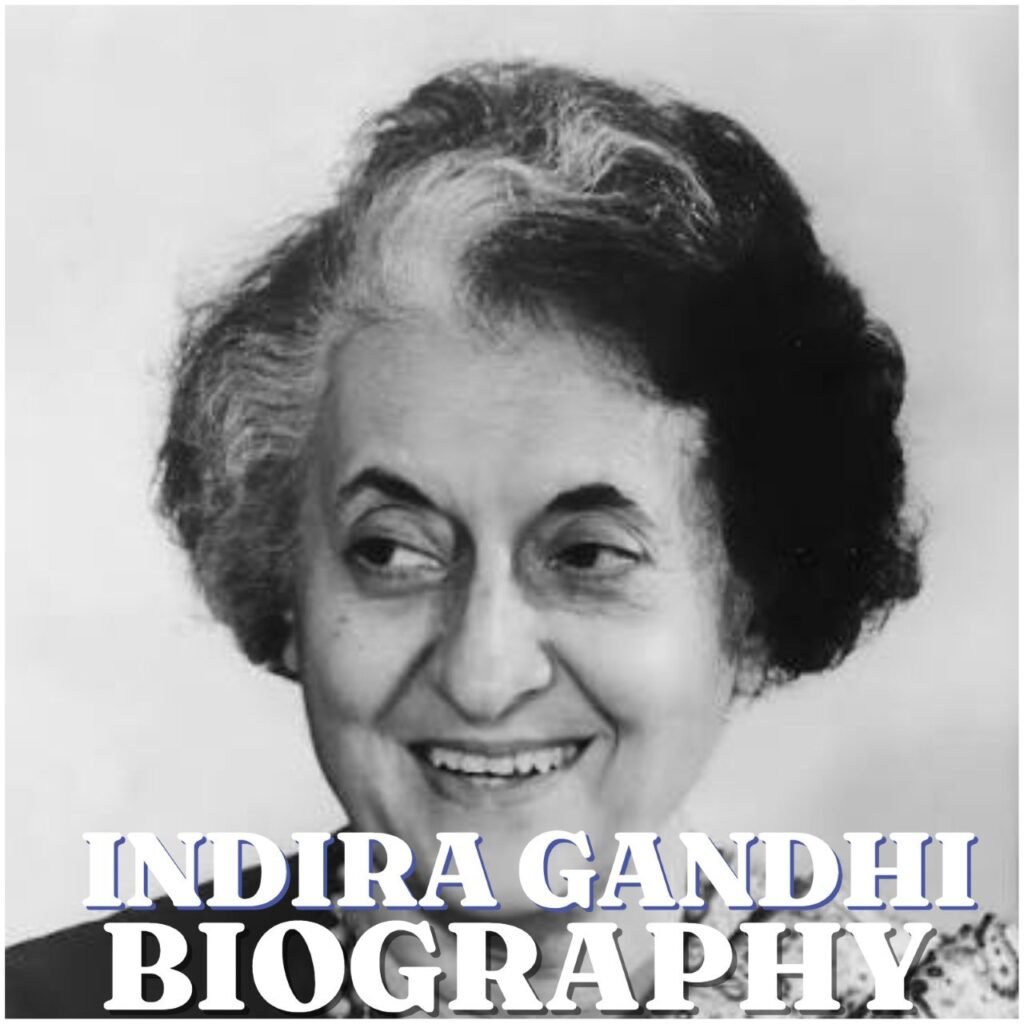
Indira Gandhi was recognised for her distinctive appearance and traditional clothing. She was frequently photographed wearing Indian saris and had a familiar hairstyle with a noticeable white streak in her dark hair. Her public image combined traditional dress with a composed and authoritative political presence.
Indira Gandhi’s Social Media Accounts and Online Presence
Indira Gandhi lived long before social media platforms such as Instagram, Facebook and X became part of everyday communication. She did not have personal accounts on these platforms, and pages using her name today are maintained by other people or organisations.
Her speeches, photographs, interviews and historical records continue to circulate online. Government archives, news organisations, educational institutions and historical websites preserve material about her political career and public life. These records allow newer generations to explore her achievements, decisions and controversies.
Indira Gandhi’s Net Worth and Wealth
Indira Gandhi was one of the most powerful political figures in India, but there is no reliably established public figure for her personal net worth. As prime minister, she received an official salary and had access to the facilities and security arrangements attached to the office. These official privileges should not be confused with personal wealth.
Her family’s political prominence and historical background often attract curiosity about its financial position. However, claims about her personal fortune vary, and many online estimates lack reliable supporting evidence. It is therefore more accurate to avoid presenting an unverified net worth figure as fact.
Her historical importance is better measured through her political influence, public policies and lasting effect on India’s institutions. Her career involved decisions that shaped the country’s economy, agriculture, international relationships and democratic experience.
Indira Gandhi’s Assassination and Death
Indira Gandhi was assassinated on October 31, 1984, at her official residence in New Delhi. She was shot by two of her Sikh bodyguards, Beant Singh and Satwant Singh. The attack was linked to anger over Operation Blue Star, the military operation ordered by her government at the Golden Temple earlier that year.
On the day of her assassination, Gandhi was preparing for a television interview with British actor and filmmaker Peter Ustinov. As she walked through the garden area of her residence, her bodyguards opened fire. She was rushed to the All India Institute of Medical Sciences in New Delhi, where doctors were unable to save her.
Her assassination shocked India and the international community. It was followed by widespread anti-Sikh violence, particularly in Delhi and other parts of the country. Thousands of Sikhs were killed, and many families lost their homes and loved ones. The violence remains a painful chapter in India’s history and an important part of the aftermath of her death.
Her elder son, Rajiv Gandhi, was subsequently chosen to become prime minister. Indira’s assassination brought an abrupt end to a political career that had shaped India for nearly two decades.
Indira Gandhi’s Legacy, Achievements and Impact on India
Indira Gandhi left behind a political legacy that remains both influential and controversial. She was India’s first and only female prime minister to date and served for approximately 15 years across two periods in office. Her leadership during the 1971 war helped bring about the creation of Bangladesh, while her government’s agricultural policies contributed to greater food production and improved food security.
She also played an important role in strengthening India’s international position. Her government supported scientific and technological development, including the country’s first nuclear test in 1974. She received the Bharat Ratna in 1972 in recognition of her contribution to the nation. Her career demonstrated that a woman could occupy the highest political office in India and exercise considerable influence in domestic and international affairs.
However, her legacy cannot be separated from the Emergency of 1975–1977, which restricted civil liberties and weakened democratic institutions. Operation Blue Star and the violence that followed her assassination also remain central to historical assessments of her leadership. Her career continues to encourage debate about the balance between strong government, national security and democratic accountability.
Conclusion: The Life and Legacy of Indira Gandhi
Indira Gandhi’s life was a remarkable chapter in India’s political history. From her childhood in a family deeply involved in the independence movement to her rise as the country’s first female prime minister, she became a leader whose decisions affected millions of people. Her achievements in agriculture, foreign policy and national development remain significant, while the Emergency and Operation Blue Star continue to raise difficult questions about her leadership. Assassinated in 1984, she left behind a legacy that cannot be reduced to either praise or criticism. Her story remains essential to understanding modern India.
Frequently Asked Questions About Indira Gandhi
Who was Indira Gandhi?
Indira Gandhi was an Indian politician who served as the country’s prime minister from 1966 to 1977 and again from 1980 until her assassination in 1984. She was the first and remains the only woman to have held the office.
When was Indira Gandhi born?
She was born on November 19, 1917, in Allahabad, now known as Prayagraj, in Uttar Pradesh, India.
How old was Indira Gandhi when she died?
She was 66 years old when she was assassinated on October 31, 1984.
Who was Indira Gandhi’s father?
Her father was Jawaharlal Nehru, India’s first prime minister and a leading figure in the country’s independence movement.
Who was Indira Gandhi’s husband?
She was married to Feroze Gandhi, a Parsi politician and journalist. They married on March 26, 1942.
How many children did Indira Gandhi have?
She had two sons, Rajiv Gandhi and Sanjay Gandhi.
Was Indira Gandhi related to Mahatma Gandhi?
No. Indira Gandhi was not related by family descent to Mahatma Gandhi. She acquired the Gandhi surname through her marriage to Feroze Gandhi.
What was Indira Gandhi famous for?
She was known for being India’s first female prime minister, leading the country during the 1971 war with Pakistan, supporting the Green Revolution and overseeing India’s first nuclear test in 1974. She was also widely criticised for declaring the Emergency in 1975.
How long did Indira Gandhi serve as prime minister?
She served from January 1966 to March 1977 and returned to office in January 1980. Her second term ended with her assassination on October 31, 1984.
What was the Emergency declared by Indira Gandhi?
The Emergency was a period of national rule from June 1975 to March 1977 during which civil liberties were restricted, opposition leaders were arrested and press censorship was imposed.
Why was Indira Gandhi assassinated?
She was assassinated by two of her Sikh bodyguards on October 31, 1984. The killing was linked to anger over Operation Blue Star, the military operation ordered at the Golden Temple in June 1984.
What was Operation Blue Star?
Operation Blue Star was a military operation ordered by Indira Gandhi’s government in June 1984 to remove armed militants from the Golden Temple complex in Amritsar, Punjab. The operation caused extensive casualties and deeply angered many Sikhs.
What awards did Indira Gandhi receive?
Among her most notable honours was the Bharat Ratna, India’s highest civilian award, which she received in 1972.
What was Indira Gandhi’s net worth?
There is no reliably established public figure for her personal net worth. Online estimates vary and should be treated cautiously.
Who became prime minister after Indira Gandhi’s death?
Her elder son, Rajiv Gandhi, became prime minister following her assassination in October 1984.