
Joe Orton Biography Introduction
Joe Orton was a British playwright and author whose short but remarkable career transformed the landscape of modern British theatre. Born John Kingsley Orton on January 1, 1933, in Leicester, England, he became known for his sharp wit, outrageous humour, provocative themes and ability to challenge the social conventions of his time. Although his professional writing career lasted only a few years, Orton produced influential works including Entertaining Mr Sloane, Loot and What the Butler Saw, establishing himself as one of the most distinctive voices in 1960s British theatre.
Beyond his writing, Joe Orton’s personal life and relationship with Kenneth Halliwell have remained an important part of his biography. Orton met Halliwell in the early 1950s, and the two became partners and collaborators during the early stages of their literary ambitions. Their relationship was complex and later became the subject of considerable public and artistic interest. Orton’s diaries, plays and correspondence have also provided valuable insight into his personality, relationships, sexuality and creative development, helping later generations understand the man behind his provocative theatrical style.
Joe Orton’s life ended tragically on August 9, 1967, when he was murdered by Kenneth Halliwell at the age of 34; Halliwell subsequently died by suicide. Despite his premature death, Orton’s reputation has continued to grow, with his plays remaining part of the British theatrical canon and his life inspiring books, films, stage productions and academic research. In 2026, renewed scholarly and theatrical interest in Orton has once again brought attention to his work, his relationship with Halliwell and the complicated ways his life and death have been remembered.
Joe Orton Early Life and Family Background
Joe Orton was born John Kingsley Orton on January 1, 1933, in Leicester, England, into a working-class family. His father, William Arthur Orton, worked as a gardener for Leicester City Council, while his mother, Elsie Mary Orton, worked in the local footwear industry before health problems affected her ability to continue. Orton was the eldest of four children, with a younger brother, Douglas, and two younger sisters, Marilyn and Leonie. When he was about two years old, the family moved to the Saffron Lane council estate in Leicester, where he spent much of his childhood. His upbringing in a working-class environment and the social inequalities he observed around him would later influence aspects of his writing and comic view of British society.
As a child, Orton attended Marriott Road Primary School, but recurring asthma affected his education and he failed the eleven-plus examination, which limited his opportunity to attend a grammar school. From 1945 to 1947, he studied at Clark’s College in Leicester, where he received commercial and secretarial training before entering the workforce as a junior clerk. Although his formal education was not especially distinguished, Orton developed a strong interest in books, theatre and popular culture. Later research into his Leicester years has emphasized that he was already developing his literary interests before leaving the city, making extensive use of local libraries and becoming involved with drama groups.
Orton’s interest in acting and theatre became increasingly serious during his late teenage years. Around 1949, he joined local dramatic societies, including the Leicester Dramatic Society, and began appearing in amateur productions. Determined to improve himself, he took elocution lessons and worked on developing an accent that would help him pursue a career in professional theatre. In 1950, he applied for a scholarship to the Royal Academy of Dramatic Art in London and was accepted. He began his studies there in May 1951 after a short delay caused by appendicitis. At RADA, Orton met Kenneth Halliwell, an older actor and writer who would become his close companion and an important figure in his early adult life.
Joe Orton Education
Joe Orton’s formal education began at Marriott Road Primary School in Leicester, where he spent his early school years. His education was affected by recurring asthma, and he failed the eleven-plus examination, which prevented him from taking the grammar-school route that was commonly associated with higher academic opportunities at the time. Between 1945 and 1947, he attended Clark’s College in Leicester, where he studied commercial subjects and secretarial skills. Although this training was practical rather than literary, Orton developed a strong interest in reading, theatre and performance outside the classroom.
After leaving Clark’s College, Orton’s education increasingly came through his involvement in amateur theatre. Around the age of 16, he began joining local dramatic groups and taking part in productions, gradually discovering that acting and theatre could provide him with a path beyond the clerical work for which he had been trained. He also took elocution lessons to improve his voice and speech, an important step toward his ambition of becoming a professional actor. His participation in local theatre helped him gain confidence on stage and introduced him to the creative environment that would eventually lead him toward playwriting.
In 1951, Orton’s ambitions took him to London after he won a scholarship to the Royal Academy of Dramatic Art, one of Britain’s leading institutions for theatrical training. He began his studies there in May 1951, after recovering from appendicitis, and trained as an actor alongside other aspiring theatre professionals. It was during his time at RADA that he met Kenneth Halliwell, who was several years older and would become his partner and early creative collaborator. Although Orton ultimately became better known as a playwright than as an actor, his RADA education and theatrical experiences provided an important foundation for his later career, helping him understand stage performance, dialogue, characterisation and the mechanics of theatre.
Joe Orton Career and Major Works
Joe Orton’s professional career developed gradually after his years of acting training at the Royal Academy of Dramatic Art. After leaving RADA in 1953, he initially struggled to establish himself as a professional actor and worked a number of ordinary jobs while continuing to pursue writing. During this period, Orton and Kenneth Halliwell lived together and began writing collaboratively. Their early efforts included novels that were not accepted for publication, but the experience helped Orton develop the distinctive comic and satirical voice that would later define his plays. He eventually shifted his attention away from acting and toward playwriting, a decision that would transform his short career.
Orton’s breakthrough came with Entertaining Mr Sloane, a dark comedy that was first produced in London in 1964. The play’s mixture of sexual provocation, violence, black humour and attacks on conventional morality attracted considerable attention and established Orton as an exciting new playwright. His success continued with Loot, which premiered in 1965 and won the Evening Standard Award for Best Play. The work demonstrated Orton’s ability to turn subjects such as death, crime, corruption and authority into outrageous comedy. His plays frequently challenged accepted ideas about respectability and exposed what he viewed as hypocrisy within British society.
Orton’s final years were marked by increasing critical and commercial success, although his career lasted only a few years. His play What the Butler Saw opened after his death in 1969 and became one of his most recognised works, while The Erpingham Camp, Funeral Games and other writings further strengthened his reputation. Orton also worked in radio and television, including the television play The Good and Faithful Servant, and wrote extensively in his diaries. His career was tragically cut short on August 9, 1967, when he was murdered by Kenneth Halliwell at the age of 34. Despite his brief professional career, Orton’s plays continued to be performed internationally and helped secure his position as one of Britain’s most important and provocative playwrights of the 1960s.
Renewed Interest in Joe Orton Following New 2026 Research and Theatre Productions
Joe Orton is trending again in 2026 because of renewed academic and theatrical interest in his life, death and enduring influence on British theatre. On August 10, 2026, University of Leicester researcher Emma Parker published a new academic study titled Queer Thanatography: Joe Orton’s Death and Afterlife. The research examines how Orton’s death has been repeatedly portrayed in books, films and plays and identifies a corpus of 24 plays about Orton, arguing that the intense focus on his murder and Kenneth Halliwell’s suicide has sometimes overshadowed his achievements as a playwright.
The new research is attracting attention because it offers a different way of understanding Orton’s legacy and his relationship with Halliwell. Rather than treating Orton’s death simply as a tragic ending to a controversial life, Parker examines how later artists have repeatedly reinterpreted the events and challenged established narratives surrounding the couple. The study also argues that some theatrical portrayals have attempted to give greater attention to Halliwell’s role as Orton’s longtime partner, mentor and creative collaborator, encouraging audiences to consider the complexities of their relationship beyond the circumstances of the 1967 murder-suicide.
The renewed attention demonstrates that Joe Orton remains culturally relevant more than five decades after his death. His provocative writing, unconventional personal life and dramatic relationship with Halliwell continue to inspire theatre-makers and scholars, while new interpretations are encouraging audiences to reconsider how his story has been remembered. For a biography update in 2026, this new research is particularly important because it places Orton’s legacy within a modern discussion about biography, theatre, sexuality, memory and the way historical figures are represented after death.
Joe Orton Personal Life and Family
Joe Orton was born into a working-class Leicester family and was the eldest of four children. His parents were William Arthur Orton, who worked as a gardener, and Elsie Mary Orton, who worked in the footwear industry before later working as a cleaner. His younger siblings were Douglas Orton, Marilyn Orton and Leonie Orton. Orton remained connected to his family despite his move to London and growing theatrical success. His youngest sister, Leonie Orton-Barnett, later wrote a memoir about her brother and their upbringing, providing valuable insight into the family environment in which Orton grew up.
The most significant relationship in Joe Orton’s adult life was with Kenneth Halliwell, whom he met while studying at the Royal Academy of Dramatic Art in 1951. Halliwell was seven years older than Orton, and they soon became lovers and eventually lived together in London. Their relationship was both personal and creative, with the two men initially collaborating on several unpublished novels. They lived together for many years, including at their small flat at 25 Noel Road in Islington, where Orton developed much of the writing style that would eventually make him famous. Their relationship was complicated, however, and ended tragically when Halliwell murdered Orton on August 9, 1967, before taking his own life.
Orton never married and did not have a wife or fiancé. His personal diaries reveal that he had relationships and sexual encounters outside his partnership with Halliwell, although his family was reportedly unaware of his sexuality during much of his lifetime. His sister Leonie later recalled that she initially believed Halliwell was simply Orton’s flatmate and only learned the true nature of their relationship after Orton’s death. Orton’s family continued to play a role in preserving his memory, with his sisters Leonie Orton-Barnett and Marilyn Orton becoming involved in administering the Orton Estate and preserving aspects of his literary legacy.
Joe Orton Age, Religion, Nationality, Height and Physical Appearance
Joe Orton was 34 years old when he died on August 9, 1967. He was born John Kingsley Orton on January 1, 1933, in Leicester, England, meaning he had lived for just over three decades when his life was tragically cut short. Although his writing career lasted only from the early 1960s until his death, Orton achieved considerable recognition during that brief period and became an important figure in British theatre.
Orton was English and British by nationality. Information about his personal religious beliefs is less straightforward than his nationality. He was not a Catholic, although Catholicism appeared frequently in his writing and became a subject of satire in several of his works. In a 1965 interview, Orton explained his fascination with Catholicism and its usefulness as a subject for theatrical satire, but he did not identify himself as Catholic. His plays frequently explored subjects involving religion, morality, sexuality and social hypocrisy.
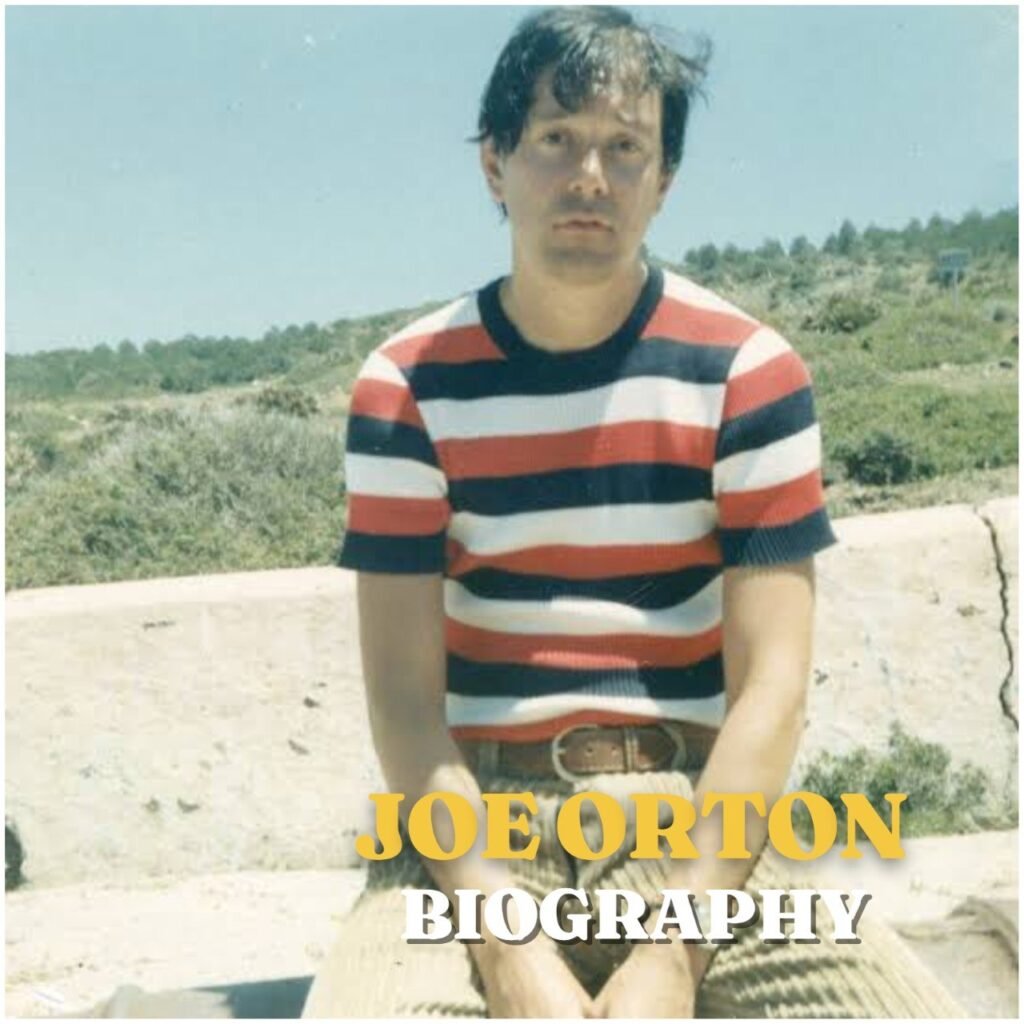
Joe Orton’s recorded height was approximately 5 feet 10 inches (1.78 metres). Contemporary descriptions and available biographical records portray him as a slim, distinctive-looking young man who became increasingly conscious of his appearance during his youth. Before attending RADA, he took elocution lessons and pursued bodybuilding exercises as part of his efforts to improve his appearance and stage presence. Photographs of Orton from the 1960s show his characteristic dark hair, expressive features and lean build, contributing to the recognisable public image he developed during his brief period of fame.
Joe Orton Cause of Death and Death
Joe Orton died on August 9, 1967, at the age of 34, at the flat he shared with his longtime partner, Kenneth Halliwell, on Noel Road in Islington, London. Orton’s cause of death was homicide: Halliwell attacked him with a hammer, striking him repeatedly in the head. Contemporary and later accounts state that Orton suffered nine hammer blows and died from the injuries.
The circumstances surrounding Orton’s death became one of the most tragic and widely discussed episodes of his biography. After killing Orton, Halliwell took an overdose of Nembutal (pentobarbital) and died by suicide. A note referring readers to Orton’s diary was found at the scene. Their bodies were discovered the following morning after a chauffeur arrived at the flat to collect Orton for a scheduled meeting concerning the possible filming of his screenplay Up Against It.
Orton’s death shocked Britain’s theatrical community and received considerable media attention because he had been rapidly becoming one of the country’s most successful and controversial young playwrights. His funeral was held at Golders Green Crematorium on August 18, 1967, and his death subsequently became an important part of the way his life and work were remembered. More than five decades later, scholars continue to examine the circumstances of his death and how the tragedy has sometimes overshadowed his considerable achievements as a playwright.
Joe Orton Net Worth
There is no reliable publicly documented figure for Joe Orton’s personal net worth at the time of his death. However, contemporary reports make it clear that he had become financially successful shortly before his death. The Guardian reported that Orton was making substantial sums of money from his writing, while the film rights to Loot alone were reported at £100,000 at the time. His other works, including Entertaining Mr Sloane, were also generating publishing, theatre and adaptation income.
Additional evidence suggests that Orton’s earnings had risen dramatically during the final stage of his career. Research into his life records payments of around £10,000 for the screenplay Up Against It and substantial sums associated with Loot. His plays were enjoying successful West End runs, and Loot eventually ran for hundreds of performances and generated significant rights income. These figures indicate that Orton had moved from a relatively modest financial background into the higher-earning ranks of successful British playwrights shortly before his death.
Because there is no authoritative estate valuation that can reasonably be converted into a modern personal-net-worth figure, it would be misleading to give an exact amount. A reasonable historical estimate would place Joe Orton’s wealth at the time of his death in the tens of thousands of pounds, potentially considerably higher when the value of his literary and film rights is included. His estate continued generating income after his death, and his sister Leonie later explained that money from Orton’s estate helped transform her own circumstances. Today, the continuing performance, publication and licensing of his works means his literary estate remains an important part of his legacy.
Joe Orton Legacy
Joe Orton left a lasting mark on British theatre despite having a professional writing career that lasted only a few years. His plays Entertaining Mr Sloane, Loot and What the Butler Saw became known for their combination of black comedy, sexual themes, absurd situations and attacks on conventional ideas of respectability. Orton’s distinctive style challenged audiences and theatrical conventions in the 1960s, earning him a reputation as one of Britain’s most provocative and influential playwrights.
Orton’s legacy also extends beyond his plays to his diaries, letters and personal story. His diaries, published after his death, provided an unusually intimate account of his relationships, ambitions, sexuality and experiences as a young writer in London. His life and relationship with Kenneth Halliwell have inspired biographies, films and numerous stage productions, including the 1987 film Prick Up Your Ears, which introduced Orton’s story to a much wider audience. His work has also remained relevant to discussions about censorship, sexuality, class, morality and the changing social attitudes of 20th-century Britain.
More than five decades after his death, Orton continues to attract academic and theatrical interest. His plays are regularly revived, studied and performed, while scholars continue to reassess his life and the circumstances surrounding his death. In 2026, renewed research into Orton’s “afterlife” and the numerous dramatic portrayals of his story has encouraged fresh discussion about how his legacy has been constructed. His ability to combine outrageous comedy with serious observations about society has ensured that Joe Orton remains an important name in modern British theatre.
Conclusion
Joe Orton remains one of the most memorable and unconventional playwrights in British theatrical history. From his working-class childhood in Leicester and training at the Royal Academy of Dramatic Art to his rapid rise through works such as Entertaining Mr Sloane, Loot and What the Butler Saw, Orton established a distinctive voice built around dark humour, satire and social provocation. His life was tragically cut short at just 34 following his murder by Kenneth Halliwell, but his brief career produced works that continued to influence theatre long after his death. Through his plays, diaries, literary estate and the continuing scholarly and theatrical interest in his life, Joe Orton’s contribution to British culture remains significant, ensuring that his name and work continue to be remembered by new generations.
Frequently Asked Questions About Joe Orton
Who was Joe Orton?
Joe Orton was an English playwright and author best known for his dark comedies and satirical plays, including Entertaining Mr Sloane, Loot and What the Butler Saw. He became one of the most distinctive British playwrights of the 1960s.
When was Joe Orton born?
Joe Orton was born John Kingsley Orton on January 1, 1933, in Leicester, England.
How old was Joe Orton when he died?
Joe Orton was 34 years old when he died on August 9, 1967.
What was Joe Orton’s cause of death?
Joe Orton died after being murdered by his longtime partner, Kenneth Halliwell, who attacked him with a hammer at their home in London.
Who was Joe Orton’s partner?
Joe Orton’s longtime partner was Kenneth Halliwell, whom he met while studying at the Royal Academy of Dramatic Art in 1951. They lived together and initially collaborated on writing projects.
Was Joe Orton married?
No. Joe Orton never married and did not have a wife or fiancé. His most significant long-term relationship was with Kenneth Halliwell.
What were Joe Orton’s most famous plays?
His best-known plays include Entertaining Mr Sloane, Loot and What the Butler Saw. Other important works include The Erpingham Camp and Funeral Games.
What was Joe Orton’s nationality?
Joe Orton was British, specifically English, and was born in Leicester, England.
What was Joe Orton’s religion?
Joe Orton’s personal religious beliefs are not clearly documented. He was not known to be a Catholic, although Catholicism and religious morality frequently appeared as subjects of satire in his writing.
What was Joe Orton’s net worth?
There is no reliable official figure for Joe Orton’s net worth at the time of his death. However, he had become financially successful through theatre, publishing and film-related work shortly before his death, with some of his works generating substantial sums.
What is Joe Orton famous for?
Joe Orton is famous for revolutionising British black comedy and satirical theatre during the 1960s. His provocative treatment of sexuality, crime, authority, morality and social hypocrisy made him one of the era’s most controversial playwrights.
Where did Joe Orton live?
Joe Orton lived with Kenneth Halliwell at 25 Noel Road in Islington, London, the home where Orton was murdered in 1967.
What is Joe Orton’s legacy?
Joe Orton’s legacy lives on through the continued performance and study of his plays. His work remains influential for its combination of black humour, social satire, sexual themes and attacks on conventional respectability, while his life continues to inspire biographies, films, theatre productions and academic research.