
Introduction
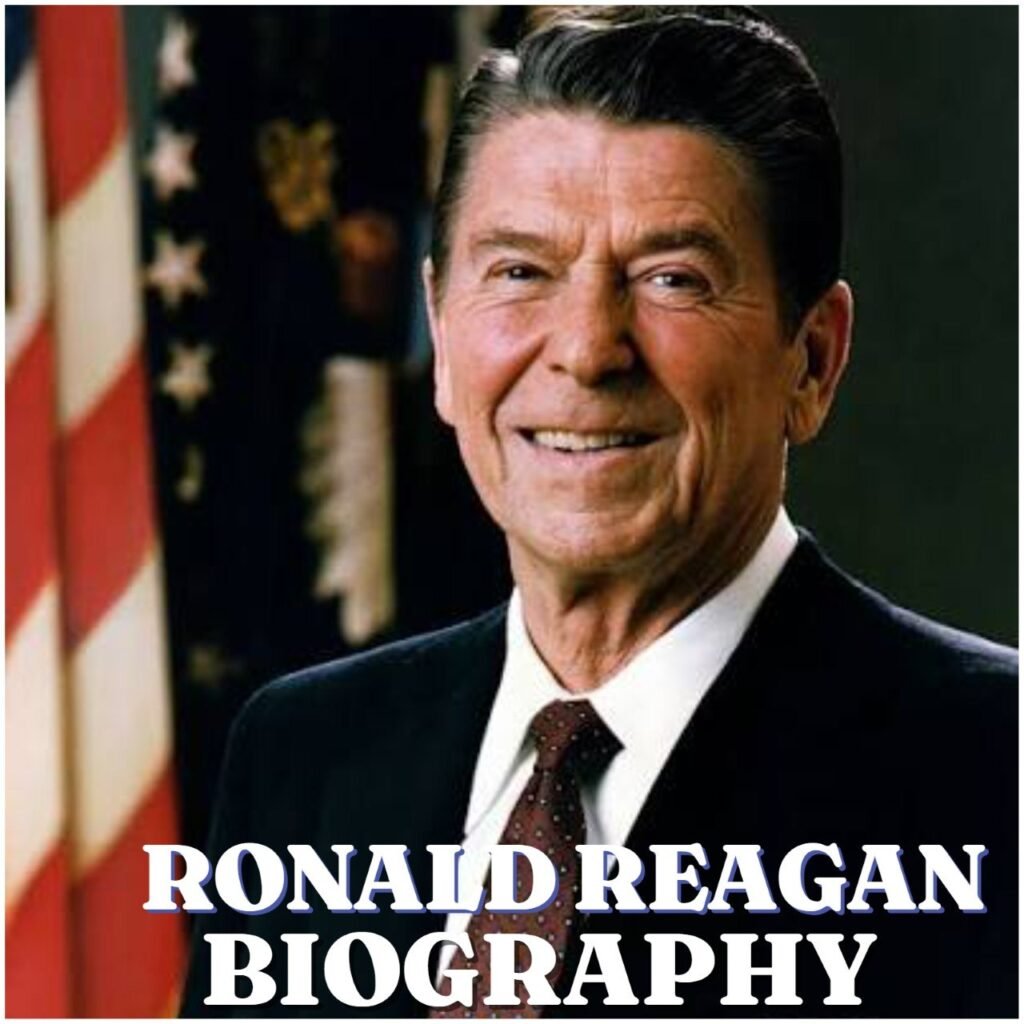
Ronald Reagan was an American actor, radio broadcaster, union leader, and politician who became the 40th president of the United States. Born on February 6, 1911, in Tampico, Illinois, he rose from a modest Midwestern background to become one of the most recognisable political figures of the twentieth century. Before entering politics, Reagan built a successful career in Hollywood, appearing in numerous films and developing the communication skills that later earned him the nickname “The Great Communicator.” His journey from entertainment to the White House remains an important part of American political and cultural history.
Reagan served as president from January 20, 1981, to January 20, 1989, during a period shaped by economic challenges, debates over the role of government, international tensions, and the final decade of the Cold War. His administration pursued tax reductions, deregulation, increased defence spending, and a foreign policy focused on confronting the Soviet Union. Reagan later worked with Soviet leader Mikhail Gorbachev to negotiate arms-control agreements and reduce tensions between the two superpowers. His presidency also generated considerable debate over the consequences of his economic and social policies, the Iran-Contra affair, and the impact of his administration on different groups within American society.
More than two decades after his death, Reagan remains a prominent figure in discussions about American conservatism, presidential leadership, political communication, and international relations. Supporters remember his emphasis on individual initiative, national confidence, and the eventual easing of Cold War tensions, while critics highlight issues including rising federal deficits, the distribution of economic gains, the administration’s response to the AIDS crisis, and controversies surrounding its foreign policy. His life continues to attract attention through historical documentaries, archival material, presidential commemorations, and the work of the Ronald Reagan Presidential Library. In 2026, renewed attention to his family history followed the death of his adopted son, Michael Reagan, in January.
Early Life and Childhood
Ronald Wilson Reagan was born on February 6, 1911, in Tampico, a small town in Illinois, to John Edward “Jack” Reagan and Nelle Wilson Reagan. His father worked as a shoe salesman, while his mother was known for her interest in literature, religion, and community activities. Reagan grew up in a household that experienced financial uncertainty, particularly during periods when his father’s employment was inconsistent. His family later moved to Dixon, Illinois, where he spent much of his childhood and developed interests in sports, storytelling, performance, and public speaking. These early experiences helped shape the confident and approachable public personality that became a defining feature of his later career.
Reagan’s childhood was not entirely free from difficulty. His father struggled with alcoholism, and the family faced periods of economic hardship. Nevertheless, his mother encouraged his interest in reading, acting, and community life. Reagan became involved in school activities and developed a talent for entertaining people through stories and performances. He also worked as a lifeguard during his teenage years at Lowell Park near Dixon, reportedly saving numerous people from drowning. The job gave him practical work experience and became a frequently retold part of his early biography, reflecting his life before Hollywood and national politics.
Growing up in the American Midwest influenced Reagan’s later political image. He often presented himself as someone shaped by ordinary communities, personal responsibility, hard work, and the values of small-town America. His childhood experiences became part of the stories he used in speeches and public appearances to explain his beliefs about opportunity and individual initiative. Although his later political career would take him far beyond Illinois, the Midwestern background he frequently recalled remained central to how he described himself and connected with audiences.
Education and Academic Background
Ronald Reagan attended Dixon High School in Illinois, where he participated in sports, drama, and student activities. He was especially interested in public speaking and performance, interests that later proved valuable in his careers as a radio announcer, film actor, and politician. He was also active in school athletics and served in student leadership roles. Although he was not initially known as an exceptional academic scholar, he developed communication skills and a strong interest in storytelling that became important throughout his adult life.
After graduating from high school in 1928, Reagan enrolled at Eureka College in Eureka, Illinois. He studied economics and sociology while participating in football, swimming, drama, and campus activities. He also became involved in student affairs and served as student body president. His college years helped him develop a wider understanding of American society and gave him opportunities to practise leadership and public speaking. He graduated in 1932 with a degree in economics and sociology, at a time when the Great Depression was creating serious economic difficulties across the United States.
Reagan did not pursue a conventional career in economics or sociology after graduation. Instead, he used his speaking ability and interest in sports to obtain work as a radio sports announcer. His first broadcasting opportunities came from radio stations in Iowa, where he covered sporting events and developed a reputation for describing games in a lively and engaging manner. This experience trained him to communicate clearly without relying on visual presentation, a skill that later helped him reach millions of listeners and television viewers. His educational background, combined with his broadcasting experience, provided a foundation for his eventual transition into acting and politics.
Acting Career and Rise to Fame
Ronald Reagan began his professional career in radio before entering the film industry. As a sports broadcaster, he recreated baseball games for listeners by using telegraph reports and detailed descriptions, helping audiences imagine the action. His confident voice and conversational style attracted attention and opened the way for opportunities beyond radio. In 1937, while travelling with the Chicago Cubs during spring training in California, Reagan took a screen test that led to a contract with Warner Bros. This opportunity marked the beginning of his long career in Hollywood.
Reagan appeared in dozens of films during the following two decades, building a reputation as a reliable leading man and supporting actor. His early film roles included Love Is on the Air (1937), while one of his most recognised performances came in Knute Rockne, All American (1940), in which he portrayed football player George Gipp. The role helped popularise the nickname “the Gipper,” which followed him into political life. He also appeared in Kings Row (1942), a drama that demonstrated his ability to take on more serious roles. Although he never reached the same level of film stardom as some of Hollywood’s biggest leading actors, he became a familiar face to American audiences.
During World War II, Reagan served in the United States Army Air Forces. Because of his eyesight, he did not serve overseas in combat. Instead, he worked in the First Motion Picture Unit, where he participated in the production of training and military films. His wartime service connected him to the American military establishment while allowing him to continue using his acting and communication skills. After the war, he returned to Hollywood and continued appearing in films, although his opportunities gradually changed as the industry evolved.
Reagan’s involvement in Hollywood extended beyond acting. He became president of the Screen Actors Guild, the labour union representing film and television performers, and served multiple terms in that role. During his union leadership, he participated in disputes over wages, working conditions, and the influence of communism in the entertainment industry. His experiences in union negotiations and political conflict contributed to his developing views about organised labour, government, and American political life. Over time, his political outlook shifted toward conservatism, a change that became increasingly visible through his speeches and public appearances.
A major turning point came when Reagan became a spokesman for General Electric and hosted the television programme General Electric Theater. Through this role, he travelled widely, visited company facilities, spoke with workers, and addressed audiences across the country. His public speaking increasingly focused on free enterprise, individual responsibility, and the limits of government. These appearances helped him develop a political identity separate from his acting career and introduced him to audiences who would later support his campaigns. By the time he entered electoral politics, Reagan had accumulated years of experience communicating with large audiences and presenting political arguments in accessible language.
Political Career Before the Presidency
Ronald Reagan’s move into politics developed gradually. Although he had previously supported Democratic candidates and had been involved in organised labour, his political views became more conservative during the postwar period. His speeches increasingly defended private enterprise and criticised the expansion of federal government authority. In 1964, he delivered a televised address supporting Republican presidential candidate Barry Goldwater. The speech, commonly known as “A Time for Choosing,” attracted national attention and helped establish Reagan as an influential conservative voice.
In 1966, Reagan ran for governor of California as a Republican and defeated incumbent Democratic governor Pat Brown. He took office in January 1967 and was re-elected in 1970. As governor, he dealt with disputes over public spending, university protests, welfare policy, taxation, and state administration. His time in office was marked by efforts to control government expenditure, but he also faced the practical challenges of managing a large and diverse state. The experience gave him executive credentials and expanded his political network, making him a serious contender for national office.
Reagan sought the Republican presidential nomination in 1976 but lost to incumbent President Gerald Ford after a closely contested campaign. The campaign nevertheless increased his national profile and prepared him for another run. In 1980, Reagan won the Republican nomination and faced Democratic President Jimmy Carter in the general election. Economic difficulties, high inflation, unemployment, and the ongoing Iran hostage crisis were central issues in the campaign. Reagan won the election by a wide margin in the Electoral College, beginning a presidency that would reshape American politics and influence international affairs.
Ronald Reagan as the 40th President of the United States
Ronald Reagan was inaugurated as the 40th president of the United States on January 20, 1981, with George H. W. Bush serving as vice president. His administration entered office during a period of high inflation, elevated interest rates, economic uncertainty, and continuing Cold War tensions. Reagan promised to reduce taxes, limit the growth of government, strengthen national defence, and restore public confidence in American institutions. His administration pursued these goals through major changes in economic policy, federal spending priorities, and relations with the Soviet Union.
One of Reagan’s first major initiatives was an economic programme that became known as “Reaganomics.” It included substantial reductions in federal income-tax rates, efforts to reduce regulation, and a policy of increasing defence spending. The administration argued that lower taxes and greater incentives for private investment would encourage economic growth. The economy experienced a severe recession in the early 1980s before a sustained recovery began, and employment and output later expanded. However, the effects of the administration’s economic policies remain debated. Critics point to growing federal deficits, widening income inequality, and uneven benefits across different communities, while supporters emphasise economic expansion, lower inflation, and the role of private investment.
Reagan’s presidency also included significant domestic policy decisions. In 1986, he signed a major tax-reform law that lowered some tax rates while broadening the tax base by removing or limiting certain deductions. His administration also supported immigration reform legislation in 1986, which combined increased enforcement measures with a legalisation process for many undocumented immigrants who met specified requirements. Reagan signed legislation strengthening federal support for the war on drugs, while critics challenged aspects of the administration’s criminal justice and social policies. These measures reflected the administration’s broader emphasis on law enforcement, personal responsibility, and a more limited role for the federal government in certain social programmes.
Reagan’s judicial appointments also shaped the direction of American law. He appointed Sandra Day O’Connor, the first woman to serve on the Supreme Court of the United States, along with Antonin Scalia and Anthony Kennedy. He later elevated William Rehnquist to chief justice. These appointments influenced constitutional interpretation and legal debates for decades. Reagan’s approach to judicial selection reflected his administration’s preference for judges who placed emphasis on the text of the Constitution and limits on judicial policymaking, although the individual justices developed their own records and did not always align perfectly with the administration’s expectations.
The presidency was also marked by a dramatic event in March 1981, when Reagan was shot in an assassination attempt outside a Washington, D.C., hotel. He survived after receiving emergency medical treatment and returned to public duties following his recovery. His humour and composure in the aftermath of the attack received considerable attention and reinforced his image as a confident public communicator. Nevertheless, the episode was a serious security incident and a reminder of the risks faced by public officials.
Reagan won re-election in 1984, defeating Democratic candidate Walter Mondale in a landslide. His second term continued to focus on economic policy and national security, but it also brought major controversies. The Iran-Contra affair emerged in 1986 after it was revealed that officials in his administration had secretly facilitated arms sales to Iran and diverted proceeds to support the Contra movement in Nicaragua, despite restrictions on such assistance. Investigations criticised the administration’s management and oversight, and Reagan publicly accepted responsibility for failures in the handling of the affair. The scandal damaged his administration’s credibility and remains one of the most significant controversies associated with his presidency.
His administration’s response to the AIDS epidemic also remains a major subject of historical criticism. AIDS was identified in the early 1980s and became a public health emergency, particularly affecting gay men and other vulnerable communities. Critics argue that the administration’s public communication and early response were inadequate as the epidemic spread, while later federal funding and research initiatives expanded. The issue remains central to assessments of the social consequences of Reagan-era policy and the experiences of people affected by the crisis.
Foreign Policy and the End of the Cold War
Ronald Reagan’s foreign policy was shaped by his opposition to Soviet communism and his belief that the United States needed a strong military position. Early in his presidency, he increased defence spending and used forceful rhetoric to describe the Soviet Union as a major threat to democratic societies. His administration supported anti-communist governments and movements in several regions, including Central America, Afghanistan, and parts of Africa. These policies were intended to limit Soviet influence, but they also generated controversy over human rights, military intervention, and American support for armed groups.
Relations with the Soviet Union changed significantly during Reagan’s second term. When Mikhail Gorbachev became Soviet leader in 1985, he introduced reforms intended to restructure the Soviet economy and increase openness in public life. Reagan and Gorbachev met at a series of summits, including meetings in Geneva, Reykjavik, Washington, and Moscow. Their discussions did not resolve every disagreement, but they helped establish a new framework for arms control and improved communication between the two countries.
A major achievement was the Intermediate-Range Nuclear Forces Treaty, signed by Reagan and Gorbachev in 1987. The agreement required both countries to eliminate an entire category of ground-launched nuclear and conventional missiles with ranges covered by the treaty. It also established verification procedures that increased transparency and confidence between the two superpowers. The agreement represented an important step in reducing nuclear tensions and demonstrated that sustained negotiation could produce concrete results despite ideological differences.
Reagan’s role in the Cold War remains the subject of historical debate. Supporters argue that his defence buildup, diplomatic pressure, and commitment to anti-communist movements contributed to the weakening of Soviet power. Other historians emphasise the importance of internal economic and political problems within the Soviet Union, the reforms introduced by Gorbachev, and the actions of people across Eastern Europe. The Cold War ended through a combination of factors rather than one individual’s decisions alone. Reagan left office in January 1989, before the Berlin Wall fell later that year and before the Soviet Union dissolved in 1991.
Personal Life and Family
Ronald Reagan’s family life was an important part of his public identity. His parents were John Edward “Jack” Reagan and Nelle Wilson Reagan, and he had an older brother, Neil Reagan, who worked in advertising and broadcasting. Ronald’s relationship with his family and his memories of growing up in Illinois often appeared in his speeches and autobiographical accounts. He presented family, faith, and personal responsibility as central values, although his private life also experienced the challenges that accompany marriage, parenthood, and a demanding professional career.
Reagan first married actress Jane Wyman in 1940. The couple had two children: Maureen Reagan and Michael Reagan, whom they adopted shortly after his birth. They also experienced the loss of a daughter, Christine, who was born prematurely in 1947 and died shortly after birth. Ronald and Jane Wyman divorced in 1949. Their marriage ended before Reagan’s political career reached its peak, but their children remained part of his family history. Maureen later became involved in politics and public life, while Michael worked as a broadcaster, author, and political commentator.
In 1952, Reagan married actress Nancy Davis, who later became known as Nancy Reagan. Their marriage lasted until his death in 2004 and became one of the most prominent partnerships in American public life. They had two children together, Patti Davis and Ronald Prescott Reagan. Nancy played an active role during his acting career and political rise, later serving as First Lady of the United States from 1981 to 1989. She became associated with the “Just Say No” anti-drug campaign and was also a prominent advocate for her husband after he left office and was diagnosed with Alzheimer’s disease.
Reagan’s family continued to experience public attention after his presidency. His son Michael Reagan died on January 4, 2026, at the age of 80, according to an announcement by his family. Michael had built a career in radio, television commentary, and writing, and he also worked to preserve his father’s political legacy. His death renewed public interest in the Reagan family and the ways in which Ronald Reagan’s children understood and presented his life. The family remains connected to his historical legacy through memoirs, interviews, archival projects, and work associated with the Reagan Library and related foundations.
Cause of Death: How Did Ronald Reagan Die?
Ronald Reagan died on June 5, 2004, at the age of 93, at his home in Los Angeles, California. He had been living with Alzheimer’s disease, a progressive neurological condition that affects memory, thinking, and other cognitive abilities. Reagan publicly announced his diagnosis in November 1994, five years after leaving the presidency. In a letter to the American people, he explained that he had been diagnosed with the disease and expressed gratitude for the opportunity to have served as president.
As his condition progressed, Reagan withdrew from most public appearances and spent his later years largely in private life with the support of Nancy Reagan and his family. His diagnosis drew public attention to Alzheimer’s disease and helped increase awareness of the condition. Nancy Reagan later became a prominent advocate for medical research, particularly research involving stem cells, believing that scientific advances might eventually help families affected by Alzheimer’s and other serious illnesses.
Reagan died from pneumonia, a complication associated with Alzheimer’s disease, according to public accounts of his death. His passing prompted tributes from political leaders, former colleagues, and members of the public in the United States and around the world. He was honoured with a state funeral in Washington, D.C., and was buried at the Ronald Reagan Presidential Library in Simi Valley, California. His death marked the end of a long life that had encompassed careers in entertainment, labour leadership, and national politics.
Age, Religion, Nationality, Tribe, Height and Physical Appearance
Ronald Reagan was born on February 6, 1911, and died on June 5, 2004, at the age of 93. His long life included major changes in American society, the development of mass television, the Cold War, and the transformation of modern presidential campaigning. He served two terms as president and remained an influential public figure after leaving office, particularly through his memoirs, public statements, and the continuing work of the Reagan Presidential Library.
Reagan was an American national, born in Tampico, Illinois, in the United States. His family background was largely European, with Irish ancestry through his father and Scottish and English ancestry through his mother. The word “tribe” is not generally the most accurate way to describe his background because his known ancestry is usually discussed in terms of European family heritage rather than membership in a specific Indigenous or African ethnic community.
Reagan was commonly reported to have been approximately 6 feet 1 inch (185 cm) tall. He had light-coloured eyes, a prominent jaw, and a distinctive smile that became familiar to audiences through his films, television appearances, and political speeches. His appearance was often described as polished and approachable, and his experience as a film actor helped him feel comfortable in front of cameras. His measured speaking style, relaxed posture, and use of humour contributed to the public image he maintained throughout his political career.
Reagan was raised in a Christian household and was associated with Protestant Christianity, particularly the Disciples of Christ tradition in which he was raised. His religious beliefs and language influenced his public speeches, where he sometimes referred to faith, moral responsibility, and the role of religion in American public life. His religious outlook was also part of his broader political identity, although the relationship between religious belief and government policy remained a subject of debate during his presidency.
Social Media Presence and Online Legacy
Ronald Reagan lived before the emergence of modern social media platforms, so he did not personally maintain Instagram, Facebook, X, or TikTok accounts. Today, however, his historical legacy is shared through official institutions, archival collections, educational projects, and accounts associated with the Ronald Reagan Presidential Foundation and Institute. These platforms publish photographs, speeches, historical clips, quotations, and information about exhibitions and public programmes connected to his life and presidency.
People searching for Reagan on social media should distinguish between official institutional accounts, fan pages, political commentary accounts, and profiles that simply use his name or image. The Ronald Reagan Presidential Library and related organisations are useful starting points for locating verified historical material. His speeches and interviews are also widely available through archival video collections, allowing audiences to examine his words and public appearances in their original context.
Online interest in Reagan remains connected to discussions about presidential history, conservative political thought, economic policy, and the Cold War. His speeches are frequently quoted in political debates, while his presidency is examined in documentaries, podcasts, books, and classroom resources. This continuing digital presence allows people to study his political achievements and controversies while comparing different interpretations of his influence on American society.
Ronald Reagan Net Worth
Ronald Reagan accumulated wealth through several careers, including acting, radio broadcasting, television work, public speaking, writing, and political life. Before entering politics, he worked in Hollywood for many years and appeared in numerous films. He also earned income from television and commercial engagements, including his work as host of General Electric Theater. These professional activities helped provide the financial foundation for his later life, although his earnings changed considerably as he moved from entertainment into public service.
As president, Reagan received the salary and benefits associated with the office, but his overall financial position was also shaped by his earlier career, investments, property, and later publishing activities. After leaving the White House, he received income from memoirs and other professional arrangements. His California ranch, Rancho del Cielo, became closely associated with his post-presidential years and formed part of the public image of his life away from Washington. As with many historical figures, exact comparisons between his personal wealth at different points in his life are complicated by changes in asset values and the absence of a single, universally accepted estimate.
There is no need to treat any one online net-worth figure as definitive unless it is supported by reliable financial documentation. Reagan’s wealth is generally discussed in the context of his long career in entertainment and public life rather than as a central measure of his historical significance. His legacy is more closely associated with his influence on American politics, his role in Cold War diplomacy, and his lasting impact on the Republican Party and conservative political movements.
Legacy and Influence on American Politics
Ronald Reagan’s legacy is closely connected to the development of modern American conservatism. His presidency strengthened a political approach that emphasised lower taxes, reduced regulation, private enterprise, a strong military, and limits on the federal government’s role in addressing social problems. His election in 1980 helped consolidate a conservative coalition within the Republican Party, and his language and political strategy continued to influence Republican candidates long after he left office. His impact can be seen in debates about taxation, government spending, national defence, and the relationship between individual responsibility and public assistance.
Reagan’s role in the final years of the Cold War is another major part of his historical legacy. His administration initially pursued a confrontational policy toward the Soviet Union, but his later negotiations with Mikhail Gorbachev produced important arms-control agreements and helped reduce tensions between the two countries. Historians continue to debate how much credit should be assigned to Reagan personally, compared with Soviet reforms, economic pressures, popular movements in Eastern Europe, and the actions of other international leaders. Nevertheless, the diplomatic relationship between Reagan and Gorbachev remains an important case study in how ideological rivals can negotiate agreements that serve shared security interests.
At the same time, Reagan’s presidency remains controversial. His economic policies are associated with economic growth and lower inflation during the recovery of the 1980s, but also with rising deficits and debates about the distribution of wealth. His administration’s handling of the AIDS epidemic, the Iran-Contra affair, and support for anti-communist governments and movements continue to shape critical assessments of his record. These disagreements illustrate why historical evaluations of a president should consider both stated objectives and the consequences of policy decisions for different communities.
Reagan’s influence also extends to political communication. His background in radio, film, and television helped him develop a style that combined prepared speeches, memorable stories, humour, and direct appeals to viewers. His ability to explain complex political ideas through accessible language earned him the nickname “The Great Communicator.” Modern politicians continue to study his use of television, campaign messaging, and public appearances, although his approach developed in a media environment very different from today’s digital landscape.
The Ronald Reagan Presidential Library in Simi Valley, California, helps preserve his papers, records, photographs, and historical artefacts. It provides resources for researchers, students, and members of the public interested in his presidency and personal life. Through these archives, his speeches and decisions can be examined alongside the events and controversies of the period. His legacy therefore remains both commemorated and debated, reflecting the continuing significance of his life in American political history.
Conclusion
Ronald Reagan’s journey from a small-town childhood in Illinois to Hollywood and eventually the White House made him one of the most recognisable figures in modern American history. His presidency reshaped debates about taxation, government, national defence, and American conservatism, while his dealings with Mikhail Gorbachev contributed to a period of changing relations between the United States and the Soviet Union. His administration also faced serious controversies, including the Iran-Contra affair and criticism over its response to the AIDS epidemic. Reagan died in 2004 after living with Alzheimer’s disease, but his speeches, policies, and political style continue to influence public debate. His life remains important not only because of his achievements but also because the disagreements surrounding his decisions reveal the lasting consequences of presidential leadership.
Frequently Asked Questions About Ronald Reagan
Who was Ronald Reagan?
Ronald Reagan was an American actor, broadcaster, labour union leader, and politician who served as the 40th president of the United States from 1981 to 1989. Before entering politics, he built a career in Hollywood and became known for his communication skills and conservative political views.
When was Ronald Reagan born?
Ronald Reagan was born on February 6, 1911, in Tampico, Illinois, United States.
How old was Ronald Reagan when he died?
Ronald Reagan was 93 years old when he died on June 5, 2004, in Los Angeles, California.
What was Ronald Reagan’s cause of death?
Reagan died from pneumonia, a complication associated with Alzheimer’s disease. He had publicly announced his Alzheimer’s diagnosis in 1994.
Was Ronald Reagan an actor before becoming president?
Yes. Reagan worked as a radio sports announcer before becoming a Hollywood actor in the late 1930s. He appeared in numerous films, including Knute Rockne, All American and Kings Row, before becoming governor of California and later president.
How many years was Ronald Reagan president?
Ronald Reagan served two terms as president, from January 20, 1981, to January 20, 1989.
Who was Ronald Reagan’s wife?
Ronald Reagan was married first to actress Jane Wyman from 1940 to 1949. In 1952, he married Nancy Davis, later known as Nancy Reagan, who served as First Lady during his presidency. They remained married until his death in 2004.
How many children did Ronald Reagan have?
Reagan had five children across his family history: Maureen Reagan and Michael Reagan with his first wife, Jane Wyman; and Patti Davis and Ronald Prescott Reagan with his second wife, Nancy Reagan. He and Jane Wyman also had a daughter, Christine, who died shortly after her premature birth.
What was Ronald Reagan’s political party?
Ronald Reagan was a member of the Republican Party when he served as governor of California and president of the United States. He became one of the most influential figures in the modern conservative movement.
What was Reaganomics?
Reaganomics is the term commonly used for the economic policies pursued by Reagan’s administration. These policies included tax cuts, deregulation, reductions in some domestic spending programmes, and increased defence spending. Supporters associated the approach with economic expansion, while critics highlighted rising deficits and concerns about how the benefits were distributed.
What role did Ronald Reagan play in ending the Cold War?
Reagan opposed Soviet communism and increased American defence spending during his first term. In his second term, he held a series of meetings with Soviet leader Mikhail Gorbachev, and the two signed the 1987 Intermediate-Range Nuclear Forces Treaty. Their diplomacy contributed to reduced tensions, alongside other economic, political, and social changes within the Soviet Union and Eastern Europe.
What was the Iran-Contra affair?
The Iran-Contra affair was a political scandal revealed in 1986 involving secret arms sales to Iran and the diversion of proceeds to support the Contra movement in Nicaragua. The affair raised questions about the administration’s oversight and compliance with restrictions on assistance to the Contras.
What was Ronald Reagan’s religion?
Reagan was raised in a Protestant Christian tradition associated with the Disciples of Christ. Faith and religious language featured in some of his public statements and political speeches.
What was Ronald Reagan’s net worth?
There is no single universally accepted figure that definitively establishes Reagan’s net worth. His financial position developed through his acting career, broadcasting, property, investments, writing, and post-presidential activities.
What is Ronald Reagan remembered for today?
Reagan is remembered for his two-term presidency, his influence on modern American conservatism, his economic policies, his public communication style, and his role in Cold War diplomacy. His record remains debated because of controversies involving economic inequality, federal deficits, the AIDS epidemic, and the Iran-Contra affair.
What recent development involving Ronald Reagan’s family made news in 2026?
Michael Reagan, Ronald Reagan’s adopted son with his first wife, Jane Wyman, died on January 4, 2026, at the age of 80. Michael worked as a broadcaster, author, and political commentator and helped promote his father’s legacy. His death renewed public attention to the Reagan family and its role in preserving the former president’s history.