
 Introduction
 Introduction
Helen Keller was one of the most remarkable figures in modern history, remembered around the world for her extraordinary determination, intellectual achievements and lifelong advocacy for people with disabilities. Born on June 27, 1880, in Tuscumbia, Alabama, United States, Helen Keller lost both her sight and hearing after an illness when she was only about 19 months old. Despite facing profound communication and educational challenges from an early age, she eventually learned to communicate, read, write and express her ideas with remarkable ability. Her journey from a deafblind child to an internationally recognized author, speaker and activist continues to inspire millions of people.
Keller’s transformation was strongly influenced by her teacher, Anne Sullivan, who began working with her in 1887. Through Sullivan’s patient teaching, Keller gradually learned the connection between words and objects and eventually developed advanced communication skills. She went on to receive a formal education and graduated from Radcliffe College in 1904, becoming the first deafblind person to earn a Bachelor of Arts degree. Her educational achievements challenged widespread assumptions about the abilities of people who were blind or deaf and established her as an important figure in the history of disability education.
Beyond her personal achievements, Helen Keller became a writer, lecturer and passionate social activist. She wrote books and articles, travelled internationally and advocated for blind and disabled people, women’s rights, workers’ rights and social equality. Her autobiography, The Story of My Life, remains one of her best-known works, while her public advocacy helped bring greater attention to the experiences and rights of people with disabilities. Helen Keller died on June 1, 1968, at the age of 87, but her influence continues today through disability-rights organizations, educational institutions and the many people inspired by her life and determination.
Helen Keller Early Life and Background
Helen Keller was born on June 27, 1880, in Tuscumbia, Alabama, into the Keller family. Her father, Arthur Henley Keller, was a former Confederate Army officer and newspaper editor, while her mother, Kate Adams Keller, played an important role in supporting Helen’s education and development. Helen had several siblings, including her younger sister Mildred Campbell Keller and half-brother James Keller. Her family initially struggled to understand how to educate a child who was both deaf and blind, but her parents eventually sought professional help, which led to the arrival of Anne Sullivan in 1887.
At approximately 19 months old, Helen Keller suffered an illness that left her both deaf and blind. The exact illness was never definitively established. The loss of her sight and hearing created significant difficulties with communication, particularly because she was too young to have developed normal language skills before becoming deaf and blind. As a young child, she developed her own signs to communicate with members of her family, but her frustration with being unable to communicate effectively sometimes resulted in difficult behaviour.
Her life changed dramatically when Anne Sullivan arrived at the Keller household in March 1887. Sullivan began teaching Helen through a method of spelling words into her hand, eventually helping her understand that everything around her had a name. The famous breakthrough occurred when Helen connected the hand-spelled word for water with the water flowing from a pump. This moment opened the way for her formal education and became one of the most important events in her life.
Helen Keller Education
Helen Keller’s education began under extraordinary circumstances because she became both deaf and blind when she was still a young child. For several years, her inability to communicate effectively made formal education extremely difficult. Her life changed significantly in 1887, when Anne Mansfield Sullivan arrived at the Keller family home in Alabama and became her teacher. Sullivan patiently taught Helen to communicate by spelling words into her hand, eventually helping her understand that objects and experiences had names. This breakthrough opened the door to a much wider world of learning for Keller.
As her communication skills developed, Helen Keller received instruction from several teachers and attended educational institutions that supported students with disabilities. She learned to read using Braille, developed strong writing skills and became proficient in several methods of communication. Keller later studied at the Perkins School for the Blind in Massachusetts and also attended the Wright-Humason School for the Deaf in New York. Her determination to continue learning despite the barriers created by deafblindness demonstrated her exceptional intellectual ability and commitment to education.
Helen Keller eventually pursued higher education at Radcliffe College, which was then the women’s college associated with Harvard University. She entered Radcliffe in 1900 and graduated in 1904 with a Bachelor of Arts degree, cum laude. She is widely recognized as the first deafblind person to earn a Bachelor of Arts degree. Her achievement was groundbreaking because it challenged the prevailing assumptions about the educational capabilities of people who were deaf and blind. Keller’s academic success became an important part of her legacy and helped demonstrate the transformative power of accessible education, dedicated teaching and personal determination.
Helen Keller Career and Professional Life
Helen Keller built an extraordinary career as an author, lecturer, educator and social activist, becoming one of the most recognized advocates for people with disabilities in the world. After graduating from Radcliffe College in 1904, she devoted much of her life to writing and public speaking. Her ability to communicate effectively despite being both deaf and blind challenged widespread misconceptions about disability and demonstrated the importance of education and accessible communication. Her personal experiences became a powerful foundation for her work as a writer and advocate.
As an author, Helen Keller published numerous books, essays and articles throughout her lifetime. Her most famous work, The Story of My Life, was published in 1903 and described her childhood, education and relationship with her teacher, Anne Sullivan. She also wrote works including The World I Live In and Out of the Dark, using her writing to express her views on society, education, politics and human rights. Through her books and articles, Keller reached readers around the world and established herself as an influential literary figure.
Helen Keller also became a highly active public speaker and political campaigner. She travelled extensively, giving lectures and meeting people in different countries while raising awareness about blindness and other disabilities. She supported organizations working to improve the lives of blind people and advocated for better education, employment opportunities and social services. Her activism extended beyond disability rights to issues such as women’s suffrage, workers’ rights and social equality, reflecting her broader commitment to creating a more inclusive society.
Keller’s career was also closely connected with the American Foundation for the Blind (AFB), where she served as a prominent ambassador and advocate. She travelled across the United States and internationally to raise funds and public awareness for services benefiting people who were blind. Her international advocacy took her to numerous countries, where she met political leaders, educators and disability advocates. Through these activities, she helped bring greater public attention to the needs and rights of people with visual and hearing disabilities.
By the later years of her career, Helen Keller had become an internationally respected figure whose influence extended far beyond her personal story. In 1964, she received the Presidential Medal of Freedom, one of the United States’ highest civilian honours. She continued to inspire disability-rights advocacy and public discussion about accessibility long after her major public-speaking years had ended. Her career remains significant because she transformed the challenges she faced into a lifelong mission of education, writing, advocacy and social change.
Helen Keller Personal Life and Family
Helen Keller was born on June 27, 1880, in Tuscumbia, Alabama, into the Keller family. Her father, Arthur Henley Keller, was a former Confederate Army officer and newspaper editor, while her mother, Kate Adams Keller, played an important role in supporting Helen’s education and development. Helen had several siblings, including her younger sister Mildred Campbell Keller and half-brother James Keller. Her family initially struggled to understand how to educate a child who was both deaf and blind, but her parents eventually sought professional help, which led to the arrival of Anne Sullivan in 1887.
One of the most important relationships in Helen Keller’s life was her lifelong bond with Anne Mansfield Sullivan, who became her teacher, companion and close friend. Sullivan’s teaching transformed Helen’s ability to communicate and helped her gain access to education and the wider world. Helen later developed another important close relationship with Polly Thomson, who worked with Keller for many years after Sullivan’s health declined and eventually died in 1936. Although these women were not members of Helen’s biological family, their companionship and support were central to her personal and professional life.
Helen Keller never married and did not have a husband or children. There have been accounts of a brief romantic relationship with Peter Fagan, a young man who worked as a secretary for Keller and her family in 1916. Some historical accounts state that the two developed romantic feelings and wanted to marry, but the relationship ended before marriage, partly because of opposition from their families and concerns about Helen’s independence. Keller subsequently remained unmarried and devoted much of her life to writing, travelling and advocating for people with disabilities. Her personal life was therefore shaped less by marriage and children and more by the close friendships, family relationships and professional partnerships that supported her remarkable journey.
Helen Keller Age, Religion, Nationality, Height and Physical Appearance
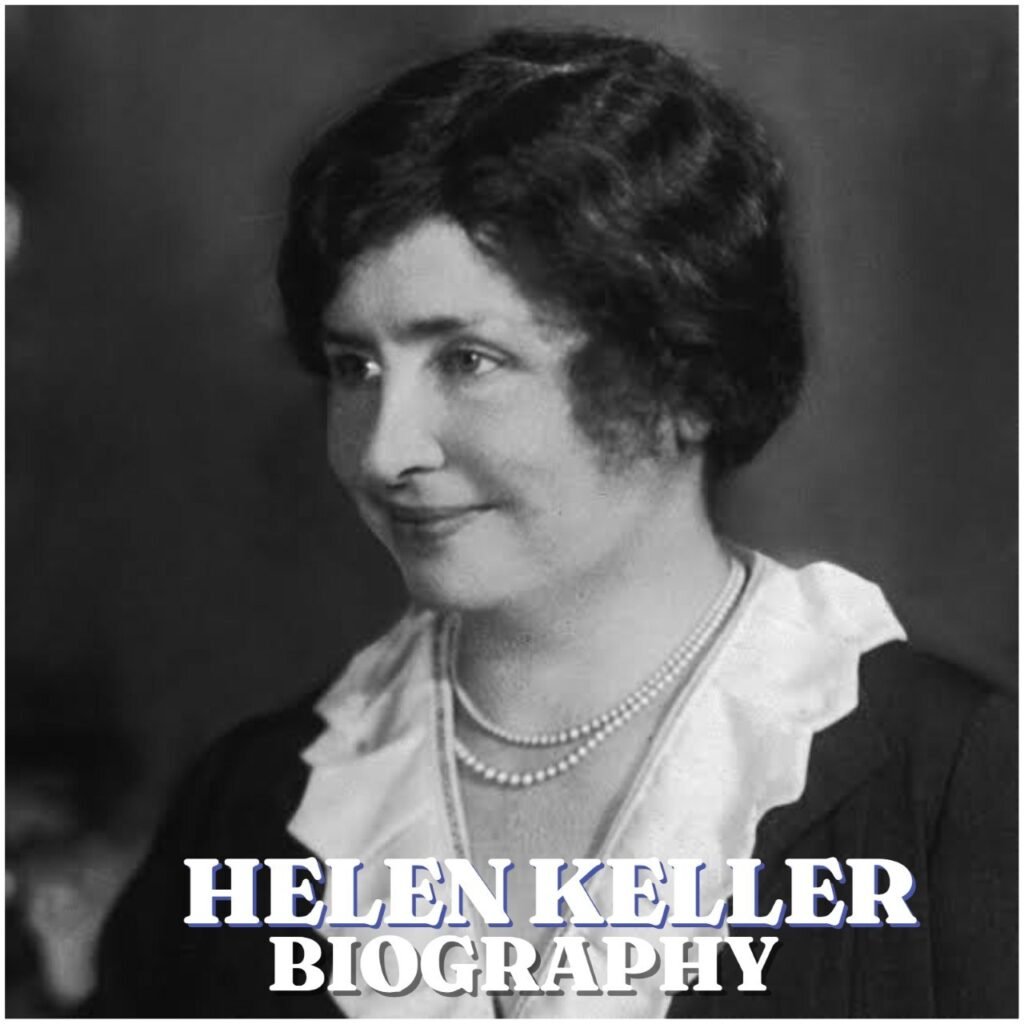
Helen Keller was born on June 27, 1880, in Tuscumbia, Alabama, United States, and died on June 1, 1968, at the age of 87. She was American by nationality and was raised in a Christian family, later identifying strongly with Christianity and expressing spiritual and religious ideas throughout her writings and public life. Keller became deaf and blind after an illness when she was approximately 19 months old, and these disabilities shaped many aspects of her life and advocacy. Historical descriptions and photographs show her as a petite woman with light-colored hair and a composed appearance, although an exact height is not reliably documented in authoritative biographical sources. Because historical records do not provide a consistently verified measurement, specific height figures found on some websites should be treated cautiously. Despite her deafblindness, Keller developed exceptional communication skills and became known for her confident presence, expressive writing and determination, characteristics that contributed significantly to her enduring public image.
Helen Keller Cause of Death and Death
Helen Keller died on June 1, 1968, at the age of 87. She passed away peacefully in her sleep at her home, Arcan Ridge, in Easton, Connecticut, United States. By the time of her death, Keller had already established herself as an internationally respected author, lecturer and advocate for people with disabilities. Her death marked the end of an extraordinary life that had spanned nearly nine decades.
The cause of Helen Keller’s death was a heart attack, according to widely reported biographical accounts. In the years before her death, Keller had experienced declining health and suffered several strokes during the 1960s. Despite these health difficulties, she continued to receive visitors and remained interested in the causes and organizations she had supported throughout her life.
Following her death, Helen Keller was cremated, and her ashes were placed at Washington National Cathedral in Washington, D.C., alongside those of her longtime teacher and companion, Anne Sullivan, and Sullivan’s companion, Polly Thomson. Keller’s final resting place reflects the importance of the relationships that shaped her life. More than five decades after her death, her story continues to inspire people around the world, particularly through her achievements in education, literature and disability advocacy.
Helen Keller Social Media Presence and Online Legacy
Helen Keller did not have a personal social-media presence because she died in 1968, decades before platforms such as Facebook, Instagram, TikTok and X were created. However, her name and legacy remain highly visible across modern social-media platforms, where educational organizations, disability-rights groups, museums and historical institutions share information about her life, achievements, writings and advocacy. Her story continues to reach younger generations through digital content, quotations, photographs and educational posts.
One of the most important organizations preserving Helen Keller’s legacy is the American Foundation for the Blind (AFB), which maintains extensive archival information about her life and work. Social-media users may find Helen Keller-related content through the organization’s official accounts and other reputable educational pages. Handles such as @HelenKeller may appear on social-media platforms, but users should not assume that such accounts personally belonged to Keller because she lived and died long before social media existed.
Helen Keller’s continuing presence online demonstrates the lasting influence of her work as an author, lecturer and disability-rights advocate. Her famous writings, photographs and inspirational story are frequently shared on platforms such as Instagram, Facebook, TikTok and X. Although she never had a personal social-media handle, her digital legacy continues to introduce her message of education, equality, courage and disability inclusion to millions of people around the world.
Helen Keller Legacy and Lasting Impact
Helen Keller left an extraordinary legacy as one of the most influential advocates for people with disabilities in modern history. Her achievements as a deafblind woman challenged the social attitudes of her time and demonstrated that disability should not prevent a person from receiving an education, developing talents or participating fully in society. Her graduation from Radcliffe College, literary achievements and international public-speaking career became powerful examples of what could be accomplished when people are given education, support and opportunities.
Keller’s legacy also extends through her lifelong advocacy for the rights and welfare of blind and disabled people. She worked with organizations supporting people with vision loss and travelled extensively to raise awareness about accessibility, education and employment. She also spoke publicly about women’s rights, workers’ rights and social equality. Her activism helped bring disability issues into wider public discussion and contributed to changing perceptions about the capabilities and rights of people with disabilities.
Today, Helen Keller remains an internationally recognized symbol of determination, education and disability advocacy. Her books, letters, photographs and other historical materials continue to be preserved and studied, while her story is taught in schools and discussed through documentaries, films and educational programs. Her relationship with Anne Sullivan, her achievements as a writer and her commitment to social change have ensured that her influence continues long after her death in 1968. Helen Keller’s enduring legacy is not simply the story of overcoming deafblindness, but the story of a woman who used education and her public voice to advocate for a more inclusive and equal society.
Conclusion
Helen Keller’s life remains one of the most inspiring stories of courage, education, determination and social advocacy. Despite becoming deaf and blind as a young child, she overcame enormous barriers with the support of Anne Sullivan and went on to become an accomplished author, lecturer and activist. Her education at Radcliffe College, successful writing career and lifelong campaign for disability rights challenged society’s understanding of what people with disabilities could achieve. Although Helen Keller died on June 1, 1968, at the age of 87, her influence continues through her books, advocacy and the many people inspired by her remarkable journey. Her legacy remains a powerful reminder that education, opportunity and determination can help individuals overcome extraordinary challenges and make a lasting difference in the world.
Frequently Asked Questions About Helen Keller
Who was Helen Keller?
Helen Keller was an American author, lecturer, educator and social activist who became deaf and blind after an illness when she was about 19 months old. With the help of her teacher, Anne Sullivan, she learned to communicate, received a university education and became an internationally recognized advocate for people with disabilities.
When was Helen Keller born?
Helen Keller was born on June 27, 1880, in Tuscumbia, Alabama, United States.
When did Helen Keller die?
Helen Keller died on June 1, 1968, at the age of 87, at her home in Easton, Connecticut.
What was the cause of Helen Keller’s death?
Helen Keller is widely reported to have died from a heart attack. She had experienced declining health and several strokes during the final years of her life.
How did Helen Keller become deaf and blind?
Helen Keller became deaf and blind after suffering an illness when she was approximately 19 months old. The exact illness was never definitively established, although it was historically believed to have been scarlet fever or meningitis.
Who was Helen Keller’s teacher?
Helen Keller’s famous teacher was Anne Mansfield Sullivan, who began teaching her in 1887. Sullivan played a crucial role in helping Keller develop communication and educational skills.
Where did Helen Keller go to school?
Helen Keller attended the Perkins School for the Blind, the Wright-Humason School for the Deaf and later Radcliffe College. She graduated from Radcliffe in 1904 with a Bachelor of Arts degree, cum laude.
What degree did Helen Keller earn?
Helen Keller earned a Bachelor of Arts degree from Radcliffe College in 1904. She is widely recognized as the first deafblind person to earn a Bachelor of Arts degree.
What was Helen Keller famous for?
Helen Keller was famous for becoming an accomplished author, lecturer and disability-rights advocate despite being deafblind. She also campaigned for women’s rights, workers’ rights and social equality.
What is Helen Keller’s most famous book?
Helen Keller’s most famous book is The Story of My Life, published in 1903. The autobiography describes her childhood, education and relationship with Anne Sullivan.
Did Helen Keller get married?
No. Helen Keller never married and had no children. She had a romantic relationship with Peter Fagan in 1916, but they did not marry.
Who were Helen Keller’s parents?
Helen Keller’s parents were Arthur Henley Keller and Kate Adams Keller. Her mother played an important role in seeking educational opportunities for Helen after she became deaf and blind.
What was Helen Keller’s nationality?
Helen Keller was American. She was born in Tuscumbia, Alabama, and spent much of her life in the United States while also travelling internationally for her advocacy work.
What religion did Helen Keller follow?
Helen Keller was raised in a Christian family and was associated with Christianity. She expressed spiritual and religious ideas in some of her writings, although her religious views developed throughout her life.
Did Helen Keller have social media?
No. Helen Keller died in 1968, long before modern social-media platforms existed. Today, her life and legacy are shared through social-media accounts operated by organizations, educational institutions and historical communities.
- What is Helen Keller’s legacy?
Helen Keller’s legacy is centered on education, disability rights, equality and social advocacy. Her achievements challenged negative attitudes toward deafblind people and continue to inspire disability-rights movements and educational programs worldwide.