
Introduction
Stephen Hawking was one of the most celebrated theoretical physicists and cosmologists in modern history, widely recognized for his groundbreaking research on black holes, the origins of the universe, and the fundamental laws governing space and time. Born on January 8, 1942, in Oxford, England, Stephen William Hawking became an internationally respected scientist whose work transformed humanity’s understanding of the cosmos. Despite living with motor neurone disease for most of his adult life, he continued to pursue scientific research, write influential books, and communicate complex scientific ideas to audiences around the world. His remarkable journey from a curious young student to one of the most recognizable scientists of the twentieth and early twenty-first centuries remains an important part of his enduring legacy.
Throughout his distinguished career, Stephen Hawking made significant contributions to theoretical physics, particularly through his research into black holes and the relationship between quantum mechanics and gravity. His prediction that black holes could emit radiation, subsequently known as Hawking radiation, challenged established assumptions and opened new avenues for scientific investigation. He also gained international recognition through his bestselling book, A Brief History of Time, published in 1988, which explained complicated concepts about the universe, the Big Bang, black holes, and the nature of time in language accessible to general readers. His academic achievements, public lectures, television appearances, and collaborations with other researchers helped establish him as both a leading scientific thinker and an influential science communicator.
Although Stephen Hawking died on March 14, 2018, at the age of 76, his scientific ideas and cultural influence continue to attract attention worldwide. In 2026, renewed interest in his life and work has been reflected in discussions surrounding a new biography, continuing research into black-hole physics, and the Stephen Hawking Medal for Science Communication, which recognizes achievements in making science accessible to the public. His life story continues to inspire students, researchers, and readers interested in science, perseverance, and the mysteries of the universe. From his influential theories to his ability to communicate ambitious scientific ideas despite significant physical challenges, Stephen Hawking remains a defining figure in modern scientific history, and his contributions continue to shape conversations about the universe and humanity’s place within it.
Early Life of Stephen Hawking
Stephen Hawking was born on January 8, 1942, in Oxford, England, to Frank Hawking and Isobel Hawking. His birth occurred exactly 300 years after the death of the Italian astronomer Galileo Galilei, a coincidence that Hawking and biographers have often noted when discussing his life and scientific achievements. His father, Frank, was a medical researcher specializing in tropical medicine, while his mother, Isobel, had studied philosophy, politics, and economics at the University of Oxford. Hawking grew up in an intellectually curious family that valued education, independent thinking, and discussion. Although the family was not wealthy by the standards of the academic world, his parents encouraged their children to develop their interests and think critically about the world around them.
During his childhood, Hawking spent part of his early years in Oxford before his family moved to St Albans, Hertfordshire, where he attended school. He initially studied at Byron House School and later attended St Albans School. As a young boy, he demonstrated curiosity about how things worked and became increasingly interested in mathematics, science, and the fundamental questions surrounding the universe. His friends and family sometimes described him as imaginative and unconventional, and he enjoyed exploring ideas rather than simply accepting information without questioning it. Although he was not always considered an outstanding student in every subject, his interest in scientific problems gradually became more pronounced. His upbringing in a household that encouraged intellectual exploration helped lay the foundation for his future career in theoretical physics and cosmology.
As Hawking grew older, his fascination with the universe developed into a serious ambition to understand its underlying principles. He became particularly interested in mathematics and physics, subjects that allowed him to investigate questions about the origins of existence, the nature of time, and the forces governing the cosmos. His father initially hoped that he would pursue medicine, but Hawking preferred mathematics and physics because they offered opportunities to explore abstract scientific questions. During his teenage years, he also developed a reputation for being inventive and resourceful, building simple scientific equipment and engaging in discussions about complex ideas with friends. These early experiences helped shape his determination to pursue scientific research, eventually leading him to the University of Oxford and then the University of Cambridge, where he would begin the academic journey that made him one of the most influential physicists of his generation.
Education of Stephen Hawking
Stephen Hawking began his formal education in England, where he attended Byron House School before continuing his studies at St Albans School in Hertfordshire. During his school years, he developed a growing interest in mathematics, science, and the fundamental questions surrounding the universe. Although he was not always regarded as an exceptional student in every subject, he demonstrated a strong capacity for analytical thinking and problem-solving. His curiosity about how things worked encouraged him to explore scientific ideas beyond the classroom, and he gradually became more determined to pursue a career that would allow him to investigate the laws governing nature. His parents supported his intellectual development, although his father initially preferred that he study medicine rather than mathematics or physics.
In 1959, Hawking enrolled at the University of Oxford, where he studied physics at University College. He completed his undergraduate degree in physics in 1962, earning first-class honours. His time at Oxford provided him with a strong foundation in theoretical physics and helped him develop the mathematical and analytical skills necessary for advanced scientific research. Although he later acknowledged that he had not always devoted himself consistently to his undergraduate studies, he demonstrated considerable intellectual ability and completed his degree with outstanding results. His academic experience at Oxford prepared him for the next stage of his education, when he would focus more intensively on cosmology, gravity, and the origins of the universe.
After graduating from Oxford, Hawking moved to the University of Cambridge in 1962 to pursue postgraduate research in cosmology. He studied under the supervision of physicist Dennis Sciama, whose academic guidance helped him develop his research interests in the structure and evolution of the universe. During his doctoral studies, Hawking began investigating the mathematical implications of general relativity and the conditions under which the universe could have originated from a singularity. He received his PhD in applied mathematics and theoretical physics from Cambridge in 1966. His doctoral research established an important foundation for his later work on gravitational singularities, black holes, and the Big Bang theory. Hawking subsequently remained at Cambridge, eventually becoming Lucasian Professor of Mathematics in 1979, a prestigious academic position previously held by Isaac Newton. His education and research at Oxford and Cambridge played a central role in establishing him as one of the world’s leading theoretical physicists.
Career of Stephen Hawking
Stephen Hawking built an extraordinary career as a theoretical physicist, cosmologist, author, and academic whose work transformed scientific discussions about black holes and the origins of the universe. After completing his undergraduate degree at the University of Oxford in 1962, he continued his education at the University of Cambridge, where he earned his PhD in 1966. His early research focused on cosmology, general relativity, and the mathematical structure of the universe. Working alongside other prominent researchers, including Roger Penrose, Hawking developed important theoretical results concerning gravitational singularities and the conditions under which the universe may have begun. His work helped strengthen the scientific foundations of the Big Bang model and established him as a rising figure in theoretical physics. Despite being diagnosed with motor neurone disease in the early 1960s, Hawking continued his academic career, demonstrating a lasting commitment to research and scientific discovery.
One of Hawking’s most influential scientific contributions was his prediction that black holes are not entirely black but can emit thermal radiation as a result of quantum effects near their boundaries. This phenomenon became known as Hawking radiation and represented a major development in theoretical physics because it connected ideas from quantum mechanics, gravity, and thermodynamics. His research challenged the traditional view that black holes could only absorb matter and energy, raising important questions about their temperature, entropy, and eventual evolution. Hawking also investigated the nature of space and time, the early universe, and the possibility of a unified description of fundamental physical laws. In 1979, he was appointed Lucasian Professor of Mathematics at the University of Cambridge, a distinguished position once held by Isaac Newton. He occupied the post until 2009 and continued contributing to scientific research and academic discussion long after his physical condition made everyday activities increasingly difficult.
Beyond his research, Hawking became internationally famous for making complex scientific subjects accessible to the general public. His 1988 book, A Brief History of Time, explored the Big Bang, black holes, the nature of time, and the structure of the universe in a way intended for readers without specialist scientific training. The book became an international bestseller and helped establish him as one of the best-known science communicators of his generation. He subsequently wrote or co-authored other books, including Black Holes and Baby Universes and Other Essays, The Universe in a Nutshell, and A Briefer History of Time. He also appeared in documentaries and television programmes, including guest appearances in popular series such as Star Trek: The Next Generation, The Simpsons, and The Big Bang Theory. His distinctive computerized voice became widely recognized, while his public appearances helped encourage interest in physics, astronomy, and cosmology among audiences of different ages.
Throughout his career, Hawking received numerous honours in recognition of his scientific achievements, including the Albert Einstein Medal in 1979, the Wolf Prize in Physics in 1988, and the Copley Medal in 2006. He was also appointed a Companion of Honour in 1989 in recognition of his contributions to science. Although he never received the Nobel Prize in Physics, his work remains highly influential in theoretical physics, particularly in research concerning black holes and quantum gravity. His career demonstrated how mathematical reasoning and imaginative scientific questions could challenge established assumptions and expand humanity’s understanding of the universe. Stephen Hawking died on March 14, 2018, but his publications, scientific theories, and influence on public engagement with science continue to inspire researchers, students, and readers worldwide.
Why Stephen Hawking Is Trending in 2026: New Biography and Renewed Interest in His Scientific Legacy
Stephen Hawking is attracting renewed public attention in 2026 following the publication of Hawking: His Life and Work, a biography by physicist and science writer Graham Farmelo. A review published in Nature on September 28, 2026, explores Hawking’s scientific achievements, personal relationships, and the experiences that shaped his extraordinary career. The biography offers readers a deeper understanding of the man behind the celebrated theories and examines how his work influenced modern ideas about gravity, black holes, and the universe.
Another reason Hawking remains a trending subject is the continuing scientific interest in black holes and his prediction of Hawking radiation. Researchers continue to investigate the connections between quantum mechanics, gravity, and black-hole thermodynamics. Although Hawking’s prediction of radiation from astrophysical black holes has not been directly confirmed through observation, it remains an important theoretical contribution that inspires further research. These ongoing investigations keep his name relevant in scientific discussions and educational publications.
Hawking’s influence on science communication is also receiving attention through the 2026 Stephen Hawking Medal for Science Communication. Physicist and broadcaster Brian Cox received the award at the Royal Astronomical Society in London on October 2, 2026, in recognition of his efforts to make science accessible to wider audiences. The medal was established by Hawking and the STARMUS Festival’s co-founders to celebrate people who connect science with the public. This recognition highlights the lasting influence of Hawking’s belief that scientific knowledge should reach beyond universities and research institutions.
Overall, Stephen Hawking is trending because his life story continues to fascinate readers, his scientific theories remain central to important questions in physics, and his legacy as a science communicator continues to be celebrated. The renewed interest in his biography and the latest recognition of science communicators demonstrate that, years after his death, Hawking remains an influential figure in global scientific culture.
Cause of Death and Death of Stephen Hawking
Stephen Hawking died on March 14, 2018, at the age of 76, at his home in Cambridge, England. His death was announced by his family, who paid tribute to his extraordinary contributions to science and his influence on people around the world. Hawking had spent decades investigating some of the universe’s most challenging scientific questions, becoming internationally known for his research on black holes, cosmology, and the nature of space and time. His death was widely reported by scientific institutions, universities, public figures, and media organizations, with tributes emphasizing both his intellectual achievements and his determination to continue working despite significant physical challenges.
Hawking lived with amyotrophic lateral sclerosis (ALS), a form of motor neurone disease that progressively affects the nerve cells responsible for controlling voluntary muscles. He was diagnosed in the early 1960s, when he was a young postgraduate student, and doctors initially feared that he had only a limited time to live. However, he lived for more than five decades after his diagnosis, a remarkably long period for someone with the condition. As the disease progressed, he gradually lost much of his ability to move and speak independently, eventually relying on a wheelchair and computerized communication technology. Although his condition was a defining aspect of his life, Hawking continued his academic research, wrote influential books, delivered lectures through assistive technology, and contributed to public discussions about science and humanity’s future.
The precise medical cause of Hawking’s death was not publicly established in a detailed official statement from his family. His long-standing motor neurone disease was widely associated with his declining physical health, but it would be inaccurate to claim a specific terminal event without reliable confirmation. Following his death, tributes came from scientists, political leaders, educational institutions, and admirers across the world. His ashes were later interred at Westminster Abbey in London, near the graves of other distinguished British scientists, including Isaac Newton and Charles Darwin. Stephen Hawking’s death marked the end of an extraordinary personal journey, but his theories, books, and contributions to science continue to influence research and inspire people interested in understanding the universe.
Personal Life and Family of Stephen Hawking
Stephen Hawking’s personal life was marked by his scientific ambitions, family relationships, and determination to live as independently as possible while coping with motor neurone disease. In 1963, he met Jane Wilde, a languages student, and the two developed a close relationship despite the challenges surrounding his diagnosis. They married on July 14, 1965, and Jane became an important source of support during the early years of his academic career and the progression of his illness. Their marriage lasted approximately 30 years, during which Jane helped care for their family while Hawking continued his research and writing. Their experiences together were later explored in Jane’s memoir, Travelling to Infinity: My Life with Stephen, which inspired the 2014 film The Theory of Everything. The film portrayed aspects of their relationship, family life, and the difficulties they faced as Hawking’s physical condition changed over time.
Stephen and Jane Hawking had three children: Robert Hawking, Lucy Hawking, and Timothy Hawking. Robert pursued a career in software engineering, while Lucy became a journalist and author, including writing books for younger readers with her father. Timothy also became part of the family’s public story, although he has generally maintained a more private profile than his sister. Despite Hawking’s demanding academic responsibilities and physical limitations, his children remained an important part of his life. Family experiences, including the challenges of balancing caregiving with professional ambitions, formed a significant part of the story of his early adulthood. Jane’s memoir and the family’s occasional public reflections have helped readers understand the personal sacrifices and support involved in Hawking’s life beyond his scientific achievements.
Hawking and Jane separated in the early 1990s and divorced in 1995. Later that year, Hawking married Elaine Mason, a nurse who had been involved in his care. Their marriage lasted until their divorce in 2006. Following the end of his second marriage, Hawking continued to focus on his scientific interests, public appearances, writing, and relationships with his children and colleagues. His family history remains an important aspect of his biography because it illustrates the human experiences behind his public reputation as a leading physicist. Although public attention often focused on his disability and scientific accomplishments, Hawking’s life also involved marriage, parenthood, changing relationships, and the everyday challenges of maintaining family connections. His legacy therefore extends beyond physics, reflecting a complex personal journey shaped by intellectual curiosity, family relationships, and decades of perseverance.
Stephen Hawking’s Age, Religion, Nationality, Health and Physical Appearance
Age
Stephen Hawking was born on January 8, 1942, in Oxford, England, and died on March 14, 2018, at the age of 76. His life spanned a period of remarkable developments in theoretical physics, space exploration, and cosmology. During his 76 years, he became one of the world’s most recognized scientists, making important contributions to the understanding of black holes, gravitational singularities, and the origins of the universe. Although he died in 2018, his scientific achievements and popular science books continue to attract interest from researchers, students, and readers worldwide. His longevity despite a diagnosis of motor neurone disease in early adulthood also became a notable part of his personal story.
Religion
Stephen Hawking expressed a largely non-religious, scientific understanding of the universe and frequently discussed questions about creation, the laws of nature, and humanity’s place in the cosmos. In his writings and public statements, he explained that he did not believe in a conventional personal God who intervenes in the universe. In his book The Grand Design, written with Leonard Mlodinow, Hawking explored how the laws of physics could help explain the origins and development of the universe without requiring a supernatural explanation. His views sometimes generated debate among religious thinkers, philosophers, and scientists, particularly concerning the relationship between science and faith. Hawking generally approached these questions through scientific reasoning, emphasizing the importance of evidence, mathematical explanations, and continued investigation of the natural world.
Nationality
Stephen Hawking was British by nationality. He was born and raised in England, completed his university education at Oxford and Cambridge, and spent much of his professional life working at the University of Cambridge. His scientific achievements earned him international recognition, and he became an important representative of British scientific research on the global stage. Throughout his career, he received numerous awards and honours, including the Copley Medal and the Albert Einstein Medal. His work crossed national boundaries, influencing scientific discussions and public understanding of cosmology around the world. Although his nationality was British, his influence extended internationally through his research, lectures, books, and appearances in popular culture.
Health
Stephen Hawking was diagnosed with amyotrophic lateral sclerosis (ALS), a form of motor neurone disease, in the early 1960s while studying at Cambridge. The condition progressively affected the nerve cells responsible for controlling voluntary muscles, gradually limiting his mobility and ability to speak. Despite the seriousness of the diagnosis and the initially pessimistic prognosis, Hawking lived with the condition for more than five decades. Over time, he relied on a wheelchair and assistive technology, including a computerized speech-generating system, to communicate with others. These adaptations enabled him to continue researching, writing books, supervising students, and participating in public scientific discussions. His experience demonstrated how assistive technology and sustained support can help people with significant physical disabilities remain active in academic and public life.
Physical Appearance
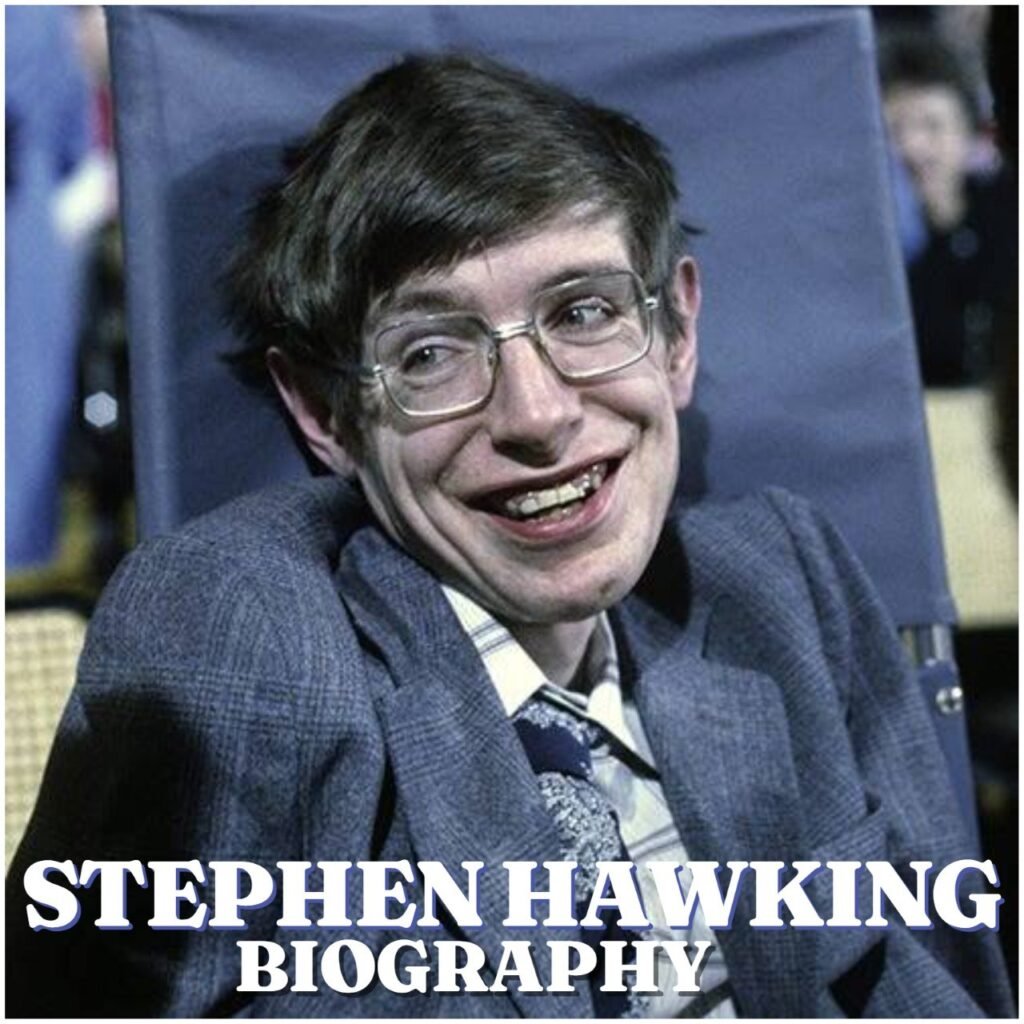
Stephen Hawking was widely recognizable because of his seated posture in a wheelchair, his distinctive facial expressions, and the computerized voice he used for communication. In his younger years, before the progression of motor neurone disease significantly affected his mobility, he had a relatively slim build and dark hair. As the condition advanced, he lost much of his ability to control voluntary muscle movements and required increasing assistance with daily activities. He usually appeared in public wearing practical clothing, often including sweaters, jackets, or formal attire for academic events and public ceremonies. His wheelchair and speech-generating computer became closely associated with his public image, but these physical characteristics were only one aspect of his life. Hawking was primarily remembered for his scientific imagination, intellectual contributions, and ability to communicate complex ideas about the universe to a global audience.
Stephen Hawking’s Age, Religion, Tribe, Height and Physical Appearance
Age
Stephen Hawking was born on January 8, 1942, in Oxford, England, and died on March 14, 2018, at the age of 76. During his lifetime, he became one of the most influential theoretical physicists of the modern era, making important contributions to the understanding of black holes, cosmology, and the origins of the universe. His long life was particularly remarkable because he was diagnosed with motor neurone disease in his early twenties and continued living with the condition for more than five decades. Although he passed away in 2018, his scientific discoveries, books, and public lectures continue to attract international interest. His age at death is frequently mentioned in biographies because it reflects the extraordinary length of his life and career despite significant health challenges.
Religion
Stephen Hawking was widely known for his non-religious philosophical outlook and his preference for scientific explanations of the universe. In interviews and publications, he expressed skepticism about the existence of a personal God who intervenes in human affairs. In his book The Grand Design, co-authored with physicist Leonard Mlodinow, Hawking discussed how the laws of physics could explain aspects of the universe’s existence without necessarily requiring a supernatural creator. His views generated considerable discussion among scientists, philosophers, and religious communities. However, his central focus remained on investigating the universe through mathematics, observation, and scientific theories. His approach to questions about existence and creation made him an influential public voice in discussions about the relationship between science, philosophy, and religion.
Tribe
Stephen Hawking was British and belonged to an English family background. The term “tribe” is generally more commonly used when discussing particular ethnic or Indigenous communities, whereas British biographies typically describe his heritage in terms of nationality and ancestry. Hawking was born in Oxford, England, to Frank Hawking and Isobel Hawking, and grew up in an English family that valued education and intellectual curiosity. His parents encouraged independent thinking and academic development, helping create an environment in which his interests in mathematics and science could flourish. His international reputation was built primarily on his scientific research and contributions to cosmology rather than on ethnic or tribal affiliation.
Height
Stephen Hawking’s exact height is not consistently documented in authoritative biographical sources, and widely circulated online estimates should therefore be treated cautiously. As a result of his motor neurone disease, he used a wheelchair for much of his adult life, making it difficult to assess his standing height from many public photographs and appearances. His physical condition gradually affected his movement and posture, and his public image became closely associated with the wheelchair and computerized communication system he used. Reliable accounts of his life focus primarily on his scientific achievements, education, and long-term experience with motor neurone disease rather than on a precise measurement of his height.
Physical Appearance
Stephen Hawking had a distinctive appearance that became familiar to audiences around the world through scientific documentaries, interviews, photographs, and television appearances. In his younger years, he had dark hair and a relatively conventional appearance for a British university student. As motor neurone disease progressed, the condition increasingly affected his voluntary muscle control and mobility, and he came to rely on a wheelchair for movement. He also used a computerized speech-generating system after losing the ability to speak naturally. His characteristic seated posture, facial expressions, and electronic voice became closely associated with his public identity. Despite the physical limitations caused by his condition, Hawking remained active in scientific research and public communication for decades, and he is remembered primarily for his intellectual contributions and lasting influence on our understanding of the universe.
Social Media Presence of Stephen Hawking
Stephen Hawking maintained a significant public presence through interviews, scientific lectures, documentaries, and online platforms that helped share his ideas with audiences worldwide. During his lifetime, he used social media to communicate about scientific discoveries, space exploration, artificial intelligence, and the future of humanity. One notable platform was X (formerly Twitter), where his public account was associated with the handle @ProfStephenHawking. He also maintained a presence on China’s Weibo platform, where he interacted with audiences interested in science and the future of space exploration.
Following his death in 2018, Hawking’s scientific legacy continued through his official website, which shares information about his life, research, publications, and ongoing projects connected with his work. Readers can visit the [Stephen Hawking Estate’s official website](https://www.hawking.org.uk/) to learn more about his achievements and legacy. His name and scientific ideas also continue to appear across social media through educational institutions, science communicators, and admirers who share his discoveries and memorable public appearances.
Although Hawking is no longer personally active on social media, his digital legacy remains an important way for people to explore his contributions to science. Anyone interested in his work should distinguish verified historical accounts from unofficial fan pages and impersonation accounts. His lasting online presence reflects the worldwide interest in his theories, books, and efforts to make the mysteries of the universe understandable to a broad audience.
Stephen Hawking’s Net Worth
Stephen Hawking’s estimated net worth at the time of his death in March 2018 was approximately $20 million, according to Celebrity Net Worth. However, this figure should be treated as an estimate rather than a verified statement of his total wealth, because his private financial records and the complete value of his estate were not publicly established. Hawking accumulated his wealth over decades through his distinguished career as a theoretical physicist, university professor, author, and science communicator.
A significant portion of Hawking’s earnings came from his successful books, particularly A Brief History of Time, published in 1988. The book became an international bestseller, introducing complex ideas about black holes, cosmology, and the origins of the universe to millions of readers. He also earned income from subsequent publications, including The Universe in a Nutshell, as well as academic work, public appearances, documentaries, and other science-related projects. His ability to communicate complicated scientific concepts to a broad audience helped establish a career that extended beyond traditional university research.
Hawking’s financial legacy was also connected to the substantial expenses associated with his long-term care, family responsibilities, and estate planning. He lived with motor neurone disease for more than five decades and required increasingly specialized assistance and communication technology as his condition progressed. Although some online sources estimate his wealth at around $20 million, other financial commentary has suggested lower figures, illustrating the uncertainty surrounding his final net worth. Ultimately, Hawking’s greatest legacy was not his financial wealth but his transformative contributions to physics, his bestselling books, and his efforts to make scientific knowledge accessible to people worldwide.
Legacy of Stephen Hawking
Stephen Hawking left an extraordinary legacy in theoretical physics, cosmology, and humanity’s understanding of the universe. He is best remembered for his groundbreaking work on black holes, particularly his prediction that black holes can emit radiation, now known as Hawking radiation. This discovery connected concepts from quantum mechanics, gravity, and thermodynamics, creating new questions that continue to influence theoretical physics. His research into gravitational singularities, undertaken with mathematician and physicist Roger Penrose, also contributed significantly to scientific understanding of the Big Bang and the possible origins of the universe. Through his academic career at the University of Cambridge, including his tenure as Lucasian Professor of Mathematics from 1979 to 2009, Hawking established himself as one of the most influential physicists of his generation. His ideas continue to guide scientific discussions about black holes, the nature of space and time, and the search for a deeper understanding of the fundamental laws of nature.
Beyond his scientific achievements, Hawking made a lasting impact by bringing complex scientific ideas to the general public. His bestselling book, A Brief History of Time, introduced millions of readers to subjects such as the Big Bang, black holes, and the structure of the universe. He followed this success with other popular science books, including The Universe in a Nutshell and A Briefer History of Time, helping people with different levels of scientific knowledge engage with questions about the cosmos. His appearances in documentaries and television programmes also made him a familiar figure beyond academic circles. In addition, the Stephen Hawking Medal for Science Communication, established in collaboration with the STARMUS Festival’s co-founders, carries forward his commitment to making science accessible and celebrating people who communicate scientific knowledge effectively. Through these efforts, Hawking helped demonstrate that scientific discovery can be both intellectually challenging and understandable to a wide audience.
Stephen Hawking’s personal journey also became an important part of his legacy. Diagnosed with motor neurone disease in early adulthood, he lived with the progressive condition for more than five decades while continuing his scientific research, writing, and public engagement. His use of assistive communication technology highlighted the importance of innovation in enabling people with significant physical disabilities to participate in academic and public life. Although his experience was often discussed in terms of perseverance, his achievements also reflected the support of his family, colleagues, caregivers, and scientific community. Hawking died on March 14, 2018, at the age of 76, but his influence remains visible in scientific research, popular science education, and continuing debates about the universe’s origins and future. His enduring legacy rests on the questions he helped scientists explore, the knowledge he shared with the public, and the generations of students and researchers he inspired to look beyond the familiar and investigate the mysteries of existence.
Conclusion
Stephen Hawking remains one of the most influential scientists in modern history, celebrated for his groundbreaking contributions to theoretical physics, cosmology, and the understanding of black holes. From his early education at the University of Oxford and the University of Cambridge to his internationally recognized research on Hawking radiation and the origins of the universe, he demonstrated the power of curiosity, scientific reasoning, and intellectual perseverance. Despite living with motor neurone disease for more than five decades, he continued to conduct research, write bestselling books such as A Brief History of Time, and inspire millions through his lectures and public appearances. Although he died on March 14, 2018, at the age of 76, his scientific discoveries, publications, and influence on science communication continue to shape how people understand the cosmos. Stephen Hawking’s remarkable life stands as a lasting reminder that the pursuit of knowledge can expand human understanding and inspire future generations to explore the universe’s greatest mysteries.
Frequently Asked Questions About Stephen Hawking
1. Who was Stephen Hawking?
Stephen Hawking was a British theoretical physicist, cosmologist, and author best known for his research on black holes, Hawking radiation, and the origins of the universe. He became one of the world’s most recognizable scientists through his groundbreaking research and bestselling book, A Brief History of Time.
2. When was Stephen Hawking born?
Stephen Hawking was born on January 8, 1942, in Oxford, England. He grew up in an intellectually curious family and later studied physics at the University of Oxford before pursuing postgraduate research at the University of Cambridge.
3. When did Stephen Hawking die?
Stephen Hawking died on March 14, 2018, at the age of 76. He died at his home in Cambridge, England, after living with motor neurone disease for more than five decades.
4. What was Stephen Hawking’s cause of death?
Hawking lived with motor neurone disease, also known as amyotrophic lateral sclerosis (ALS), for most of his adult life. Although his death was widely associated with his long-term illness, his family did not publicly establish a specific medical cause in a detailed official statement.
5. What was Stephen Hawking famous for?
Stephen Hawking was famous for his theoretical work on black holes, gravitational singularities, and the origins of the universe. His prediction that black holes can emit radiation, known as Hawking radiation, became one of his most influential scientific contributions.
6. What was Stephen Hawking’s net worth?
Stephen Hawking’s net worth at the time of his death has been estimated at approximately $20 million by online celebrity wealth publications. However, this figure is not an officially verified accounting of his estate. His income came from scientific work, academic positions, bestselling books, and public appearances.
7. Who was Stephen Hawking’s wife?
Stephen Hawking married Jane Wilde in 1965, and they had three children together: Robert, Lucy, and Timothy. The couple separated in the early 1990s and divorced in 1995. Hawking later married Elaine Mason in 1995, and they divorced in 2006.
8. How many children did Stephen Hawking have?
Stephen Hawking had three children with his first wife, Jane Wilde. Their children are Robert Hawking, Lucy Hawking, and Timothy Hawking. Lucy became a journalist and author, while Robert pursued a career in software engineering.
9. What disease did Stephen Hawking have?
Stephen Hawking had motor neurone disease, a progressive neurological condition that affects the nerves controlling voluntary muscles. He was diagnosed in the early 1960s and lived with the condition for more than 50 years, using a wheelchair and computerized communication technology as his physical abilities declined.
10. Did Stephen Hawking win a Nobel Prize?
No, Stephen Hawking did not receive a Nobel Prize during his lifetime. Nevertheless, he received numerous prestigious scientific honours, including the Albert Einstein Medal, the Wolf Prize in Physics, and the Copley Medal, in recognition of his contributions to theoretical physics.
11. What book made Stephen Hawking famous?
His book A Brief History of Time, published in 1988, brought him international fame beyond the scientific community. It explained complex topics involving the universe, black holes, time, and the Big Bang for general readers and became an international bestselle.
12. What was Stephen Hawking’s nationality?
Stephen Hawking was British. He was born in Oxford, England, and spent much of his academic career at the University of Cambridge, where he conducted influential research in theoretical physics and cosmology.
13. What was Stephen Hawking’s religion?
Stephen Hawking expressed a largely non-religious worldview and questioned the idea of a personal God who intervenes in the universe. He generally explored questions about creation and existence through scientific theories and the laws of physics.
14. What was Stephen Hawking’s most important scientific discovery?
One of Hawking’s most influential contributions was his theoretical prediction that black holes emit radiation due to quantum effects. Known as Hawking radiation, this idea connected quantum mechanics, gravity, and thermodynamics and continues to influence research into black holes.
15. Is Stephen Hawking still alive in 2026?
No, Stephen Hawking is not alive in 2026. He died on March 14, 2018, aged 76. However, his scientific legacy continues through ongoing research, his published books, educational projects, and the Stephen Hawking Medal for Science Communication.
Stephen Hawking’s legacy includes his contributions to black-hole physics and cosmology, his ability to explain complex scientific concepts to general audiences, and his influence on future generations of scientists. His research and books continue to inspire interest in the universe and humanity’s place within it.