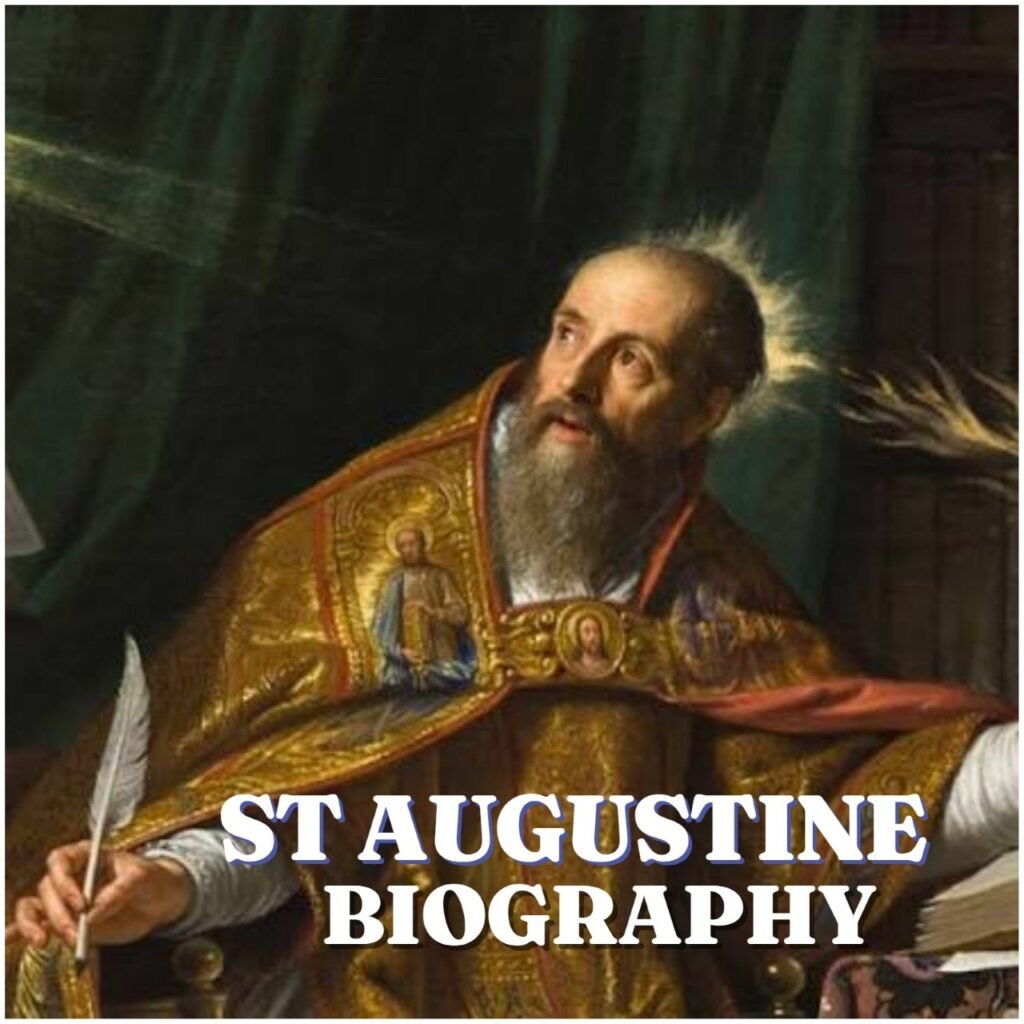

St. Augustine Biography
Saint Augustine of Hippo, widely known as St. Augustine, was one of the most influential Christian theologians, philosophers, bishops, and writers of late antiquity. Born on November 13, 354 AD, in Thagaste, a Roman town in North Africa that is now Souk Ahras, Algeria, Augustine lived during a period of major political, cultural, and religious change in the Roman Empire. His remarkable journey from a young man searching for truth to one of Christianity’s most important thinkers has made his life a subject of enduring interest more than 1,500 years after his death.
Augustine’s life was shaped by his intellectual ambitions, personal struggles, philosophical questions, and eventual conversion to Christianity. His mother, Saint Monica, played an important role in his spiritual journey, while his education in rhetoric and philosophy helped prepare him for the intellectual career he initially pursued. After his conversion and baptism in Milan, Augustine returned to North Africa, became a priest, and later served as Bishop of Hippo. During his years as a bishop, he produced an enormous body of theological and philosophical writings that influenced Christian thought for centuries.
Among Augustine’s most famous works are Confessions, an influential spiritual autobiography, and The City of God, a major work examining Christianity, society, history, and the collapse of the Roman world. His writings addressed subjects such as faith, grace, free will, sin, human nature, morality, and the relationship between Christianity and philosophy. Even in 2026, Augustine remains a major figure in Christian theology and Western philosophy, while continuing to attract scholarly attention, including research into previously unknown or rediscovered writings associated with his work.
Early Life of St. Augustine
Saint Augustine was born on November 13, 354 AD, in Thagaste, a Roman town in North Africa that is now known as Souk Ahras in Algeria. He was born into a family that valued education, although the family had limited financial resources compared with the wealthier Roman elite. His father, Patricius, was a pagan who later converted to Christianity, while his mother, Saint Monica, was a devout Christian whose faith had a profound influence on Augustine. From an early age, Augustine showed strong intellectual abilities, and his parents placed considerable importance on his education.
Augustine received his early education in Thagaste before continuing his studies in Madaurus and later Carthage, one of the most important cultural and educational centers in Roman North Africa. He studied grammar, literature, rhetoric, and philosophy, developing skills that would eventually make him an outstanding speaker and writer. His education was primarily designed to prepare him for a career in public life, particularly in law or rhetoric. Although he was raised with Christian influence through his mother, Augustine did not immediately embrace Christianity as the central focus of his adult life.
As a young man, Augustine became deeply interested in questions about truth, morality, human nature, and the meaning of life. His intellectual curiosity led him to explore different philosophical and religious ideas, including Manichaeism, which he followed for several years. At the same time, he began building a successful career as a teacher of rhetoric, first in North Africa and later in Rome and Milan. His early experiences, education, relationships, and intellectual struggles would eventually become important parts of the spiritual transformation that led him toward Christianity and ultimately shaped his legacy as one of history’s most influential Christian thinkers.
Education of St. Augustine
Saint Augustine received his earliest education in Thagaste, where he studied the basic subjects expected of a young person from a family that valued learning. He later continued his studies in Madaurus, an important educational center in Roman North Africa, where he developed a strong interest in Latin literature, grammar, and classical authors. His education focused heavily on language and rhetoric, subjects that were highly valued in the Roman world because they prepared students for careers in public administration, law, teaching, and politics.
Augustine eventually moved to Carthage, one of the most important intellectual and cultural centers in North Africa, to pursue advanced studies. There, he studied rhetoric, literature, philosophy, and public speaking. His natural intelligence and ability with language helped him become an excellent student, and rhetoric became particularly important to his future career. However, his years in Carthage were also a period of personal and intellectual exploration, as he began asking deeper questions about morality, truth, religion, and the purpose of human life.
After completing his formal education, Augustine began working as a teacher of rhetoric, first in Thagaste and later in Carthage. He eventually traveled to Rome and then to Milan, where he continued developing his intellectual interests. His education in classical rhetoric and philosophy had a lasting influence on his writing style and theological thought. Although he had initially pursued education as a pathway to professional success, his intellectual journey eventually led him toward Christianity, particularly through his encounters with the teachings of Saint Ambrose of Milan and the works of Christian and Neoplatonist thinkers.
Career of St. Augustine
Saint Augustine began his professional career as a teacher of rhetoric, using the education he had received in grammar, literature, public speaking, and philosophy. He first taught in Thagaste and later established himself as a teacher in Carthage. His ability to communicate complex ideas and his knowledge of classical rhetoric helped him build a promising career. Augustine was ambitious during this period and wanted to achieve recognition through his intellectual abilities, eventually seeking opportunities outside North Africa.
Augustine later moved to Rome, where he continued his work as a teacher of rhetoric. He eventually traveled to Milan, where he obtained an important position as a professor of rhetoric supported by the Roman authorities. His years in Milan became a major turning point in his life because he encountered Saint Ambrose, the influential Bishop of Milan. Augustine was impressed by Ambrose’s preaching and interpretation of Christian scripture, and these encounters contributed significantly to his growing interest in Christianity. In 387 AD, Augustine was baptized by Ambrose in Milan.
After returning to North Africa, Augustine gradually moved away from his earlier career as a professional rhetorician and devoted himself to Christian service and scholarship. He became a priest in Hippo Regius around 391 and was later appointed Bishop of Hippo around 395 or 396. As bishop, he spent the rest of his career preaching, teaching, writing theological works, defending Christian doctrine, and responding to religious and philosophical controversies. His extensive writings, including Confessions and The City of God, established him as one of the most influential Christian thinkers of late antiquity and left a lasting impact on Western theology and philosophy.
Personal Life and Family of St. Augustine
Saint Augustine’s personal life before his conversion was quite different from the disciplined religious life for which he later became known. During his years in Carthage, Augustine was involved in a long-term relationship with a woman whose name is not recorded in history. The couple lived together for about 15 years and had a son named Adeodatus, whose name means “given by God.” Augustine remained emotionally connected to his son, and Adeodatus was later baptized alongside his father by Saint Ambrose in Milan in 387 AD. Augustine never married the woman, and historical sources do not provide her name.
One of the most important people in Augustine’s family life was his mother, Saint Monica, a devout Christian who strongly influenced his spiritual development. Monica continued praying for her son during the years when Augustine followed different philosophical and religious beliefs and lived a lifestyle that concerned her. His father, Patricius, was initially a pagan but converted to Christianity near the end of his life. Augustine also had a brother named Navigius and at least one sister, although her name has not survived in reliable historical records. His family’s influence, particularly Monica’s Christian faith, remained important throughout his life.
After his conversion to Christianity, Augustine chose a radically different path and eventually dedicated himself to religious service, celibacy, study, and writing. His son Adeodatus died while still a young man, probably not long after returning to North Africa with Augustine. Augustine never had a wife or fiancé in the later part of his life, and after becoming a priest and eventually Bishop of Hippo, he lived a celibate religious life. His personal experiences, relationships, family struggles, and spiritual transformation became central themes in his famous autobiography, Confessions, which remains one of the most important accounts of an individual’s inner and religious life from the ancient world.
St. Augustine Age, Religion, Tribe, Nationality, Height and Physical Appearance
How Old Was St. Augustine?
Saint Augustine was born on November 13, 354 AD, in Thagaste, Roman North Africa, and died on August 28, 430 AD, in Hippo Regius. He was 75 years old at the time of his death. Augustine lived through a period of significant transformation in the Roman Empire and spent much of his later life serving as a priest, bishop, theologian, and writer.
What Religion Was St. Augustine?
Saint Augustine was a Christian and became one of the most influential theologians in Christian history. His mother, Saint Monica, was a committed Christian and had a strong influence on his early religious upbringing. However, Augustine spent several years exploring different philosophical and religious ideas before converting to Christianity. He was baptized by Saint Ambrose of Milan in 387 AD, later became a priest, and eventually served as the Bishop of Hippo.
What Was St. Augustine’s Tribe?
It is not historically accurate to assign Augustine a modern African tribal identity. He was born in Thagaste, in the Roman province of Africa, a region that is now part of Algeria. Augustine belonged to the Roman North African cultural and Latin-speaking world, and his family was part of the local provincial population. While some modern sources may describe him broadly as North African or Berber, there is insufficient reliable evidence to identify him with a specific modern tribe. Therefore, the safest historical description is that Augustine was a Roman North African.
What Was St. Augustine’s Nationality?
Augustine was a Roman citizen from North Africa. Calling him Algerian in the modern national sense would be historically inaccurate because the modern country of Algeria did not exist during his lifetime. He lived within the Roman Empire and was part of the Latin-speaking intellectual and cultural world of Roman North Africa.
What Was St. Augustine’s Height?
There is no reliable historical record of Saint Augustine’s exact height. Since he lived in the fourth and fifth centuries and no contemporary physical measurements of him have survived, assigning a specific height would be speculation. For an accurate biography, it is better to state that his height is unknown rather than present an estimated figure as an established fact.
What Did St. Augustine Look Like?
Detailed contemporary descriptions of Augustine’s physical appearance are limited. Later paintings, icons, and sculptures commonly portray him as a mature or elderly man with a beard, dark hair, and the clothing of a Christian bishop, but these artistic representations were produced long after his death and cannot be considered exact portraits. His precise complexion, eye color, body build, and other physical characteristics remain uncertain because reliable contemporary descriptions are unavailable.
St. Augustine Net Worth
Saint Augustine’s net worth cannot be reliably calculated because he lived from 354 to 430 AD, more than 1,500 years ago, in a completely different economic system from the modern world. There are no surviving financial records that could be converted meaningfully into a modern net-worth figure. Augustine was a Roman North African intellectual who worked as a teacher of rhetoric before becoming a priest and later the Bishop of Hippo, rather than a modern businessman or entertainer with a publicly measurable personal fortune.
Before becoming a Christian bishop, Augustine earned income through his work as a teacher and professor of rhetoric, including his position in Milan. However, his later religious life was centered on preaching, pastoral duties, scholarship, and theological writing. As a bishop, he did not build a personal fortune in the modern sense, and his writings indicate a strong commitment to Christian service and a relatively disciplined lifestyle. Church resources under his administration should also not be confused with Augustine’s personal wealth.
For modern biography purposes, St. Augustine’s net worth is best described as unknown or not applicable, rather than assigning him a specific dollar amount. Although an estimate based on the earnings of a Roman rhetorician could theoretically be attempted, such a calculation would be highly speculative and would not accurately represent his personal wealth. His historical significance comes from his intellectual and religious legacy, particularly works such as Confessions and The City of God, rather than from financial wealth.
Major Works and Books by St. Augustine
St. Augustine became one of the most prolific Christian writers of late antiquity, leaving behind a large collection of books, sermons, letters, theological arguments, and biblical commentaries. His writings explored major questions concerning God, faith, human nature, morality, sin, grace, free will, salvation, society, and history. His ability to combine personal reflection with philosophical and theological analysis made his works particularly influential.
His best-known book is Confessions, generally regarded as one of the most important autobiographical and spiritual works of the ancient world. In it, Augustine reflects on his childhood, education, relationships, intellectual struggles, religious searching, conversion, and relationship with God. Another major work, The City of God, examines Christianity, human society, political life, history, and the decline of the Roman Empire. Augustine wrote many other influential works, including theological writings that continued to shape Christian thought for centuries.
Legacy of St. Augustine
Saint Augustine left one of the most enduring intellectual and religious legacies in the history of Christianity. His writings shaped Christian theology for centuries, particularly his teachings on grace, sin, free will, human nature, faith, and salvation. His influence extended beyond theology into philosophy, ethics, political thought, and Western intellectual history. He is widely regarded as one of the most important Church Fathers of late antiquity, and his ideas continued to influence major Christian thinkers long after his death.
Among Augustine’s most influential works are Confessions and The City of God. Confessions is considered one of the earliest major autobiographical works in Western literature and provides an unusually personal account of his childhood, intellectual struggles, relationships, conversion, and spiritual development. The City of God, meanwhile, examined Christianity, human society, history, politics, and the decline of the Roman Empire. Together with his numerous sermons, letters, and theological writings, these works established Augustine as a foundational figure in Christian and Western thought.
Augustine’s influence remains visible in the modern world more than 1,500 years after his death. He is recognized as a Doctor of the Church and is especially important to the Catholic tradition, while his writings also influenced Protestant thinkers such as Martin Luther and John Calvin. His ideas continue to be studied in universities, seminaries, churches, and philosophy departments around the world. His feast day is celebrated on August 28, and his legacy continues through the Augustinian religious tradition, which takes inspiration from his teachings, writings, and commitment to Christian community and intellectual inquiry.
Conclusion
Saint Augustine of Hippo remains one of the most influential figures in Christian history and Western philosophy. From his early life in Roman North Africa and his education in rhetoric to his conversion to Christianity, priesthood, and service as Bishop of Hippo, his life reflected a remarkable intellectual and spiritual transformation. Through influential works such as Confessions and The City of God, Augustine addressed enduring questions about faith, human nature, morality, grace, and society. More than 1,500 years after his death in 430 AD, his writings and teachings continue to shape Christian theology, philosophy, literature, and academic scholarship, ensuring that his legacy remains relevant in the modern world.
Frequently Asked Questions About St. Augustine
Who was St. Augustine?
St. Augustine of Hippo was a Christian theologian, philosopher, bishop, and writer who lived from 354 to 430 AD. He became one of the most influential Church Fathers and is best known for his works Confessions and The City of God.
When and where was St. Augustine born?
St. Augustine was born on November 13, 354 AD, in Thagaste, a Roman town in North Africa that is now known as Souk Ahras in Algeria.
How old was St. Augustine when he died?
St. Augustine died on August 28, 430 AD, at the age of 75. He died in Hippo Regius, where he had served as bishop.
Who were St. Augustine’s parents?
His father was Patricius, a Roman North African who was initially a pagan and later became a Christian. His mother was Saint Monica, a devoted Christian who played a major role in Augustine’s spiritual journey.
Did St. Augustine have a wife?
No. St. Augustine never married. Before his conversion, however, he was in a long-term relationship with an unnamed woman for about 15 years and had a son named Adeodatus.
Who was St. Augustine’s son?
St. Augustine’s son was Adeodatus, whose name means “given by God.” Adeodatus was born during Augustine’s early adult years and was baptized alongside his father in Milan in 387 AD.
What religion was St. Augustine?
St. Augustine was a Christian. He became a major Christian theologian after his conversion and baptism and later served as a priest and Bishop of Hippo.
When did St. Augustine become a Christian?
Augustine was baptized as a Christian by Saint Ambrose of Milan in 387 AD. His conversion followed years of intellectual and spiritual searching.
What was St. Augustine’s tribe?
There is no reliable historical evidence that identifies St. Augustine with a specific modern African tribe. He was a Roman North African from Thagaste, in a region that is now part of Algeria.
What was St. Augustine’s nationality?
St. Augustine was a Roman citizen from North Africa. Calling him Algerian in the modern national sense would be historically inaccurate because the modern country of Algeria did not exist during his lifetime.
What was St. Augustine’s height?
St. Augustine’s exact height is unknown because no reliable historical record provides his physical measurements. Any specific height published online should therefore be treated as an estimate rather than an established fact.
What is St. Augustine famous for?
St. Augustine is famous for his contributions to Christian theology and Western philosophy, as well as for writing Confessions and The City of God. His teachings influenced later Christian thought on grace, free will, sin, salvation, human nature, and society.
What are St. Augustine’s most famous books?
His two most famous works are Confessions and The City of God. He also produced numerous sermons, letters, biblical commentaries, and theological works.
What was St. Augustine’s profession?
Augustine initially worked as a teacher and professor of rhetoric. After converting to Christianity, he became a priest and later served as Bishop of Hippo.
What was St. Augustine’s net worth?
There is no reliable record of St. Augustine’s net worth. Because he lived between 354 and 430 AD, assigning a modern dollar value to his wealth would be speculative and historically unreliable.
When did St. Augustine die?
St. Augustine died on August 28, 430 AD, in Hippo Regius in Roman North Africa. He was 75 years old.
Why is St. Augustine important today?
St. Augustine remains important because his writings continue to influence Christian theology, philosophy, literature, ethics, and political thought. His ideas have been studied by Catholic, Protestant, and other Christian thinkers for centuries and remain the subject of academic research today.