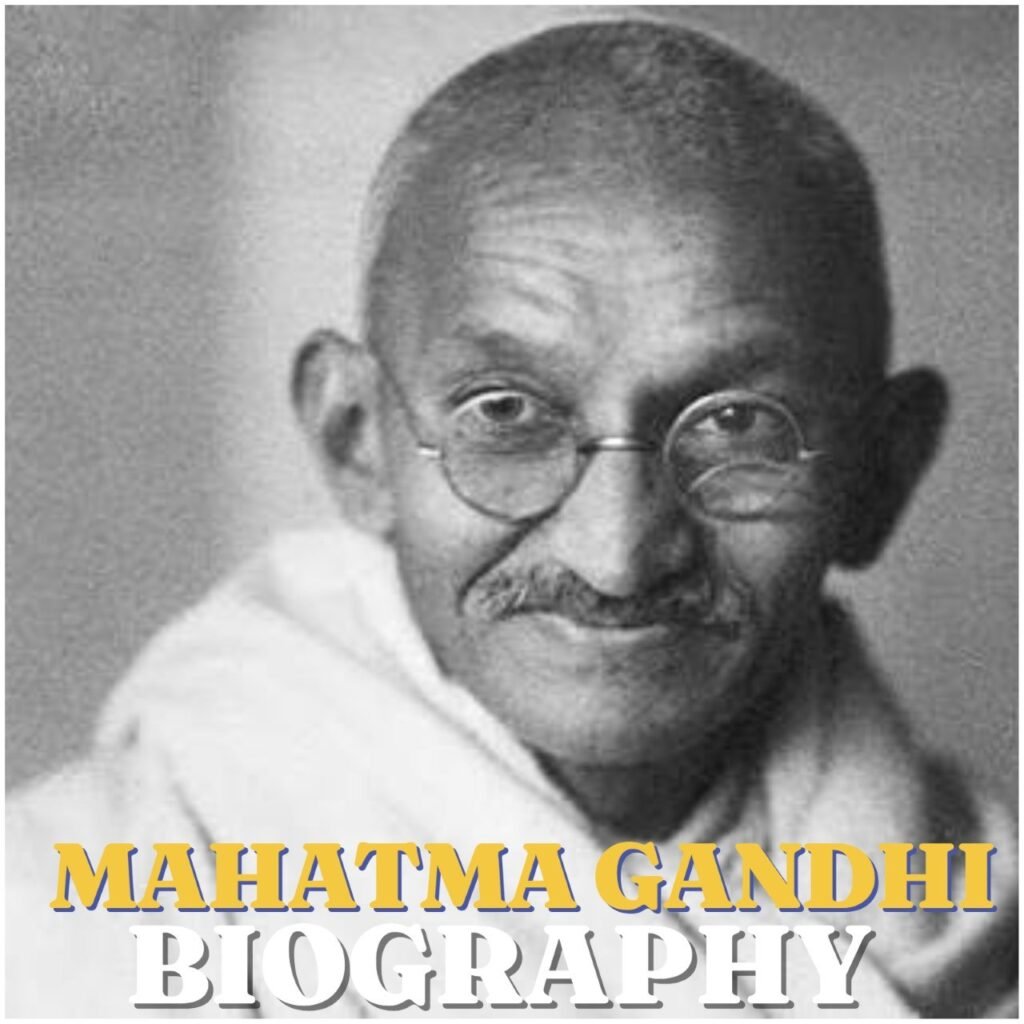

Introduction
Mahatma Gandhi was one of the most influential leaders in modern history. He helped lead India’s struggle for independence from British rule and introduced a powerful approach to protest based on truth and non-violence. His ideas reached far beyond India, inspiring people around the world to challenge injustice without resorting to violence.
Born Mohandas Karamchand Gandhi on October 2, 1869, he began life as a quiet boy in a small coastal town in western India. His journey took him from the classrooms of Gujarat to the law schools of London and the streets of South Africa. There, he experienced racial discrimination firsthand. That experience changed his life and inspired him to fight for equal rights.
After returning to India, Gandhi became a central figure in the independence movement. He organised peaceful protests, encouraged people to reject unfair laws, and called for unity across religious and social groups. His leadership helped turn the fight for freedom into a mass movement. Yet his life was not without controversy. His political decisions, personal beliefs, and views on social issues continue to attract debate. Understanding both his achievements and his shortcomings offers a fuller picture of the man behind the name.
Who Was Mahatma Gandhi?
Mahatma Gandhi was an Indian lawyer, political activist, writer, and independence leader. He is best remembered for promoting non-violent resistance as a way to challenge injustice and colonial rule.
His birth name was Mohandas Karamchand Gandhi. The title Mahatma, meaning “great soul,” became widely associated with him. Many people also called him Bapu, a word meaning “father.”
Gandhi developed a philosophy known as Satyagraha, which centred on truth and peaceful resistance. He believed people could oppose unjust laws without attacking those who enforced them. Instead, they could refuse to cooperate, organise peaceful protests, and accept the consequences of their actions.
His leadership helped bring millions of Indians into the independence movement. However, he was not the only person responsible for India’s freedom. Many other leaders, activists, revolutionaries, workers, farmers, and ordinary citizens contributed to the struggle.
Mahatma Gandhi: Quick Facts
| Detail | Information |
|---|---|
| Full name | Mohandas Karamchand Gandhi |
| Popular name | Mahatma Gandhi |
| Date of birth | October 2, 1869 |
| Birthplace | Porbandar, Gujarat, India |
| Date of death | January 30, 1948 |
| Age at death | 78 years |
| Nationality | Indian |
| Religion | Hinduism |
| Profession | Lawyer, writer, political activist |
| Father | Karamchand Gandhi |
| Mother | Putlibai Gandhi |
| Wife | Kasturba Gandhi |
| Children | Harilal, Manilal, Ramdas, and Devdas |
| Education | University College London; legal training at the Inner Temple |
| Famous philosophy | Satyagraha |
| Best known for | India’s independence movement |
| Cause of death | Assassination |
Mahatma Gandhi’s Early Life and Family Background
Mohandas Karamchand Gandhi was born on October 2, 1869, in Porbandar, a coastal town in present-day Gujarat, India. His father, Karamchand Gandhi, served as a senior official in several princely states. His mother, Putlibai, was a deeply religious woman whose beliefs shaped much of his childhood.
Karamchand was known for his practical judgment and involvement in public affairs. Although he had limited formal education, he earned respect for his experience and ability to handle difficult matters. His position also exposed young Mohandas to the responsibilities of leadership and public service.
Putlibai had an even deeper influence on Gandhi’s personal values. She followed a disciplined religious routine that included prayer, fasting, and acts of devotion. Her example taught him the importance of self-control, honesty, and compassion.
Gandhi grew up in a home where people from different religious backgrounds were not unfamiliar. These early encounters helped develop his interest in religious tolerance. They also influenced his later belief that people of different faiths should be able to live together peacefully.
His Childhood and Early Influences
Gandhi described himself as a shy and fairly ordinary student. He was not known for outstanding academic performance, and he often avoided drawing attention to himself. However, he developed a strong concern for truth and honesty.
Stories about moral courage made a lasting impression on him. One story that particularly influenced him was that of King Harishchandra, who was remembered for refusing to abandon the truth even when faced with hardship. Gandhi later explained that such stories shaped his understanding of personal integrity.
His teenage years were not without mistakes. In his autobiography, The Story of My Experiments with Truth, he openly discussed some of his early struggles and poor decisions. He presented his life as a journey of learning rather than claiming to have always been perfect.
This willingness to examine his own behaviour later became part of his philosophy. Gandhi believed that people who wanted to change society also had to work on themselves.
Mahatma Gandhi’s Education and Early Career
Gandhi received his early education in Rajkot, where his family had settled during his childhood. He attended local schools and later entered high school. In 1887, he passed his matriculation examination and briefly studied at Samaldas College in Bhavnagar.
He found college life challenging and did not remain there for long. His family then considered a career in law as a way to secure his future. This decision led him to England.
Studying Law in London
In September 1888, Gandhi travelled to London to study law. Before leaving India, he made promises to his mother that he would avoid meat, alcohol, and sexual misconduct. Keeping those promises mattered greatly to him as he adjusted to life in a different culture.
He enrolled at University College London and trained at the Inner Temple, one of England’s legal institutions. At first, he struggled to adapt to English society. He worried about his appearance, manners, and ability to fit in.
During this period, he became more interested in vegetarianism and joined the London Vegetarian Society. He also explored religious and philosophical writings that encouraged him to think deeply about morality, faith, and human responsibility.
Gandhi completed his legal training and was called to the Bar in 1891. He returned to India that year and tried to establish a legal practice in Bombay. However, he struggled to attract clients and lacked confidence in court. His early career as a lawyer did not develop as he had expected.
Mahatma Gandhi’s Life in South Africa
In 1893, Gandhi accepted a legal assignment with an Indian business firm and travelled to Natal, South Africa. He expected the stay to be temporary. Instead, the experience transformed his life and set him on the path to political activism.
Soon after arriving, he encountered racial discrimination. One of the best-known incidents occurred at Pietermaritzburg railway station. Despite holding a valid first-class ticket, Gandhi was ordered to leave the compartment because of his race. He was removed from the train, an experience that exposed him to the injustice faced by Indians under the racial system of the time.
The incident strengthened his determination to challenge discrimination. He began studying the laws affecting Indians in South Africa and became increasingly involved in public affairs.
Fighting Discrimination and Organising the Indian Community
In 1894, Gandhi helped establish the Natal Indian Congress. The organisation aimed to represent the interests of Indians and oppose discriminatory laws. It brought people together and gave them a platform to organise politically.
He used petitions, public meetings, legal arguments, and newspaper articles to challenge unfair treatment. In 1904, he helped establish Indian Opinion, a newspaper that discussed discrimination, community issues, and political reform.
His work in South Africa gradually expanded beyond legal representation. He became a community organiser and developed methods of peaceful protest that would later influence the Indian independence movement.
The Birth of Satyagraha
Gandhi’s most important political development in South Africa was Satyagraha. The word is often translated as “holding firmly to truth.” It describes resistance to injustice through courage, discipline, and non-violence.
He developed this approach during campaigns against discriminatory laws, including regulations that required Indians to register and carry certificates. Instead of responding with violence, he encouraged people to refuse to obey unjust rules peacefully.
Participants held demonstrations, accepted arrest, and continued protesting despite punishment. Gandhi believed that such actions could expose injustice and place moral pressure on those in power.
He also helped establish communal settlements, including Phoenix Settlement and Tolstoy Farm. These communities encouraged simple living, shared work, education, and self-reliance.
Gandhi spent more than two decades in South Africa. When he left in 1914, he was no longer simply a lawyer. He had become an experienced political organiser with a clear philosophy of resistance.
Mahatma Gandhi’s Return to India
Gandhi returned to India in January 1915. By then, his work in South Africa had earned him recognition as a campaigner for civil rights and peaceful resistance.
His political mentor, Gopal Krishna Gokhale, advised him to travel around India before becoming deeply involved in national politics. Gandhi followed this advice. He visited different communities, observed local conditions, and met people from various backgrounds.
These journeys helped him understand the problems facing farmers, workers, and rural communities. He realised that the independence movement needed to reach beyond educated political leaders and involve ordinary citizens.
He later established an ashram near Ahmedabad. The community became a centre for simple living, self-discipline, education, and social reform. It eventually moved to the banks of the Sabarmati River and became known as Sabarmati Ashram.
Mahatma Gandhi’s Major Campaigns for Indian Independence
Gandhi gradually became one of the leading figures in the Indian National Congress. His greatest strength was his ability to connect national politics with the everyday struggles of ordinary people.
He believed that independence meant more than replacing British officials with Indian leaders. In his view, true freedom also required social reform, economic self-reliance, religious tolerance, and personal responsibility.
His campaigns attracted farmers, workers, students, merchants, and women. They also brought him into disagreement with leaders who preferred different methods of achieving independence.
Champaran Satyagraha
One of Gandhi’s first major campaigns in India took place in Champaran, Bihar, in 1917. Farmers in the region were forced under the tinkathia system to grow indigo on part of their land for European planters. The arrangement placed a heavy burden on them and limited their freedom to choose what to cultivate.
Gandhi travelled to Champaran to investigate their complaints. When officials ordered him to leave, he refused. His decision attracted public attention and strengthened the farmers’ confidence.
The authorities eventually allowed an inquiry into their grievances. The campaign led to changes in the system and established Gandhi as a national leader willing to challenge colonial authority on behalf of ordinary people.
Ahmedabad Mill Workers’ Strike
In 1918, Gandhi became involved in a dispute between textile mill workers and employers in Ahmedabad. Workers demanded better wages, but the mill owners resisted their requests.
Gandhi encouraged the workers to remain united and use peaceful methods. He also undertook a fast to strengthen the campaign and encourage a settlement.
The dispute eventually moved towards arbitration, and the workers secured a wage increase. The campaign showed that peaceful resistance could also be used to address workplace disputes.
Kheda Satyagraha
That same year, Gandhi supported farmers in Kheda, Gujarat, who were struggling after poor harvests. Despite their losses, the colonial government continued to demand land revenue.
Gandhi encouraged the farmers to withhold payments peacefully until their situation was addressed. Local leaders, including Sardar Vallabhbhai Patel, helped organise the campaign.
The government eventually offered concessions. The protest strengthened Gandhi’s relationship with rural communities and demonstrated the power of organised, non-violent action.
The Non-Cooperation Movement
In 1920, Gandhi launched the Non-Cooperation Movement to challenge British rule. He urged Indians to withdraw their support from colonial institutions and reject practices that helped maintain British authority.
The campaign encouraged people to boycott British goods, government schools, law courts, official titles, and other colonial institutions. Gandhi also promoted khadi, a hand-spun and handwoven cloth, as a symbol of economic independence.
The movement attracted people from different parts of Indian society. Students left government institutions, lawyers abandoned legal practice, and citizens joined protests and public meetings. The independence struggle was becoming a mass movement.
However, the campaign suffered a major setback in February 1922. In Chauri Chaura, protesters attacked a police station and killed several police officers. Gandhi believed the violence went against the movement’s principles, so he called off the campaign.
His decision disappointed some nationalist leaders who wanted to maintain pressure on the British government. Gandhi, however, insisted that non-violence was essential to the struggle.
The Salt March: A Turning Point in the Freedom Struggle
One of the most memorable moments in Gandhi’s political career was the Salt March of 1930. At the time, the British colonial government controlled salt production and imposed a tax on it. Since salt was an everyday necessity, the law affected people across society.
Gandhi chose to challenge the salt laws because he believed the issue would unite Indians from different backgrounds. He wanted an act of civil disobedience that ordinary people could understand and take part in.
On March 12, 1930, Gandhi left Sabarmati Ashram with a group of followers. They walked approximately 240 miles to the coastal village of Dandi in Gujarat. Their journey lasted 24 days and attracted growing public attention.
On April 6, Gandhi reached the coast and broke the salt law by making salt from seawater. His action inspired people across India to organise similar protests, boycott British goods, and refuse to cooperate with colonial authorities.
The British government responded with arrests and restrictions. Gandhi was among those imprisoned, but the campaign continued to attract international attention.
In March 1931, Gandhi and Viceroy Lord Irwin reached an agreement known as the Gandhi-Irwin Pact. Gandhi agreed to suspend the civil disobedience campaign, while the government agreed to release many political prisoners and permit certain forms of peaceful protest.
Gandhi later attended the Second Round Table Conference in London. However, the discussions did not produce the political settlement he had hoped for.
The Quit India Movement
During the Second World War, pressure for Indian independence grew stronger. Many Indian leaders opposed Britain’s decision to involve India in the war without consulting its people.
In August 1942, the Indian National Congress launched the Quit India Movement. Gandhi called on the British to leave India and urged citizens to remain committed to freedom.
His famous message was “Do or Die.” He wanted Indians to maintain their determination even in the face of arrest and repression.
The British government quickly arrested Gandhi and other Congress leaders. Gandhi was detained at the Aga Khan Palace in Pune, where his wife, Kasturba, and several associates were also held.
Kasturba died there on February 22, 1944. Her death was a devastating personal loss for Gandhi. Despite the arrests and restrictions, the Quit India Movement became an important part of the final phase of the independence struggle.
India’s Independence and the Pain of Partition
India gained independence from British rule on August 15, 1947. Gandhi’s campaigns had helped mobilise millions of people and increase pressure on the colonial government. However, independence was the result of a much wider struggle involving many leaders, organisations, and communities.
Freedom came with a painful division. British India was partitioned into two countries, India and Pakistan. The separation triggered widespread violence, forced migration, and the displacement of millions of people.
Gandhi strongly opposed the division and was deeply troubled by the violence between religious communities. While political leaders negotiated the future of the two countries, he travelled through areas affected by unrest and appealed for peace.
He visited Noakhali in Bengal and later worked in Bihar and Delhi to reduce communal tensions. He held prayer meetings, spoke with community leaders, and encouraged people to reject religious hatred.
In January 1948, Gandhi undertook a fast in Delhi to encourage peace and protect the rights of vulnerable communities. His actions attracted both support and criticism, but he remained committed to preventing further bloodshed.
For Gandhi, independence was incomplete if people could not live together in peace. His final months were therefore devoted to the difficult task of promoting unity in a country still recovering from Partition.
Mahatma Gandhi’s Philosophy and Teachings
Gandhi’s influence came not only from his political campaigns but also from the principles behind them. He believed that individuals could challenge injustice through truth, discipline, courage, and peaceful action.
His philosophy drew from Hindu traditions, Jain teachings on non-violence, and other religious and ethical writings. He was also influenced by thinkers such as Leo Tolstoy and John Ruskin.
Satyagraha: The Power of Truth
Satyagraha was the foundation of Gandhi’s approach to political resistance. It involved refusing to cooperate with injustice without using violence against opponents.
Gandhi believed that truth should guide both personal behaviour and public action. People practising Satyagraha were expected to remain disciplined, accept personal sacrifice, and resist hatred even when facing punishment.
This method gave ordinary citizens a way to participate in political struggles without weapons. It also placed moral pressure on authorities by exposing the injustice of their actions.
Ahimsa: Choosing Non-Violence
Ahimsa means non-violence or avoiding harm. Gandhi considered it essential to both personal conduct and political action.
He believed violence often created more suffering and that lasting change required respect for human dignity. This principle influenced his decision to stop the Non-Cooperation Movement after the violence at Chauri Chaura.
Not everyone agreed with his approach. Some nationalists believed armed resistance was necessary to defeat colonial rule. This disagreement remained an important part of India’s wider independence movement.
Swadeshi: Supporting Local Production
Gandhi promoted Swadeshi, which encouraged Indians to support locally made goods instead of depending on imported products.
He especially encouraged the production and use of khadi. The spinning wheel became a symbol of self-reliance and resistance to British economic control.
For Gandhi, wearing locally made cloth was more than a personal choice. He believed local production could create employment, strengthen village economies, and give ordinary people a practical role in the independence struggle.
Simple Living and Self-Discipline
Gandhi believed that a person’s lifestyle should reflect their values. He wore simple clothing, encouraged manual labour, and tried to avoid unnecessary material possessions.
He also practised fasting as a form of spiritual discipline and political protest. He believed self-control helped people remain committed to their principles.
His simple lifestyle became one of the most recognisable parts of his public image. However, some of his personal experiments and strict expectations of family members have also attracted criticism.
Mahatma Gandhi’s Wife and Children
Gandhi married Kasturba Makhanji, widely known as Kasturba Gandhi, in 1883. They were both around 13 years old, reflecting the child-marriage customs that existed in parts of India at the time.
Their marriage lasted more than six decades. Kasturba stood beside Gandhi through major periods of his life, including his years in South Africa and his campaigns in India.
She was more than a supportive wife. Kasturba took part in public protests, supported community activities, and faced imprisonment for her involvement in the independence struggle. She also developed her own role in campaigns involving women and social reform.
Their relationship had its difficulties. Gandhi’s strict beliefs and changing personal practices sometimes created tension within the family. Their marriage was therefore more complex than the simple image of a political leader and a devoted wife.
How Many Children Did Mahatma Gandhi Have?
Gandhi and Kasturba had four surviving sons:
- Harilal Gandhi: Their eldest surviving son. His relationship with his father became strained over time.
- Manilal Gandhi: He continued his father’s public work and became involved in journalism and activism in South Africa.
- Ramdas Gandhi: He remained connected to the family and took part in aspects of the wider freedom movement.
- Devdas Gandhi: He became a journalist and married Lakshmi, the daughter of C. Rajagopalachari.
The couple also experienced the loss of a child who died shortly after birth. Gandhi’s relationship with his sons, especially Harilal, has attracted the attention of biographers because his strict ideals sometimes conflicted with their personal ambitions.
Kasturba died on February 22, 1944, while imprisoned with Gandhi at the Aga Khan Palace in Pune. Her death was one of the greatest personal losses of his life.
Mahatma Gandhi’s Books and Writings
Gandhi used books, newspapers, letters, and public statements to share his ideas. His writing covered politics, religion, education, health, morality, and social reform.
His best-known work is The Story of My Experiments with Truth. In this autobiography, he discusses his childhood, education, personal struggles, religious beliefs, and political development. Rather than simply listing his achievements, he examines his attempts to live according to his principles.
Another important work is Hind Swaraj, published in 1909. In it, Gandhi explored the meaning of self-rule and criticised aspects of modern civilisation that he believed encouraged materialism and dependence.
Other important works and publications associated with him include:
- Satyagraha in South Africa
- Young India
- Harijan
- Indian Opinion
Through these publications, Gandhi reached readers in India and abroad. His writing also provides a valuable record of how his political and social ideas developed.
Mahatma Gandhi’s Controversies and Criticisms
Gandhi is widely remembered for non-violence and India’s independence. However, his life and beliefs have also attracted serious criticism. A balanced account must examine these issues rather than present him as a flawless historical figure.
His Early Views on Race
Gandhi’s years in South Africa remain a subject of historical debate. Although he challenged discrimination against Indians, some of his early writings used language about Africans that reflected racial and colonial prejudices of the period.
Historians have questioned whether his early campaigns focused too narrowly on improving the position of Indians without challenging the wider system of racial discrimination affecting Black Africans.
His views and language changed over time, but scholars continue to debate the extent and meaning of that change. This part of his history complicates the popular image of Gandhi as a campaigner against every form of racial injustice.
His Disagreement with Dr. B. R. Ambedkar
Gandhi’s views on caste and untouchability also created major disagreements. He publicly opposed untouchability and supported efforts to improve the treatment of communities excluded by the caste system.
However, his approach differed sharply from that of Dr. B. R. Ambedkar, a leading Dalit intellectual and political figure. Ambedkar argued that caste itself had to be dismantled and pushed for stronger political safeguards for oppressed communities.
Their disagreement became especially important in 1932, when the British government’s Communal Award proposed separate electorates for the Depressed Classes. Gandhi opposed the proposal and began a fast while imprisoned.
Ambedkar eventually negotiated the Poona Pact with representatives of caste Hindu leaders. The agreement replaced separate electorates with reserved seats within joint electorates.
The pact remains controversial. Some view it as a necessary compromise, while others argue that the pressure surrounding Gandhi’s fast limited Ambedkar’s ability to secure the political representation he wanted.
His Personal Experiments and Views on Women
Gandhi’s beliefs about sexuality, celibacy, and self-control have also attracted criticism. He took a vow of celibacy in 1906, despite remaining married to Kasturba.
In later years, he conducted controversial personal experiments intended to test his commitment to celibacy. Some involved younger women, raising questions about consent, power, and personal boundaries.
Modern scholars have examined these practices critically, particularly because of the unequal relationships involved. These debates form an important part of the continuing discussion about Gandhi’s private life and public ideals.
Examining these issues does not erase his contribution to India’s independence. It provides a more complete understanding of a historical figure whose decisions and beliefs remain open to serious study.
Mahatma Gandhi’s Assassination and Death
Mahatma Gandhi was assassinated on January 30, 1948, in New Delhi, India. He was 78 years old.
At the time, he was staying at Birla House, where he regularly attended public prayer meetings. As he walked towards one of these meetings, Nathuram Vinayak Godse approached him and shot him at close range.
Godse was a Hindu nationalist who opposed Gandhi’s efforts to promote Hindu-Muslim unity and his approach to the tensions surrounding Partition. He was arrested, tried, convicted, and executed in November 1949.
Gandhi’s assassination shocked India and attracted worldwide attention. His funeral drew enormous crowds, reflecting the depth of his influence across the country.
His death came only months after India gained independence. Even in his final days, he had continued to campaign for peace and religious harmony at a time when the country was struggling with violence and division.
Mahatma Gandhi’s Achievements and International Recognition
Gandhi’s influence extended far beyond India’s borders. His campaigns helped transform the independence struggle into a mass movement, while his philosophy became an important model for peaceful resistance.
Some of his most significant achievements include:
- Expanding the independence movement: He encouraged ordinary Indians to participate in the struggle against British rule.
- Developing Satyagraha: His philosophy of peaceful resistance influenced later movements for civil rights and political freedom.
- Promoting non-violence: He made non-violence a central principle of political action.
- Encouraging economic self-reliance: His support for Swadeshi and khadi promoted local production.
- Opposing untouchability: He campaigned against the exclusion and mistreatment of oppressed communities, although his approach differed from that of other anti-caste leaders.
- Promoting religious harmony: He repeatedly called for peaceful coexistence among India’s religious communities.
Gandhi was nominated for the Nobel Peace Prize several times but never received it. His influence on peace and civil rights movements has nevertheless been recognised around the world.
India celebrates his birthday on October 2 as Gandhi Jayanti. The United Nations also marks the date as the International Day of Non-Violence, recognising his contribution to peaceful resistance.
Mahatma Gandhi’s Net Worth and Lifestyle
Gandhi did not pursue wealth in the way modern public figures often do. He devoted much of his life to public service, political organising, and social reform.
His lifestyle reflected his belief in simplicity. He wore basic clothing, lived in communal settlements, and encouraged people to avoid unnecessary material possessions. The spinning wheel and handwoven khadi became lasting symbols of his commitment to self-reliance.
There is no reliable modern net worth figure for Gandhi. He died in 1948, and applying today’s celebrity wealth estimates to his life would be misleading. His historical importance is better measured through his political achievements, writings, and influence than through a financial valuation.
Mahatma Gandhi’s Legacy and Influence Around the World
Gandhi’s influence did not end with India’s independence. His methods of peaceful protest inspired movements that challenged racial segregation, colonial rule, and political injustice across the world.
One of the leaders influenced by Gandhi was Martin Luther King Jr. During the American civil rights movement, King studied Gandhi’s philosophy and adapted aspects of non-violent resistance to challenge racial discrimination in the United States.
Nelson Mandela also recognised Gandhi’s importance. Gandhi’s earlier activism in South Africa became part of the country’s wider history of resistance to racial injustice. Although Mandela’s methods evolved in response to the conditions of apartheid, Gandhi remained an important figure in discussions about peaceful protest.
His ideas continue to influence debates about political resistance, community development, religious tolerance, and ethical leadership. Students, historians, activists, and political thinkers still study his work.
However, Gandhi’s legacy is not free from disagreement. His early views on race, his approach to caste, his attitudes towards women, and his personal experiments have all received serious criticism. His disagreements with leaders such as Ambedkar also remain important to understanding India’s social and political history.
Gandhi’s lasting significance lies in both his achievements and the questions his life raises. He helped transform India’s independence movement and demonstrated how organised non-violent resistance could challenge powerful institutions. His life remains a subject of admiration, debate, and historical reassessment.
Conclusion
Mahatma Gandhi’s journey from a shy boy in Gujarat to one of the world’s most influential political leaders is a remarkable chapter in modern history. Through his work in South Africa and India, he developed a powerful approach to resisting injustice without violence. His campaigns helped bring millions of people into the struggle for independence and contributed to the end of British colonial rule in 1947. Yet Gandhi’s life was not without contradictions. His views on race, caste, gender, and personal discipline continue to attract criticism and debate. Assassinated in 1948, he left behind ideas that still influence movements for freedom, equality, and peaceful change. His story is ultimately one of courage, conviction, and the difficult challenge of turning deeply held beliefs into meaningful action.
Frequently Asked Questions About Mahatma Gandhi
Who was Mahatma Gandhi?
Mahatma Gandhi was an Indian lawyer, writer, political activist, and independence leader. He is best known for promoting non-violent resistance and leading major campaigns against British colonial rule.
What was Mahatma Gandhi’s real name?
His birth name was Mohandas Karamchand Gandhi. He became widely known as Mahatma Gandhi, with Mahatma meaning “great soul.”
When and where was Mahatma Gandhi born?
Gandhi was born on October 2, 1869, in Porbandar, a coastal town in present-day Gujarat, India.
How old was Mahatma Gandhi when he died?
Gandhi was 78 years old when he was assassinated on January 30, 1948, in New Delhi.
Who was Mahatma Gandhi’s wife?
His wife was Kasturba Gandhi, born Kasturba Makhanji. They married in 1883 and remained together for more than six decades.
How many children did Mahatma Gandhi have?
Gandhi and Kasturba had four surviving sons: Harilal, Manilal, Ramdas, and Devdas.
What did Mahatma Gandhi study?
Gandhi studied law in London. He attended University College London and completed his legal training at the Inner Temple before being called to the Bar in 1891.
Why did Mahatma Gandhi go to South Africa?
He travelled to South Africa in 1893 for a legal assignment. His experiences with racial discrimination led him to organise campaigns for the rights of Indians living there.
What is Satyagraha?
Satyagraha is Gandhi’s philosophy of resistance based on truth and non-violence. It encourages people to challenge unjust laws peacefully rather than use violence.
What was Mahatma Gandhi’s role in India’s independence?
Gandhi helped lead major campaigns against British rule, including the Non-Cooperation Movement, the Civil Disobedience Movement, the Salt March, and the Quit India Movement. His leadership helped turn the independence struggle into a mass movement.
What was the Salt March?
The Salt March was a protest led by Gandhi in 1930 against British salt laws. He and his followers walked from Sabarmati Ashram to Dandi, where he broke the law by making salt from seawater.
Why is Mahatma Gandhi called the Father of the Nation?
Gandhi is widely known by this title in India because of his leadership and influence during the independence struggle. It reflects his symbolic importance in the country’s national history.
Who assassinated Mahatma Gandhi?
Nathuram Godse assassinated Gandhi on January 30, 1948, during a prayer meeting at Birla House in New Delhi.
Did Mahatma Gandhi win the Nobel Peace Prize?
No. Gandhi was nominated for the Nobel Peace Prize several times but never received it. His influence on non-violent movements has remained significant worldwide.
What is Gandhi Jayanti?
Gandhi Jayanti is an Indian national holiday celebrated on October 2 to mark Gandhi’s birthday. The United Nations also observes the date as the International Day of Non-Violence.
What is Mahatma Gandhi most famous for?
Gandhi is most famous for his role in India’s independence movement and his philosophy of non-violent resistance. His ideas later influenced civil rights and freedom movements around the world.