
Introduction
John Milton was one of the most influential English poets and intellectuals of the 17th century, best known for his epic poem Paradise Lost. Born on December 9, 1608, in London, England, Milton developed an extraordinary reputation through his poetry, prose, political writings, and religious arguments. His works explored major themes such as freedom, morality, temptation, faith, human responsibility, political authority, and the relationship between humanity and God. Although he lived more than three centuries ago, his writings continue to be widely studied and discussed in schools, universities, and literary circles around the world.
Milton’s literary career developed during one of the most politically and religiously turbulent periods in English history. He lived through the English Civil War, the Commonwealth and Protectorate under Oliver Cromwell, and the Restoration of the monarchy under Charles II. Beyond poetry, Milton was deeply involved in political and intellectual debates, particularly concerning freedom of expression, religion, government, and individual liberty. His famous 1644 prose work Areopagitica became an important historical argument against censorship, while his later writings demonstrated his continued engagement with political and religious questions.
Despite experiencing serious personal difficulties, including the loss of his eyesight, Milton continued producing major literary works. Paradise Lost, first published in 1667, eventually became regarded as one of the greatest epic poems in the English language. His other important works include Paradise Regained, Samson Agonistes, and Lycidas. Milton died on November 8, 1674, at the age of 65, but his influence has continued through generations of writers, scholars, poets, and readers, securing his place as a lasting figure in English literature.
Early Life of John Milton
John Milton was born on December 9, 1608, in Bread Street, London, England, into a prosperous and well-educated family. His father, John Milton Sr., was a successful scrivener, composer, and music enthusiast, while his mother, Sarah Jeffrey, came from a wealthy family. Milton grew up in an intellectually stimulating household where education, literature, music, and religious discussion were valued. His father’s support played an important role in encouraging his academic development and eventual literary career.
From an early age, Milton received a rigorous education. He was initially educated at home by private tutors before attending St Paul’s School in London. His studies included Latin, Greek, Hebrew, classical literature, history, philosophy, and religious texts. Milton showed an exceptional interest in reading and writing, and his early exposure to classical authors and biblical literature strongly influenced the style and themes that later appeared in his poetry. His education also helped him develop the deep knowledge of languages that became one of the defining characteristics of his intellectual life.
In 1625, Milton entered Christ’s College, Cambridge, where he continued his classical and theological education. He earned a Bachelor of Arts degree in 1629 and a Master of Arts degree in 1632. During his years at Cambridge, Milton began writing poetry seriously and developed ambitions of becoming a major literary figure. His early poems, including works such as On the Morning of Christ’s Nativity, revealed the exceptional literary ability that would later make him one of England’s most celebrated poets. After Cambridge, he spent several years studying independently at his family home in Horton, Buckinghamshire, preparing himself for the literary career he had envisioned.
Education of John Milton
John Milton received an extensive education from an early age, beginning with private tutoring at home before attending St Paul’s School in London. His education at St Paul’s was particularly important because it exposed him to classical languages and literature, including Latin and Greek, as well as history, philosophy, theology, and the works of ancient writers. Milton developed a strong passion for reading and intellectual study, spending long hours with books and developing the linguistic skills that would later become central to his poetry and prose.
In 1625, Milton entered Christ’s College, Cambridge, where he continued his formal education. He studied subjects associated with the classical curriculum and gained extensive knowledge of literature, philosophy, theology, rhetoric, and ancient languages. He received his Bachelor of Arts degree in 1629 and later completed his Master of Arts degree in 1632. His years at Cambridge helped strengthen his intellectual interests and gave him the foundation for the sophisticated literary style that would characterize his later works.
After leaving Cambridge, Milton did not immediately enter a conventional profession. Instead, he spent several years pursuing an intensive program of private study at his family’s home in Horton, Buckinghamshire. During this period, he read widely in classical literature, European languages, history, philosophy, theology, and political thought while also developing his skills as a poet. His self-directed education continued to shape his intellectual outlook and prepared him for the major literary and political writings he would produce later in life, including Paradise Lost, Areopagitica, Paradise Regained, and Samson Agonistes.
John Milton’s Career and Professional Life
John Milton began developing his literary career while he was still a young man, writing poetry that demonstrated his deep knowledge of classical literature, Christianity, mythology, and philosophy. After leaving Cambridge, he spent several years studying independently at his family home in Horton, Buckinghamshire, while producing important early poems. Among these were L’Allegro, Il Penseroso, Comus, and Lycidas. These works established Milton as a talented poet and demonstrated his ability to combine classical influences with Christian themes and sophisticated English verse.
Milton’s career later expanded beyond poetry into political and religious writing. During the English Civil War and the years that followed, he became increasingly involved in political debates and wrote pamphlets defending his views on government, religion, and individual liberty. His famous 1644 work Areopagitica argued strongly against pre-publication censorship and became one of his most influential prose works. Milton’s political reputation eventually led to government service under the Commonwealth, where he worked as Secretary for Foreign Tongues and was responsible largely for producing and translating official correspondence and defending the government against critics.
After the Restoration of the monarchy in 1660, Milton’s political position became dangerous because of his association with the Commonwealth government. He went into hiding for a period and was eventually arrested, although he escaped severe punishment. By this stage, Milton had also become completely blind, but he continued his literary work by dictating his writings to assistants, family members, and other helpers. His greatest achievement, Paradise Lost, was published in 1667, followed by Paradise Regained and Samson Agonistes in 1671. Through these works, Milton secured his reputation as one of the most important poets in English literary history.
Why John Milton Is Trending in 2026
John Milton has attracted renewed attention in 2026 because of a number of new developments in Milton scholarship and literary studies. A major reason is the publication of Stephen M. Fallon’s new book, Milton and Newton: Matter, God, and Modernity, which was published online by Oxford University Press on July 17, 2026, and became available in print on August 13. The book examines the intellectual connections between Milton and Isaac Newton, particularly their ideas about matter, religion, theology, and the natural world.
Milton is also receiving attention through new academic publications. A New Companion to Milton, a substantially updated collection of scholarship edited by Thomas N. Corns, has a new August 2026 edition that incorporates recent research on Milton’s writings and historical context. In addition, the Milton Quarterly published a new article on August 3, 2026, examining new evidence concerning Milton’s Florentine connections. These developments show that scholars continue to discover new perspectives on the poet’s life, works, and intellectual world.
Another reason for the current interest is the continuing public study of Paradise Lost. A live online study course focused specifically on Milton’s epic has been running from July 14 through September 1, 2026, with sessions continuing through August 25 and September 1. The course explores the poem’s themes of rebellion, freedom, temptation, fate, obedience, and redemption, demonstrating that Milton’s work remains relevant to modern readers more than three centuries after his death.
John Milton’s Cause of Death and Death
John Milton died on November 8, 1674, in London, England, at the age of 65. Historical sources generally state that he died from complications associated with gout, a painful inflammatory condition that affected him during the later years of his life. The Poetry Foundation records that Milton died on or about November 8, 1674, from complications of gout.
Milton’s final years were marked by significant physical difficulties. He had become completely blind by 1652, but his loss of sight did not prevent him from continuing his literary work. He dictated his major later poems, including Paradise Lost, to assistants and members of his household. His blindness and declining health made his final years challenging, yet he continued producing works that would eventually become central to English literature.
Following his death, Milton was buried in St Giles Cripplegate, London. His death marked the end of the life of one of England’s most important poets, but his literary influence continued to grow. His epic Paradise Lost, particularly its 1674 revised edition published shortly before his death, became one of the most influential works in English literature and helped secure Milton’s enduring place in literary history.
John Milton’s Personal Life and Family
John Milton married three times during his lifetime. His first and most significant marriage was to Mary Powell, whom he married in 1642 when he was in his early thirties. Mary came from a Royalist family, while Milton held strong Puritan and Parliamentarian views, and their marriage experienced serious difficulties soon after the wedding. Mary returned to her parents shortly after the marriage, but the couple eventually reconciled and remained together until her death in 1652. They had four children: Anne, Mary, John, and Deborah. Their son John died as an infant, while Anne, Mary, and Deborah survived their father.
After Mary Powell’s death, Milton married Katherine Woodcock on November 12, 1656. Their marriage was short-lived because Katherine died in 1658, along with their infant daughter, also named Katherine. Milton later married for a third time to Elizabeth Minshull on February 24, 1663. Elizabeth survived Milton and remained his wife until his death in 1674. During his later years, when Milton was completely blind, members of his household and assistants helped him continue his literary work, including the dictation of Paradise Lost.
Milton’s wider family also played an important role in his personal life. His parents were John Milton Sr., a successful scrivener and composer, and Sara Jeffrey Milton, who was known for her charitable activities. Milton had an older sister, Anne, and a younger brother, Christopher Milton, who followed a very different political and religious path from his famous brother, becoming a Royalist, Roman Catholic, and lawyer. Milton also maintained a close relationship with Anne’s children, particularly Edward Phillips, who later wrote about his famous uncle. His family experiences, marriages, bereavements, blindness, and political struggles all formed part of the personal background surrounding some of his most important literary works.
John Milton’s Age, Religion, Nationality, Height and Physical Appearance
Age: John Milton was born on December 9, 1608, in London, England, and died on November 8, 1674. He was therefore 65 years old when he died, although the Poetry Foundation notes that he was almost 66 at the time of his death. Milton lived through some of the most politically and religiously turbulent periods in English history, including the English Civil War, the Commonwealth, the Protectorate, and the Restoration.
Religion: Milton was raised and baptized in the Protestant Church of England and became strongly associated with Puritan and nonconformist religious thought. His religious views became increasingly independent and unconventional as he grew older. His writings demonstrate a deep engagement with Christianity, the Bible, free conscience, and theological questions, although scholars have noted that some of his later theological beliefs differed significantly from orthodox Christian doctrine.
Nationality: John Milton was English by nationality and was born in London during the early Stuart period. He spent most of his life in England, although he also traveled through France and Italy during his European journey of 1638–1639. His English identity was closely connected to his political and literary work, and he became one of the most important figures in the history of English literature.
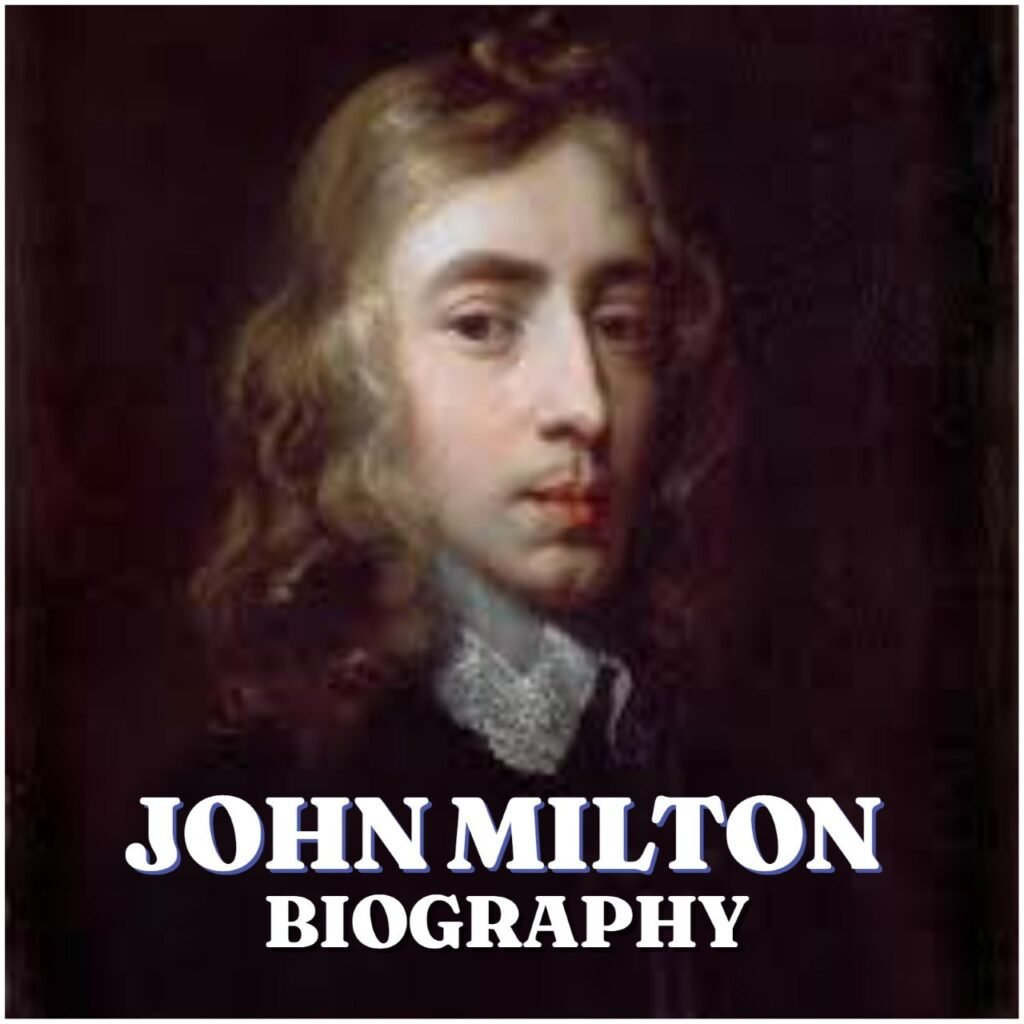
Height and Physical Appearance: There is no reliable historical record giving John Milton’s exact height, so a precise measurement should not be presented as fact. However, contemporary descriptions and surviving portraits provide some information about his appearance. As a young man, Milton was described and portrayed as handsome, with fair complexion, reddish or auburn hair, delicate facial features, and long hair. The Poetry Foundation notes that his youthful appearance was distinctive enough that he was known at Cambridge by the nickname “The Lady of Christ’s.” Later in life, Milton became completely blind, a major physical condition that affected his daily life but did not stop him from producing his most important literary works through dictation.
John Milton Net Worth
There is no reliable modern net-worth figure for John Milton, because he lived in the 17th century and the concept of celebrity net worth did not exist in the way it does today. However, historical records provide some indication of the value of his estate. One historical account states that Milton died with approximately £900 in money, excluding household goods, while another early account gives a figure of about £1,500 in cash, also excluding household possessions. These differences show why it is difficult to assign one precise figure to Milton’s wealth.
Milton had earned income through his work as a writer and government official. During the Commonwealth period, he served as Secretary for Foreign Tongues, which provided him with an official income, and he also inherited property from his father. Historical biographies indicate that he was relatively well-off before the Restoration, with investments and property that may have produced several hundred pounds a year. However, political upheaval, financial losses, the end of his government position, and other expenses substantially reduced his wealth later in life.
For a modern biography, it is more accurate to describe Milton as having left a modest but significant estate rather than assigning him an invented millionaire-style net worth. A reasonable historical estimate would place his remaining personal estate at approximately £900–£1,500 in 1674 money, excluding household goods and certain claims or property interests. His greatest financial and cultural asset ultimately became his literary legacy: Paradise Lost earned Milton only a small amount during his lifetime, with historical records indicating that he initially received just £10 under his publishing agreement.
John Milton’s Legacy
John Milton’s greatest legacy is his lasting influence on English literature, particularly through Paradise Lost. The epic poem established Milton as one of the most important poets in the English language and demonstrated the possibilities of using blank verse for a long, sophisticated narrative. Its exploration of free will, temptation, obedience, rebellion, sin, justice, and redemption has continued to generate debate among readers and scholars for centuries. Milton’s ability to combine biblical themes with classical literature, philosophy, and his own political and religious ideas made Paradise Lost a landmark of Western literature.
Beyond poetry, Milton left an important legacy as a writer on political and intellectual freedom. His 1644 pamphlet Areopagitica became one of the most influential arguments against pre-publication censorship and is frequently discussed in the history of freedom of expression and the press. His political writings also reflected his strong convictions about liberty, government, religion, and individual conscience. Although some of his political views were controversial, his willingness to defend principles that he considered important established him as a major intellectual figure of 17th-century England.
Milton’s influence has continued long after his death in 1674. His poems and prose remain widely studied in universities and schools, while Paradise Lost continues to inspire writers, artists, scholars, musicians, and filmmakers. His portrayal of Satan, Adam, Eve, and the themes of human freedom and responsibility has generated countless interpretations and adaptations. Milton’s combination of literary ambition, intellectual independence, political engagement, and perseverance despite blindness has secured his place as one of the enduring figures of English literature.
Conclusion
John Milton remains one of the most remarkable figures in English literary history, remembered for his extraordinary poetry, political writings, intellectual independence, and enduring influence. From his early education and literary ambitions to his government service, personal challenges, blindness, and later achievements, his life reflected the turbulent political and religious world of 17th-century England. His masterpiece, Paradise Lost, continues to be regarded as one of the greatest epic poems ever written in English, while works such as Areopagitica, Paradise Regained, Samson Agonistes, and Lycidas have strengthened his reputation as a major literary and intellectual figure. Although Milton died in 1674 at the age of 65, his ideas and writings continue to attract readers and scholars worldwide, ensuring that his legacy remains influential centuries after his death.
Frequently Asked Questions About John Milton
Who was John Milton?
John Milton was an English poet, writer, and political thinker best known for his epic poem Paradise Lost. He was born on December 9, 1608, in London and became one of the most influential literary figures of 17th-century England.
What is John Milton famous for?
John Milton is most famous for writing Paradise Lost, an epic poem about the biblical story of the Fall of Man. He is also known for works such as Paradise Regained, Samson Agonistes, Lycidas, and Areopagitica.
When was John Milton born?
John Milton was born on December 9, 1608, in Bread Street, London, England.
When did John Milton die?
John Milton died on November 8, 1674, in London, England, at the age of 65.
What was the cause of John Milton’s death?
Historical sources generally associate Milton’s death with complications from gout. He experienced declining health during his final years before dying in London in 1674.
How old was John Milton when he died?
John Milton was 65 years old when he died on November 8, 1674.
Was John Milton married?
Yes. John Milton was married three times. His wives were Mary Powell, Katherine Woodcock, and Elizabeth Minshull. His first marriage produced four children.
Who was John Milton’s first wife?
John Milton’s first wife was Mary Powell, whom he married in 1642. They eventually had four children together: Anne, Mary, John, and Deborah.
Did John Milton have children?
Yes. Milton had four children with Mary Powell: Anne, Mary, John, and Deborah. His son John died as an infant. Milton also had a daughter with his second wife, Katherine Woodcock, but the child died in infancy.
What religion was John Milton?
Milton was raised in the Protestant tradition and became strongly associated with Puritan and nonconformist religious thought. His religious views developed considerably throughout his life and were reflected in many of his writings.
Was John Milton blind?
Yes. John Milton became completely blind by 1652. Despite losing his eyesight, he continued writing by dictating his works to assistants, family members, and other helpers.
What was John Milton’s nationality?
John Milton was English. He was born in London, England, and spent most of his life in England, although he traveled through parts of continental Europe.
What was John Milton’s net worth?
There is no reliable modern net-worth figure for John Milton. Historical accounts suggest that he left an estate worth approximately £900 to £1,500 in 1674 money, although estimates vary depending on what assets are included.
What is John Milton’s most famous book?
John Milton’s most famous work is Paradise Lost, first published in 1667. It is widely regarded as one of the greatest epic poems in the English language.
What is John Milton’s legacy?
John Milton’s legacy rests on his enormous contribution to English literature, especially through Paradise Lost. He is also remembered for his writings on political liberty, religion, censorship, and freedom of expression. His works continue to be studied and discussed centuries after his death.