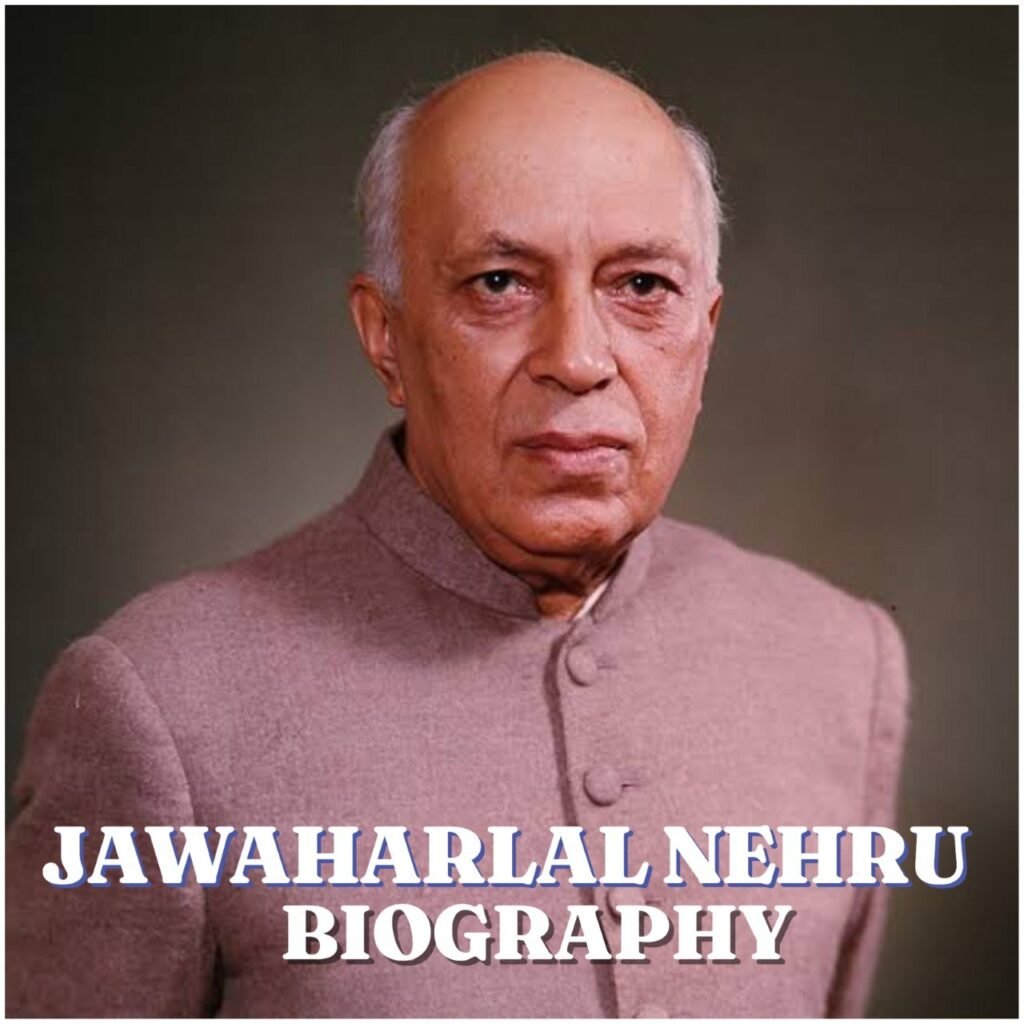

Introduction
Jawaharlal Nehru was one of the most influential political leaders in Indian history and the first Prime Minister of independent India. Born on 14 November 1889 in Allahabad (now Prayagraj), he played a leading role in India’s struggle for freedom from British colonial rule and became one of the principal architects of the modern Indian nation. Serving as Prime Minister from 15 August 1947 until his death on 27 May 1964, Nehru helped establish India’s democratic institutions, promoted secularism, and laid the foundation for the country’s long-term economic and scientific development. His leadership during the formative years of independence continues to make him one of the most studied and debated figures in Indian politics.
Before becoming India’s first Prime Minister, Nehru emerged as a prominent leader of the Indian National Congress and worked closely with Mahatma Gandhi during the independence movement. He participated in major campaigns against British rule, endured several years of imprisonment, and became a powerful voice for national unity and self-governance. His vision extended beyond political freedom, as he believed that a newly independent India should invest in education, industrialization, scientific research, and social equality. His writings, including The Discovery of India and An Autobiography, remain important works that provide insight into India’s history, culture, and the ideals that shaped its independence movement.
More than six decades after his passing, Jawaharlal Nehru’s legacy remains deeply embedded in India’s political, educational, and cultural landscape. He is remembered for establishing key national institutions, strengthening parliamentary democracy, and advocating an independent foreign policy through the Non-Aligned Movement during the Cold War. While historians and political analysts continue to debate some of his policies and decisions, there is broad recognition of his enduring influence on modern India. His birthday, celebrated annually as Children’s Day in India, reflects his lasting affection for young people and his belief that the nation’s future depended on educating and empowering the next generation.
Early Life
Jawaharlal Nehru was born on 14 November 1889 in Allahabad, in the North-Western Provinces of British India (now Prayagraj, Uttar Pradesh, India). He was born into a prosperous Kashmiri Pandit family known for its strong emphasis on education, public service, and intellectual pursuits. His father, Motilal Nehru, was one of India’s most successful lawyers and later became a prominent leader of the Indian National Congress, while his mother, Swarup Rani Thussu, came from a respected Kashmiri family. Growing up in the family’s luxurious residence, Anand Bhavan, Nehru enjoyed a privileged childhood, but he was also exposed to discussions about politics, law, and India’s growing demand for self-rule.
Unlike many children of his time, Nehru received much of his early education at home under the guidance of private tutors. He developed a deep interest in literature, history, science, and nature from an early age, encouraged by his family’s extensive library and educational environment. His parents believed in providing him with a world-class education, and at the age of fifteen he was sent to England to study at the prestigious Harrow School. After completing his studies there, he attended Trinity College, Cambridge, where he studied natural sciences, before enrolling at the Inner Temple in London to train as a barrister. These years abroad broadened his understanding of global politics, philosophy, and liberal democratic ideals.
Nehru returned to India in 1912 after qualifying as a lawyer and briefly practiced law alongside his father in Allahabad. Although he possessed the qualifications to build a successful legal career, he found himself increasingly drawn to the political and social challenges facing India under British colonial rule. His travels across the country exposed him to widespread poverty, inequality, and the hardships experienced by ordinary Indians, inspiring him to dedicate his life to public service. These formative experiences, combined with the influence of his family and his education in England, laid the foundation for his future role as one of the foremost leaders of India’s independence movement and the nation’s first Prime Minister.
Education
Jawaharlal Nehru received an exceptional education that reflected his family’s wealth, status, and commitment to academic excellence. During his early years in Allahabad, he was educated primarily at home by private tutors rather than attending a conventional school. His tutors introduced him to a wide range of subjects, including English literature, history, mathematics, science, and classical studies. Nehru also developed a keen interest in nature and scientific inquiry, interests that would later influence his belief in scientific progress as a cornerstone of India’s development. His early education provided him with a strong intellectual foundation and prepared him for higher studies abroad.
In 1905, at the age of fifteen, Nehru traveled to England to enroll at Harrow School, one of Britain’s most prestigious boarding schools. There, he received a rigorous education that emphasized academic discipline, leadership, and critical thinking. After completing his studies at Harrow, he entered Trinity College, Cambridge, in 1907, where he studied natural sciences. Although science was his primary field of study, Nehru also immersed himself in history, economics, politics, and philosophy. His years at Cambridge exposed him to liberal political thought and international affairs, helping to shape his worldview and his future vision for an independent India.
After graduating from Cambridge, Nehru continued his legal education at the Inner Temple in London, one of the four Inns of Court responsible for training barristers in England and Wales. He was called to the Bar in 1912, officially qualifying as a lawyer before returning to India that same year. While he briefly practiced law alongside his father, Motilal Nehru, his growing interest in India’s freedom struggle soon overshadowed his legal career. The combination of his elite British education, legal training, and broad exposure to global political ideas equipped Nehru with the knowledge and confidence that later defined his leadership as one of the principal figures in India’s independence movement and its first Prime Minister.
Career
Jawaharlal Nehru’s political career began shortly after he returned to India in 1912 following his legal studies in England. Although he briefly practiced law alongside his father, Motilal Nehru, in Allahabad, he soon realized that his true calling lay in public service and the fight for India’s independence. He joined the Indian National Congress and became increasingly active in nationalist politics. Influenced by Mahatma Gandhi’s philosophy of nonviolent resistance, Nehru participated in several campaigns against British colonial rule, including the Non-Cooperation Movement, Civil Disobedience Movement, and the Quit India Movement. His dedication to the cause led to multiple arrests, and he spent more than nine years in British prisons, where he wrote several influential books, including The Discovery of India, Glimpses of World History, and An Autobiography.
During the 1920s and 1930s, Nehru emerged as one of the most prominent leaders of the Indian National Congress. He was elected President of the Congress on several occasions, including the historic Lahore Session of 1929, where the party formally declared Purna Swaraj (Complete Independence) as its objective. Nehru advocated for democratic governance, social justice, economic modernization, and national unity, earning widespread support among India’s youth and freedom fighters. Throughout the independence movement, he worked closely with Mahatma Gandhi, Sardar Vallabhbhai Patel, Maulana Abul Kalam Azad, and other senior leaders while representing India’s aspirations on the international stage. His leadership and vision positioned him as the natural choice to lead the nation after independence.
On 15 August 1947, Jawaharlal Nehru became the first Prime Minister of independent India, a position he held until his death on 27 May 1964, making him the country’s longest-serving Prime Minister at the time. His government focused on nation-building by strengthening parliamentary democracy, drafting and implementing economic plans, promoting industrialization, and expanding higher education and scientific research. Under his leadership, India established major institutions such as the Indian Institutes of Technology (IITs), the All India Institute of Medical Sciences (AIIMS), and several public sector enterprises. He also championed large infrastructure projects, including dams and steel plants, which he described as the “temples of modern India.”
Nehru played a defining role in shaping India’s foreign policy during the Cold War. He was one of the principal architects of the Non-Aligned Movement (NAM), advocating that newly independent nations should remain independent of both the Western and Soviet power blocs. Alongside leaders such as Josip Broz Tito, Gamal Abdel Nasser, Kwame Nkrumah, and Sukarno, Nehru promoted peaceful coexistence, anti-colonialism, and international cooperation. His foreign policy emphasized diplomacy, respect for national sovereignty, and peaceful resolution of conflicts, helping India establish a respected position in global affairs.
Despite his many achievements, Nehru’s tenure also faced significant challenges. India experienced food shortages, economic constraints, regional disputes, and the 1962 Sino-Indian War with China, which exposed weaknesses in the country’s defense preparedness and affected his political standing. Nevertheless, he continued to guide the nation through its early years with a focus on democratic values, constitutional governance, secularism, and inclusive development. By the time of his death in 1964, Nehru had laid many of the institutional, political, and economic foundations that continued to influence India’s growth and governance for decades, securing his place as one of the most consequential leaders in the country’s history.
Death and Cause of Death
Jawaharlal Nehru died on 27 May 1964 in New Delhi, India, at the age of 74. In the months leading up to his death, his health had begun to decline due to the immense physical and emotional strain of leading India through numerous domestic and international challenges. He had suffered a mild stroke in early 1964, which raised concerns about his well-being, although he continued to carry out many of his official duties. On the morning of 27 May, Nehru suddenly became seriously ill at his residence, Teen Murti House, and despite receiving medical attention, he passed away later that afternoon.
The official cause of Jawaharlal Nehru’s death was a heart attack (myocardial infarction), following complications associated with a stroke and long-standing cardiovascular problems. His passing marked the end of nearly seventeen years of continuous leadership as India’s first Prime Minister. The news of his death shocked the nation and the international community, prompting an outpouring of grief from political leaders, diplomats, and millions of ordinary citizens who regarded him as a symbol of independent India.
Nehru was accorded a state funeral in New Delhi, attended by world leaders, foreign dignitaries, and an estimated millions of mourners who lined the streets to pay their final respects. In accordance with his wishes, most of his ashes were immersed in the sacred Ganges River, while a portion was scattered over India’s fields from an aircraft, symbolizing his lifelong connection with the people and the land of India. His death created a significant political transition, and he was succeeded as Prime Minister by Gulzarilal Nanda in an acting capacity before Lal Bahadur Shastri was later chosen as India’s next Prime Minister. More than six decades later, Nehru’s contributions to democracy, nation-building, education, science, and foreign policy continue to shape modern India, ensuring that his legacy remains an integral part of the country’s history.
Personal Life and Family
Jawaharlal Nehru was born into one of the most distinguished and influential families in British India. His father, Motilal Nehru, was a celebrated lawyer, wealthy businessman, and senior leader of the Indian National Congress who played a significant role in India’s independence movement. His mother, Swarup Rani Thussu, was known for her gentle nature and strong support of the family’s nationalist ideals. Nehru also had two younger sisters, Vijaya Lakshmi Pandit, who later became a renowned diplomat and the first woman to serve as President of the United Nations General Assembly, and Krishna Hutheesing, a respected author and writer. The Nehru family’s commitment to public service and politics greatly influenced Jawaharlal’s worldview and future career.
In 1916, Jawaharlal Nehru married Kamala Kaul, who became popularly known as Kamala Nehru after their marriage. Kamala was an active participant in India’s freedom struggle and frequently supported nationalist campaigns despite suffering from poor health for much of her adult life. The couple welcomed their only child, Indira Priyadarshini Nehru, on 19 November 1917. Indira would later become Indira Gandhi, one of India’s most influential Prime Ministers and the country’s first woman to hold the office. Kamala Nehru died on 28 February 1936 in Lausanne, Switzerland, after a prolonged battle with tuberculosis, a loss that deeply affected Nehru both personally and emotionally.
Following his wife’s death, Jawaharlal Nehru never remarried and devoted much of his life to public service and raising his daughter. He shared a close bond with Indira Gandhi, who often accompanied him on political engagements and gradually became one of his closest confidantes. Through Indira, Nehru became the grandfather of Rajiv Gandhi and Sanjay Gandhi, both of whom later played prominent roles in Indian politics. Throughout his life, Nehru was affectionately known as “Chacha Nehru” (Uncle Nehru) because of his love for children and his belief that they represented India’s future. His birthday, 14 November, is celebrated across India as Children’s Day, reflecting his enduring connection with young people and his lasting influence on generations of Indians. There is no verified historical evidence that Jawaharlal Nehru was engaged to anyone other than his wife, Kamala Nehru.
Age, Religion, Tribe, Height and Physical Appearance
Jawaharlal Nehru was born on 14 November 1889 in Allahabad (now Prayagraj), Uttar Pradesh, India, and was 74 years old when he passed away on 27 May 1964. He was an Indian by nationality and belonged to the Kashmiri Pandit community, an ethnocultural group of Hindu Brahmins with ancestral roots in the Kashmir Valley. Nehru took pride in his heritage while advocating a secular and inclusive vision for India, believing that people of all religions and communities should enjoy equal rights under the Constitution.
Nehru practiced Hinduism, but he was widely respected for promoting secularism throughout his political career. As India’s first Prime Minister, he emphasized that the government should treat all religions equally and safeguard the religious freedom of every citizen. His commitment to religious harmony became one of the defining principles of his administration and continues to influence India’s constitutional values. Although his personal beliefs were rooted in Hindu traditions, he consistently championed unity in a nation characterized by diverse faiths and cultures.
In terms of physical appearance, Jawaharlal Nehru stood at approximately 5 feet 7 inches (170 cm) and had a slim, graceful build. He possessed a fair complexion, dark brown eyes, and black hair that gradually turned grey as he grew older. Nehru was known for his refined and elegant style of dressing, most often appearing in a traditional Achkan or Sherwani, paired with a white Gandhi cap. His trademark red rose pinned to the lapel of his coat became an iconic part of his public image, symbolizing his appreciation for beauty, simplicity, and nature, and remains one of the most enduring visual symbols associated with his legacy.
Net Worth
Jawaharlal Nehru’s exact personal net worth has never been publicly documented, and there are no reliable historical records that assign a verified financial value to his wealth. Although he was born into the affluent Nehru family, his fortune was largely tied to family assets rather than personal business ventures. His father, Motilal Nehru, was one of the wealthiest lawyers in British India and owned substantial properties, including the famous Anand Bhavan residence in Allahabad. After entering public life, Nehru devoted himself to politics and national service rather than accumulating personal wealth.
As India’s first Prime Minister from 1947 to 1964, Nehru earned a government salary and enjoyed official state benefits associated with his office. Unlike many modern political figures, he did not build wealth through private businesses, commercial investments, or corporate partnerships. His focus remained on governance, institution-building, education, industrial development, and the country’s economic progress. Historians generally describe him as living a relatively modest lifestyle despite coming from an influential and privileged family background.
Because no official figure exists, any estimate of Jawaharlal Nehru’s personal wealth is necessarily speculative. Based on his inheritance, family standing, government salary, and lifestyle during his lifetime, historians and financial observers would likely place the value of his personal estate at the equivalent of approximately US$2 million to US$5 million in today’s money, though this is only a reasoned estimate and not a verified historical fact. Nehru’s enduring legacy is measured far more by his contributions to India’s independence, democracy, scientific advancement, and nation-building than by his personal wealth.
Legacy
Jawaharlal Nehru’s legacy is deeply intertwined with the birth and development of modern India. As the country’s first Prime Minister, he played a pivotal role in guiding India through the difficult transition from British colonial rule to an independent democratic republic. Nehru championed parliamentary democracy, secularism, the rule of law, and constitutional governance, establishing institutions that continue to shape India’s political system. His commitment to democratic values ensured that India emerged as one of the world’s largest and most enduring democracies, laying a stable foundation for future generations.
Beyond politics, Nehru is remembered for his vision of a self-reliant and scientifically advanced nation. He promoted industrialization through Five-Year Plans, encouraged the growth of public sector enterprises, and invested heavily in higher education, scientific research, and technological innovation. During his tenure, institutions such as the Indian Institutes of Technology (IITs), the All India Institute of Medical Sciences (AIIMS), and several major research organizations were established or expanded. He also supported the construction of large dams, steel plants, and infrastructure projects, famously describing them as the “temples of modern India.” His emphasis on education and scientific thinking continues to influence India’s economic and technological development.
Internationally, Jawaharlal Nehru is recognized as one of the founding architects of the Non-Aligned Movement (NAM), advocating peaceful coexistence, anti-colonialism, and cooperation among newly independent nations during the Cold War. While some of his economic policies and decisions—particularly regarding the 1962 Sino-Indian War—remain subjects of debate, historians broadly acknowledge his lasting impact on India’s nation-building process. His birthday, 14 November, is celebrated annually as Children’s Day in India, reflecting his affection for children and his belief that investing in young people was essential to the country’s future. More than six decades after his death, Nehru remains one of the most influential and widely studied figures in Indian history, with his ideas and leadership continuing to shape discussions on democracy, development, and India’s role in the world.
Conclusion
Jawaharlal Nehru remains one of the most influential figures in India’s history, remembered for his leadership during the country’s transition to independence and his vision for building a democratic, secular, and modern nation. As India’s first Prime Minister, he laid the foundations for many of the country’s political institutions, educational systems, scientific advancements, and economic policies that continue to shape its development today. Although some of his decisions remain the subject of historical debate, his contributions to the freedom movement, nation-building, and international diplomacy have secured his place as one of the architects of modern India. More than six decades after his passing, Nehru’s life, ideals, and legacy continue to inspire scholars, political leaders, and citizens around the world.
Frequently Asked Questions (FAQs)
Who was Jawaharlal Nehru?
Jawaharlal Nehru was an Indian freedom fighter, statesman, and the first Prime Minister of independent India. He served from 15 August 1947 until his death on 27 May 1964 and played a key role in shaping modern India’s democracy, economy, education, and foreign policy.
When and where was Jawaharlal Nehru born?
Jawaharlal Nehru was born on 14 November 1889 in Allahabad, North-Western Provinces, British India (now Prayagraj, Uttar Pradesh, India).
How old was Jawaharlal Nehru when he died?
Jawaharlal Nehru was 74 years old when he died on 27 May 1964 in New Delhi, India.
What was the cause of Jawaharlal Nehru’s death?
Jawaharlal Nehru died of a heart attack (myocardial infarction) following complications related to a stroke and long-standing cardiovascular problems.
Who was Jawaharlal Nehru’s wife?
Jawaharlal Nehru was married to Kamala Nehru. They married in 1916, and she was an active participant in India’s independence movement until her death in 1936.
Did Jawaharlal Nehru have children?
Yes. Jawaharlal Nehru had one daughter, Indira Gandhi, who later became India’s first female Prime Minister.
What was Jawaharlal Nehru’s religion?
Jawaharlal Nehru practiced Hinduism and belonged to the Kashmiri Pandit community. He was also a strong advocate of secularism and religious equality.
What was Jawaharlal Nehru’s height?
Jawaharlal Nehru was approximately 5 feet 7 inches (170 cm) tall.
What books did Jawaharlal Nehru write?
Jawaharlal Nehru wrote several influential books, including The Discovery of India, An Autobiography, and Glimpses of World History, many of which were written during his imprisonment under British rule.
Why is Jawaharlal Nehru called “Chacha Nehru”?
Jawaharlal Nehru was affectionately called “Chacha Nehru” (Uncle Nehru) because of his love for children and his belief that they represented India’s future. His birthday, 14 November, is celebrated as Children’s Day in India.
What was Jawaharlal Nehru’s estimated net worth?
There is no officially verified record of Jawaharlal Nehru’s personal net worth. Based on his family background, inheritance, and government service, historians estimate that his personal wealth would have been equivalent to approximately US$2 million to US$5 million in today’s value, although this is only an informed estimate and not an official figure.
What is Jawaharlal Nehru’s legacy?
Jawaharlal Nehru is remembered as the architect of modern India. His legacy includes strengthening democracy, promoting secularism, establishing major educational and scientific institutions, encouraging industrial development, and helping found the Non-Aligned Movement.