
1. Introduction: Who Was James Joyce?
James Joyce was one of the most influential writers in modern literary history, widely recognised for his experimental writing style, imaginative storytelling, and extraordinary contribution to modernist literature. Born on 2 February 1882 in Dublin, Ireland, Joyce became famous for challenging traditional literary conventions and exploring the complexities of human consciousness, identity, religion, memory, and everyday life. He was a novelist, poet, short-story writer, and literary critic whose works transformed how writers presented characters, thoughts, and experiences. Despite spending much of his adult life outside Ireland, Joyce remained deeply connected to Dublin, which became the central setting for many of his most celebrated works.
Joyce achieved international recognition through literary masterpieces such as “Dubliners (1914), A Portrait of the Artist as a Young Man(1916), Ulysses (1922), and Finnegans Wake (1939)”. His distinctive use of stream of consciousness, symbolism, wordplay, and experimental narrative structures established him as a central figure in twentieth-century literature. While some of his works attracted controversy because of their unconventional language and treatment of sexuality, religion, and social conventions, they also earned admiration for their intellectual depth and artistic originality. His writing often transformed ordinary moments into complex explorations of the human mind, making seemingly familiar experiences rich with psychological and cultural meaning.
Although Joyce experienced financial difficulties, censorship challenges, serious eye problems, and periods of personal uncertainty, his determination to pursue literature helped him establish a lasting international reputation. He died in Zurich, Switzerland, on 13 January 1941, aged 58, but his influence continues through universities, literary organisations, translations, academic research, and annual celebrations such as Bloomsday. His work remains widely studied because of its innovative approach to language and its detailed portrayal of Irish life. More than eight decades after his death, James Joyce continues to attract readers and scholars who seek to understand his literary achievements and the lasting significance of his contribution to world literature.
2. Early Life of James Joyce
James Augustine Aloysius Joyce was born on 2 February 1882 in Rathgar, a suburb of Dublin, Ireland. He was the eldest surviving child of John Stanislaus Joyce and Mary Jane Joyce, commonly known as May Joyce. His father came from a family with financial resources and worked in several positions, including employment connected with local government, while his mother was known for her religious upbringing and commitment to family life. Joyce grew up in a large household with several siblings, and his early years were shaped by a mixture of family affection, religious instruction, educational opportunities, and growing financial uncertainty. His childhood provided much of the personal and social material that later appeared in his literary works.
The Joyce family initially enjoyed a relatively comfortable standard of living, but its circumstances deteriorated as John Joyce experienced financial difficulties and struggled to maintain the family’s position. The family’s movement between homes and the decline in its economic security exposed young James to the pressures associated with poverty, social status, and family instability. These experiences later informed his portrayal of middle-class Irish life, particularly in “Dubliners”, where characters frequently confront disappointment, restricted opportunities, and the consequences of personal decisions. His upbringing also placed him within the cultural environment of late nineteenth-century Ireland, where religion, nationalism, family expectations, and questions of identity played important roles in everyday life.
Religion and education were significant influences during Joyce’s childhood. He attended Catholic schools, including Clongowes Wood College, and became familiar with religious teachings and practices from an early age. Although he developed a complicated relationship with Catholicism as he grew older, its language, rituals, moral questions, and institutions remained important subjects throughout his writing. Joyce also demonstrated an early interest in literature and intellectual debate, gradually developing an independent perspective on Irish society and artistic expression. His exposure to the works of European writers, particularly Henrik Ibsen, strengthened his desire to become a writer. These formative experiences helped shape the literary ambition that eventually led him to leave Ireland and pursue an international career.
3. Education of James Joyce
James Joyce received his early education at Clongowes Wood College, a Jesuit boarding school in County Kildare, where he developed a strong academic foundation. His time at the school exposed him to classical subjects, religious instruction, literature, and the disciplined environment of Catholic education. Financial difficulties later affected his schooling, and he subsequently attended other institutions, including O’Connell School and Belvedere College in Dublin. At Belvedere, Joyce continued to develop his intellectual interests and literary ambitions. His education was not simply a process of acquiring academic knowledge; it also introduced him to the religious authorities, social expectations, and cultural traditions that he would later examine critically in his writing.
In 1898, Joyce entered University College Dublin, where he studied modern languages, including English, French, and Italian. His university education broadened his understanding of European literature and introduced him to writers and intellectual traditions beyond Ireland. He became particularly interested in the Norwegian playwright Henrik Ibsen, whose dramatic treatment of individual freedom, social pressure, and moral independence influenced Joyce’s developing artistic outlook. Joyce even studied Norwegian to engage more closely with Ibsen’s work. During his university years, he began writing literary criticism and developing ideas about the relationship between artistic independence and society. These interests helped him move towards a conception of literature that prioritised creative freedom over conventional expectations.
After completing his university studies in 1902, Joyce travelled to Paris, initially intending to pursue medical studies. However, financial pressures, practical difficulties, and his growing commitment to literature prevented him from establishing a medical career. He spent much of his time reading, writing, and pursuing intellectual interests rather than completing the course of study he had originally planned. In 1903, he returned to Dublin after his mother became seriously ill and subsequently died. The experience affected him deeply and further complicated his relationship with religion and family expectations. Although Joyce did not pursue a conventional academic career, his formal education and independent study gave him a broad literary foundation that supported the experimentation for which he later became famous.
4. Career and Literary Achievements of James Joyce
James Joyce’s literary career developed through years of persistence, experimentation, and financial uncertainty. In 1904, he left Ireland with Nora Barnacle, the woman who became his lifelong partner, and began living abroad. Their life together took them to several European cities, particularly Trieste, Rome, Paris, and Zurich. Joyce worked as an English-language teacher to support himself and his family while continuing to write. Living outside Ireland gave him physical distance from his homeland, but Dublin remained central to his imagination. He drew on its streets, institutions, language, social relationships, religious culture, and political atmosphere to create detailed literary worlds. His experience of exile became an important part of his identity as a writer.
Joyce’s first major poetry collection, “Chamber Music”, was published in 1907. The collection revealed his interest in musical language, lyrical expression, and carefully structured verse. Although it did not bring him substantial financial success, it marked an important early step in his development as a published author. He subsequently concentrated on short fiction and developed the stories that would form “Dubliners”. This collection was intended to present a realistic picture of Irish urban life, exploring childhood, adolescence, adulthood, and public life through characters who often struggle with disappointment, paralysis, and missed opportunities. Publication proved difficult because publishers and printers raised concerns about the book’s treatment of Irish society and its language. After years of obstacles, “Dubliners” was finally published in 1914 and became an important foundation for Joyce’s literary reputation.
In 1916, Joyce published “A Portrait of the Artist as a Young Man”, a novel that follows the intellectual and emotional development of Stephen Dedalus, a young Irishman searching for artistic independence. The work explores family, education, religion, nationality, and the tension between individual ambition and social expectations. Joyce’s narrative gradually reflects the development of Stephen’s consciousness, allowing readers to observe how language and perception change as the character grows. The novel established Joyce as an important experimental writer and provided a clearer expression of his belief that artistic creation required a degree of independence from conventional institutions and inherited beliefs.
Joyce’s most celebrated novel, “Ulysses”, was published in Paris on 2 February 1922 by Sylvia Beach, the American bookseller and publisher who operated the Shakespeare and Company bookshop. The novel follows Leopold Bloom, Stephen Dedalus, and other characters through Dublin on 16 June 1904. Although its basic events unfold over a single day, the narrative explores a vast range of subjects, including identity, sexuality, politics, religion, family relationships, memory, and the workings of the mind. Joyce experimented with multiple narrative styles, shifting perspectives, internal monologues, literary allusions, and complex patterns of symbolism. The novel attracted controversy and censorship challenges in several countries, but it gradually came to be regarded as one of the defining works of modernist literature.
After “Ulysses”, Joyce continued experimenting with literary form. He published “Pomes Penyeach” in 1927, a small collection of poems that reflected his continuing interest in lyrical expression. He then devoted many years to developing “Finnegans Wake”, which appeared in 1939. The work is famous for its unusual vocabulary, multilingual wordplay, dreamlike narrative, and deliberately complex structure. Rather than following a conventional linear plot, it explores recurring patterns of history, family, language, and human experience. The book divided readers, but it demonstrated Joyce’s determination to expand the possibilities of written language. Throughout his career, he also depended at times on assistance from supporters, including Harriet Shaw Weaver, whose financial and practical support helped him continue writing during difficult periods.
5. Why James Joyce Is Trending in 2026
James Joyce continues to attract attention in 2026 through new cultural projects, literary events, translations, and renewed efforts to make his work accessible to wider audiences. One significant development is the planned James Joyce Museum at the University at Buffalo in the United States. The university announced in September 2026 that planning was progressing for a dedicated public space showcasing materials from its extensive James Joyce Collection. The proposed museum is intended to introduce visitors to Joyce’s literary life, historical background, manuscripts, and lasting influence through exhibitions and interactive experiences. The university’s current projections point towards an opening in 2028, although a firm opening date has not been established.
The museum project received further attention in October 2026 after Ireland’s Taoiseach, Micheál Martin, announced $90,000 in government funding for the University at Buffalo Libraries. According to the university, the funding will support elements of the planned museum, including its welcome area and an immersive presentation provisionally titled ”Ulysses Unbound”. The proposed facility is expected to occupy approximately 11,000 square feet in Abbott Hall on the university’s South Campus. The project reflects continuing international interest in preserving Joyce’s manuscripts and making his work accessible to readers who may be unfamiliar with modernist literature.
Another recent development is the Irish-language translation of Joyce’s celebrated short story “The Dead”, titled “Na Mairbh”, by Irene Duffy Lynch. The James Joyce Centre in Dublin hosted a launch event on 15 October 2026, accompanied by an exhibition of charcoal drawings by Irish artist Penny Stuart inspired by the story. The event connected literary translation with visual art, demonstrating how Joyce’s work continues to inspire new interpretations across different forms of cultural expression. Together, these developments show that Joyce’s influence is not confined to academic study: his writing continues to inspire exhibitions, public programmes, translation projects, and international cultural investment.
6. Cause of Death and Death of James Joyce
James Joyce died on 13 January 1941 in Zurich, Switzerland, at the age of 58. His death followed complications from a perforated duodenal ulcer, a serious medical condition affecting the upper part of the small intestine. He was taken to hospital and underwent surgery, but his condition deteriorated, and he did not recover. His death came during the Second World War, a period of considerable uncertainty in Europe. Joyce had spent much of his life moving between countries, and the political circumstances of the time formed part of the wider background to his final years.
Joyce had also experienced significant health difficulties throughout his life, particularly serious problems with his eyesight. He underwent numerous eye treatments and operations, and his deteriorating vision created practical challenges for his writing. Despite these difficulties, he continued working on demanding literary projects and maintained a strong commitment to experimentation. His health problems affected his daily life, but they did not erase the ambition and intellectual energy that had driven his career. The final years of his life were also marked by concern for his family, particularly his daughter Lucia, whose mental health difficulties caused considerable distress.
Following his death, Joyce was buried at Fluntern Cemetery in Zurich, Switzerland. His grave has become a place of interest for literary admirers visiting the city. Although he did not live to see the full extent of the international reputation his work would achieve, his books continued to gain readers and critical attention after his death. His passing marked the end of a remarkable literary career, but it did not diminish the importance of his writing. Today, his novels and short stories remain central to discussions of modernism, narrative experimentation, and the development of twentieth-century literature.
7. Personal Life and Family of James Joyce
James Joyce was the son of John Stanislaus Joyce and Mary Jane Joyce, known as May. His father was an intelligent and sociable man whose financial difficulties contributed to the family’s declining circumstances, while his mother was deeply connected to the family’s Catholic background. Joyce grew up among several siblings in a household where financial instability, religious expectations, and family relationships influenced daily life. His childhood experiences became important sources of material for his writing, particularly his portrayal of domestic conflict, social pressure, and the difficulties faced by Irish families. Although his literary reputation eventually extended far beyond Ireland, his family background remained a significant influence on his imagination.
Joyce met Nora Barnacle in Dublin on 10 June 1904, and their relationship became one of the most important personal connections in his life. Later that year, the couple left Ireland together and established a life abroad. Nora supported Joyce through many periods of uncertainty, including financial difficulties, repeated relocations, and his struggle to maintain a literary career. Although they lived together for decades, they did not legally marry until 4 July 1931, when they married in London. Their partnership was central to Joyce’s private life, and Nora’s presence is often discussed in biographies of the writer because of her importance to his personal stability and family life.
Joyce and Nora had two children: Giorgio, born in 1905, and Lucia, born in 1907. Giorgio pursued singing, while Lucia studied dance and showed considerable artistic ability. Lucia later experienced serious mental health difficulties, which caused great concern for her family. The family sought professional assistance, including consultation with the Swiss psychiatrist Carl Jung. Joyce’s relationship with his children was shaped by the challenges of living abroad, financial uncertainty, and Lucia’s condition. Nora remained with Joyce until his death in 1941 and survived him until 1951. The family’s experiences formed part of the wider personal background against which Joyce produced some of his most ambitious literary works.
8. James Joyce’s Age, Religion, Nationality, Tribe, Height and Physical Appearance
James Joyce was born on 2 February 1882 and died on 13 January 1941. He was therefore 58 years old at the time of his death, having passed away less than a month before his 59th birthday. His life spanned a period of major political, cultural, and technological change, including the transformation of Ireland’s relationship with Britain, the development of modernist art and literature, and the upheaval of the First and Second World Wars. These historical circumstances helped shape the environment in which Joyce wrote, although his work frequently focused on individual consciousness and everyday experiences rather than direct historical narration.
Joyce was Irish by nationality and was born and raised in Dublin. His cultural background was rooted in Irish society, language, religion, family life, and politics. The word “tribe” is not generally an appropriate classification for describing his identity, since Joyce is more accurately identified through his Irish nationality and cultural background. His writing frequently examined questions of national identity, colonial influence, religious tradition, and the complicated relationship between Irish individuals and the society in which they lived. Although he spent much of his adult life outside Ireland, he continued to draw extensively on Dublin and Irish life in his literary work.
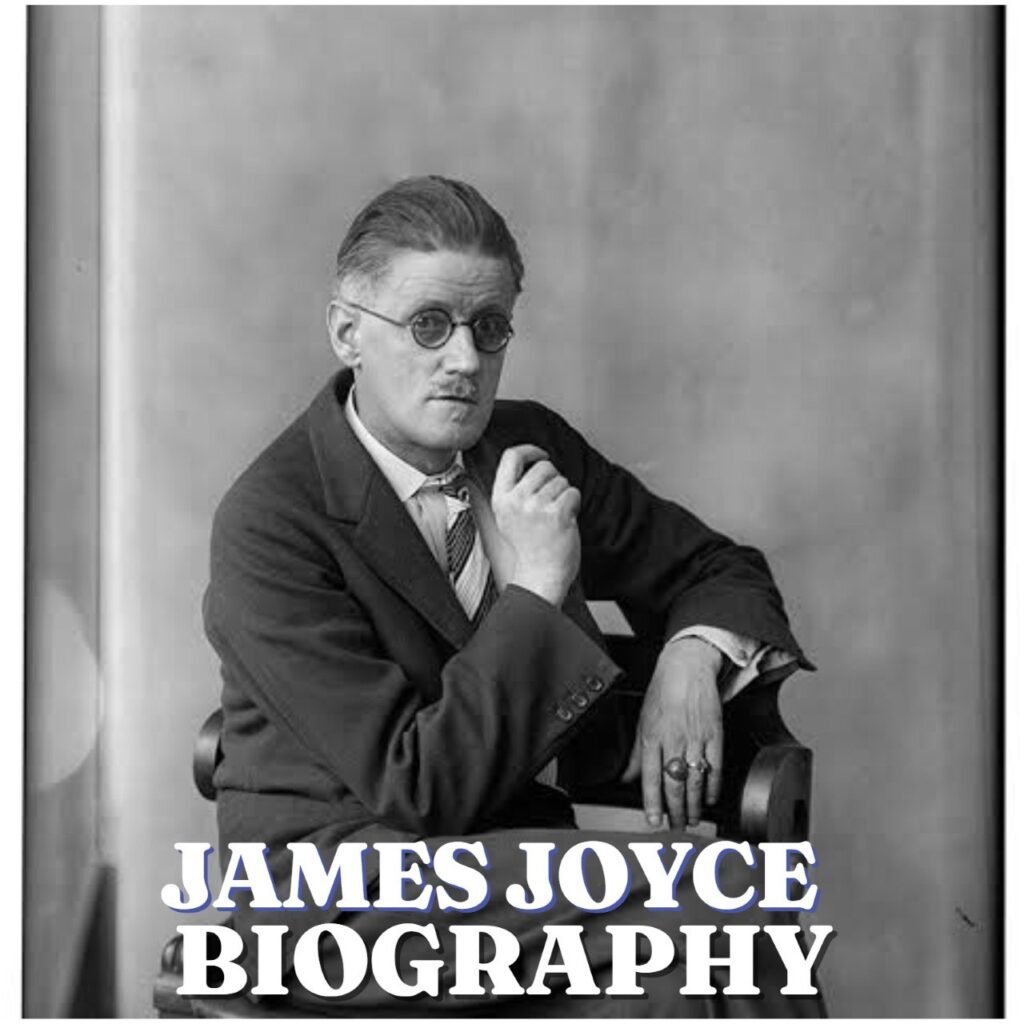
Joyce was raised as a Roman Catholic and attended Catholic schools, but his relationship with religion became increasingly complex as he developed his intellectual and artistic independence. Catholic teachings, religious rituals, and moral questions remained prominent in his writing, even when he criticised religious authority or explored the tension between belief and doubt. Details about his exact height are not consistently established in reliable biographical accounts, so a precise measurement should not be presented as fact without a dependable source. Photographs of Joyce commonly show a slender man with a narrow face, a prominent nose, and round spectacles. His appearance became particularly recognisable in later life, when his eye problems and distinctive formal clothing contributed to the image associated with the celebrated writer.
9. James Joyce’s Social Media Presence
James Joyce did not have personal social media accounts because he died in 1941, decades before the development of modern social networking platforms. It would therefore be inaccurate to describe any contemporary account as his own official personal profile. Nevertheless, his name remains highly visible online through literary institutions, university collections, museums, publishers, book communities, and cultural organisations that promote his writing and preserve his legacy.
Readers who want to follow news about Joyce-related exhibitions, literary tours, lectures, translations, and Bloomsday celebrations can look for the James Joyce Centre’s official social media presence. The centre shares information about its cultural programmes and activities dedicated to Joyce’s life and work. Its website, JamesJoyce.ie, is also a useful source for checking current events and institutional announcements. The University at Buffalo Libraries provides additional updates about the James Joyce Collection and the planned museum project. These institutional platforms help connect contemporary audiences with Joyce’s literary heritage while making it easier to discover events and educational resources.
Joyce’s online presence is therefore best understood as the continuing digital circulation of his work rather than personal social media activity. Discussions of Ulysses, Dubliners, Finnegans Wake, and Bloomsday appear across literary websites, reading communities, academic platforms, and cultural publications. This online interest allows readers around the world to exchange interpretations, discover resources, and participate in celebrations of his writing. Although Joyce himself never used social media, digital platforms have become important tools for preserving and expanding public interest in his achievements.
10. James Joyce’s Net Worth and Sources of Income
James Joyce’s exact net worth is not known in the way the wealth of a contemporary public figure might be calculated. He lived during a period when literary earnings, publishing arrangements, patronage, and personal finances were recorded differently from modern celebrity wealth. His financial circumstances changed throughout his life, and he experienced periods of insecurity despite his growing literary reputation. His books did not immediately provide the financial stability that might be expected from the later reputation of Ulysses. Consequently, a modern net-worth figure should not be presented as a confirmed historical fact without clear evidence.
Joyce’s income came from several sources, including his work as an English-language teacher, payments connected with literary publications, and assistance from supporters. One of his most important patrons was Harriet Shaw Weaver, an English editor and benefactor who provided financial support that helped Joyce continue his writing. Such assistance was particularly significant during periods when his literary work attracted controversy or did not produce sufficient income. Joyce’s career illustrates how even writers who eventually become internationally celebrated can struggle financially while developing innovative work that challenges established publishing conventions.
Historical financial records and estate valuations may provide clues about Joyce’s circumstances at different stages of his life, but they should not be treated as directly equivalent to a modern net-worth calculation. Figures reported for particular investments or the value of an estate at death represent specific historical snapshots rather than a reliable total of his lifetime wealth. His lasting importance is therefore better measured through his literary achievements, influence on later writers, and continuing cultural significance than through an unverified financial estimate. Today, his books remain widely published, studied, translated, and adapted, ensuring that his work continues to have a substantial presence in the international literary world.
11. Legacy and Influence of James Joyce
James Joyce’s legacy rests largely on his transformation of modern literature. His experimental narrative methods, stream-of-consciousness writing, symbolic structures, and innovative use of language expanded the possibilities of the novel and short story. Rather than relying exclusively on straightforward narration, Joyce explored how thoughts, memories, emotions, and perceptions interact within the human mind. His works challenged readers to engage actively with language and structure, and his influence can be seen in later writers who experimented with perspective, interior monologue, fragmented narrative, and the relationship between individual experience and social reality. His reputation as a major modernist writer continues to be reinforced by the sustained critical attention given to his books.
Joyce also left an enduring literary portrait of Dublin and Irish society. Although he lived abroad for much of his adult life, his homeland remained central to his imagination. Through works such as “Dubliners and Ulysses”, he explored family relationships, religious institutions, social class, political identity, urban life, and the ordinary struggles of individuals. His detailed portrayal of Dublin has made the city inseparable from his literary reputation. Bloomsday, celebrated every year on 16 June, commemorates the date on which the events of “Ulysses” take place. The celebration brings readers, scholars, performers, and visitors together through readings, literary walks, performances, and other activities inspired by Joyce’s writing.
His influence also continues through international scholarship, literary organisations, archival collections, translations, exhibitions, and artistic adaptations. Institutions preserve his manuscripts and related materials, while universities introduce new generations of students to his writing and its place in modernism. Contemporary projects, including the planned James Joyce Museum at the University at Buffalo and recent cultural activities at the James Joyce Centre, demonstrate continued efforts to make his work accessible to wider audiences. His books can be demanding, particularly for readers encountering their experimental language for the first time, but that complexity is also part of their enduring attraction. James Joyce’s contribution extends beyond individual titles: he helped redefine what literature could express and how a story could be told, securing his place among the most influential writers of the twentieth century.
12. Conclusion: The Enduring Influence of James Joyce
James Joyce remains one of the most influential writers in modern literary history, celebrated for his extraordinary ability to transform ordinary experiences into complex and meaningful works of art. Born in Dublin, Ireland, on 2 February 1882, Joyce drew inspiration from his homeland, family experiences, religious upbringing, and personal struggles to create groundbreaking works such as “Dubliners, A Portrait of the Artist as a Young Man, Ulysses, and Finnegans Wake”. His experimental writing techniques, particularly his use of stream of consciousness, symbolism, and innovative language, challenged traditional storytelling and reshaped the development of modern literature. Although he spent much of his adult life outside Ireland and faced financial difficulties, censorship controversies, and serious health problems, his literary achievements secured his place among the great writers of the twentieth century. Today, Joyce’s works continue to attract readers, scholars, and literary enthusiasts worldwide, while annual celebrations such as Bloomsday keep his connection to Dublin alive. His life and career demonstrate how creativity, intellectual curiosity, and a willingness to challenge established conventions can leave a lasting mark on literature and culture. James Joyce’s legacy therefore extends far beyond his lifetime, ensuring that his name and works remain an essential part of the global literary conversation.
Frequently Asked Questions About James Joyce
1. Who was James Joyce?
James Joyce was an Irish novelist, poet, and short-story writer widely regarded as one of the most influential figures in modernist literature. He is best known for his experimental writing style and major works, including Ulysses, Dubliners, A Portrait of the Artist as a Young Man, and Finnegans Wake.
2. When and where was James Joyce born?
James Joyce was born on 2 February 1882 in Dublin, Ireland. His childhood experiences, Irish cultural background, and Catholic upbringing significantly influenced his literary works.
3. How old was James Joyce when he died?
James Joyce was 58 years old when he died on 13 January 1941 in Zurich, Switzerland. He was born on 2 February 1882 and died shortly before his 59th birthday.
4. What was James Joyce famous for?
James Joyce was famous for revolutionising modern literature through experimental narrative techniques, stream of consciousness, complex symbolism, and innovative language. His novel “Ulysses”, published in 1922, is considered one of the most important works of twentieth-century literature.
5. What are James Joyce’s most famous books?
James Joyce’s most famous books include “Dubliners (1914), A Portrait of the Artist as a Young Man (1916), Ulysses (1922), and Finnegans Wake (1939)”. These works explore Irish society, identity, religion, human consciousness, and the complexities of everyday life.
6. Who was James Joyce’s wife?
James Joyce’s wife was Nora Barnacle, whom he met in Dublin on 10 June 1904. The couple spent much of their lives abroad and legally married in London on 4 July 1931. They had two children, Giorgio and Lucia.
7. Did James Joyce have children?
Yes, James Joyce had two children with Nora Barnacle: Giorgio Joyce, born in 1905, and Lucia Joyce, born in 1907. Giorgio pursued a career in singing, while Lucia studied dance.
8. What was James Joyce’s religion?
James Joyce was raised in the Roman Catholic faith and attended Catholic schools. Although Catholicism strongly influenced his education and literary imagination, he developed a complicated relationship with the Church and frequently explored religious belief, doubt, and authority in his writing.
9. Why did James Joyce leave Ireland?
James Joyce left Ireland in 1904 with Nora Barnacle, seeking greater personal and artistic freedom. He spent much of his adult life in cities such as Trieste, Rome, Paris, and Zurich, although Dublin remained the central setting and inspiration for many of his literary works.
10. What is James Joyce’s most important work?
*Ulysses* is widely regarded as James Joyce’s most influential and celebrated novel. Published in 1922, it follows the experiences of Leopold Bloom and Stephen Dedalus during a single day in Dublin, 16 June 1904. The novel is particularly famous for its experimental style and detailed portrayal of human consciousness.
11. What is stream of consciousness in James Joyce’s writing?
Stream of consciousness is a literary technique that presents the continuous flow of a character’s thoughts, memories, emotions, and perceptions. James Joyce helped popularise and develop this technique, allowing readers to experience characters’ inner lives in unusually direct and complex ways.
12. What caused James Joyce’s death?
James Joyce died on 13 January 1941 in Zurich, Switzerland, following complications from a perforated duodenal ulcer. He underwent surgery but did not recover. He was buried at Fluntern Cemetery in Zurich.
13. What was James Joyce’s net worth?
James Joyce’s exact net worth is not established in modern financial terms. During his lifetime, he experienced financial difficulties and relied partly on literary patronage, including support from Harriet Shaw Weaver. His income came from writing, publishing, and teaching, but a reliable contemporary estimate of his total wealth is unavailable.
14. Where is James Joyce buried?
James Joyce is buried at Fluntern Cemetery in Zurich, Switzerland. His grave remains a place of interest for readers, scholars, and admirers of his literary achievements.
15. What is Bloomsday, and how is it connected to James Joyce?
Bloomsday is an annual celebration held on 16 June to honour James Joyce and his novel *Ulysses*. The date corresponds to the day on which the novel’s events take place in Dublin in 1904. Celebrations often include readings, literary walks, performances, and activities inspired by Joyce’s work.
16. Did James Joyce have social media accounts?
No verified personal social media accounts belong to James Joyce, who died in 1941, long before social media existed. However, literary organisations, cultural institutions, and the James Joyce Centre use social media to share information about his works, exhibitions, events, and continuing influence.
17. Why is James Joyce still important today?
James Joyce remains important because his experimental approach to language, storytelling, and character psychology transformed modern literature. His works continue to influence writers, academics, and artists, while his detailed portrayal of Dublin preserves a distinctive literary record of Irish life and culture.