
Introduction to Isaac Newton
Sir Isaac Newton was one of the most influential scientists, mathematicians, and astronomers in world history. Born on December 25, 1642, according to the Julian calendar then used in England, at Woolsthorpe Manor in Lincolnshire, England, he made groundbreaking contributions to physics, mathematics, astronomy, and optics. His discoveries transformed humanity’s understanding of the natural world and established principles that continue to shape modern science. Newton is best known for formulating the three laws of motion and the law of universal gravitation, which explained how objects move and how gravitational forces operate throughout the universe.
Throughout his remarkable career, Isaac Newton demonstrated exceptional intellectual ability and a deep commitment to understanding the laws governing nature. He studied at the University of Cambridge, where he developed many of his most important scientific ideas. His influential book, *Philosophiæ Naturalis Principia Mathematica*, published in 1687, became a landmark in scientific history by presenting mathematical explanations for motion and gravity. Newton also made significant contributions to calculus, investigated the properties of light and colour, and developed an early reflecting telescope. His research helped establish the foundations of classical physics and influenced generations of scientists, engineers, and mathematicians.
Although Isaac Newton died on March 31, 1727, according to the calendar then used in England, his influence remains significant in the twenty-first century. His discoveries continue to feature prominently in science education, engineering, astronomy, and technological development. Newton’s life and achievements also remain subjects of historical research, with scholars examining his manuscripts, personal beliefs, and scientific methods to better understand his intellectual journey. Today, his name is honoured through scientific institutions, awards, and educational programmes, demonstrating the enduring importance of his contributions to human knowledge and his position as one of the founding figures of modern science.
Early life of Newton Isaac
Isaac Newton was born on December 25, 1642, according to the Julian calendar then in use in England, at Woolsthorpe Manor in Woolsthorpe-by-Colsterworth, Lincolnshire, England. His birth came just a few months after the death of his father, also named Isaac Newton, who had been a farmer. Newton was born prematurely and was reportedly so small that his survival was initially uncertain. His mother, Hannah Ayscough, raised him during his early years, but when he was about three years old, she remarried the Reverend Barnabas Smith and left young Isaac in the care of his maternal grandmother. These early family circumstances shaped his childhood and contributed to the independent personality he developed as he grew older.
During his childhood, Newton showed an interest in mechanical devices, construction, and practical experiments. He attended the King’s School in Grantham, where he received an education in Latin and other subjects that prepared him for further studies. While living in Grantham, he stayed with a local family and gradually developed a reputation for being intelligent and inventive. Accounts of his childhood describe his interest in building small mechanical models, including devices that demonstrated his understanding of movement and basic physical principles. Although some popular stories about his early inventions may have been embellished over time, they reflect the longstanding association between Newton and a curiosity about how things work.
Newton’s early life was not entirely devoted to academic pursuits, as his mother initially expected him to return to the family estate and manage its agricultural affairs. However, his schoolmaster and other supporters recognised his intellectual potential and encouraged him to continue his education. Newton eventually returned to formal schooling in preparation for university, and in 1661, he entered Trinity College, University of Cambridge. His transition to Cambridge marked a decisive turning point in his life, giving him access to mathematical and philosophical ideas that would influence his future discoveries. The curiosity, discipline, and independent thinking he developed during his early years helped lay the foundation for his later achievements in physics, mathematics, astronomy, and optics.
Education of Isaac Newton
Isaac Newton began his formal education at the King’s School in Grantham, Lincolnshire, England, where he studied subjects such as Latin and developed the academic foundation that would support his later scientific achievements. During his school years, Newton demonstrated a strong interest in learning, mechanical inventions, and understanding how objects worked. Although his mother initially hoped he would manage the family farm, his teachers recognised his intellectual ability and encouraged him to continue his studies. With their support, Newton returned to school to prepare for university, marking an important step toward his future as one of the most influential thinkers in scientific history.
In 1661, Newton enrolled at Trinity College, University of Cambridge, where he initially studied a traditional curriculum that included Aristotle’s philosophy. However, he soon became interested in newer scientific and mathematical ideas associated with thinkers such as René Descartes, Galileo Galilei, and Johannes Kepler. Newton pursued independent studies in mathematics, astronomy, optics, and natural philosophy, often exploring subjects beyond the standard university curriculum. His academic development accelerated during this period, and he began forming ideas that would later contribute to his groundbreaking work on calculus, motion, and gravitation. Cambridge provided him with access to scholarly resources and an intellectual environment that helped shape his approach to scientific investigation.
Newton’s education was interrupted in 1665 when the Great Plague forced Cambridge University to close temporarily. He returned to Woolsthorpe Manor, where he continued studying and developing mathematical and scientific ideas independently. This period, often associated with his remarkable early intellectual achievements, helped him advance his work on calculus, optics, and gravity. Newton later returned to Cambridge, received his Bachelor of Arts degree in 1665, and earned his Master of Arts degree in 1668. In 1669, he became Lucasian Professor of Mathematics at Cambridge, a prestigious position that reflected his growing reputation as a mathematician. His educational journey demonstrates how formal instruction, independent study, and persistent experimentation combined to produce some of the most important discoveries in the history of science.
Career of Isaac Newton
Isaac Newton’s career was marked by extraordinary achievements in mathematics, physics, astronomy, optics, and natural philosophy. He began developing many of his groundbreaking ideas while studying at the University of Cambridge in the 1660s. During the temporary closure of the university because of the Great Plague in 1665, Newton returned to his family home in Woolsthorpe, where he devoted considerable time to independent research. This period proved highly productive, as he explored mathematical methods that contributed to the development of calculus, investigated the nature of gravity, and conducted experiments involving light. These early discoveries laid the foundation for a career that would transform scientific understanding across Europe and beyond.
In 1669, Newton became the Lucasian Professor of Mathematics at the University of Cambridge, succeeding Isaac Barrow. In this position, he continued his mathematical research and developed his influential theories about light and colour. Through experiments with prisms, Newton demonstrated that white light consists of a mixture of colours that can be separated through refraction. He also designed an early practical reflecting telescope in 1668, using a mirror to address certain optical limitations associated with conventional refracting telescopes. In 1672, he presented his work on light and colour to the Royal Society, attracting considerable attention from the scientific community. Although some of his findings generated debate with other scholars, his experiments helped establish a new approach to investigating optical phenomena.
One of the most significant achievements of Newton’s career was the publication of *Philosophiæ Naturalis Principia Mathematica* in 1687. Commonly known as *Principia*, the book presented his three laws of motion and the law of universal gravitation, providing a mathematical framework for understanding the movement of objects on Earth and the orbits of celestial bodies. The work established Newton as a leading figure in the scientific revolution and profoundly influenced the development of classical mechanics. His scientific reputation continued to grow, and in 1703, he became president of the Royal Society, a position he held until his death. In 1705, Queen Anne knighted him, making him Sir Isaac Newton. He also served as Warden and later Master of the Royal Mint, where he helped oversee currency reforms and efforts to combat counterfeiting. Newton died on March 31, 1727, according to the calendar then used in England, leaving behind a scientific legacy that continues to influence research, education, and technological development.
Why Isaac Newton Is Trending in 2026
Isaac Newton continues to attract attention in 2026 because of his lasting influence on science, mathematics, and modern technology. Although he died in 1727, his discoveries remain essential to understanding motion, gravity, and the physical laws governing the universe. His name frequently appears in educational discussions, scientific publications, historical exhibitions, and conversations about the scientists who transformed human knowledge. Newton’s work remains relevant because it provides the foundation for classical mechanics, which is still widely used in engineering, astronomy, and many practical scientific applications.
A major reason for the renewed interest in Newton is the 2026 Isaac Newton Medal and Lecture, awarded to Professor J. Ignacio Cirac on October 12, 2026, by the Institute of Physics. Cirac was recognised for his pioneering contributions to quantum information science, including theoretical work that helped establish the foundations of quantum computing and quantum communication. The announcement highlights how Newton’s scientific reputation continues to inspire recognition of groundbreaking discoveries centuries after his death.
Historical research has also contributed to Newton’s continued relevance. In July 2026, the Royal Society published an examination of a late portrait of Newton by John Vanderbank, exploring the symbolism of a serpent-like figure and its possible connections to chronology, alchemy, and Newton’s broader intellectual interests. Such investigations demonstrate that Newton was not only a pioneering physicist but also a complex historical figure whose life and writings continue to attract scholarly attention.
Isaac Newton’s Most Important Discoveries
The Three Laws of Motion
Newton described how forces affect the movement of objects. These laws remain foundational to classical mechanics and help explain motion in engineering, transport and everyday physical systems.
Universal Gravitation
Newton developed a mathematical explanation of gravity, showing how objects attract one another. The famous apple story is associated with his thinking about gravity, although popular versions of the story often simplify the historical account.
Optics and the Nature of Light
Newton demonstrated that white light can be separated into different colours using a prism. His experiments transformed scientific understanding of colour and helped advance the study of optics.
The Reflecting Telescope
Newton built an early practical reflecting telescope in 1668. It used a mirror rather than relying entirely on lenses, helping address some optical problems in telescopes of the period.
Calculus
Newton independently developed methods that became part of calculus, which he called the method of fluxions. These mathematical techniques are essential to understanding changing quantities and are widely used in physics, engineering and economics.
Isaac Newton’s Personal Life and Family
Isaac Newton was born on December 25, 1642, according to the Julian calendar then used in England, at Woolsthorpe Manor in Lincolnshire, England. His father, Isaac Newton Sr., was a prosperous farmer who died before his son’s birth. His mother, Hannah Ayscough, later married Reverend Barnabas Smith when Newton was about three years old, leaving him in the care of his maternal grandmother. This early separation from his mother is often discussed in biographies of Newton, although its precise influence on his personality is difficult to establish. He grew up in a family environment shaped by farming, religious traditions, and the social expectations of seventeenth-century England. Despite these early challenges, Newton developed a strong interest in learning and eventually became one of the most influential scientists in history.
Newton’s family relationships remained an important part of his personal history. His mother, Hannah Ayscough, returned to Woolsthorpe after the death of her second husband in 1653, and Newton subsequently lived with her and his younger half-siblings for a period. Through his mother’s second marriage, he had three half-siblings: Mary Smith, Benjamin Smith, and Hannah Smith. Newton never married and had no known children, and there is no reliably documented fiancée or wife associated with him. Although he maintained relationships with relatives and colleagues, much of his adult life was devoted to intellectual pursuits, scientific research, mathematics, public service, and religious study. His personal correspondence and surviving manuscripts suggest that he valued privacy and could be intensely focused on his work.
Beyond his family life, Newton had a complex personality and a wide range of interests that extended beyond physics and mathematics. He studied theology, biblical chronology, and alchemy, devoting considerable time to questions about religion, ancient history, and the natural world. He also developed professional relationships with prominent scholars, including Edmond Halley, who supported the publication of Newton’s influential work *Principia Mathematica*. Newton later became president of the Royal Society and served as Master of the Royal Mint, balancing scientific responsibilities with public duties. He died in London on March 31, 1727, according to the calendar then used in England, at the age of 84 by that calendar’s reckoning. Although he had no spouse or direct descendants, his intellectual legacy became his most enduring contribution, influencing generations of scientists, mathematicians, and researchers around the world.
Isaac Newton’s Age, Religion, Nationality, Health and Physical Appearance
Age
Sir Isaac Newton was born on December 25, 1642, according to the Julian calendar used in England at the time, equivalent to January 4, 1643, in the Gregorian calendar. He died on March 31, 1727, under the calendar then in use in England, which corresponds to April 11, 1727, in the Gregorian calendar. He was 84 years old by the contemporary English reckoning, or 84 years old by completed years using the modern calendar as well. Newton lived through a period of major scientific, political, and intellectual change, and his long life allowed him to develop influential ideas that transformed mathematics, physics, and astronomy.
Religion
Newton was deeply interested in religion and devoted considerable time to studying the Bible, Christian theology, and biblical chronology. Although he lived in a society dominated by the Church of England, his personal theological views differed from orthodox Anglican teachings. His private writings indicate that he rejected the traditional doctrine of the Trinity, a position that he largely kept private during his lifetime because openly expressing such beliefs could have damaged his career. Newton believed that studying nature and studying Scripture were both ways of investigating God’s creation. His religious writings reveal an intellectual life that extended well beyond his celebrated scientific discoveries.
Nationality
Isaac Newton was English and was born in Woolsthorpe-by-Colsterworth, Lincolnshire, England. During his lifetime, England and Scotland were united politically in 1707 to form the Kingdom of Great Britain. Newton therefore spent the later part of his life as a subject of Great Britain, although he is most commonly identified historically as an English scientist. His work helped establish Britain’s reputation as a major centre of scientific advancement during the Scientific Revolution. Today, Newton is recognised internationally as one of the most influential figures in the history of science.
Health
Newton experienced periods of physical and emotional difficulty throughout his life, although historical accounts must be interpreted cautiously because modern medical diagnoses cannot reliably be established from limited surviving records. In 1693, he experienced a period of significant distress and disrupted correspondence, which has prompted historians to debate possible explanations, including exhaustion, stress, and illness. Some accounts also describe health concerns in his later years. Despite these difficulties, Newton remained intellectually active for much of his life and continued to contribute to mathematics, scientific administration, and public service. He died in 1727 at his residence in Kensington, London.
Physical Appearance
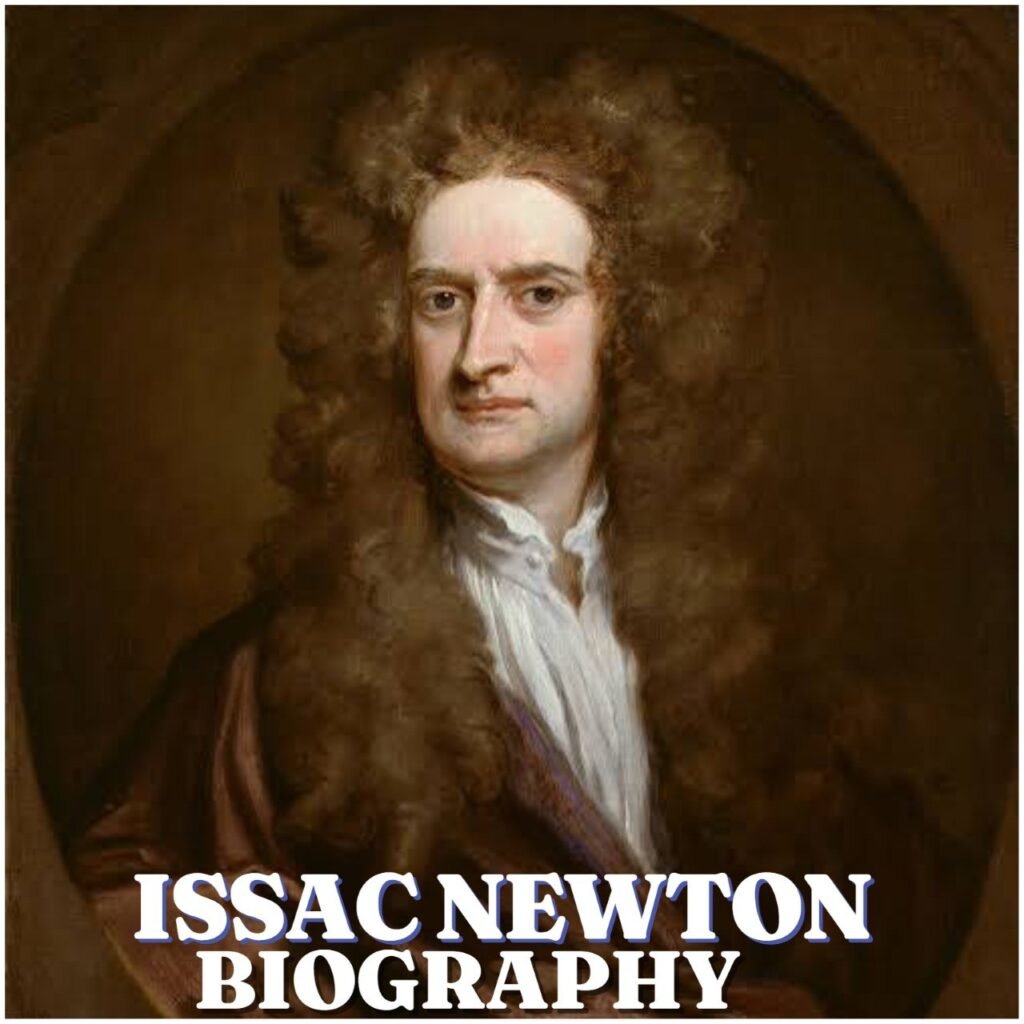
Isaac Newton’s appearance is best known through portraits painted during his lifetime, particularly those by artists such as Godfrey Kneller. These portraits commonly depict him with long, flowing hair or a formal wig, a composed expression, and the clothing associated with a distinguished English gentleman of the seventeenth and early eighteenth centuries. As he aged, his appearance changed, and later portraits show him as an established scholar and public figure. There is no universally reliable modern measurement of his height, so specific claims about his exact stature should be treated cautiously. His portraits, however, remain important historical records of the man whose discoveries helped transform scientific understanding.
Isaac Newton’s Age, Religion, Tribe, Height and Physical Appearance
Age
Sir Isaac Newton was born on December 25, 1642, according to the Julian calendar used in England at the time, equivalent to January 4, 1643, in the Gregorian calendar. He died on March 31, 1727, according to the contemporary English calendar, at the age of 84 by that calendar’s reckoning. Newton lived during a period of remarkable scientific and intellectual change, and his discoveries in mathematics, physics, and astronomy established principles that continue to influence modern science. Although he has been gone for nearly three centuries, his contributions remain relevant in classrooms, laboratories, and engineering institutions worldwide.
Religion
Newton was deeply interested in Christianity, biblical interpretation, and theological studies. Although he lived in an era when the Church of England held considerable religious influence, his private theological beliefs differed from some established Christian doctrines. His writings indicate that he rejected the doctrine of the Trinity, a position he largely kept private during his lifetime. Newton believed that the natural world reflected divine order and that scientific investigation could help people understand God’s creation. His religious studies occupied a significant portion of his intellectual life alongside his work in mathematics, optics, and physics.
Tribe
Isaac Newton was English, born in Lincolnshire, England, and belonged to the historical English population of the British Isles. The concept of tribe, commonly used in discussions of ethnic groups in parts of Africa, does not directly correspond to the social and historical classifications typically applied to seventeenth-century English people. Newton is therefore generally identified by his English nationality and cultural background rather than by a specific tribe. His historical identity is associated with England, where he received his education, conducted much of his scientific research, and developed the discoveries that made him internationally famous.
Height
There is no widely accepted, reliable historical measurement establishing Isaac Newton’s exact height. Surviving portraits provide information about his appearance and clothing but cannot accurately establish his physical measurements. Consequently, specific figures sometimes circulated online about Newton’s height should be treated cautiously unless supported by credible historical evidence. His historical significance rests on his intellectual achievements, including the laws of motion, universal gravitation, and contributions to calculus, rather than on his physical stature.
Physical Appearance
Isaac Newton’s physical appearance is documented through several portraits created during his lifetime, including well-known paintings by Godfrey Kneller. These portraits depict him with long, flowing hair or a formal wig, a composed expression, and the formal clothing associated with educated and influential men of his period. His appearance changed as he grew older, with later portraits presenting him as a distinguished scholar and public official. Newton’s portraits remain valuable historical records because they provide visual impressions of one of the most influential figures in the history of science, whose work fundamentally changed humanity’s understanding of motion, gravity, light, and the universe.
Isaac Newton’s Social Media Presence
Isaac Newton lived centuries before the invention of the internet and social media, so he did not have personal accounts on platforms such as Instagram, Facebook, X (formerly Twitter), or TikTok. Nevertheless, his scientific discoveries and historical legacy continue to attract considerable attention online. Educational institutions, museums, science organisations, and history enthusiasts regularly share information about his life, theories, and contributions to mathematics and physics through their official social media accounts.
Although Sir Isaac Newton has no verified personal social media handle, people interested in his work can explore posts about him using hashtags such as **#IsaacNewton**, **#Newton**, **#Physics**, and **#ScienceHistory**. These hashtags can help users discover educational videos, historical photographs, explanations of his laws of motion, and discussions of universal gravitation. Accounts associated with institutions such as the Royal Society and Cambridge University also provide opportunities to learn more about Newton’s scientific achievements and historical influence.
Newton’s continued visibility on social media demonstrates how historical figures can remain relevant in the digital age. His discoveries are frequently discussed in science education content, documentaries, animated explanations, and online discussions about the origins of modern physics. While no authentic personal handle belongs to Newton, his name remains widely recognised across digital platforms, where his work continues to inspire students, researchers, teachers, and science enthusiasts around the world.
Isaac Newton’s Net Worth
Isaac Newton was a highly successful scientist and public official who accumulated considerable wealth during his lifetime. Although his exact net worth cannot be directly compared with modern celebrity fortunes, historical records indicate that he was financially comfortable and wealthy by the standards of seventeenth- and eighteenth-century England. His income came primarily from his academic career at the University of Cambridge, his senior position at the Royal Mint, and investments in financial assets. Historical research published in *Physics Today* estimates that Newton’s net worth before the South Sea Bubble crisis was slightly above £30,000.
A substantial portion of Newton’s wealth came from his appointment as Master of the Royal Mint in 1699, a position he held until his death in 1727. Unlike his earlier academic role, this office provided him with considerable financial opportunities through salary and fees associated with the production of coins. He also invested in government bonds and company shares, including South Sea Company stock. Although he initially made profits during the South Sea Bubble speculation, he later suffered significant investment losses. Nevertheless, historical accounts indicate that he retained substantial wealth despite these setbacks.
Based on available historical records, Isaac Newton’s estimated net worth at the time of his death was approximately £30,000 to £40,000 in eighteenth-century money. This is a historical estimate rather than a precise modern valuation, and converting it into today’s currency is difficult because prices, wages, investment markets, and economic conditions have changed considerably. Newton’s financial success reflected not only his scientific reputation but also his public service and investment activities. His wealth is a reminder that, alongside his extraordinary intellectual achievements, he was an influential administrator and investor whose career extended well beyond the scientific world.
Legacy of Isaac Newton
Isaac Newton’s legacy is deeply rooted in his revolutionary contributions to physics, mathematics, astronomy, and the scientific method. His three laws of motion and law of universal gravitation transformed humanity’s understanding of how objects move and how celestial bodies interact. Published in 1687, his influential book *Philosophiæ Naturalis Principia Mathematica* established a mathematical framework that shaped scientific investigation for centuries. Newton’s work demonstrated that the same physical principles could explain phenomena on Earth and in space, helping unite astronomy and terrestrial mechanics. His discoveries laid the foundation for classical physics and influenced generations of scientists, including those who later developed new theories to explain aspects of the universe beyond the limits of Newtonian mechanics.
Newton also left a lasting mark on mathematics, optics, and scientific institutions. His independent development of calculus provided essential tools for studying motion, change, and complex mathematical relationships. His experiments on light and colour advanced the understanding of optics, while his reflecting telescope contributed to improvements in astronomical observation. Beyond his research, Newton served as president of the Royal Society and helped shape Britain’s scientific community during a period of major intellectual progress. His influence continues through university curricula, scientific research, engineering applications, and the Isaac Newton Medal, which recognises outstanding contributions to physics. These achievements demonstrate the breadth of his influence and his importance in the development of modern scientific thought.
Today, Sir Isaac Newton is remembered as one of the most influential figures in the history of science. His ideas remain important in education, engineering, astronomy, and many technological applications, even as modern physics has expanded our understanding of gravity and the behaviour of matter at extreme scales. Newton’s intellectual curiosity, mathematical precision, and commitment to investigating natural phenomena continue to inspire students and researchers worldwide. His legacy also illustrates how careful observation, experimentation, and mathematical reasoning can transform humanity’s understanding of the world. Nearly three centuries after his death in 1727, Newton remains a central figure in scientific history, and his discoveries continue to shape the way people study motion, forces, light, and the universe.
Conclusion
Sir Isaac Newton remains one of the most influential scientists in history, celebrated for his groundbreaking contributions to physics, mathematics, astronomy, and optics. Through his three laws of motion, law of universal gravitation, contributions to calculus, and pioneering experiments on light, Newton transformed humanity’s understanding of the natural world and laid the foundations for many scientific and technological developments. Beyond his scientific achievements, his work at the University of Cambridge, leadership of the Royal Society, and service at the Royal Mint demonstrated his versatility and influence in public life. Although Newton died in 1727, his discoveries continue to shape scientific education, engineering, and research worldwide. His remarkable intellectual legacy serves as a lasting reminder of the power of curiosity, experimentation, and mathematical reasoning, securing his place among the greatest thinkers in human history.
Frequently Asked Questions About Isaac Newton
1. Who was Isaac Newton?
Isaac Newton was an English mathematician, physicist, astronomer, and author widely regarded as one of the most influential scientists in history. He is best known for developing the three laws of motion and the law of universal gravitation.
2. When was Isaac Newton born?
Isaac Newton was born on December 25, 1642, according to the Julian calendar used in England at the time. His birth date in the modern Gregorian calendar is January 4, 1643.
3. How old was Isaac Newton when he died?
Isaac Newton died on March 31, 1727, according to the calendar then used in England, at the age of 84 by that calendar’s reckoning.
4. What was Isaac Newton famous for?
Newton was famous for his three laws of motion, the law of universal gravitation, his contributions to calculus, and his experiments on light and colour. His book *Principia Mathematica*, published in 1687, is one of the most influential works in scientific history.
5. What was Isaac Newton’s nationality?
Isaac Newton was English. He was born in Lincolnshire, England, and spent most of his life working in England.
6. Did Isaac Newton get married?
No, Isaac Newton never married and had no known children. Much of his life was devoted to scientific research, mathematics, theology, and public service.
7. What was Isaac Newton’s religion?
Newton was deeply interested in Christianity and biblical studies. However, his private theological beliefs differed from some established Christian doctrines, including the traditional doctrine of the Trinity.
8. What was Isaac Newton’s estimated net worth?
Newton accumulated considerable wealth through his academic career, his position at the Royal Mint, and investments. Historical estimates suggest that his wealth was worth tens of thousands of pounds in eighteenth-century money, although an exact modern equivalent is difficult to establish.
9. What did Isaac Newton discover about gravity?
Newton formulated the law of universal gravitation, which explains how objects attract one another through gravity. His theory helped explain the motion of falling objects, the Moon’s orbit, and the movement of planets.
10. Did Isaac Newton invent calculus?
Newton independently developed methods that became part of calculus, which he called the method of fluxions. German mathematician Gottfried Wilhelm Leibniz independently developed calculus around the same period, and both are recognised as important founders of the subject.
11. What book did Isaac Newton write?
Newton’s most famous book is *Philosophiæ Naturalis Principia Mathematica*, commonly known as *Principia Mathematica*. Published in 1687, it presented his laws of motion and law of universal gravitation.
12. What was Isaac Newton’s role at the Royal Society?
Newton became president of the Royal Society in 1703 and held the position until his death in 1727. The organisation played an important role in promoting scientific research and discussion.
13. What was Isaac Newton’s contribution to optics?
Newton conducted experiments demonstrating that white light contains different colours that can be separated using a prism. He also built an early practical reflecting telescope, contributing to advances in optical science and astronomy.
14. Is Isaac Newton still alive?
No, Isaac Newton died in 1727. However, his discoveries continue to influence modern science, mathematics, engineering, and astronomy.
Isaac Newton remains important because his discoveries established fundamental principles of classical mechanics and helped shape modern scientific thinking. His laws are still used in many engineering calculations, educational programmes, and practical applications involving motion and forces.