
Introduction
Indira Gandhi was one of the most influential and controversial political leaders in modern Indian history. Born on November 19, 1917, in Allahabad, India, she was the only child of Jawaharlal Nehru, India’s first Prime Minister, and Kamala Nehru. Growing up in one of the country’s most prominent political families, Indira was exposed from an early age to India’s independence movement and the political struggles surrounding British rule. Her childhood experiences and close relationship with her father played an important role in shaping her political outlook and eventual career.
Indira Gandhi became India’s first and, for many years, only woman Prime Minister when she took office in January 1966. She led the country during several major periods of political, economic and military change, including the 1971 India-Pakistan War and the creation of Bangladesh. Her government also pursued major policies such as the nationalization of major banks and the expansion of India’s role in international affairs. At the same time, her leadership remains deeply debated because of decisions such as the declaration of the Emergency from 1975 to 1977, when civil liberties were significantly restricted and political opponents were imprisoned.
Indira Gandhi returned to power in 1980 after losing the 1977 election and remained Prime Minister until her assassination on October 31, 1984, by two of her Sikh bodyguards. Her death came months after Operation Blue Star, the controversial Indian military operation at the Golden Temple in Amritsar. More than four decades after her assassination, Indira Gandhi remains a major subject of historical and political discussion. Her contributions to India’s development, her strong leadership style, her political achievements and the controversies surrounding her rule continue to shape how she is remembered in India and around the world.
Early Life of Indira Gandhi
Indira Gandhi was born on November 19, 1917, in Allahabad, then part of British India and now known as Prayagraj, Uttar Pradesh. She was the only child of Jawaharlal Nehru and Kamala Nehru. Her father later became independent India’s first Prime Minister, while her mother was also involved in the Indian independence movement. Indira grew up in an influential political environment at Anand Bhavan, the Nehru family home, where she witnessed important political figures and freedom fighters visiting her family. Her childhood was therefore closely connected with India’s struggle for independence from British rule.
From a young age, Indira was exposed to the political activities of her father and other leaders of the Indian National Congress. The frequent imprisonment of her father and other members of her family affected her childhood and gave her an early understanding of the sacrifices associated with India’s independence movement. As a child, she reportedly organized a group known as the Vanar Sena, or Monkey Brigade, involving children who supported the nationalist movement by performing activities such as carrying messages. Although accounts of the group’s exact activities vary, the experience reflected her early interest in India’s political struggle.
Indira’s childhood was also affected by her mother’s poor health and frequent absences caused by medical treatment. She received her early education in several schools in India and later continued her studies abroad. She attended schools including St. Mary’s Convent in Allahabad and eventually studied at Somerville College, Oxford, although she did not complete a degree there. Her formative years, marked by political activism, family responsibilities, education and exposure to the independence movement, helped shape the determination and political confidence that would later become defining characteristics of her career.
Education of Indira Gandhi
Indira Gandhi received her early education in India, where her schooling was influenced by her family’s political circumstances and frequent movements. She studied at institutions including St. Cecilia’s and St. Mary’s Convent in Allahabad, the International School of Geneva in Switzerland, and the Pupil’s Own School in Poona, now Pune. Her education was not entirely conventional because her mother’s illness and her family’s involvement in the Indian independence movement frequently disrupted her studies. Nevertheless, these experiences exposed her to different educational environments and cultures from an early age.
In 1937, Indira Gandhi went to England and enrolled at Somerville College, Oxford, where she studied subjects including history, economics and politics. Her time at Oxford gave her an opportunity to develop a broader understanding of European history and political affairs. However, her health problems and other difficulties interrupted her studies, and she did not complete a degree at Oxford. Despite not graduating, her years in England contributed to her international outlook and increased her exposure to political developments outside India.
Indira’s education extended beyond formal academic qualifications. Growing up as Jawaharlal Nehru’s daughter meant that political discussions, India’s independence movement and international affairs were a regular part of her upbringing. She also spent time in Switzerland during her mother’s medical treatment, gaining exposure to European society and education. These experiences helped develop her knowledge of politics and world affairs, which later became valuable during her long political career. Her education, combined with the political environment of the Nehru household, played an important role in preparing her for national leadership.
Political Career of Indira Gandhi
Indira Gandhi’s political career developed gradually through her involvement with the Indian National Congress and her close association with her father, Jawaharlal Nehru. After India’s independence in 1947, she increasingly became involved in political and organizational activities within the Congress. She served as Congress president in 1959 and later became a member of the Rajya Sabha, India’s upper house of Parliament, in 1964. Following Nehru’s death in 1964, Prime Minister Lal Bahadur Shastri appointed her Minister of Information and Broadcasting. Her growing political influence eventually led to her becoming Prime Minister after Shastri died unexpectedly in January 1966.
As Prime Minister, Indira Gandhi quickly established herself as a powerful and independent political leader. Her government introduced major economic policies, including the nationalization of major commercial banks in 1969, while she also promoted policies aimed at reducing poverty. Her leadership became particularly significant during the 1971 India-Pakistan War, which resulted in the creation of Bangladesh. India’s military and diplomatic success greatly strengthened her domestic reputation, and she was widely regarded as one of the country’s most influential leaders. In 1972, she received the Bharat Ratna, India’s highest civilian award, partly in recognition of her leadership during the Bangladesh crisis.
Indira Gandhi’s career also included some of the most controversial decisions in India’s political history. In June 1975, after facing political and legal challenges, she declared a state of Emergency that lasted until March 1977. During this period, civil liberties were restricted, opposition politicians were imprisoned and the government faced widespread criticism for authoritarian measures. The Congress Party subsequently lost the 1977 general election, and Gandhi was temporarily removed from office. She returned to power after winning the 1980 election and served as Prime Minister until her assassination on October 31, 1984. Her career therefore remains a complex combination of political achievements, strong leadership, economic and foreign-policy initiatives, and serious controversies over democratic freedoms.
Why Indira Gandhi Is Trending in 2026
Indira Gandhi remains a trending subject in 2026 largely because renewed public interest in India’s political history continues to bring attention to her leadership, family and legacy. Discussions surrounding the Nehru-Gandhi family frequently revisit her years as Prime Minister, particularly her role in the 1971 India-Pakistan War, the creation of Bangladesh, the nationalization of banks and the controversial Emergency period of 1975–1977. Her political career continues to generate debate because supporters highlight her strong leadership and major national decisions, while critics focus on the restrictions on civil liberties during the Emergency.
Another reason for renewed interest is the continuing attention surrounding the Nehru-Gandhi family and its political legacy. Rajiv Gandhi, Indira’s elder son, became Prime Minister after her assassination in 1984, while Sonia Gandhi later became one of the most prominent figures in the Indian National Congress. In 2026, forthcoming memoir-related coverage involving Sonia Gandhi has also renewed public discussion about the family’s personal history and the events surrounding Indira Gandhi’s final years. Such developments have encouraged readers to revisit Indira’s life, family relationships and influence on subsequent generations of Indian politics.
Indira Gandhi also remains relevant because her legacy continues to be discussed more than four decades after her death. Her image has been preserved through books, documentaries, historical archives, political commentary and public commemorations, while debates about her policies remain part of discussions about India’s modern history. As interest in India’s past continues online, searches for information about her early life, education, political career, family, achievements, controversies and assassination continue to make Indira Gandhi a prominent historical figure for readers researching influential world leaders.
Personal Life and Family of Indira Gandhi
Indira Gandhi married Feroze Gandhi on March 26, 1942. Feroze was a journalist, freedom fighter and later a Member of Parliament who became known for his work as a parliamentarian. Their marriage connected two prominent families involved in India’s independence movement, although Feroze was not related to Mahatma Gandhi. The couple had two sons, Rajiv Gandhi and Sanjay Gandhi, and their family life unfolded alongside Indira’s increasing involvement in Indian politics. The official Prime Minister of India biography confirms her marriage to Feroze Gandhi and that they had two sons.
Indira’s relationship with her sons was an important part of her personal life, particularly as both eventually became involved in politics in different ways. Rajiv Gandhi, born in 1944, initially pursued a career as a commercial pilot and was reluctant to enter politics. However, following the death of his younger brother Sanjay in an airplane crash in 1980, Rajiv became increasingly involved in political life and eventually succeeded his mother as Prime Minister after her assassination in 1984. Sanjay Gandhi, meanwhile, became an influential political figure and was closely associated with his mother’s government during her later years.
Indira Gandhi’s wider family background was equally significant. She was the daughter of Jawaharlal Nehru, India’s first Prime Minister, and Kamala Nehru, making her part of one of India’s most historically important political families. Her grandson Rahul Gandhi and granddaughter Priyanka Gandhi Vadra, the children of Rajiv Gandhi and Sonia Gandhi, later became prominent figures in Indian public and political life. Indira’s family connections therefore continued to influence Indian politics for generations, contributing greatly to the enduring public interest in her personal life, family history and political legacy.
Indira Gandhi Age, Religion, Nationality, Height and Physical Appearance
Age: Indira Gandhi was born on November 19, 1917, in Allahabad, British India, now known as Prayagraj, Uttar Pradesh. She was assassinated on October 31, 1984, in New Delhi, at the age of 66. She had already served two separate periods as India’s Prime Minister and remained one of the country’s most prominent political figures until her death.
Religion and Nationality: Indira Gandhi was an Indian national and came from a Kashmiri Pandit Hindu family. Her religious and cultural background was rooted in Hindu traditions, although her public political identity was primarily associated with Indian nationalism and secular democratic politics. She was the daughter of Jawaharlal Nehru and became the first woman to serve as Prime Minister of India.
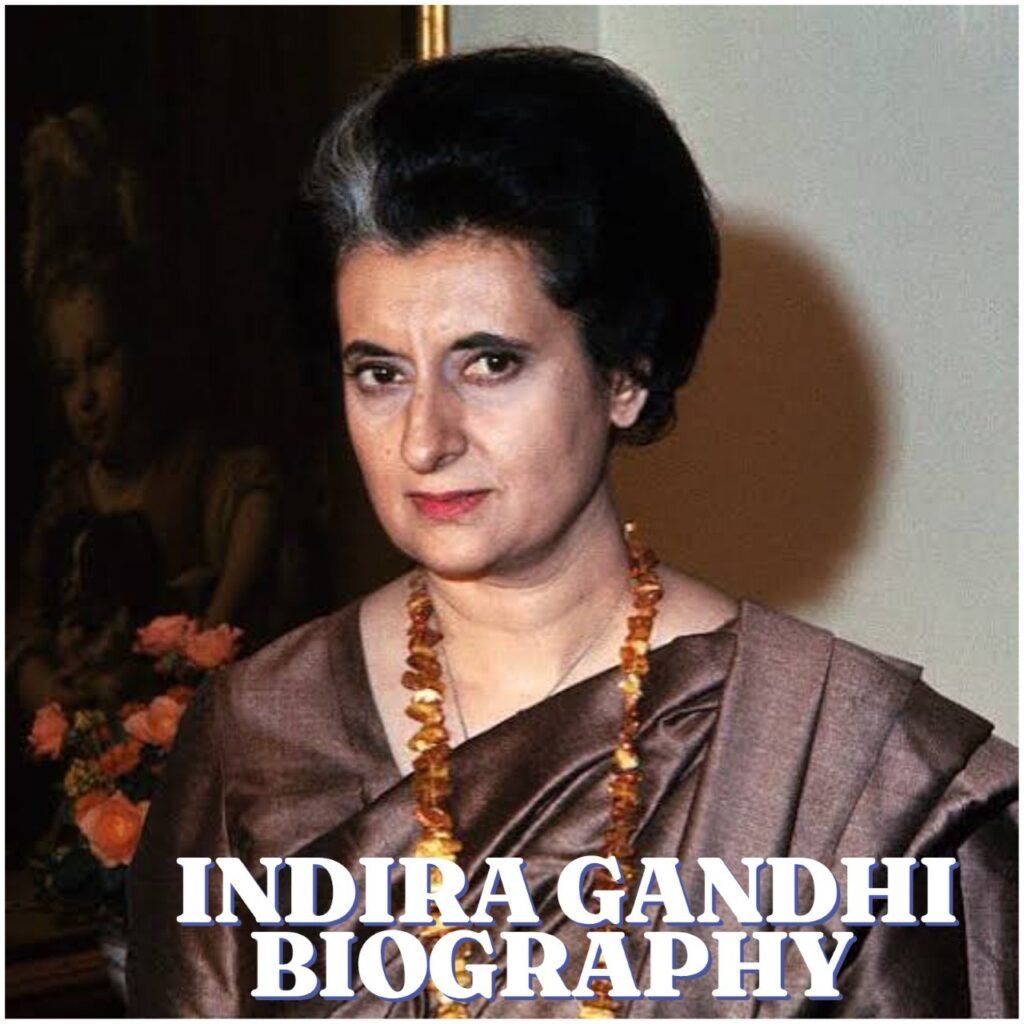
Height and Physical Appearance: Historical biographical sources commonly list Indira Gandhi’s height at approximately 5 feet 4 inches (about 1.63 metres), although exact measurements are not consistently documented in authoritative government records. She was recognizable for her distinctive shoulder-length hairstyle, which became increasingly characterized by a prominent streak of white hair on one side. Photographs from her political career show her frequently wearing traditional Indian sarees, contributing to an appearance that became closely associated with her public image as India’s long-serving woman Prime Minister.
Indira Gandhi Social Media Presence
Indira Gandhi lived and served as Prime Minister decades before the rise of social media, so she did not have personal accounts on platforms such as Instagram, Facebook or X (formerly Twitter). As a result, there is no verified personal social-media handle that can accurately be attributed to her. Her speeches, photographs, letters and historical records are instead preserved and shared online by institutions dedicated to documenting her life and political legacy.
The Indira Gandhi Memorial Trust maintains an official website featuring material about her philosophy, timeline, speeches, letters, milestones and memorial. The organization also provides links to its social-media platforms, including Facebook, Instagram and YouTube, allowing people to follow historical content and updates related to Indira Gandhi.
For readers searching for Indira Gandhi on social media, it is important to distinguish official institutional pages from fan accounts, historical pages and profiles using her name. There are numerous posts and archived photographs about her on social platforms, but these should not be presented as accounts personally operated by Indira Gandhi. Her continuing online presence is therefore primarily a historical and commemorative presence, rather than a personal social-media presence.
Indira Gandhi Net Worth
Indira Gandhi’s exact net worth at the time of her death in 1984 is not officially documented in modern net-worth terms, so figures found online should be treated cautiously. However, her probate records provide a much stronger basis for estimating her personal estate. When her will was made public in 1985, contemporary reporting valued her entire estate at approximately $175,000 at the time, including a farm and farmhouse, cash, stocks, bonds, jewelry and book copyrights.
The reported estate was relatively modest considering that Indira Gandhi had served as India’s Prime Minister for many years and came from the influential Nehru family. Her will indicated that the family’s wealth had declined considerably after India’s independence and that her own assets had not simply accumulated through her political career. The estate was left primarily to her three grandchildren—Rahul Gandhi, Priyanka Gandhi Vadra and Varun Gandhi—with different assets allocated under the terms of her will.
Because Indira Gandhi died in 1984, quoting a modern figure such as $2 million or more as her net worth would be speculative unless it is clearly described as an inflation-adjusted or modern estimate. For a biography, a reasonable approach is to state that her documented estate was worth roughly $175,000 in 1984-era value, while emphasizing that this represented her estate rather than a definitive calculation of every asset she may have possessed. Her primary source of income was her official political career, supplemented by personal assets and royalties associated with writings.
Legacy of Indira Gandhi
Indira Gandhi’s legacy is closely connected to her role as one of India’s most powerful and consequential Prime Ministers. She led the country through major political, economic and military events, most notably the 1971 India-Pakistan War, which resulted in the creation of Bangladesh. Her government also pursued policies such as the nationalization of major banks and programs aimed at addressing poverty and expanding India’s economic development. Her decisive leadership during periods of national crisis helped establish her reputation as a strong and influential figure in Indian and international politics.
At the same time, Indira Gandhi’s legacy remains deeply controversial because of the Emergency of 1975–1977. During the Emergency, civil liberties were restricted, opposition leaders were imprisoned and the press faced significant restrictions. Her government’s actions during this period continue to generate debate about the balance between political stability and democratic freedoms. The Operation Blue Star military action in 1984 also became an important and painful part of her legacy, particularly because it contributed to heightened tensions between the Indian government and sections of the Sikh community before her assassination later that year.
More than four decades after her death, Indira Gandhi continues to be remembered through historical institutions, books, documentaries, public discussions and political references. Her influence also continued through her family, particularly her son Rajiv Gandhi, who became Prime Minister after her assassination, and later generations of the Nehru-Gandhi family. Supporters remember her as a determined leader who strengthened India’s position internationally, while critics emphasize the authoritarian aspects of her rule. This combination of major achievements and serious controversies has ensured that Indira Gandhi remains one of the most studied and debated figures in India’s modern political history.
Conclusion
Indira Gandhi remains one of the most significant figures in India’s modern history, remembered for her strong leadership, major political decisions and enduring influence on the country. From growing up as Jawaharlal Nehru’s daughter during India’s independence movement to becoming India’s first woman Prime Minister, her life was closely connected with the political transformation of the nation. Her achievements, including her role during the 1971 war and major economic policies, stand alongside the controversies of the Emergency and the events that preceded her assassination in 1984. More than four decades after her death, Indira Gandhi’s life, family, political career and legacy continue to attract worldwide interest, making her an important subject for anyone seeking to understand India’s political history.
Frequently Asked Questions About Indira Gandhi
Who was Indira Gandhi?
Indira Gandhi was an Indian politician who served as the Prime Minister of India for two periods, from 1966 to 1977 and again from 1980 until 1984. She was the daughter of India’s first Prime Minister, Jawaharlal Nehru, and remains one of the most influential and controversial leaders in Indian history.
When was Indira Gandhi born?
Indira Gandhi was born on November 19, 1917, in Allahabad, British India, now known as Prayagraj, Uttar Pradesh.
How old was Indira Gandhi when she died?
Indira Gandhi was 66 years old when she was assassinated on October 31, 1984, in New Delhi, India.
Who was Indira Gandhi’s husband?
Indira Gandhi’s husband was Feroze Gandhi, a journalist, freedom fighter and politician. They married on March 26, 1942, and had two sons, Rajiv Gandhi and Sanjay Gandhi.
How many children did Indira Gandhi have?
Indira Gandhi had two children, both sons: Rajiv Gandhi and Sanjay Gandhi. Rajiv Gandhi later became Prime Minister of India.
What religion was Indira Gandhi?
Indira Gandhi was born into a Kashmiri Pandit Hindu family. Her political outlook was strongly associated with Indian nationalism and secularism.
What was Indira Gandhi famous for?
Indira Gandhi was famous for becoming India’s first woman Prime Minister and for leading the country during major events including the 1971 India-Pakistan War, the creation of Bangladesh, major economic reforms and the controversial Emergency of 1975–1977.
What happened to Indira Gandhi?
Indira Gandhi was assassinated on October 31, 1984, by two of her Sikh bodyguards in New Delhi. Her assassination followed months of heightened tensions after Operation Blue Star at the Golden Temple in Amritsar.
What was Indira Gandhi’s net worth?
There is no modern official net-worth figure for Indira Gandhi. Contemporary reporting on her will indicated that her estate was worth approximately $175,000 in 1984-era value, including property and financial and personal assets.
Did Indira Gandhi have social media?
No. Indira Gandhi died in 1984, before social media platforms existed. Therefore, she did not have personal Instagram, Facebook or X accounts. Social-media profiles using her name today are historical, commemorative or unofficial accounts rather than accounts personally operated by her.
What is Indira Gandhi’s legacy?
Indira Gandhi’s legacy combines major political achievements with significant controversy. She is remembered for her decisive leadership, India’s role in the 1971 war, economic policies and international influence, while the Emergency, restrictions on civil liberties and events surrounding Operation Blue Star remain important and debated parts of her historical legacy.