
Introduction
Elizabeth Holmes is an American businesswoman best known for founding Theranos, a health technology company that promised to change how people received blood tests. She attracted worldwide attention with her claim that a small drop of blood could provide results for many medical tests. Her idea sounded simple, affordable and revolutionary. It also made her one of the most talked-about young entrepreneurs in the United States.
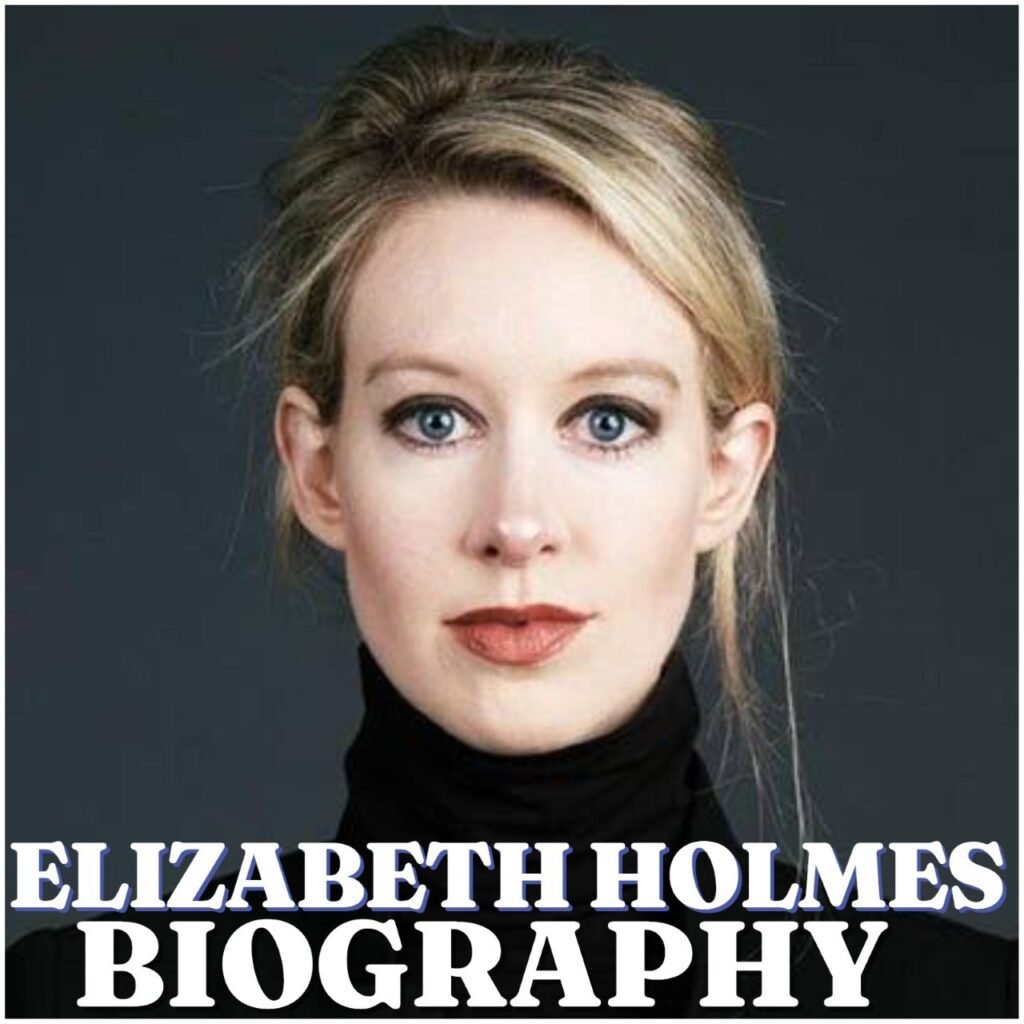
At the height of her success, Holmes became a symbol of ambition and innovation. She appeared at major business events, attracted wealthy investors and built relationships with influential figures. Theranos was once valued at approximately $9 billion, while Holmes was widely described as one of the world’s youngest self-made female billionaires. Her serious expression, deep voice and black turtleneck became familiar features of her public image.
However, the company’s success did not last. Investigations raised major questions about the accuracy of its blood-testing technology and the claims made to investors and the public. Theranos eventually collapsed, and Holmes faced criminal charges. Her conviction and prison sentence turned her story into one of the most widely discussed business scandals in modern American history.
Early Life and Family Background
Elizabeth Anne Holmes was born on February 3, 1984, in Washington, D.C., United States. She grew up in a family with professional and business connections. Her father, Christian Holmes IV, held positions in government and business, while her mother, Noel Holmes, worked as a congressional committee staffer. Her family background exposed her to conversations about leadership, public service and professional achievement.
Holmes developed an interest in technology and business while she was still young. She was known as an ambitious student who wanted to achieve something significant. Reports about her childhood describe her as someone who enjoyed learning and thinking about new ideas. She also developed an early interest in computer programming and entrepreneurship.
Her family’s later move to Houston, Texas, became an important part of her upbringing. She attended school there and continued to pursue her academic interests. Although her early life appeared ordinary in many ways, her ambition eventually led her toward an unusual business idea: making medical testing faster, easier and less expensive.
Education and Academic Background
Holmes attended St. John’s School, a private school in Houston, Texas. During her time there, she developed an interest in science and technology. She also explored computer programming and reportedly took steps to learn Mandarin Chinese. Her academic interests helped shape her plans for the future.
After completing secondary school, Holmes enrolled at Stanford University in California. She studied chemical engineering, a field that combines chemistry, mathematics and engineering principles. Stanford gave her access to a strong academic environment and opportunities to explore scientific research. It was also where she began developing the idea that would later become Theranos.
While studying at Stanford, Holmes became interested in improving medical testing. She believed that existing blood-testing methods could be made simpler and more convenient. In 2003, she left the university before completing her degree to establish her own company. Her decision marked the beginning of her journey as an entrepreneur.
Career and Rise to Fame
Founding of Theranos
In 2003, at the age of 19, Holmes founded a company originally called Real-Time Cures. She later renamed it Theranos, combining the words “therapy” and “diagnosis.” Her goal was to develop a technology that could perform a wide range of blood tests using only a small amount of blood collected from a finger prick.
The idea attracted attention because traditional blood tests often require larger samples collected through a vein. Holmes presented her proposed system as a way to make testing more convenient, reduce costs and help people receive medical information more easily. She believed the technology could transform healthcare.
Theranos attracted investors and gained support from prominent businesspeople and public figures. Its valuation rose sharply, reaching an estimated $9 billion at its peak. Holmes became the company’s public face and was celebrated as a young entrepreneur with the potential to change the medical industry.
Theranos and Its Promises
Holmes promoted the company’s technology as a major breakthrough in laboratory testing. Theranos claimed that its devices could carry out numerous tests from a very small blood sample. The company also entered a partnership with Walgreens, allowing it to offer blood-testing services through selected retail locations.
The company’s promises attracted customers who wanted convenient and affordable healthcare services. Investors also saw an opportunity to support a business that could disrupt an established industry. However, the technology did not perform as reliably as the company had suggested.
Questions about the accuracy and capabilities of Theranos’s devices became increasingly serious. Investigations later found that the company had used conventional laboratory machines for many tests instead of relying entirely on its own technology. These findings raised concerns about the claims Holmes and other company executives had made.
Investigations and Collapse of Theranos
In 2015, investigative reporting by journalist John Carreyrou of The Wall Street Journal brought major concerns about Theranos into public view. His reports questioned whether the company’s blood-testing devices could deliver the results it had promised. Former employees and other sources also raised concerns about the company’s testing practices.
The reports led to wider scrutiny from regulators, healthcare professionals and investors. Theranos faced investigations, legal challenges and growing public criticism. Its partnership with Walgreens ended, and the company struggled to maintain confidence in its services.
By 2018, Theranos had shut down. The collapse destroyed the company’s value and damaged the reputation of Holmes, who had once been celebrated as a leading figure in the technology industry. The story also raised important questions about transparency, scientific evidence and the responsibility of business leaders.
Criminal Trial and Prison Sentence
In 2018, federal prosecutors charged Holmes with fraud-related offences connected to her statements about Theranos. Her trial began in 2021 and attracted significant public attention. Prosecutors argued that she had misled investors about the company’s technology, business performance and financial position. Holmes denied the allegations and maintained that she had not intentionally defrauded anyone.
On January 3, 2022, a jury found her guilty of one count of conspiracy to commit wire fraud and three counts of wire fraud involving investors. She was acquitted of the charges relating to patients, while the jury did not reach a decision on some other counts. The verdict marked a major turning point in her life and career.
In November 2022, a federal judge sentenced Holmes to 135 months in prison. She began serving her sentence at a federal prison camp in Bryan, Texas, in May 2023. Her case became a major example of the legal consequences that can follow when business claims are not supported by reliable evidence.
Why Elizabeth Holmes Remains in the News
Elizabeth Holmes continues to attract public attention because her story raises questions about business ethics, investor protection and the limits of entrepreneurial ambition. Her rise and fall remain relevant to discussions about startup culture, especially when companies make bold claims about technology that has not been fully proven.
Her criminal conviction and prison sentence have also kept her in the public conversation. The case is frequently discussed in business reporting, documentaries and debates about corporate accountability. People remain interested in how a company that attracted billions of dollars in investment could collapse after serious questions emerged about its central technology.
The Theranos scandal has also become a warning for entrepreneurs and investors. It shows why scientific claims must be tested carefully and why business leaders should communicate honestly about the abilities and limitations of their products. Holmes’s story remains a reminder that public confidence cannot replace evidence.
Personal Life and Family
Elizabeth Holmes has kept much of her personal life away from public attention, although her relationship with Billy Evans has attracted media interest. Evans comes from a business family and has been linked to the hospitality industry. Reports about their relationship became public around 2017, before the Theranos scandal reached its final stages.
Holmes and Evans have two children. However, the couple have generally kept their children out of the public spotlight. Their decision to protect their family’s privacy means that limited information about their children’s lives is publicly available.
Her personal life has also been affected by the Theranos investigation and subsequent criminal case. The legal proceedings brought intense media attention and changed the direction of her future. Despite the public interest, details about her private family relationships should be treated carefully, especially where reports differ or information has not been independently confirmed.
Elizabeth Holmes’ Age, Religion, Tribe, Nationality, Height and Physical Appearance
Elizabeth Holmes was born on February 3, 1984. As of November 2026, she is 42 years old. She is American by nationality and was born in Washington, D.C., United States.
There is no reliable public confirmation of her religious beliefs. She has also not publicly identified with a particular tribe or ethnic community. Since she is American, tribal affiliation is not generally used as a standard part of her public biography.
Holmes is commonly reported to be about 5 feet 7 inches tall, although this measurement has not been confirmed through an authoritative public record. She has blonde hair and blue eyes. During her years leading Theranos, she became widely recognised for wearing black turtlenecks, a style that contributed to her carefully shaped public image.
Social Media Presence
Elizabeth Holmes has maintained a relatively limited public presence on social media, particularly since the collapse of Theranos and her criminal conviction. A public X account has been associated with her name, but its current activity and management should not be assumed without direct confirmation. Her public profile has largely been shaped by news coverage, court proceedings and discussions about the Theranos scandal.
Holmes’s limited online visibility reflects the change in her public life. Before the company’s collapse, she frequently appeared at business events and in media interviews. Today, most updates about her come through established news organisations rather than regular personal social media posts.
Elizabeth Holmes’ Net Worth
Elizabeth Holmes’s exact net worth is not publicly known. During Theranos’s most successful period, she was widely described as a billionaire because of the estimated value of her ownership stake in the company. At its peak, Theranos was valued at approximately $9 billion, and her stake was once estimated to be worth billions.
However, that wealth depended heavily on the company’s private valuation. When Theranos collapsed, its shares lost their value, and Holmes’s estimated fortune disappeared. The billionaire status associated with her name no longer reflected her financial position after the company’s failure.
Holmes was also ordered to pay restitution alongside former Theranos executive Ramesh “Sunny” Balwani. The court ordered them to pay approximately $452 million to victims, jointly and severally. This financial obligation, combined with the collapse of Theranos, makes it difficult to establish a reliable current net worth. Any exact figure presented without verified financial records should therefore be treated with caution.
Legacy and Public Impact
Elizabeth Holmes’s legacy is closely connected to the rise and collapse of Theranos. She began with an ambitious idea that promised to make medical testing easier and more accessible. Her ability to attract investors and public attention showed how strongly people can respond to a compelling vision, especially when it appears to offer a solution to a major problem.
However, the failure of Theranos changed how many people view her achievements. The case exposed the dangers of making scientific and medical claims without sufficient evidence. It also highlighted the need for independent testing, honest communication and strong oversight in companies that provide healthcare services.
Her story continues to influence conversations about entrepreneurship, leadership and corporate responsibility. For business founders, it demonstrates that ambition must be supported by facts and that trust takes years to build but can be destroyed by dishonesty. For investors, it shows the importance of examining a company’s technology and financial claims rather than relying only on its reputation or the confidence of its leaders.
Conclusion
Elizabeth Holmes’s life story is one of ambition, rapid success and a dramatic fall from public favour. She founded Theranos with the promise of transforming blood testing, attracted major investors and became one of the most recognisable young entrepreneurs in America. However, serious questions about the company’s technology led to investigations, its eventual collapse and her conviction for fraud involving investors. Her story remains an important lesson about honesty, scientific responsibility and the need to support business promises with reliable evidence.
Frequently Asked Questions About Elizabeth Holmes
Who is Elizabeth Holmes?
Elizabeth Holmes is an American former entrepreneur best known for founding Theranos, a health technology company that claimed it could perform many blood tests using small samples of blood.
How old is Elizabeth Holmes?
Elizabeth Holmes was born on February 3, 1984. She is 42 years old as of November 2026.
Where was Elizabeth Holmes born?
She was born in Washington, D.C., United States.
What is Elizabeth Holmes famous for?
She is famous for founding Theranos and promoting its blood-testing technology. The company later collapsed after investigations raised serious concerns about its technology and business claims.
Did Elizabeth Holmes graduate from Stanford University?
No. She studied chemical engineering at Stanford University but left in 2003 before completing her degree to establish her company.
What happened to Theranos?
Theranos collapsed after investigations exposed serious problems with its blood-testing technology and the claims made about its capabilities. The company shut down in 2018.
Was Elizabeth Holmes found guilty?
Yes. In January 2022, a jury found her guilty of one count of conspiracy to commit wire fraud and three counts of wire fraud involving investors. She was acquitted of charges relating to patients.
How long was Elizabeth Holmes sentenced to prison?
She was sentenced to 135 months in prison in November 2022.
Does Elizabeth Holmes have children?
Yes. Elizabeth Holmes and her partner, Billy Evans, have two children.
What is Elizabeth Holmes’ net worth?
Her exact current net worth is not publicly known. Her former wealth was largely tied to her ownership stake in Theranos, which became worthless after the company collapsed.
Is Elizabeth Holmes married?
Holmes has been publicly linked to Billy Evans, with whom she has two children. Reports about their legal marital status have not always been consistent, so it is best not to describe their relationship as a confirmed marriage without reliable evidence.
What is Elizabeth Holmes’ nationality?
Elizabeth Holmes is American.