
Introduction
Dame Agatha Mary Clarissa Christie was a British novelist and playwright widely regarded as the Queen of Crime. She became famous for creating ingenious murder mysteries, memorable detectives and surprising plot twists that transformed detective fiction into one of the world’s most popular literary genres. Her best-known fictional characters, Hercule Poirot and Miss Jane Marple, have entertained generations of readers through novels, short stories, films, television series and stage productions. Her ability to combine logical investigation with suspense and a deep understanding of human behaviour established her as one of the most influential writers in literary history.
Born on September 15, 1890, in Torquay, Devon, England, Christie developed her storytelling abilities through reading, imagination and independent learning. During the First World War, she worked in a hospital and dispensary, gaining knowledge of medicines and poisons that later helped her construct convincing crime plots. Her first published detective novel, The Mysterious Affair at Styles, appeared in 1920 and introduced Hercule Poirot. From that point, she built an extraordinary career that included 66 detective novels, 14 short-story collections and numerous plays, including the internationally celebrated The Mousetrap.
Christie died on January 12, 1976, at the age of 85, but her literary influence has continued through new editions, translations, adaptations and reading initiatives. Her stories remain popular because they invite readers to examine clues, question appearances and reconsider what they believe about the characters. In 2026, her work continues to attract attention through renewed reading campaigns and adaptations, demonstrating that her approach to suspense remains relevant long after her death.
Early Life and Family Background
Agatha Christie was born Agatha Mary Clarissa Miller on September 15, 1890, in Torquay, England. She was the youngest child of Frederick Alvah Miller, an American-born man, and Clara Boehmer Miller, who came from a British family with Irish connections. She grew up with her older sister, Margaret Frary Miller, known as Madge, and her older brother, Louis Montant Miller, known as Monty. Her childhood home, Ashfield, provided a comfortable environment in which she could read, play and develop her imagination.
Her mother played an important role in nurturing her creativity. Christie enjoyed stories and imaginative games, and she taught herself to read while still young. She also developed an interest in writing and inventing characters, sometimes creating stories with her sister. These early experiences encouraged her to explore the motives and secrets that would later become central to her detective fiction.
Christie’s childhood was affected by her father’s death in 1901, when she was ten years old. The loss brought emotional and financial challenges to the family, strengthening the importance of her relationship with her mother. As she grew older, Christie also spent time in France, where she gained experience of a different culture and improved her French. Her early experiences of family life, independence and travel helped shape her understanding of people and relationships, which became important elements of her writing.
Education and Early Interests
Christie received much of her early education at home before attending schools in Torquay and Paris. Her upbringing encouraged independent reading and learning, allowing her to explore literature and develop her imagination. Although she did not attend university, she gained knowledge through reading, practical experience and travel. She also studied music and singing and at one stage considered pursuing a musical career, but her shyness made public performance difficult.
During the First World War, Christie worked in a hospital and later in a dispensary. She studied medicines and pharmaceutical substances and passed an examination associated with the Society of Apothecaries in 1917. This practical experience became especially valuable when she began writing mysteries involving poisoning. Her knowledge allowed her to incorporate medical details into her stories and use poisons as important elements of her plots.
Christie’s education therefore combined formal schooling with practical learning and personal curiosity. Her ability to observe people, research unfamiliar subjects and construct convincing narratives proved more important to her literary success than a conventional academic career. Her experience demonstrates how independent study and professional exposure can contribute to a writer’s development.
Career and Rise to Fame
The beginning of her writing career
Christie began experimenting with fiction as a young woman, writing short stories and exploring different narrative styles. Her first detective novel, The Mysterious Affair at Styles, was published in 1920 after she experienced difficulties finding a publisher. The book introduced Hercule Poirot, a Belgian detective known for his intelligence, precise habits and reliance on logical reasoning.
The novel established the foundation of Christie’s career. She developed a style built around a group of suspects, carefully placed clues, misleading statements and a final explanation that revealed the truth. Her experience in the dispensary helped her write poisoning plots, while her interest in human behaviour enabled her to give characters believable motives. These techniques became hallmarks of her work.
Hercule Poirot and Miss Marple
Hercule Poirot became one of Christie’s most recognisable creations. His meticulous reasoning, distinctive moustache and confidence in his intellectual abilities made him a memorable detective. He appeared in numerous novels and short stories, including The Murder of Roger Ackroyd, Murder on the Orient Express, Death on the Nile and The ABC Murders. Christie eventually brought his story to a planned conclusion in Curtain: Poirot’s Last Case, published in 1975.
Christie’s other major detective, Miss Jane Marple, offered a different approach to solving crimes. First introduced in a published short story in 1927, she became the central character of The Murder at the Vicarage in 1930. Miss Marple is an observant older woman whose knowledge of village life helps her recognise patterns in human behaviour. While Poirot often relies on systematic questioning and formal analysis, Miss Marple draws on her understanding of jealousy, greed, deception and social relationships.
These detectives helped distinguish Christie from other crime writers. Their contrasting personalities allowed her to explore different kinds of mysteries while maintaining the intellectual challenge that readers expected. Both characters remain familiar through books and screen adaptations.
Famous novels and literary achievements
Christie wrote 66 detective novels and 14 short-story collections. Her most famous books include And Then There Were None, Murder on the Orient Express, Death on the Nile, The Murder of Roger Ackroyd, The ABC Murders and The Mysterious Affair at Styles.
The Murder of Roger Ackroyd, published in 1926, became particularly notable for its unconventional narrative technique. Murder on the Orient Express attracted attention for its unusual resolution, while And Then There Were None demonstrated her ability to build tension around a group of people trapped in a dangerous situation. Her plots encouraged readers to examine evidence, challenge assumptions and look for clues hidden in ordinary conversations.
Christie also wrote romantic novels under the pseudonym Mary Westmacott. These works allowed her to explore relationships and emotions outside the detective genre. Her willingness to write under another name reflected the breadth of her interests and her ability to work across different literary forms.
Theatre and The Mousetrap
Christie’s success extended to the stage. Her most famous play, The Mousetrap, opened in London in 1952 and became renowned for its exceptionally long theatrical run. Its continued popularity reflects her ability to maintain suspense through dialogue, character interactions and carefully controlled revelations.
Another celebrated play, Witness for the Prosecution, adapted from one of her short stories, explores uncertainty and conflicting testimony within a courtroom setting. It has also received successful screen adaptations. Her theatrical work helped introduce her mysteries to audiences who might never have read her novels, reinforcing her position as a versatile storyteller.
Travel and archaeological inspiration
Travel became another important source of inspiration for Christie. In 1922, she accompanied her first husband, Archibald Christie, on a journey connected with a British Empire trade mission. Later, her second husband, archaeologist Max Mallowan, introduced her to archaeological expeditions in the Middle East, which she frequently joined.
These experiences influenced books such as Murder in Mesopotamia, Death on the Nile and Appointment with Death. International settings allowed her to explore unfamiliar environments, travel-related encounters and complicated social relationships. Her travels enriched her descriptions of places and gave her additional settings in which to construct mysteries.
Why Agatha Christie Is Trending in 2026
Agatha Christie continues to attract attention in 2026 because her books remain widely read and her stories continue to inspire adaptations. The Read Christie 2026 initiative encourages readers to revisit her work and discover novels beyond her most famous titles. It reflects the continuing interest in her catalogue and introduces her mysteries to readers who may have first encountered them through films, television or audiobooks.
New and developing adaptations also help keep her work in public discussion. Audio, screen and theatrical projects based on her stories continue to demonstrate the flexibility of her plots and characters. Her mysteries can be reinterpreted for new audiences while retaining the central elements that made them popular: suspense, hidden motives, clues and unexpected conclusions.
Christie’s stories also reward rereading. Readers familiar with a novel’s ending can return to earlier scenes and recognise clues they previously overlooked. This makes her books particularly suitable for reading groups, online discussions and mystery enthusiasts. Her continued relevance in 2026 shows that her reputation rests not only on nostalgia but also on storytelling techniques that remain entertaining and influential.
Personal Life and Family
Christie married Archibald Christie, commonly known as Archie, in 1914. Their early marriage took place during the First World War, when she was working in a hospital and he was serving in the military. They had one daughter, Rosalind Margaret Clarissa Christie, born on August 5, 1919. While Christie developed her writing career, she also tried to maintain family life and care for her daughter.
Her marriage to Archie eventually broke down after he became involved with another woman. The couple divorced in 1928, a difficult period that also coincided with the death of Christie’s mother. Despite these personal challenges, Christie continued writing and gradually rebuilt her life. Her ability to maintain her career during a period of emotional upheaval reflected her determination and commitment to her work.
In 1930, Christie married Max Mallowan, a British archaeologist. Their marriage lasted until her death in 1976. Through her relationship with Mallowan, she became closely involved with archaeological expeditions and developed a lasting interest in the history and cultures of the Middle East. Their shared travels influenced her writing and gave her opportunities to experience life beyond England.
Agatha Christie’s daughter and grandchildren
Christie’s only daughter, Rosalind, later became Rosalind Hicks after marrying Hubert Prichard. Rosalind remained an important part of her mother’s life, while her son, Mathew Prichard, became closely involved in preserving Christie’s literary legacy.
Mathew Prichard has helped keep his grandmother’s books and history accessible to new generations. The family’s role in maintaining her literary estate has contributed to the continuing publication and promotion of her work. Their involvement also helps readers understand Christie as a family member and private individual, not only as a famous author.
Age, Religion, Nationality, Tribe, Height and Physical Appearance
Agatha Christie was born on September 15, 1890, and died on January 12, 1976, at the age of 85. She was British and was born in Torquay, Devon, England. Her family background included American ancestry through her father and British and Irish connections through her mother’s family. A specific tribal identity is not generally applicable to her biography in the way it is often used in biographies of African public figures.
Christie grew up within a Christian cultural environment, but her personal religious beliefs are not consistently documented as a central part of her public biography. Her exact height is also not reliably established in widely available biographical records, so a precise measurement should not be assumed.
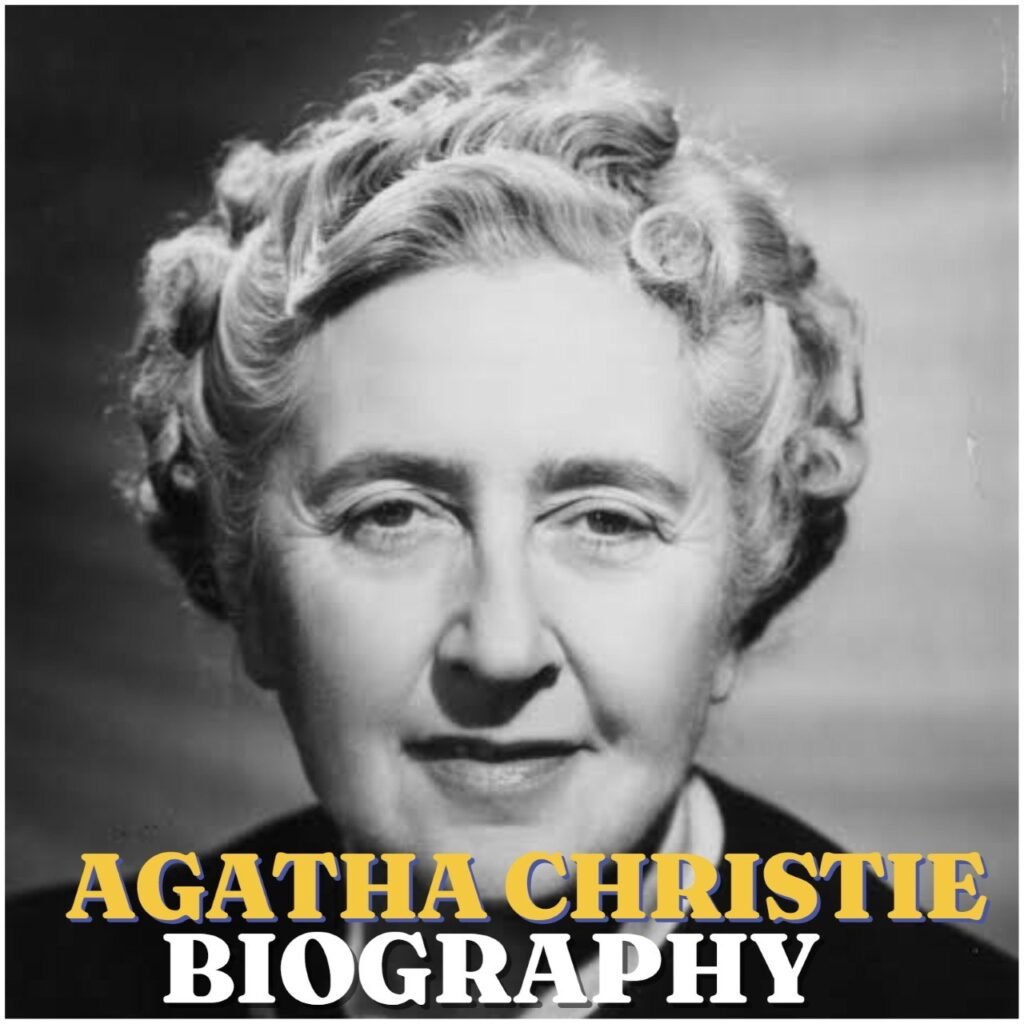
Historical photographs show Christie with carefully styled hair, composed expressions and understated clothing typical of her generation. Unlike entertainers whose public images depend on fashion or celebrity appearances, her reputation was primarily associated with her writing. Her most recognisable public identity came from her books, plays and literary achievements.
Social Media Presence and Digital Legacy
Agatha Christie did not have personal social media accounts because she died in 1976, long before platforms such as Instagram, Facebook, TikTok and X existed. Accounts using her name today should not automatically be considered personal accounts belonging to the author.
Her literary estate and official website maintain a digital presence through which readers can explore her books, characters, adaptations and biography. These platforms share information about publications, stage productions, screen projects and reading initiatives, helping introduce her work to younger audiences.
Her continued popularity online is supported by discussions about Poirot and Miss Marple, recommendations of her novels and comparisons between different adaptations. Her carefully constructed mysteries encourage readers to revisit clues and debate possible interpretations, making her work well suited to digital reading communities.
Agatha Christie’s Net Worth and Sources of Wealth
Agatha Christie’s exact net worth at the time of her death is not established by one universally accepted public figure. Nevertheless, her financial success as an author and playwright is well documented through the enormous readership of her books and the continuing popularity of her stage works and adaptations.
Her principal source of income was writing. She published dozens of novels and short-story collections, many of which were translated into numerous languages and repeatedly reprinted. Her plays, particularly The Mousetrap, also contributed to her commercial success. Film, television, radio and audio adaptations have helped preserve the commercial value of her stories long after her death.
Christie’s official literary biography reports that her books have sold more than a billion copies in English and another billion in translation. This extraordinary readership demonstrates her global reach and lasting commercial importance. Rather than relying on an unverified net-worth estimate, her publishing success, theatrical achievements and continuing adaptations provide a more reliable picture of her financial legacy.
Awards, Honours and Major Achievements
Christie received major recognition for her contribution to British literature. In 1950, she became a Fellow of the Royal Society of Literature. In 1956, she was appointed Commander of the Order of the British Empire (CBE), and in 1971 she was made a Dame Commander of the Order of the British Empire (DBE).
Her other major achievements include creating two of the most recognisable detectives in fiction, writing The Mousetrap and producing a large body of internationally successful mysteries. Her books have been translated into many languages, adapted for different media and read by generations of audiences.
Her most significant achievement may be the durability of her readership. Christie’s work remains a defining part of detective fiction, demonstrating that popular storytelling can combine commercial success with intricate plotting and memorable characters.
Cause of Death: How Did Agatha Christie Die?
Agatha Christie died on January 12, 1976, at her home, Winterbrook House, near Wallingford, Oxfordshire, England. She was 85 years old, and her death was attributed to natural causes following declining health in her later years.
Her death marked the end of a remarkable literary career, but her stories continued to reach readers. Curtain: Poirot’s Last Case had been published in 1975, while Sleeping Murder, featuring Miss Marple, appeared posthumously in 1976. These publications reflected Christie’s long-term planning for the conclusions of her most famous detectives.
Although she was no longer alive to oversee new adaptations, her books and plays continued to be published, performed and reinterpreted. Her death did not diminish her influence, and her position as one of the world’s most successful mystery writers remains firmly established.
Legacy and Influence on Crime Fiction
Agatha Christie helped define the modern detective novel through her use of logical investigation, carefully arranged clues, misleading statements and unexpected revelations. Her mysteries encourage readers to participate in solving the crime, examining the evidence and questioning the motives of the characters. The final explanation often changes how earlier events are understood, creating the satisfaction that has made her work so enduring.
Her influence can be seen in generations of mystery writers who use closed-circle settings, multiple suspects, unreliable accounts and surprising conclusions. She demonstrated that crime fiction could be intellectually engaging while remaining accessible to a broad readership. Her stories also explored the psychological and social reasons behind criminal behaviour, making relationships and motives as important as physical evidence.
Poirot and Miss Marple continue to be portrayed by different actors, introducing Christie’s characters to audiences across generations. Her novels and plays remain part of international popular culture, while her writing is still studied for its structure, suspense and characterisation. More than a century after her first novel appeared, Christie remains one of the most influential figures in detective fiction.
Conclusion
Agatha Christie was a pioneering British novelist and playwright whose imagination and mastery of suspense transformed detective fiction. Through Hercule Poirot, Miss Marple, Murder on the Orient Express, And Then There Were None and The Mousetrap, she created stories that continue to challenge and entertain readers around the world. Her life included family difficulties, motherhood, two marriages, extensive travel and a literary career that lasted for decades. Although she died in 1976 at the age of 85, her books remain widely read, adapted and discussed. Her enduring achievements have secured her place as the Queen of Crime and one of the most successful storytellers in literary history.
Frequently Asked Questions About Agatha Christie
Who was Agatha Christie?
Agatha Christie was a British novelist and playwright famous for detective fiction. She created Hercule Poirot and Miss Jane Marple and wrote classics including Murder on the Orient Express and And Then There Were None.
What was Agatha Christie’s real name?
Her birth name was Agatha Mary Clarissa Miller. After her second marriage, she was also known as Agatha Mary Clarissa Mallowan.
When was Agatha Christie born?
She was born on September 15, 1890, in Torquay, Devon, England.
How old was Agatha Christie when she died?
She was 85 years old when she died on January 12, 1976.
What caused Agatha Christie’s death?
She died from natural causes at her home near Wallingford, Oxfordshire, England.
Who was Agatha Christie’s husband?
She married Archibald Christie in 1914 and divorced him in 1928. In 1930, she married archaeologist Max Mallowan, with whom she remained married until her death.
Did Agatha Christie have children?
Yes. She had one daughter, Rosalind Margaret Clarissa Christie, born in 1919.
What was Agatha Christie’s first detective novel?
Her first published detective novel was The Mysterious Affair at Styles, released in 1920. It introduced Hercule Poirot.
Who were Agatha Christie’s most famous detectives?
Her most famous detectives were Hercule Poirot, a Belgian investigator known for logical reasoning, and Miss Jane Marple, an older woman who solves crimes through her understanding of human behaviour.
What are Agatha Christie’s most famous books?
Her best-known books include And Then There Were None, Murder on the Orient Express, Death on the Nile, The Murder of Roger Ackroyd and The ABC Murders.
Did Agatha Christie write plays?
Yes. Her best-known plays include The Mousetrap and Witness for the Prosecution. The Mousetrap became famous for its exceptionally long theatrical run.
What was Agatha Christie’s net worth?
Her exact net worth at death is not reliably established in one public figure. However, her novels, plays and adaptations achieved enormous commercial success.
Did Agatha Christie use social media?
No. She died in 1976, before modern social media platforms existed. Her literary estate maintains an online presence dedicated to her life and work.
Why is Agatha Christie still famous in 2026?
Her mysteries remain popular because of their suspense, memorable detectives and surprising conclusions. Reading initiatives and new adaptations continue to introduce her work to new audiences.
What is Agatha Christie’s literary legacy?
Her legacy is her lasting influence on detective fiction, particularly her use of clues, logical investigation, multiple suspects and unexpected solutions. She remains one of the world’s most influential mystery writers.