
Introduction
Adolf Hitler was a German political leader who became one of the most consequential and destructive figures of the 20th century. Born on April 20, 1889, in Braunau am Inn, Austria-Hungary, he rose from relative obscurity to become leader of the National Socialist German Workers’ Party (Nazi Party) and, in 1933, Chancellor of Germany. His dictatorship transformed Germany’s political system and played a central role in the outbreak of the Second World War in Europe.
Hitler’s government was based on an extreme racist and antisemitic ideology, aggressive nationalism, dictatorship, and territorial expansion. Under his rule, Nazi Germany persecuted Jewish people and numerous other groups, ultimately carrying out the Holocaust, in which approximately six million Jews were murdered. The Nazi regime also persecuted and murdered Roma, disabled people, political opponents, and other targeted groups. Hitler’s policies of military expansion contributed directly to the outbreak and escalation of World War II, which caused enormous loss of life across Europe and beyond.
Adolf Hitler died in Berlin on April 30, 1945, as Nazi Germany was collapsing near the end of World War II. His historical legacy is overwhelmingly associated with dictatorship, mass persecution, genocide, war, and the catastrophic consequences of Nazi ideology. Today, historians continue to study his political rise, the structure of the Nazi regime, the Holocaust, and the social and political conditions that enabled his government to gain and maintain power, partly to better understand how democratic institutions can be undermined by authoritarian movements.
Early Life of Adolf Hitler
Adolf Hitler was born on April 20, 1889, in Braunau am Inn, a town in the Austro-Hungarian Empire near the German border. He was the fourth of six children born to Alois Hitler and Klara Hitler. His father was a customs official, while his mother devoted much of her life to caring for the family. In 1892, the family moved from Braunau to Passau, Germany, and later lived in several locations in Austria, including Linz, where Hitler spent much of his childhood. His father’s strict personality reportedly contributed to tensions within the household, while Hitler remained particularly close to his mother.
As a young person in Linz, Hitler developed an interest in art, architecture, and German nationalism. He attended several schools but did not complete a formal academic education beyond secondary-level schooling. After the death of his father in 1903, Hitler’s relationship with his mother became especially important to him. Following her death from cancer in 1907, he moved to Vienna with ambitions of becoming an artist. He applied to the Academy of Fine Arts Vienna but was rejected, including after a second application in 1908. During his years in Vienna, he struggled financially and lived for periods in men’s hostels while attempting to earn money from paintings and architectural sketches.
Hitler’s years in Vienna and later Munich were important in the development of his political worldview, although historians caution against treating his later ideology as the inevitable result of his childhood experiences. Vienna at the time contained competing nationalist, antisemitic, and political movements, and Hitler encountered a variety of ideas that later influenced his worldview. In 1913, he moved to Munich, Germany, where he remained when World War I began in 1914. He volunteered for the Bavarian Army and served as a soldier during the war, an experience that became an important part of his later political identity and propaganda.
Education of Adolf Hitler
Adolf Hitler received his early education in schools in Austria, particularly in Linz, where his family lived for much of his childhood. He attended the Realschule in Linz and later the Realschule in Steyr, but he did not complete his secondary education. Hitler was reportedly more interested in subjects connected to art and history than in following the conventional academic path expected by his father, Alois Hitler. His formal schooling therefore ended without him obtaining a university qualification or completing a professional academic program.
After leaving school, Hitler developed ambitions of becoming an artist. In 1907, he traveled to Vienna and applied to the Academy of Fine Arts Vienna, hoping to study painting. He was not admitted. He applied again the following year but was rejected a second time. According to historical accounts, the academy’s admissions process indicated that his work was considered stronger in architectural drawing than in the areas required for admission to the painting program. Hitler subsequently continued to develop his artistic skills independently and earned limited income from paintings and drawings.
Hitler never attended a university and did not earn a formal higher-education degree. His later intellectual development came largely through independent reading, political discussions, personal experiences, and exposure to nationalist and antisemitic political currents in Vienna and Munich. His education and intellectual formation should therefore be distinguished from formal academic achievement: although he acquired considerable familiarity with political and historical ideas, his later ideology was shaped through a combination of personal experiences and the political environment of the early 20th century rather than through a conventional university education.
Political Career and Rise to Power
Adolf Hitler’s public career began after his service in World War I. During the war, he served in the Bavarian Army and was wounded and temporarily affected by a gas attack in 1918. After Germany’s defeat, he remained in the military and became involved in political education and intelligence activities. In 1919, he attended a meeting of the German Workers’ Party in Munich and soon joined the organization, which was later renamed the National Socialist German Workers’ Party, commonly known as the Nazi Party. Hitler quickly became one of its most prominent speakers, using emotionally charged political speeches to attract supporters.
By the early 1920s, Hitler had become the leader of the Nazi Party and helped establish its distinctive political identity, combining extreme nationalism, antisemitism, racism, anti-communism, and opposition to Germany’s democratic Weimar government. In 1923, he attempted to seize political power through the failed Beer Hall Putsch in Munich. He was arrested and convicted of treason and spent several months in Landsberg Prison. During his imprisonment, he dictated much of Mein Kampf, a book that outlined elements of his political worldview and future objectives. After his release, Hitler reorganized the Nazi Party and increasingly pursued power through electoral politics and political alliances rather than another immediate armed uprising.
The Nazi Party gained substantial support during the economic and political crises of the late 1920s and early 1930s. Hitler was appointed Chancellor of Germany on January 30, 1933, and his government rapidly dismantled democratic institutions and established a dictatorship. Following the death of President Paul von Hindenburg in 1934, Hitler combined the offices of president and chancellor and became Germany’s Führer. His regime introduced extensive persecution of Jewish people and other targeted groups, expanded Germany’s military forces, and pursued territorial expansion. Hitler’s aggressive foreign policy contributed to the outbreak of World War II in Europe in September 1939, after Germany invaded Poland.
During World War II, Hitler exercised increasingly direct control over Germany’s military and political decisions. Nazi Germany occupied large parts of Europe, while the regime carried out mass persecution and the Holocaust, the systematic murder of approximately six million Jews. Millions of other civilians and prisoners were also killed or subjected to persecution, forced labor, and mass violence. Germany’s military position deteriorated as Allied forces advanced from both east and west. Hitler remained in Berlin during the final stage of the war and died on April 30, 1945, shortly before Germany’s unconditional surrender. His political career is therefore inseparable from dictatorship, World War II, the Holocaust, and the destruction caused by Nazi rule.
Why Adolf Hitler Is Trending Today
Adolf Hitler remains a recurring subject of public discussion because historians, educators, journalists, and political commentators continue to examine how he and the Nazi Party rose from a relatively small political movement to control Germany. Contemporary historical research continues to revisit the economic crisis, political instability, propaganda, antisemitism, nationalism, and institutional decisions that contributed to the Nazi takeover in 1933. These discussions are particularly relevant when examining how democratic systems can be weakened and how extremist political movements can exploit periods of social and economic uncertainty.
Hitler also continues to appear in contemporary debates because his historical record is frequently referenced when discussing authoritarianism, political extremism, antisemitism, genocide, and the responsibilities of governments and institutions. Such references can generate controversy, particularly when historical comparisons are made in modern political arguments. Historians generally emphasize the importance of understanding the specific circumstances of Nazi Germany rather than using comparisons without adequate historical context.
The continuing interest in Hitler is also connected to education and Holocaust remembrance. Museums, universities, historians, and educational institutions continue to research and document Nazi persecution, the Holocaust, World War II, and the experiences of victims and survivors. As new archival evidence and historical interpretations become available, scholarship continues to refine understanding of this period, making Hitler’s life and political career an enduring subject of historical study rather than a contemporary political career.
Personal Life and Family of Adolf Hitler
Adolf Hitler was born to Alois Hitler and Klara Hitler. His father worked as a customs official in the Austro-Hungarian Empire, while his mother was primarily responsible for raising the family. Hitler had several siblings, although some died during childhood. His younger sister Paula Hitler was the only sibling to survive into adulthood. Hitler was particularly close to his mother, whose death from cancer in 1907 had a significant personal impact on him. His relationship with his father was more complicated, with historical accounts describing Alois as a strict parent who wanted his son to pursue a conventional career.
Hitler never had children. Throughout much of his political career, he maintained a highly controlled public image and generally kept his private relationships away from public attention. His best-known long-term romantic relationship was with Eva Braun, whom he met in the 1920s. Braun remained largely outside Hitler’s public political life, although she lived with him privately for significant periods. The two married on April 29, 1945, in the Führerbunker in Berlin, only one day before their deaths.
Hitler’s final days were spent with Eva Braun and a small group of associates in the underground bunker as Soviet forces closed in on Berlin. Hitler and Braun died on April 30, 1945, shortly after their marriage. Hitler’s family relationships have remained a subject of historical research, particularly because his public persona was carefully constructed and his relatives generally had limited roles in Nazi Germany’s political leadership. His sister Paula survived the war and lived until 1960, maintaining a relatively private life after 1945.
Adolf Hitler Age, Religion, Nationality, Health and Physical Appearance
Adolf Hitler was born on April 20, 1889, and died on April 30, 1945, at the age of 56. His life spanned the final years of the Austro-Hungarian Empire, the First World War, the Weimar Republic, and Nazi Germany. He spent his final years directing Nazi Germany during World War II.
Hitler was baptized as a Roman Catholic and was raised within the Catholic tradition. His personal relationship with Christianity and organized religion was complicated, and historians have documented statements and policies that conflicted with Christian teachings. Claims about his precise private religious beliefs have therefore been debated by historians, and it is more accurate to distinguish his Catholic upbringing from his later political and personal views.
Hitler was born in Austria-Hungary and was an Austrian by birth. He moved to Germany in 1913 and served in the Bavarian Army during World War I. In 1925, after previously becoming stateless, he later obtained German citizenship in 1932, allowing him to stand for political office in Germany. He subsequently became the leader of Nazi Germany.
Hitler experienced several documented health problems during his lifetime. He was wounded during World War I and was temporarily affected by a mustard-gas attack in 1918. Historical accounts also document various other physical ailments and medications during his later years. However, descriptions of his health are sometimes based on disputed historical accounts, so claims about specific diagnoses should be treated cautiously.
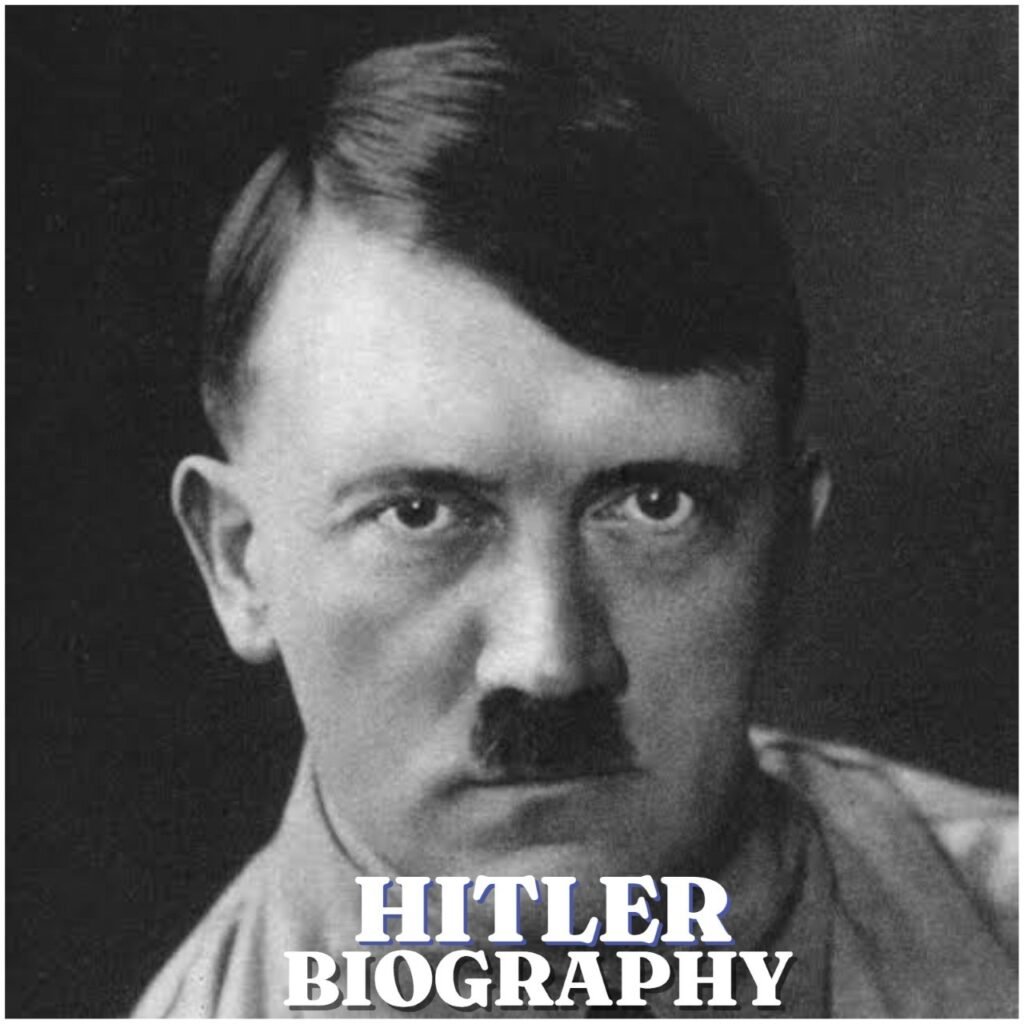
Contemporary photographs and historical descriptions generally depict Hitler as having dark brown hair, blue-gray eyes, and a distinctive toothbrush-style mustache. He was approximately 175 cm (5 feet 9 inches) tall. His appearance became closely associated with the carefully controlled visual imagery used by the Nazi regime, including formal military and political portraits designed to project authority and leadership.
Adolf Hitler Age, Religion, Tribe, Height and Physical Appearance
Adolf Hitler was born on April 20, 1889, and died on April 30, 1945, aged 56. He was born in Braunau am Inn in what was then Austria-Hungary and spent his adult life during a period of major political and social upheaval in Europe.
Hitler was baptized and raised as a Roman Catholic. His later relationship with Christianity and organized religion was complicated, and historians have debated the extent and nature of his personal religious beliefs. His Catholic upbringing should therefore not automatically be treated as a complete description of his later religious views.
The concept of “tribe” does not accurately describe Hitler’s ethnic or national background in the way it is commonly used for many African societies. He was Austrian by birth and came from a German-speaking family. His parents were Alois Hitler and Klara Hitler, and his family background was associated with the German-speaking population of the Austro-Hungarian Empire.
Historical sources generally place Hitler’s height at approximately 175 cm (5 feet 9 inches). Measurements reported in historical records can vary slightly, so this figure is best regarded as an approximate height rather than an exact measurement.
Historical photographs and descriptions depict Hitler as having dark brown hair, blue-gray eyes, and a distinctive toothbrush-style mustache. He was often photographed wearing military or formal political clothing, with his appearance deliberately incorporated into the Nazi regime’s carefully controlled propaganda imagery. These visual representations became strongly associated with his public persona during the 1930s and World War II.
Adolf Hitler Social Media Presence
Adolf Hitler had no social media presence because social-media platforms did not exist during his lifetime. He died on April 30, 1945, decades before the emergence of platforms such as Facebook, X, Instagram, YouTube, and TikTok. Consequently, there is no authentic or verified social-media handle belonging to Hitler.
Today, Hitler’s name and historical photographs may appear on social-media platforms in educational posts, historical discussions, documentaries, archival projects, and political commentary. However, accounts using handles such as @AdolfHitler or similar names should not be regarded as belonging to Hitler himself. Some may be historical-interest accounts, parody accounts, fan accounts, or accounts operated by unrelated individuals.
For an accurate historical profile, it is therefore more appropriate to refer to Adolf Hitler’s documented historical record rather than attribute any modern social-media handle to him. Researchers and readers should also exercise caution when encountering social-media posts about Hitler, particularly when quotations, photographs, or claims about his life are presented without reliable historical sources.
Adolf Hitler Net Worth
Adolf Hitler’s exact personal net worth at the time of his death cannot be established with complete certainty because his private assets, political income, royalties, property, and resources connected to the Nazi state were often difficult to separate. Historical research nevertheless shows that he had accumulated substantial personal wealth by the 1940s. A German historical source notes that Mein Kampf had sold about 10 million copies worldwide by 1945 and that the royalties made Hitler a multimillionaire.
A significant portion of Hitler’s documented personal income came from royalties from Mein Kampf, along with income associated with the use of his image and other sources. One historical estimate places his real-estate holdings alone at approximately 244 million to 566 million Reichsmarks at the end of 1944, although converting that figure directly into today’s money is difficult because wartime Reichsmark values and economic conditions do not translate neatly into modern currency.
For a modern biographical article, a cautious estimate would therefore place Hitler’s personal fortune in the tens to hundreds of millions of U.S. dollars in modern purchasing-power terms, depending on the methodology used. One recent estimate calculated an equivalent of roughly $220 million in 2026 U.S. dollars, but this should be treated as an estimate rather than an established historical figure. His wealth should also not be confused with the much larger financial resources and assets controlled by Nazi Germany itself.
Legacy of Adolf Hitler
Adolf Hitler’s historical legacy is inseparable from the Nazi dictatorship, the Holocaust, and World War II. His government established a totalitarian system in Germany, persecuted Jews and numerous other groups, and pursued territorial expansion through military force. The Holocaust resulted in the systematic murder of approximately six million Jews, while millions of other people were also killed or persecuted under Nazi rule and during the war. These events remain among the most extensively studied subjects in modern history.
Hitler’s rise and the collapse of German democracy have also become important subjects in the study of political history. Historians examine how economic hardship, political instability, propaganda, antisemitism, nationalism, and institutional decisions contributed to the Nazi Party’s rise to power. His dictatorship demonstrated the destructive consequences of dismantling democratic institutions and concentrating political authority in the hands of an authoritarian leader. The history of Nazi Germany continues to inform education about human rights, genocide, political extremism, and the protection of democratic institutions.
Today, Hitler’s name remains strongly associated with dictatorship, genocide, racism, antisemitism, war, and mass political violence. Museums, memorials, archives, universities, and Holocaust education programs continue to preserve evidence about Nazi crimes and the experiences of their victims. His legacy is therefore not simply a biography of one historical figure but part of a broader historical record used to understand how persecution and mass violence developed and how societies can work to prevent similar atrocities from recurring.
Conclusion
Adolf Hitler remains one of the most extensively studied and consequential figures of the 20th century because of the enormous impact of his dictatorship on Germany, Europe, and the wider world. His rise from an unsuccessful aspiring artist to the leader of Nazi Germany was shaped by the political and economic circumstances of his era, while his policies led to dictatorship, aggressive war, systematic persecution, and the Holocaust. Understanding Hitler’s life and career requires examining both his personal history and the institutions, social conditions, and political decisions that enabled Nazi rule, as well as remembering the millions of people who suffered and died under that regime.
Frequently Asked Questions About Adolf Hitler
Who was Adolf Hitler?
Adolf Hitler was an Austrian-born German political leader who became leader of Nazi Germany from 1933 until his death in 1945. He established a dictatorship, initiated aggressive territorial expansion, and played a central role in the Holocaust and the outbreak of World War II in Europe.
When and where was Adolf Hitler born?
Adolf Hitler was born on April 20, 1889, in Braunau am Inn, then part of Austria-Hungary. He later moved to Germany and became a German citizen in 1932.
How old was Adolf Hitler when he died?
Adolf Hitler was 56 years old when he died on April 30, 1945, in Berlin.
What was Adolf Hitler’s religion?
Hitler was baptized and raised as a Roman Catholic. His later personal views toward Christianity and organized religion were complex and have been debated by historians.
Who was Adolf Hitler’s wife?
Eva Braun was Hitler’s longtime partner. They married on April 29, 1945, shortly before both died on April 30, 1945.
Did Adolf Hitler have children?
No. Adolf Hitler had no biological or adopted children.
What was Adolf Hitler’s height?
Historical sources generally place Hitler’s height at approximately 175 cm, or 5 feet 9 inches, although historical measurements can vary slightly.
What was Adolf Hitler’s occupation?
Hitler was a politician and political leader. He became leader of the Nazi Party and served as Chancellor of Germany before becoming the country’s dictator.
How did Adolf Hitler rise to power?
Hitler rose through the Nazi Party during Germany’s political and economic crises following World War I. He became Chancellor on January 30, 1933, after which his government rapidly dismantled Germany’s democratic institutions and established a dictatorship.
When did Adolf Hitler die?
Adolf Hitler died on April 30, 1945, in Berlin as Soviet forces were closing in on the city during the final days of World War II.
What was Adolf Hitler’s net worth?
Hitler’s exact personal wealth at the time of his death is uncertain. Historical evidence indicates that he had accumulated substantial wealth through sources including royalties from Mein Kampf, property, and other income. Modern estimates vary considerably because wartime German currency and assets are difficult to convert accurately into today’s money.
Hitler is historically significant because his dictatorship was responsible for policies that contributed to World War II and the Holocaust. Studying his rise and the Nazi regime helps historians understand dictatorship, political extremism, antisemitism, genocide, propaganda, and the consequences of the destruction of democratic institutions.