
Introduction
Rosalind Franklin was one of the most important scientists of the 20th century, whose pioneering work in X-ray crystallography helped transform scientists’ understanding of DNA and other complex biological structures. Born on July 25, 1920, in London, England, Franklin developed an early passion for science and went on to become a highly skilled chemist and crystallographer. Her research at King’s College London produced some of the most important experimental evidence about the structure of DNA, most famously Photograph 51, an X-ray diffraction image that revealed crucial evidence of DNA’s helical form.
Although Franklin died in 1958 at just 37 years old, her scientific contributions have continued to receive increasing recognition. Her DNA research contributed significantly to the body of evidence that led to the double-helix model developed by James Watson and Francis Crick, while her later research at Birkbeck College produced important discoveries about the structure of viruses. Modern historical research has also brought greater attention to Franklin’s own scientific interpretation of her findings, challenging older accounts that portrayed her as merely a technician whose work was used by other scientists.
Today, Rosalind Franklin is remembered not only for her contribution to DNA research but also as a pioneering woman in science whose career demonstrated extraordinary scientific ability, determination and precision. Her story has become an important part of the history of molecular biology and discussions about recognition and credit in scientific research. Decades after her death, her name remains closely associated with Photograph 51, the discovery of DNA’s structure and the continuing effort to properly understand and celebrate the contributions of women scientists.
Rosalind Franklin Early Life and Family Background
Rosalind Elsie Franklin was born on July 25, 1920, in London, England, into a well-known and financially comfortable British Jewish family. She was the second child of Ellis Arthur Franklin, a respected merchant banker and teacher, and Muriel Frances Waley Franklin. Franklin grew up in a family that valued education, public service and intellectual development. From an early age, she displayed a strong interest in learning, particularly in science and mathematics, and her family encouraged her academic ambitions. Her upbringing in London exposed her to a wide range of cultural and educational opportunities that helped shape the disciplined and independent personality she later brought to her scientific career.
Franklin received her early education at several schools before attending St Paul’s Girls’ School in London, where her abilities in science became particularly noticeable. The school provided a strong education in mathematics and the sciences, and Franklin excelled in subjects that required careful observation and analytical thinking. She was also known for being serious, determined and highly focused on her studies. Her time at St Paul’s helped strengthen her desire to pursue science professionally at a period when opportunities for women in scientific research were considerably more limited than they are today.
In 1938, Franklin entered Newnham College, Cambridge, to study natural sciences. At Cambridge, she studied chemistry, physics and other scientific disciplines, developing the rigorous scientific foundation that would later become essential to her research in X-ray crystallography. She graduated in 1941 and subsequently completed the requirements for her Cambridge degree, while continuing to develop her scientific interests. Her early education and university training prepared her for a career in physical chemistry and crystallography, eventually leading her to research coal and carbon materials before her groundbreaking work on DNA and viruses.
Rosalind Franklin Education and Academic Background
Rosalind Franklin began developing her academic foundation at St Paul’s Girls’ School in London, where she received a strong education in science, mathematics and languages. The school was known for encouraging girls to pursue serious academic subjects, and Franklin excelled particularly in scientific disciplines. Her time there strengthened her analytical abilities and reinforced her interest in understanding how the physical world worked. Unlike many women of her generation, she was determined from an early age to pursue science as a professional career, and her education provided the foundation for her later achievements in chemistry and crystallography.
In 1938, Franklin entered Newnham College, Cambridge, one of the colleges established for women at the University of Cambridge. She studied Natural Sciences, with a particular focus on chemistry and related physical sciences. At Cambridge, she developed a strong understanding of the principles of chemistry, physics and crystallography that would later become central to her research. She graduated in 1941, although women at Cambridge at the time did not receive full university degrees in the same way as male students; this changed decades later when Cambridge granted degrees to women retroactively.
After Cambridge, Franklin continued her scientific training through research rather than immediately pursuing a conventional postgraduate academic career. She worked with the British Coal Utilisation Research Association, where she investigated the physical structure of coal and carbon using techniques that included X-ray crystallography. This research led to her PhD, awarded by the University of Cambridge in 1945 for her work on the physical chemistry of solid organic colloids, with particular reference to coal and related materials. Her early research experience gave her valuable expertise in X-ray diffraction, a technique that would later become crucial to her groundbreaking studies of DNA and viruses.
Rosalind Franklin Scientific Career and Research
Rosalind Franklin began her professional scientific career during the 1940s, initially focusing on the physical chemistry and structure of coal and carbon materials. After completing her studies at Cambridge, she worked at the British Coal Utilisation Research Association, where she used X-ray crystallography to investigate the microscopic structure of different forms of carbon. Her research produced important findings about the relationship between the molecular structure of carbon materials and their physical properties. This work became the foundation of her doctoral research and demonstrated her exceptional ability to use sophisticated experimental techniques to study materials at the molecular level. Her expertise in X-ray diffraction would later prove extremely valuable when she moved into biological research.
In 1947, Franklin moved to Paris and joined the Laboratoire Central des Services Chimiques de l’État, where she worked with Jacques Mering and other researchers on carbon and graphite. During her time in France, she became highly skilled in X-ray diffraction and helped improve the understanding of the structure of carbon materials. Her years in Paris were scientifically productive and also gave her the opportunity to work in a research environment that encouraged collaboration and technical independence. By the early 1950s, Franklin had established herself as an accomplished crystallographer, and her growing expertise eventually led her to King’s College London, where she began the research that would make her internationally famous.
In 1951, Franklin joined the Biophysics Unit at King’s College London and began investigating the molecular structure of DNA. Working with Raymond Gosling, she produced detailed X-ray diffraction photographs of DNA, including the famous Photograph 51 captured in 1952. Her measurements provided important evidence concerning DNA’s dimensions, structure and helical form. Franklin later left King’s College in 1953 and joined Birkbeck College, where she turned her attention to viruses. Her research there focused particularly on the structure of the tobacco mosaic virus and other viral particles, producing significant contributions to structural biology before her career was cut short by her death in 1958.
Why Rosalind Franklin Is Trending in 2026: Renewed Recognition of Her DNA Discovery and Scientific Legacy
Rosalind Franklin has been receiving renewed attention in 2026 as interest in her contribution to the discovery of DNA’s structure continues to grow. One major reason for the renewed focus is King’s College London’s celebration of her life and scientific legacy through Rosalind, a new opera inspired by her career and experiences at the institution. The production, which premiered in April 2026, brought Franklin’s story to a wider audience and highlighted both her scientific achievements and the challenges she faced as a woman working in science during the 1950s.
Another reason Franklin remains a trending historical figure is the continuing reassessment of her role in the discovery of DNA’s double-helix structure. For many years, popular accounts focused mainly on James Watson and Francis Crick, while Franklin was often presented as a scientist whose Photograph 51 was used by others. More recent historical research has provided a more nuanced picture, emphasizing that Franklin was an accomplished scientist who independently made important observations about DNA’s structure. Her meticulous X-ray diffraction research remains central to understanding how scientists eventually established the double-helix model.
Franklin’s legacy is also gaining attention because her story represents the broader struggle for recognition faced by women in science. Her career demonstrates how important scientific contributions can sometimes be overlooked or misunderstood during a researcher’s lifetime. Although Franklin died in 1958 at only 37, her work on DNA, coal, carbon and viruses has continued to influence scientific history. In 2026, she is increasingly remembered not simply as the scientist behind Photograph 51, but as an independent researcher whose experimental expertise made a lasting contribution to molecular biology and structural science.
Rosalind Franklin Cause of Death and Death
Rosalind Franklin died on April 16, 1958, in London, England, at the age of 37. The cause of her death was ovarian cancer, a serious disease that she had been battling for several years. Despite undergoing treatment and continuing her scientific work during periods when she was seriously ill, her health eventually deteriorated.
Franklin had been diagnosed with cancer in the mid-1950s, but she continued working at Birkbeck College and remained deeply involved in her research on viruses. Her determination allowed her to make important scientific contributions even while dealing with declining health. She died at her home in Chelsea, London, surrounded by family.
Her death came just four years before James Watson, Francis Crick and Maurice Wilkins received the 1962 Nobel Prize in Physiology or Medicine for discoveries concerning the molecular structure of nucleic acids. Because Nobel Prizes are not awarded posthumously, Franklin could not have been considered for the award after her death. Nevertheless, her contribution to the scientific evidence behind the DNA double-helix model has become increasingly recognized, and her later virus research further strengthened her scientific legacy.
Rosalind Franklin Personal Life and Family
Rosalind Franklin was born into a prominent British Jewish family and was the second child of Ellis Arthur Franklin and Muriel Frances Waley Franklin. Her father was a successful merchant banker who was also involved in education and social causes, while her mother came from a well-connected family. Franklin had four siblings, including her brothers David Franklin and Colin Franklin, and her sister Jenifer Franklin. Her family placed considerable importance on education, public service and intellectual development, which helped support Franklin’s determination to build a career in science at a time when professional opportunities for women were more limited.
Franklin never married and had no husband, fiancé or children. There is no reliable evidence that she was engaged to anyone, and much of her adult life was devoted to scientific research. She was known as a private and independent person who maintained friendships and professional relationships with colleagues and scientists. During her years in Paris, she formed friendships within the scientific community and enjoyed aspects of French culture and social life. Her close relationships with family members also remained important throughout her life, particularly as she became ill during the final years of her career.
Despite dedicating much of her life to science, Franklin was not simply defined by her laboratory work. She enjoyed travelling, walking, photography and spending time with friends and family. Her years in France were especially important to her personally, as she appreciated the intellectual freedom and social environment she experienced there. Franklin remained close to members of her family throughout her life, and they supported her during her illness with ovarian cancer. She died in 1958 at the age of 37, leaving behind no direct descendants, but her family and scientific colleagues helped preserve her memory and contributed to the later recognition of her extraordinary achievements.
Rosalind Franklin Age, Religion, Nationality, Height and Physical Appearance
Age
Rosalind Franklin was born on July 25, 1920, in London, England, and died on April 16, 1958, at the age of 37. Although her life was relatively short, she achieved remarkable success as a chemist and X-ray crystallographer, making important contributions to the study of DNA, coal, carbon and viruses.
Religion
Franklin was born into a British Jewish family and was raised within the Jewish cultural and family environment of her time. Her family was prominent in British Jewish society and placed strong emphasis on education and social responsibility. However, Franklin’s personal religious beliefs were complex, and she was not particularly known for making religion a major part of her public or professional identity.
Nationality
Rosalind Franklin was British by nationality. She was born and raised in London and spent much of her scientific career working in Britain, particularly at King’s College London and later at Birkbeck College. She also spent several productive years in France, where she conducted important research on the structure of coal and carbon materials.
Height and Physical Appearance
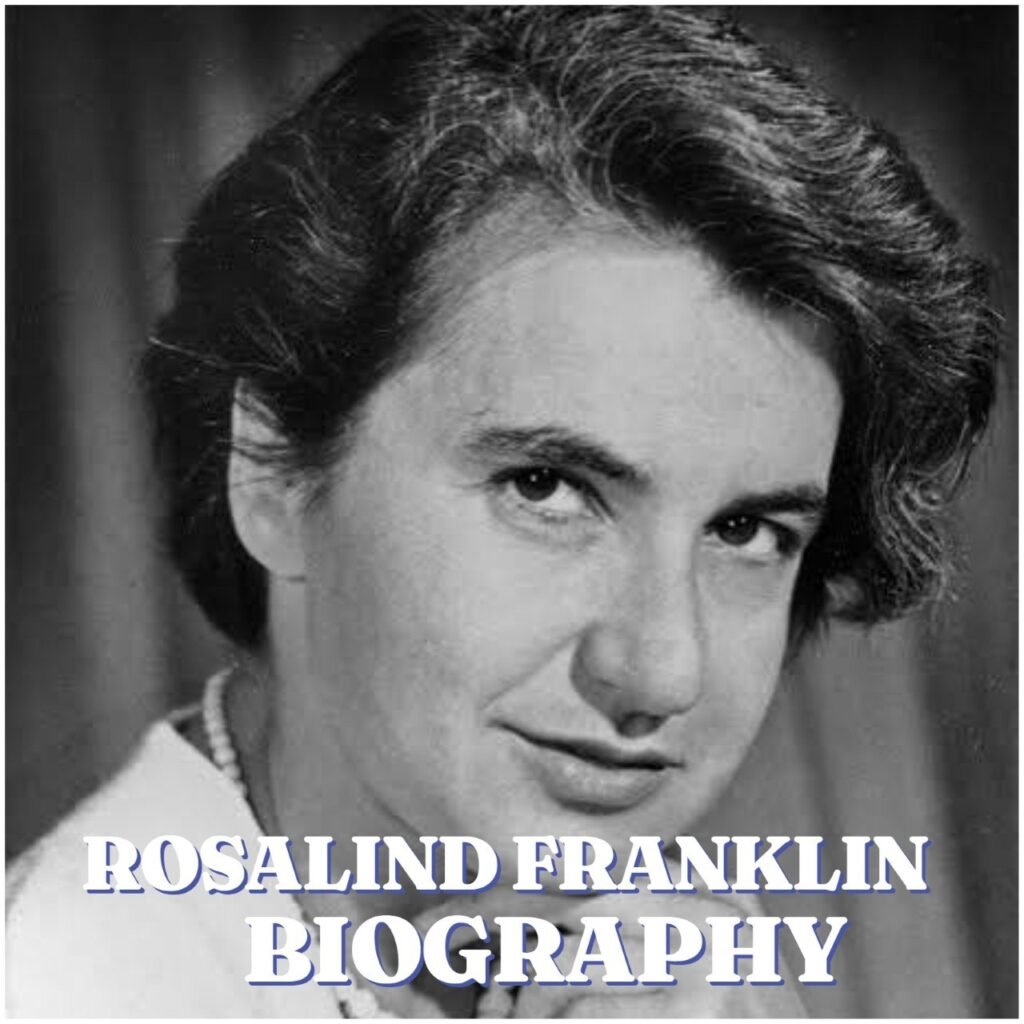
There is no reliable historical record of Rosalind Franklin’s exact height, so a precise figure should not be presented as fact. Photographs and historical descriptions show her as a slim woman with dark hair and a composed, serious appearance. She was frequently photographed wearing the professional clothing typical of a woman working in academic and laboratory environments during the mid-20th century. Her appearance is best described from surviving photographs rather than from unsupported numerical measurements.
Rosalind Franklin Net Worth
Rosalind Franklin’s exact net worth is not known, and there is no reliable historical financial record that provides a figure comparable to the net-worth estimates commonly published for modern celebrities. She was a research scientist who worked primarily in academic and scientific institutions, including King’s College London and Birkbeck College. Her income came from her professional scientific positions rather than from commercial endorsements, businesses or investments, so it would be misleading to assign her a modern celebrity-style fortune.
If an estimate is required for biographical purposes, Franklin’s financial position can be described as that of a well-educated professional scientist in Britain during the 1940s and 1950s, rather than that of a wealthy public figure. Based on the type of academic and research work she performed, a reasonable modernized estimate of the purchasing power of her accumulated personal wealth could be placed in the low hundreds of thousands of U.S. dollars, although this is only an approximation and should not be presented as an officially documented net-worth figure.
Franklin’s greatest value was ultimately not financial but scientific. Her X-ray crystallography research, including the work that produced Photograph 51, became an important part of the evidence surrounding DNA’s structure, while her later research into viruses made further contributions to structural biology. She died in 1958 at the age of 37, and her historical significance has grown enormously since then. Today, her scientific legacy is considered far more important than any estimate of the personal wealth she accumulated during her lifetime.
Rosalind Franklin Legacy and Scientific Contributions
Rosalind Franklin’s greatest legacy is her contribution to understanding the molecular structure of DNA. Through her expertise in X-ray crystallography, she produced highly precise experimental data that revealed important information about DNA’s dimensions and helical structure. Her famous Photograph 51, produced with Raymond Gosling in 1952, became particularly important because its distinctive diffraction pattern provided strong evidence of DNA’s helical nature. Franklin’s measurements and analysis formed an important part of the scientific evidence that ultimately contributed to the development of the DNA double-helix model.
Her legacy extends beyond DNA because she also made important contributions to the study of viruses. After leaving King’s College London in 1953, Franklin joined Birkbeck College, where she led research into the structure of viruses, particularly the tobacco mosaic virus. Her work helped scientists better understand the molecular organization of viral particles and demonstrated that her scientific abilities extended well beyond DNA research. Although her career was cut short by her death in 1958, the research she completed during her final years established another significant chapter in structural biology.
Franklin has also become an important symbol of the contributions of women in science and the importance of giving scientists proper recognition for their work. Modern historians have increasingly challenged simplified accounts of the DNA discovery and have emphasized Franklin’s own scientific expertise, observations and interpretations. Her name is now associated with major scientific institutions, research facilities, educational programs and awards, while her life continues to inspire scientists around the world. Decades after her death, Rosalind Franklin is remembered not merely as the woman behind Photograph 51, but as a pioneering scientist whose careful research helped shape modern molecular biology.
Conclusion
Rosalind Franklin’s life remains one of the most remarkable stories in the history of modern science. From her early education in London and pioneering research in X-ray crystallography to her important contributions to the understanding of DNA and viruses, she demonstrated exceptional scientific skill, determination and precision. Although she died from ovarian cancer in 1958 at only 37, her work continued to influence molecular biology long after her death. Today, Franklin is increasingly recognized for her independent scientific contributions, particularly her DNA research and Photograph 51, as well as her role as an inspiration to women pursuing careers in science, technology and research.
Frequently Asked Questions About Rosalind Franklin
Who was Rosalind Franklin?
Rosalind Franklin was a British chemist and X-ray crystallographer best known for her research into the molecular structure of DNA. Her X-ray diffraction work, particularly Photograph 51, provided important evidence about DNA’s helical structure. She also conducted significant research on viruses later in her career.
What was Rosalind Franklin famous for?
Rosalind Franklin was famous for producing Photograph 51, an X-ray diffraction image of DNA captured in 1952 with Raymond Gosling. The image provided crucial evidence that DNA had a helical structure and became an important part of the research that led to the DNA double-helix model.
When and where was Rosalind Franklin born?
Rosalind Franklin was born on July 25, 1920, in London, England. She grew up in a prominent British Jewish family and developed an interest in science from an early age.
How old was Rosalind Franklin when she died?
Rosalind Franklin was 37 years old when she died on April 16, 1958, in London. Her career was cut short at a time when she was making important contributions to the study of viruses.
What was Rosalind Franklin’s cause of death?
Rosalind Franklin died from ovarian cancer on April 16, 1958. She had been dealing with the disease while continuing her scientific research during the final years of her life.
Was Rosalind Franklin married?
No. Rosalind Franklin never married and had no children. There is also no reliable evidence that she was engaged to a fiancé during her lifetime. Much of her adult life was devoted to scientific research.
Did Rosalind Franklin win a Nobel Prize?
No. Rosalind Franklin did not win a Nobel Prize. She died in 1958, four years before the 1962 Nobel Prize in Physiology or Medicine was awarded to James Watson, Francis Crick and Maurice Wilkins for discoveries concerning the molecular structure of nucleic acids. Nobel Prizes are not awarded posthumously.
What was Rosalind Franklin’s religion?
Franklin was born into a British Jewish family. Although her Jewish background was an important part of her family and cultural identity, she was not publicly known for making religious beliefs a major part of her professional life.
What was Rosalind Franklin’s nationality?
Rosalind Franklin was British. She was born in London, England, and carried out major parts of her scientific career in Britain, although she also spent several years conducting research in France.
What was Rosalind Franklin’s net worth?
There is no reliable historical record of Rosalind Franklin’s exact net worth. She was a professional research scientist rather than a celebrity or businessperson, so modern net-worth figures should be treated as estimates rather than verified facts.
What was Rosalind Franklin’s contribution to DNA?
Franklin used X-ray crystallography to study DNA and produced highly precise measurements concerning its molecular structure. Her research, including Photograph 51, provided important evidence for the helical structure of DNA and contributed significantly to the scientific work surrounding the discovery of the double helix.
Where did Rosalind Franklin work?
Franklin worked at several important scientific institutions, including the British Coal Utilisation Research Association, the Laboratoire Central des Services Chimiques de l’État in Paris, King’s College London and Birkbeck College. Her research covered coal, carbon, DNA and viruses.
What did Rosalind Franklin discover after DNA research?
After leaving King’s College London, Franklin conducted research into viruses, particularly the tobacco mosaic virus, at Birkbeck College. Her work helped scientists understand the molecular structure of viruses and became another important part of her scientific legacy.
Why is Rosalind Franklin important today?
Rosalind Franklin remains important because her research helped advance the understanding of DNA and viruses while her story highlights the importance of recognizing women’s contributions to scientific discoveries. Her careful experimental work continues to be studied as part of the history of molecular biology and structural science.