
Introduction
Swami Vivekananda was one of the most influential Indian spiritual leaders, philosophers, monks, and thinkers of the modern era. Born as Narendranath Datta on January 12, 1863, in Kolkata, India, he became widely known for his powerful teachings on Vedanta, spirituality, self-realization, religious harmony, strength, and service to humanity. His meeting with the revered spiritual master Sri Ramakrishna Paramahamsa transformed his life and set him on a path that would eventually make him an important voice for Indian spirituality both in India and internationally.
Vivekananda rose to global prominence after representing Hinduism at the Parliament of the World’s Religions in Chicago in 1893. His memorable address and his message of religious tolerance, universal brotherhood, and harmony attracted widespread attention and helped introduce Vedanta and Indian spiritual philosophy to Western audiences. After returning to India, he continued spreading his message and established the Ramakrishna Mission in 1897, an organization dedicated to spiritual development as well as education, healthcare, humanitarian assistance, and service to society.
Although Swami Vivekananda died on July 4, 1902, at the age of 39, his influence has continued for generations. His writings, lectures, philosophy, and ideas about youth, education, character development, national renewal, and service remain widely studied and discussed. In 2026, institutions connected with his legacy, particularly the Ramakrishna Math and Ramakrishna Mission, continue humanitarian and educational activities inspired by his vision, keeping his teachings relevant more than a century after his death.
Early Life of Swami Vivekananda
Swami Vivekananda was born Narendranath Datta on January 12, 1863, in Calcutta, British India, now known as Kolkata, West Bengal. He was born into a respected Bengali family. His father, Vishwanath Datta, was a successful lawyer at the Calcutta High Court and was known for his broad-minded outlook, while his mother, Bhuvaneshwari Devi, was deeply religious and had a strong influence on her son’s character and spiritual development. From an early age, Narendranath displayed remarkable intelligence, curiosity, confidence, and a strong interest in both religion and philosophy.
As a young boy, Narendranath received a broad education and developed interests that went beyond traditional academic subjects. He was particularly interested in music, physical exercise, literature, philosophy, and spiritual questions. He studied at institutions in Calcutta and eventually attended Scottish Church College, where he studied Western philosophy, history, and other subjects. His exposure to Western thinkers encouraged him to question established beliefs and search for rational answers to important questions about God, human existence, and the nature of reality.
Narendranath’s search for spiritual truth eventually led him to Sri Ramakrishna Paramahamsa, whom he first met at the Dakshineswar Kali Temple in the early 1880s. Initially, Narendranath approached Ramakrishna with a questioning and analytical mind and reportedly sought a direct answer to the question of whether someone could actually experience God. Ramakrishna became his spiritual teacher and profoundly influenced his understanding of religion and spirituality. Their relationship became a defining chapter in Narendranath’s life and ultimately contributed to his transformation into the monk who would become known worldwide as Swami Vivekananda.
Education of Swami Vivekananda
Swami Vivekananda, then known as Narendranath Datta, received his early education in Calcutta and showed strong intellectual ability from a young age. He was exposed to a broad range of subjects, including literature, history, philosophy, religion, and the sciences. His education was not limited to classroom learning; he was also interested in music, physical exercise, and intellectual discussions. This wide range of interests helped shape the disciplined and questioning personality that later became an important part of his public life.
Narendranath continued his higher education at General Assembly’s Institution, which is now known as Scottish Church College in Kolkata. There, he studied subjects including Western philosophy, logic, history, and literature. His exposure to Western philosophical thinkers encouraged him to examine religious ideas critically and to search for logical and experiential answers to questions about God and existence. During his student years, he became particularly interested in philosophical and religious discussions and was associated with the Brahmo Samaj, which promoted monotheism and religious reform.
Despite his strong academic background, Narendranath increasingly felt that intellectual knowledge alone could not answer his deepest spiritual questions. He wanted direct experience rather than simply accepting religious teachings on faith. This search eventually brought him into contact with Sri Ramakrishna Paramahamsa, whose spiritual guidance had a profound impact on his life. Under Ramakrishna’s influence, Narendranath’s academic knowledge gradually became connected with practical spiritual experience, contributing to the development of the philosophy and teachings that he later shared as Swami Vivekananda.
Career of Swami Vivekananda
Swami Vivekananda’s career began to take a decisive direction after the death of his spiritual teacher, Sri Ramakrishna Paramahamsa, in 1886. Narendranath Datta and several of Ramakrishna’s young disciples formed a monastic brotherhood at Baranagar Math, where Narendranath gradually embraced the life of a monk. He later travelled extensively across India as a wandering monk, visiting different regions and interacting with people from various social backgrounds. These journeys gave him firsthand knowledge of India’s spiritual traditions as well as the poverty, social challenges, and hardships faced by ordinary people, experiences that strongly influenced his later work.
In 1893, Vivekananda travelled to the United States and represented Hinduism at the Parliament of the World’s Religions in Chicago. His opening address attracted considerable attention, and he subsequently spent several years lecturing and teaching in the United States and Europe. He spoke about Vedanta, yoga, spirituality, religious harmony, and the unity of religions, while also presenting Indian philosophical ideas to Western audiences. His international work established him as one of the most prominent Indian spiritual teachers of his generation and helped create lasting interest in Vedanta outside India.
After returning to India in 1897, Vivekananda began an organized effort to combine spiritual development with practical service to society. He founded the Ramakrishna Mission, while the broader Ramakrishna monastic movement developed around Belur Math, which became the headquarters of the Ramakrishna Order. He encouraged his followers to serve humanity through education, healthcare, relief work, and other forms of social service. Until his death in 1902, Vivekananda continued writing, teaching, travelling, and guiding his disciples, leaving behind a body of work that continues to influence spiritual and humanitarian activities around the world.
Why Swami Vivekananda Is Trending in 2026
Swami Vivekananda has been receiving renewed public attention in 2026 because of several major events celebrating and promoting his legacy more than a century after his death. One of the significant developments came on August 1, 2026, when Prime Minister Narendra Modi inaugurated the Swami Vivekananda Cultural Youth Centre – Viveka Smaraka in Mysuru, Karnataka. The centre commemorates Vivekananda’s historic association with Mysuru and his 1893 journey to the United States, where he became internationally known after addressing the Parliament of the World’s Religions in Chicago.
His name has also remained prominent through educational and cultural programmes. In August 2026, the Ramakrishna Mission Institute of Culture announced mobile photography, video and elocution competitions centred on Swami Vivekananda, encouraging young people to engage with his life and ideas. In addition, a Vivekananda Study Circle at the University of Dhaka held its first-anniversary and student-felicitation programme in July, reflecting the continuing influence of Vivekananda’s philosophy among students and young people outside India.
Another reason for the renewed interest is the continuing use of Vivekananda’s teachings in discussions about youth development, national service, education, character-building, spirituality and social responsibility. On his death anniversary on July 4, 2026, Prime Minister Narendra Modi and Vice President C. P. Radhakrishnan paid tribute to him, highlighting his contribution to India’s spiritual and cultural influence around the world. More recently, on August 21, 2026, the Indian Consulate in Durban hosted the third annual Swami Vivekananda Memorial Lecture, focusing on his influence on human rights, social justice, equality and human dignity.
Death and Cause of Death of Swami Vivekananda
Swami Vivekananda died on July 4, 1902, at Belur Math in Howrah, West Bengal, India, at the age of 39. According to accounts from the Ramakrishna Order, he spent the day engaged in spiritual practices, meditation, teaching, and discussions with fellow monks before retiring to his room in the evening. He entered deep meditation and passed away later that night. His death marked the end of a remarkably influential life, although his teachings and institutions continued to spread internationally.
The exact medical cause of Swami Vivekananda’s death is not definitively established. Historical accounts have associated his final years with several health problems, including diabetes, asthma, insomnia, and other physical ailments. Some accounts suggest that he suffered from multiple illnesses during the later part of his life, but there is no universally accepted medical diagnosis that can be identified as the single cause of his death.
According to the traditional account of the Ramakrishna Order, Vivekananda attained Mahasamadhi on July 4, 1902, while meditating. His followers understood his passing through a spiritual rather than solely medical framework. He was cremated at Belur Math, and a memorial was subsequently established at the site. Although he lived for only 39 years, his influence on Indian spirituality, Vedanta, religious harmony, education, youth development, and humanitarian service has continued long after his death.
Personal Life and Family of Swami Vivekananda
Swami Vivekananda was born Narendranath Datta into a prominent Bengali family in Calcutta. His father, Vishwanath Datta, was a lawyer at the Calcutta High Court and was known for his liberal outlook and broad intellectual interests. His mother, Bhuvaneshwari Devi, was deeply religious and played an important role in shaping Narendranath’s character, discipline, and spiritual interests. He had several siblings, including his brothers Mahendranath Datta and Bhupendranath Datta, who later became known for their own intellectual and public activities.
Vivekananda never married and did not have a wife, fiancée, or biological children. His decision to remain unmarried was connected to his commitment to the monastic life and his dedication to spiritual practice and service. After becoming a disciple of Sri Ramakrishna Paramahamsa, Narendranath increasingly devoted himself to spiritual discipline and eventually took formal monastic vows. As Swami Vivekananda, he regarded his life as being dedicated to the pursuit of spiritual realization and service to humanity rather than to conventional family life.
Although Vivekananda did not establish a conventional household of his own, he developed deep relationships with his spiritual teachers, brother disciples, followers, and supporters around the world. His relationship with Sri Ramakrishna was particularly important, as Ramakrishna became his principal spiritual mentor and profoundly influenced his understanding of religion and Vedanta. After Ramakrishna’s death, Vivekananda and his brother disciples continued his spiritual mission, eventually establishing the Ramakrishna Math and Ramakrishna Mission. Through these institutions and his teachings, Vivekananda created a spiritual family and legacy that has continued across generations.
Swami Vivekananda Age, Religion, Nationality, Height and Physical Appearance
Swami Vivekananda was born on January 12, 1863, and died on July 4, 1902, at the age of 39. He was born in Calcutta, British India, which is now Kolkata in West Bengal, India. His short life was marked by extensive travel, spiritual study, public speaking, writing, and humanitarian work, and he became one of the best-known Indian spiritual figures of the late 19th century.
Vivekananda was a Hindu monk and a major exponent of Vedanta philosophy. His spiritual worldview was deeply influenced by his guru, Sri Ramakrishna Paramahamsa, and emphasized the unity of religions, self-realization, service to humanity, and the divinity inherent in every person. He was Indian by nationality, and his teachings played an important role in presenting Indian spiritual and philosophical traditions to international audiences.
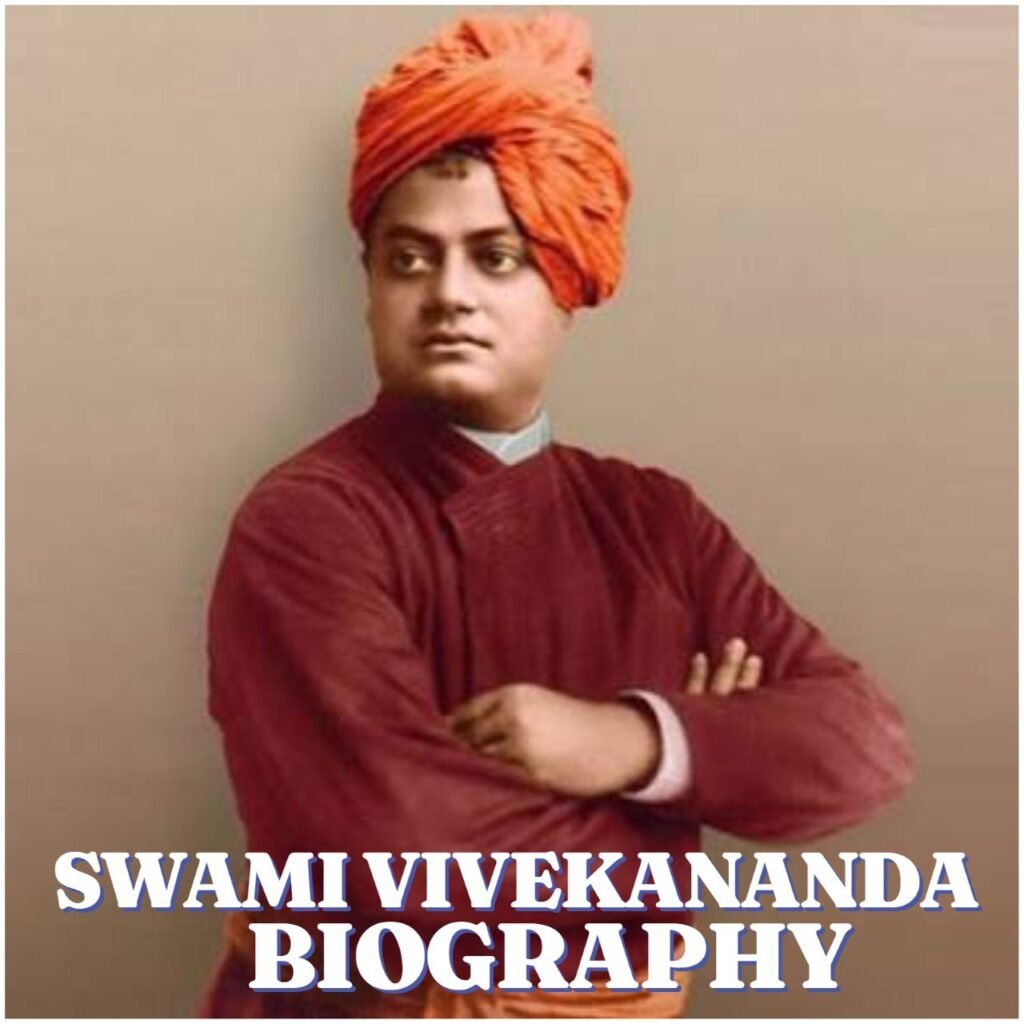
Vivekananda was known for his distinctive physical presence. Historical descriptions and photographs show him as a broad-shouldered, strongly built man who often wore traditional monastic robes and a turban. His height is frequently reported as approximately 5 feet 8 inches (173 cm), although this figure is not firmly documented in reliable contemporary records and should therefore be treated as an estimate. His composed expression, prominent features, and dignified appearance contributed to the memorable image associated with him in photographs and portraits.
Swami Vivekananda Net Worth
Swami Vivekananda’s exact net worth is not known, and assigning him a modern monetary net-worth figure would be misleading. Unlike modern celebrities, entrepreneurs, or public figures, Vivekananda was a monk who had taken vows of renunciation and dedicated his life primarily to spiritual teaching, philosophy, and service. There is no reliable historical financial record that establishes a personal fortune that can be converted into a present-day net-worth figure.
During his lifetime, Vivekananda received financial assistance and donations from supporters who helped fund his travels, lectures, publications, and institutional activities. Among his supporters were Indian rulers and wealthy individuals, as well as Western followers who assisted his work. However, these resources should not automatically be considered his personal wealth because much of the money associated with his activities was used to support his religious mission, travel, charitable efforts, and the development of institutions connected with the Ramakrishna movement.
For a modern biography, Vivekananda’s personal net worth is best described as not publicly documented rather than given a speculative dollar amount. His real legacy is better measured through the enduring influence of his teachings and the institutions established from his vision. The Ramakrishna Math and Ramakrishna Mission, which grew from the movement he helped establish, continue to conduct educational, medical, spiritual, and humanitarian activities, making his influence considerably more significant than any hypothetical personal financial valuation.
Legacy of Swami Vivekananda
Swami Vivekananda’s legacy is closely connected with his role in bringing Vedanta and Indian spiritual philosophy to international audiences. His appearance at the Parliament of the World’s Religions in Chicago in 1893 introduced many Western audiences to Hindu philosophical ideas and his message of religious harmony and universal brotherhood. His lectures and writings continued to influence discussions about spirituality, comparative religion, self-realization, and the relationship between different religious traditions.
Another major part of Vivekananda’s legacy is the Ramakrishna Math and Ramakrishna Mission, which he helped establish in the late 19th century. Inspired by his principle of serving humanity, the organizations developed programmes involving education, healthcare, disaster relief, rural development, and other forms of social service. His philosophy that spiritual life should be combined with practical service helped shape an approach to religious work that continues to influence communities in India and other parts of the world.
Vivekananda also remains an important symbol of youth empowerment, character development, education, self-confidence, and national awakening. His birthday, January 12, is observed in India as National Youth Day, reflecting the continuing importance of his ideas among younger generations. More than a century after his death, his books, speeches, photographs, and teachings remain widely studied, while institutions and cultural programmes inspired by his philosophy continue to keep his message alive in 2026.
Conclusion
Swami Vivekananda remains one of the most influential spiritual leaders and philosophers in Indian history, remembered for his powerful teachings on Vedanta, religious harmony, self-realization, service, and human dignity. From his early life as Narendranath Datta and his spiritual relationship with Sri Ramakrishna Paramahamsa to his historic appearance in Chicago and the establishment of the Ramakrishna Mission, his 39-year life had a lasting impact far beyond his generation. Although he died on July 4, 1902, his philosophy continues to inspire millions of people, while the institutions connected to his vision continue their work in education, healthcare, spirituality, and humanitarian service. His enduring influence demonstrates why Swami Vivekananda continues to be remembered as a major figure in Indian spirituality and a global advocate for religious understanding and human development.
Frequently Asked Questions About Swami Vivekananda
Who was Swami Vivekananda?
Swami Vivekananda was an Indian Hindu monk, spiritual teacher, philosopher, and prominent exponent of Vedanta. Born as Narendranath Datta in 1863, he became internationally famous after representing Hinduism at the Parliament of the World’s Religions in Chicago in 1893.
When was Swami Vivekananda born?
Swami Vivekananda was born on January 12, 1863, in Calcutta, British India, now known as Kolkata, West Bengal, India.
What was Swami Vivekananda’s real name?
Swami Vivekananda’s birth name was Narendranath Datta. He became widely known as Swami Vivekananda after entering the monastic life.
Who was Swami Vivekananda’s guru?
Swami Vivekananda’s principal spiritual teacher was Sri Ramakrishna Paramahamsa. Their relationship had a profound influence on Vivekananda’s spiritual development and later teachings.
What was Swami Vivekananda famous for?
Swami Vivekananda was particularly famous for introducing Vedanta and Indian spiritual philosophy to Western audiences, especially through his historic speech at the Parliament of the World’s Religions in Chicago in 1893. He was also known for promoting religious harmony, self-realization, education, character development, and service to humanity.
What did Swami Vivekananda do in Chicago in 1893?
Swami Vivekananda represented Hinduism at the World’s Parliament of Religions in Chicago in 1893. His speech attracted international attention and helped establish him as an important representative of Indian spirituality and Vedanta.
When did Swami Vivekananda die?
Swami Vivekananda died on July 4, 1902, at Belur Math in West Bengal, India. He was 39 years old.
What was the cause of Swami Vivekananda’s death?
The exact medical cause of Swami Vivekananda’s death is not definitively established. Historical accounts mention several health problems during his later years, including diabetes, asthma, and other ailments. The Ramakrishna tradition describes his passing as Mahasamadhi, following meditation.
Was Swami Vivekananda married?
No. Swami Vivekananda never married and did not have a wife, fiancée, or biological children. He dedicated his life to monastic discipline, spiritual realization, teaching, and service.
What religion did Swami Vivekananda follow?
Swami Vivekananda was a Hindu monk and a major teacher of Vedanta philosophy. His teachings emphasized the underlying unity of religions, spiritual realization, and service to humanity.
What is Swami Vivekananda’s nationality?
Swami Vivekananda was Indian. He was born in Calcutta, British India, in 1863.
What was Swami Vivekananda’s height?
Swami Vivekananda’s height is commonly estimated at approximately 5 feet 8 inches (173 cm), although a definitive contemporary record confirming his exact height is not widely available.
Did Swami Vivekananda have children?
No. Swami Vivekananda did not have biological children because he remained unmarried and followed a monastic life.
What organization did Swami Vivekananda establish?
Swami Vivekananda founded the Ramakrishna Mission in 1897. The organization combines spiritual development with practical service, including education, healthcare, relief work, and other humanitarian activities.
Why is Swami Vivekananda still important today?
Swami Vivekananda remains influential because his teachings address themes such as self-confidence, education, youth development, religious tolerance, spirituality, service, and human dignity. His ideas continue to be studied and promoted by institutions and organizations associated with the Ramakrishna movement.
What is Swami Vivekananda’s net worth?
There is no reliable historical record of Swami Vivekananda’s personal net worth. As a monk who embraced renunciation, he did not accumulate personal wealth in the manner of a modern public figure. Financial resources supporting his travels and activities were largely connected to his spiritual and institutional work rather than a personal fortune.
Why is January 12 celebrated as National Youth Day in India?
January 12, Swami Vivekananda’s birthday, is observed as National Youth Day in India. The day recognizes his contribution to youth inspiration, character development, education, self-confidence, and national development. :::