
Introduction
Dr. Shyama Prasad Mukherjee (6 July 1901 – 23 June 1953) was an influential Indian politician, educationist, barrister, and nationalist leader whose ideas continue to shape India’s political discourse. He is best known as the founder of the Bharatiya Jana Sangh in 1951, a political party that later evolved into the Bharatiya Janata Party (BJP), one of India’s leading political parties. Mukherjee also served as India’s first Minister for Industry and Supply in Prime Minister Jawaharlal Nehru’s cabinet after the country gained independence, playing an important role in laying the foundation for India’s industrial development.
Before entering national politics, Mukherjee established himself as one of India’s most accomplished academics. He became the youngest Vice-Chancellor of the University of Calcutta at the age of 33, earning widespread recognition for his efforts to modernize higher education and promote academic excellence. Born into a distinguished Bengali family known for its contributions to education and law, he inherited a deep commitment to public service. His transition from academia to politics reflected his desire to influence the future of independent India through policy, governance, and constitutional principles.
Shyama Prasad Mukherjee remains a significant figure in modern Indian history because of his unwavering advocacy for national unity, federal integrity, and democratic governance. He strongly opposed the special constitutional status granted to Jammu and Kashmir under Article 370 and believed in the complete integration of the region with the rest of India. His death in 1953 while in detention in Jammu and Kashmir remains one of the most debated episodes in Indian political history. More than seven decades later, his legacy continues to be commemorated across India, with his 125th birth anniversary being observed through nationwide events from 2025 to 2027, reflecting his enduring influence on the country’s political and intellectual landscape.
Early Life and Education
Dr. Shyama Prasad Mukherjee was born on 6 July 1901 in Calcutta (now Kolkata), West Bengal, into one of the most respected intellectual and educational families in British India. He was the son of Sir Ashutosh Mukherjee, a renowned jurist, mathematician, and educationist who served as the Vice-Chancellor of the University of Calcutta, and Jogmaya Devi, who played an important role in nurturing the family’s strong cultural and moral values. Growing up in an environment that emphasized education, discipline, and public service, Mukherjee developed a passion for learning and leadership from an early age. His father’s remarkable achievements and dedication to higher education profoundly influenced his outlook on life and inspired him to pursue academic excellence.
Mukherjee received his early education in Calcutta, where he quickly gained a reputation as an exceptional student. He attended the prestigious Presidency College, Calcutta, one of India’s leading educational institutions, where he excelled academically. He later enrolled at the University of Calcutta, earning a Bachelor of Arts degree before completing a Master of Arts in Bengali. Demonstrating his versatility and commitment to learning, he went on to study law and obtained a Bachelor of Law (LL.B.) degree. His outstanding academic record reflected not only his intellectual abilities but also his determination to contribute meaningfully to society through knowledge and public service.
Seeking to broaden his legal education, Shyama Prasad Mukherjee traveled to England, where he studied at Lincoln’s Inn and qualified as a barrister. Upon returning to India, he briefly practiced law at the Calcutta High Court but soon realized that his true calling lay in education and public affairs rather than legal practice alone. At just 33 years of age, he was appointed the youngest Vice-Chancellor of the University of Calcutta, a milestone that established him as one of the country’s most promising educational leaders. His early experiences in academia, law, and public life laid the foundation for a distinguished career that would later see him emerge as one of independent India’s most influential political figures.
Education
Dr. Shyama Prasad Mukherjee’s educational journey was marked by exceptional academic achievement and a lifelong commitment to intellectual excellence. Raised in a family that deeply valued learning, he attended some of the finest educational institutions in British India. After completing his early schooling in Calcutta, he enrolled at the prestigious Presidency College, Calcutta, where he distinguished himself as a brilliant student. His outstanding performance in academics earned him recognition among both his teachers and peers, laying the foundation for a career that would combine scholarship, leadership, and public service.
Mukherjee continued his higher education at the University of Calcutta, where he earned a Bachelor of Arts (B.A.) degree before completing a Master of Arts (M.A.) in Bengali. His decision to pursue postgraduate studies in Bengali reflected his appreciation for India’s rich linguistic and cultural heritage at a time when English dominated higher education. He later expanded his academic qualifications by studying law and obtaining a Bachelor of Law (LL.B.) degree. His multidisciplinary education in the humanities and law equipped him with the analytical skills and intellectual depth that later defined both his academic and political careers.
Determined to gain international legal training, Shyama Prasad Mukherjee traveled to England and joined Lincoln’s Inn, one of the four historic Inns of Court in London. There, he qualified as a barrister, enhancing his legal expertise and broadening his understanding of constitutional and judicial systems. After returning to India, he briefly practiced law before dedicating himself to academia. His remarkable educational accomplishments culminated in his appointment as the youngest Vice-Chancellor of the University of Calcutta at the age of 33, a position in which he introduced several reforms and strengthened the university’s reputation as one of India’s leading centers of higher learning.
Career
Dr. Shyama Prasad Mukherjee began his professional career in the legal field after qualifying as a barrister from Lincoln’s Inn in England. Upon returning to India, he enrolled as an advocate at the Calcutta High Court, where he practiced law for a brief period. However, his passion for education and public service soon led him toward academia. In 1934, at just 33 years of age, he became the youngest Vice-Chancellor of the University of Calcutta, a position in which he worked to modernize the university, improve academic standards, and encourage the use of Indian languages alongside English in higher education. His tenure earned him widespread respect as one of the country’s leading educationists.
Mukherjee’s entry into politics came during the late 1920s and 1930s when he was elected to the Bengal Legislative Council. Over time, he emerged as a prominent political leader and served as the Finance Minister of Bengal in the coalition government led by A. K. Fazlul Huq from 1941 to 1942. During this period, he advocated for administrative reforms, economic development, and the protection of civil rights. As India’s independence movement intensified, he became increasingly involved in national affairs and voiced strong opinions on issues related to governance, communal harmony, and the future political structure of the country.
Following India’s independence in 1947, Dr. Shyama Prasad Mukherjee joined Prime Minister Jawaharlal Nehru’s first Union Cabinet as the Minister for Industry and Supply. In this role, he contributed to shaping India’s early industrial policies and supported the development of key industries needed for nation-building. However, ideological differences with the government, particularly over the Liaquat–Nehru Pact and policies concerning East Pakistan, led him to resign from the Cabinet in 1950. His resignation marked a turning point in his political career and established him as one of the most prominent voices in the parliamentary opposition.
In 1951, Mukherjee founded the Bharatiya Jana Sangh (BJS) with the objective of promoting nationalism, cultural identity, and strong national unity. The party quickly gained support in several parts of India and became a significant force in Indian politics. Mukherjee strongly opposed the special constitutional status granted to Jammu and Kashmir under Article 370, arguing that the state should be fully integrated into the Indian Union. His famous slogan, “Ek Vidhan, Ek Nishan, Ek Pradhan” (One Constitution, One Flag, One Head), became closely associated with his campaign for national integration.
In 1953, while leading a protest against the permit system that restricted the entry of Indian citizens into Jammu and Kashmir, Mukherjee was arrested after entering the state without a permit. He was detained in Srinagar, where he died on 23 June 1953 under circumstances that have remained the subject of political debate and public discussion for decades. Although his life ended at the age of 51, his political vision continued through the Bharatiya Jana Sangh, which later became a key component in the formation of the Bharatiya Janata Party (BJP). Today, Dr. Shyama Prasad Mukherjee is remembered as one of the architects of post-independence Indian politics, with his contributions to education, industry, and national integration continuing to influence public policy and political thought.
Personal Life and Family
Dr. Shyama Prasad Mukherjee was born into a distinguished Bengali family that made significant contributions to education, law, and public life. His father, Sir Ashutosh Mukherjee, was one of India’s most celebrated jurists, mathematicians, and educationists, serving multiple terms as the Vice-Chancellor of the University of Calcutta. Widely known as the “Tiger of Bengal” for his fearless leadership and dedication to academic excellence, Sir Ashutosh played a profound role in shaping his son’s intellectual outlook and commitment to public service. Shyama Prasad’s mother, Jogmaya Devi, was known for her strong moral values and religious devotion, providing a nurturing environment that emphasized discipline, education, and compassion. Growing up in such a respected household greatly influenced Mukherjee’s character and future career.
In his personal life, Dr. Mukherjee married Sudha Devi, and the couple shared a close family life despite the demands of his academic and political responsibilities. Their marriage was blessed with five children—Anutosh Mukherjee, Devatosh Mukherjee, Santosh Mukherjee, Arati Mukherjee, and Savita Banerjee. Tragedy struck the family when Sudha Devi passed away at a relatively young age, leaving Mukherjee to balance his public duties with the responsibility of raising their children. Although deeply affected by the loss of his wife, he chose not to remarry and remained devoted to his family while continuing his work in education and national politics.
Despite becoming one of independent India’s most influential political leaders, Dr. Shyama Prasad Mukherjee maintained a private and disciplined personal life. He was respected for his integrity, simplicity, and unwavering dedication to the nation, often placing public service above personal comfort. There are no verified historical records indicating that he had a fiancée before his marriage or any other publicly documented romantic relationships outside his marriage to Sudha Devi. His family has continued to preserve his legacy, while his contributions to Indian politics, education, and national integration are commemorated through memorials, academic institutions, and nationwide observances of his birth anniversary.
Age, Religion, Tribe, Height and Physical Appearance
Dr. Shyama Prasad Mukherjee was born on 6 July 1901 in Calcutta (now Kolkata), British India, and was 51 years old when he passed away on 23 June 1953 in Srinagar, Jammu and Kashmir. He practiced Hinduism, which influenced many aspects of his personal values and public life. The concept of a “tribe” does not apply to him; rather, he belonged to the Bengali cultural and ethnic community of West Bengal, a background that shaped his appreciation for education, literature, and public service.
Although there is no officially recorded height in reliable historical sources, Dr. Mukherjee is generally estimated to have stood at approximately 5 feet 8 inches (173 cm). He had a medium build and carried himself with the confidence and dignity expected of a respected academic, lawyer, and political leader. His well-groomed appearance and composed demeanor reflected his disciplined personality and professional stature.
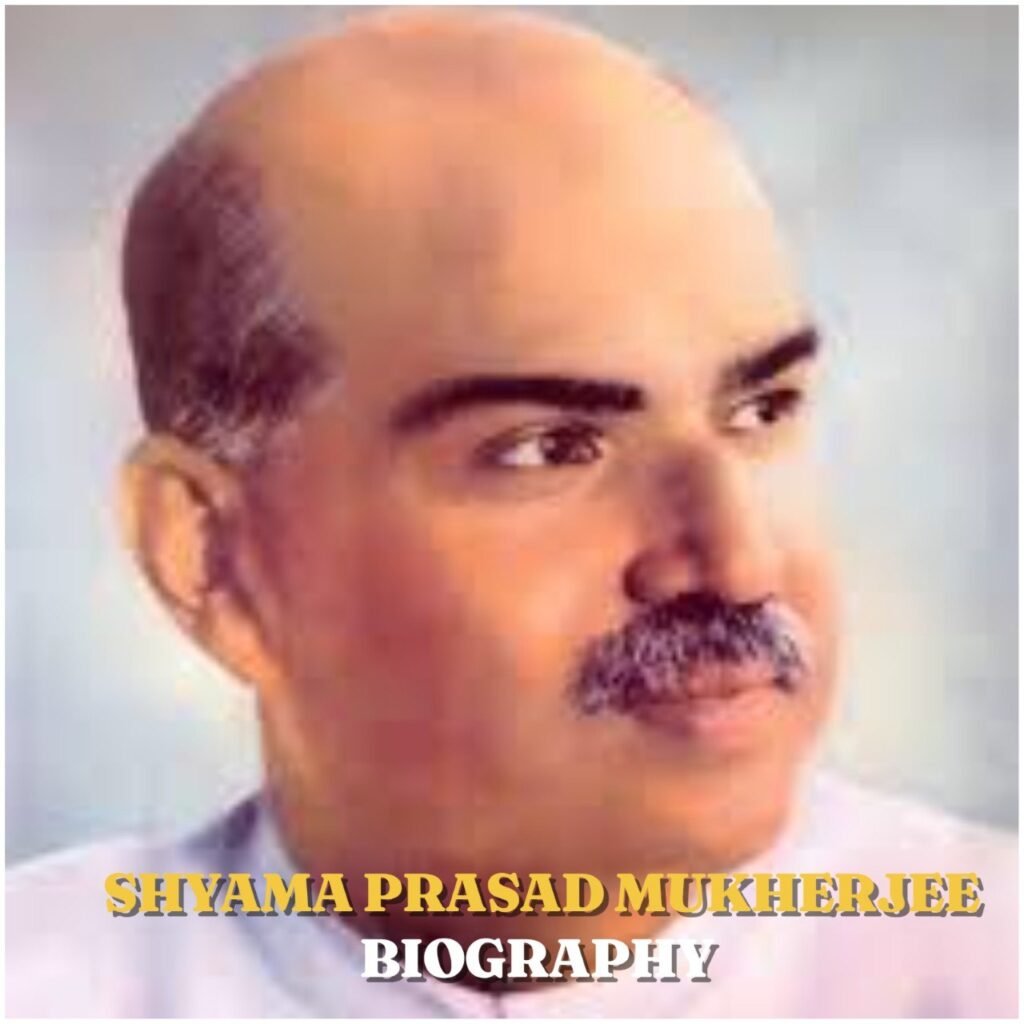
Historical photographs portray Dr. Mukherjee with dark brown eyes, black hair in his younger years that gradually turned grey with age, and a neat appearance that occasionally included a well-trimmed moustache. He was most often seen wearing traditional Bengali attire, including a dhoti and kurta, sometimes complemented by a formal coat or shawl during official engagements. His simple yet elegant style, combined with his calm expression and scholarly presence, made him one of the most recognizable political and intellectual figures of his era.
Net Worth
There are no official or verified records documenting Dr. Shyama Prasad Mukherjee’s personal net worth during his lifetime. As a politician, educationist, lawyer, and public servant in the early years of independent India, he lived during a period when political leaders generally did not accumulate wealth on the scale seen in modern public life. Most of his career was dedicated to academia, legal practice, public administration, and national politics rather than private business or commercial ventures.
Based on his professional background and social standing, historians generally regard Mukherjee as a financially comfortable member of Bengal’s educated elite rather than a wealthy industrialist or businessman. He earned income through his legal career as a barrister, his academic appointments—including serving as the Vice-Chancellor of the University of Calcutta—and later through his roles as a legislator and India’s first Minister for Industry and Supply. Adjusted to modern economic standards, his personal wealth is estimated to have been between US$500,000 and US$1 million (approximately ₹4 crore to ₹8 crore in today’s value). This estimate is speculative and intended only to provide historical context, as no authenticated financial records are available.
Although Dr. Shyama Prasad Mukherjee was not known for material wealth, his true legacy lies in his contributions to India’s education system and political history. He devoted much of his life to public service, institutional development, and nation-building rather than personal financial gain. His founding of the Bharatiya Jana Sangh, his leadership in higher education, and his role in shaping post-independence India remain far more significant than any estimate of his personal fortune, making his influence on Indian politics and public policy his greatest and most enduring asset.
Legacy
Dr. Shyama Prasad Mukherjee’s legacy is deeply embedded in the political, educational, and constitutional history of modern India. He is widely remembered as the founder of the Bharatiya Jana Sangh (BJS) in 1951, a political party that later evolved into the Bharatiya Janata Party (BJP), one of India’s leading political parties. His vision of nationalism, democratic governance, and a strong, united India continues to influence political thought and public policy. As one of the most prominent opposition leaders in the early years after India’s independence, Mukherjee played a significant role in shaping parliamentary democracy and encouraging healthy political debate during the formative years of the Republic.
Beyond politics, Mukherjee made lasting contributions to Indian education. As the youngest Vice-Chancellor of the University of Calcutta, he championed academic excellence, promoted research, and supported the inclusion of Indian languages in higher education while maintaining high educational standards. His leadership helped strengthen one of India’s oldest and most prestigious universities, inspiring future generations of students, scholars, and educators. Numerous educational institutions, roads, public buildings, and development projects across India have since been named in his honor, recognizing his lifelong commitment to learning and public service.
Dr. Mukherjee is also remembered for his advocacy of complete national integration, particularly his opposition to the special constitutional status formerly granted to Jammu and Kashmir under Article 370. His slogan, “Ek Vidhan, Ek Nishan, Ek Pradhan” (One Constitution, One Flag, One Head), became a defining symbol of his political philosophy. Following the abrogation of Article 370 in 2019, many supporters viewed the move as aligning with the vision he had long advocated. Today, his life and achievements are commemorated through memorials, annual tributes, scholarly works, and nationwide observances, including the official celebration of his 125th birth anniversary (2025–2027). More than seven decades after his death, Dr. Shyama Prasad Mukherjee remains one of the most influential and widely discussed figures in India’s political and intellectual history.
Conclusion
Dr. Shyama Prasad Mukherjee was a visionary educationist, accomplished lawyer, and influential statesman whose contributions left a lasting mark on India’s political and academic landscape. From serving as the youngest Vice-Chancellor of the University of Calcutta to becoming India’s first Minister for Industry and Supply and founding the Bharatiya Jana Sangh, he dedicated his life to public service, national development, and democratic values. His advocacy for national integration, educational reform, and constitutional principles continues to shape political discussions in India. Decades after his passing in 1953, his ideas, leadership, and commitment to nation-building remain widely studied and commemorated, securing his place as one of the most significant figures in modern Indian history.
Frequently Asked Questions (FAQs)
Who was Dr. Shyama Prasad Mukherjee?
Dr. Shyama Prasad Mukherjee was an Indian politician, educationist, barrister, and the founder of the Bharatiya Jana Sangh in 1951. He also served as India’s first Minister for Industry and Supply after the country gained independence.
When and where was Shyama Prasad Mukherjee born?
Shyama Prasad Mukherjee was born on 6 July 1901 in Calcutta (now Kolkata), West Bengal, British India.
When did Dr. Shyama Prasad Mukherjee die?
He died on 23 June 1953 in Srinagar, Jammu and Kashmir, while he was under detention during a political protest.
How old was Shyama Prasad Mukherjee when he died?
Dr. Shyama Prasad Mukherjee was 51 years old at the time of his death.
What was Shyama Prasad Mukherjee famous for?
He is best known for founding the Bharatiya Jana Sangh (BJS), serving as India’s first Minister for Industry and Supply, and advocating for the complete integration of Jammu and Kashmir with the rest of India.
Which political party did Shyama Prasad Mukherjee found?
He founded the Bharatiya Jana Sangh (BJS) in 1951, which later became the ideological predecessor of the Bharatiya Janata Party (BJP).
Who were Shyama Prasad Mukherjee’s parents?
His father was Sir Ashutosh Mukherjee, a renowned jurist and educationist, and his mother was Jogmaya Devi.
Who was Shyama Prasad Mukherjee’s wife?
Dr. Shyama Prasad Mukherjee was married to Sudha Devi. The couple had five children together.
What was Shyama Prasad Mukherjee’s educational background?
He studied at Presidency College, Calcutta, and the University of Calcutta, where he earned degrees in arts and law. He later qualified as a barrister from Lincoln’s Inn in London.
What was Shyama Prasad Mukherjee’s religion?
Dr. Shyama Prasad Mukherjee practiced Hinduism.
What was Shyama Prasad Mukherjee’s nationality?
He was Indian by nationality.
What was Shyama Prasad Mukherjee’s estimated net worth?
There are no official records of his personal wealth. Based on his career as a lawyer, academic, and public servant, his net worth is estimated to have been equivalent to US$500,000–US$1 million (approximately ₹4 crore–₹8 crore in today’s value), though this is only an informed estimate.
Why is Shyama Prasad Mukherjee remembered today?
He is remembered for his contributions to Indian education, his role in post-independence politics, the founding of the Bharatiya Jana Sangh, and his advocacy for national integration and constitutional unity.
What is the legacy of Dr. Shyama Prasad Mukherjee?
His legacy lives on through his contributions to education, his influence on Indian politics, the growth of the Bharatiya Jana Sangh into the Bharatiya Janata Party (BJP), and the nationwide recognition of his role in shaping modern India.