
1. Introduction: Who Was Stuart Hamblen?
Carl Stuart Hamblen, popularly known as Stuart Hamblen, was an American country singer, songwriter, radio broadcaster, actor, and Christian gospel music pioneer whose work helped shape early Western entertainment and country gospel music. Born on October 20, 1908, in Kellyville, Texas, he became known as one of radio broadcasting’s early singing cowboys during the 1920s. His career extended across several decades and included popular radio programmes, recordings, appearances in Western films, and the composition of songs that reached audiences across country, popular, and gospel music. Among his best-known compositions are It Is No Secret (What God Can Do), This Ole House, and Remember Me (I’m the One Who Loves You). His versatility made him an important figure in the development of American country and gospel entertainment.
Hamblen’s journey was remarkable not only because of his musical achievements but also because of the dramatic changes in his personal convictions and professional direction. During the early years of his fame, he became associated with the lively entertainment culture of Hollywood and country radio, where his performances and storytelling attracted a substantial audience. In 1949, however, he experienced a religious conversion during evangelist Billy Graham’s Los Angeles crusade. This experience transformed his public identity and influenced the direction of his songwriting, leading him to create music that explored faith, redemption, hope, and the relationship between humanity and God. He subsequently became a prominent Christian broadcaster and used his entertainment background to communicate religious messages to audiences who enjoyed traditional country music.
Beyond his music, Hamblen was known for his family life with his wife, Suzy, his involvement in horse breeding and Western culture, and his unusual decision to run for President of the United States in 1952 as the Prohibition Party candidate. His refusal to promote an alcohol advertisement after becoming a Christian contributed to the end of his nationally syndicated radio programme and became an important part of the story of his religious transformation. Over the years, he received recognition from several music organisations, including the Nashville Songwriters Hall of Fame and the Texas Country Music Hall of Fame. His songs continued to be recorded by artists from different musical backgrounds, securing his place in American country, Western, and gospel music history.
2. Early Life and Family Background of Stuart Hamblen
Stuart Hamblen was born into a religious family on October 20, 1908, in Kellyville, Texas. His father, James Henry Hamblen, was an itinerant Methodist preacher who travelled between communities to conduct religious services. His mother was Ernestine Hamblen. Because of his father’s ministry, Stuart spent much of his childhood moving between different parts of Texas rather than growing up entirely in one place. This travelling lifestyle exposed him to a variety of communities, traditions, and forms of entertainment. It also introduced him to the world of Western culture, which would later become a defining feature of his music and broadcasting career.
Growing up in Texas gave Hamblen opportunities to observe the everyday lives of cowboys, ranch workers, and other people associated with rural Western culture. He became familiar with horseback riding, roping, outdoor activities, and the stories that circulated among working people in the region. He also developed an interest in music during his youth, particularly the country and folk traditions that reflected the experiences of ordinary people. These influences helped shape the storytelling style that later distinguished his radio programmes and songs. Rather than relying solely on conventional musical performance, Hamblen combined singing, humour, personal anecdotes, and Western storytelling to create an entertaining style that appealed to listeners.
Hamblen’s early experiences also placed him between two contrasting worlds: the Christian environment of his upbringing and the entertainment culture he later encountered as a young performer. His father’s religious work meant that he grew up familiar with Christian teachings, although his adult life initially took a different direction. As his popularity increased, he became involved in the demanding lifestyle of radio entertainment, Hollywood, horse racing, and public performances. These experiences would eventually lead to personal struggles that became central to the story of his later religious transformation. His childhood background is therefore important to understanding both his early career as a singing cowboy and the renewed Christian commitment that influenced the second half of his professional life.
3. Education and Academic Background of Stuart Hamblen
Stuart Hamblen received his early education while growing up in Texas, where his family’s frequent movements were influenced by his father’s work as a travelling preacher. Although detailed information about all the schools he attended during childhood is limited, historical biographical accounts identify McMurry College in Abilene, Texas, as an important part of his formal education. He enrolled there in 1925 with the intention of preparing for a career in teaching. McMurry was a Methodist institution, which made it a natural educational environment for someone raised in a family with strong Methodist connections. His decision to pursue teacher training suggests that music and entertainment were not initially his only possible career paths.
While studying at McMurry College, Hamblen’s interest in music became increasingly influential in his life. He was inspired by country music performers, including Jimmie Rodgers, whose recordings helped shape the sound and storytelling traditions of early country music. Rather than continuing along the path towards teaching, Hamblen began pursuing singing opportunities and participating in performances that brought him closer to the professional entertainment industry. His musical ambitions eventually took him from Texas to the recording studios of the Victor Talking Machine Company in Camden, New Jersey, and later to radio broadcasting in California. His experience demonstrates how an early educational plan can change when a person discovers a strong professional interest and opportunities to develop it.
Although Hamblen became widely known as a singer, songwriter, broadcaster, and actor rather than as a teacher, his educational background remained part of his personal development. His upbringing and college experience exposed him to communication, religious traditions, and the importance of connecting with different audiences. These qualities later became useful in his radio programmes, where he combined music, humour, storytelling, and religious messages. His career did not follow a conventional academic or professional route, but his education provided an early foundation before he committed himself to music and broadcasting. The available historical accounts focus more on his attendance at McMurry College and his subsequent career than on additional academic qualifications, so claims about degrees or further formal studies should be treated cautiously.
4. Stuart Hamblen’s Music Career: From Singing Cowboy to Gospel Legend
Stuart Hamblen began his professional broadcasting career in 1926, when he obtained opportunities to sing on Texas radio. Historical accounts associate his early broadcasts with stations in Abilene and the Dallas–Fort Worth region, including KFYO, WBAP, and WFAA. He became recognised as one of radio’s pioneering singing cowboys, a performer who combined country music with the image and storytelling traditions of the American West. His early success demonstrated the growing influence of radio as a medium for popular entertainment at a time when recorded music and live broadcasting were bringing performers into homes across the United States. His ability to sing, tell stories, and entertain listeners helped him develop a distinctive public identity.
A major turning point came in 1929, when Hamblen won a talent competition and used the prize money to travel to Camden, New Jersey, to pursue recording opportunities with the Victor Talking Machine Company, a predecessor of RCA Victor. The company recorded four of his early songs, including “The Boy in Blue,” “Drifting Back to Dixie,” “When the Moon Shines Down on the Mountain,” and “The Big Rock Candy Mountain #2.” He subsequently travelled to Hollywood, California, where he began broadcasting on KFI under the name “Cowboy Joe.” He also became associated with the Beverly Hill Billies, an early Western singing group that gained popularity through radio. These experiences helped him move from regional performances into a broader entertainment market.
In 1931, Hamblen established his own musical group and developed a series of popular radio programmes, including King Cowboy’s Woolly West Revue, Stuart Hamblen and His Lucky Stars, and The Covered Wagon Jubilee. His programmes remained popular with West Coast audiences for many years, making him a familiar voice in American radio entertainment. In 1934, he became the first country artist signed by Decca Records, according to the Nashville Songwriters Hall of Fame. His early musical repertoire included Western songs such as “Texas Plains,” “My Mary,” and “Remember Me (I’m the One Who Loves You).” He also wrote humorous songs that reflected the informal, playful side of cowboy culture. His success established him as a versatile performer capable of combining music, comedy, and storytelling.
Hamblen’s entertainment career expanded into motion pictures during the 1930s and 1940s. He appeared in Western films alongside well-known stars, including Gene Autry, Roy Rogers, Wild Bill Elliott, Don “Red” Barry, and John Wayne. His film appearances allowed him to reach audiences beyond radio listeners and contributed to his reputation as a recognisable Western entertainer. Although he was primarily remembered for his music and broadcasting, his acting work formed another important part of his career. He also maintained an interest in horses and horse racing, activities that connected him to the Western lifestyle that had shaped his public image. His combination of radio, recording, film, and outdoor pursuits made him an unusual figure whose career extended across several branches of American entertainment.
The most significant transformation in Hamblen’s professional life followed his Christian conversion in 1949. After attending Billy Graham’s Los Angeles crusade, he publicly announced his renewed Christian commitment and began moving away from the drinking, gambling, and other activities associated with his earlier lifestyle. This change also influenced the subjects of his songs. Instead of focusing mainly on cowboy life, romance, and humour, he increasingly wrote about faith, forgiveness, redemption, and the hope of eternal life. His song “It Is No Secret (What God Can Do)” became one of the most enduring results of this period, while “Until Then,” “His Hands,” and “Teach Me, Lord, to Wait” further established his reputation in gospel music. His experience demonstrated how a personal transformation can influence an artist’s creative direction and public identity.
Hamblen continued his broadcasting work through The Cowboy Church of the Air, a programme that combined country music, Western storytelling, and Christian teaching. During the early 1950s, he refused to broadcast a beer commercial because it conflicted with his newly adopted religious convictions. The sponsors subsequently withdrew their support, bringing an end to the programme’s nationally syndicated run. Rather than reversing his decision, Hamblen maintained his position and later used the episode as an example of the importance he attached to living according to his beliefs. In subsequent years, he continued writing songs, participating in Christian outreach, and appearing at religious events. His later work helped bridge the worlds of traditional country entertainment and gospel music, securing his place in both traditions.
5. Why Stuart Hamblen Is Remembered: His Famous Songs and Musical Influence
Stuart Hamblen’s lasting popularity is closely connected to his ability to write songs that combined memorable melodies with relatable experiences and, later in his career, clear Christian messages. One of his most famous compositions is “It Is No Secret (What God Can Do),” a gospel song that emerged from his religious transformation in 1949. According to the Texas State Historical Association and the Texas Country Music Hall of Fame, Hamblen’s encounter with actor John Wayne helped inspire the song’s title and central idea. Wayne reportedly asked him about the changes in his life, prompting Hamblen to respond that it was no secret what God could do. The phrase became the foundation for a song that was subsequently recorded by numerous artists and translated into many languages.
Another major success was “This Ole House,” which Hamblen wrote after encountering the body of an elderly prospector in a remote mountain cabin during a hunting trip in 1954. The unusual experience inspired him to write a song that used the image of an old house to reflect on ageing, mortality, and the prospect of leaving earthly life behind. Rosemary Clooney’s recording became a major hit, and the song was named the 1954 Song of the Year in the account published by the Texas Country Music Hall of Fame. Its popularity across different countries demonstrated Hamblen’s ability to transform a real-life encounter into a song with broad emotional appeal. The composition remains one of the most recognisable works associated with his name.
Hamblen also wrote “Remember Me (I’m the One Who Loves You),” “Texas Plains,” “Until Then,” “His Hands,” “Teach Me, Lord, to Wait,” and “Open Up Your Heart (And Let the Sunshine In).” His compositions were recorded by artists from different musical backgrounds, including Elvis Presley, Johnny Cash, Mahalia Jackson, Tammy Wynette, Pat Boone, and Rosemary Clooney. This range of performers illustrates the versatility of his songwriting, which reached country, popular, and gospel audiences. His songs often relied on direct language, familiar imagery, and melodies that made them accessible to listeners. His influence therefore extended beyond his own recordings to the many artists who interpreted his material for new generations.
6. Stuart Hamblen’s Religious Conversion and Christian Faith
Stuart Hamblen’s religious conversion in 1949 was one of the defining events of his life. Although he had grown up as the son of a Methodist preacher, his early entertainment career included drinking, gambling, and behaviour that conflicted with the religious environment of his childhood. His wife, Suzy, encouraged him to attend a meeting associated with Billy Graham’s Los Angeles crusade. Hamblen initially approached the event reluctantly, but the preaching and the questions it raised about his life made a lasting impression on him. After struggling with his response to the messages he had heard, he eventually met with Graham and committed himself to Christianity on October 18, 1949, according to the Hamblen Music Company’s biographical account.
Following his conversion, Hamblen publicly announced his decision on the radio and described his intention to abandon habits that no longer aligned with his faith. He gave up drinking and gambling and began directing more of his creative energy towards Christian music and religious broadcasting. His decision to refuse an alcohol advertisement, despite the consequences for his radio programme, became a widely retold example of how his new convictions influenced his professional choices. His conversion also strengthened his friendship with Billy Graham, whose ministry remained an important part of Hamblen’s later religious life. Instead of separating entertainment from faith, Hamblen increasingly used his existing skills as a singer, storyteller, and broadcaster to communicate Christian messages.
Hamblen’s gospel songs expressed themes of salvation, patience, divine power, and hope beyond earthly life. Works such as “It Is No Secret (What God Can Do),” “Until Then,” and “Teach Me, Lord, to Wait” reflected the influence of his renewed faith and became part of the broader American gospel repertoire. Through The Cowboy Church of the Air and later Christian outreach appearances, he reached audiences who might not have been drawn to traditional sermons but were receptive to music and personal storytelling. His religious journey became inseparable from his public identity, and it continues to be a major part of how his life and musical contribution are remembered.
7. Stuart Hamblen’s Political Career: Why He Ran for President
Stuart Hamblen’s involvement in politics was an unexpected extension of his career as an entertainer and Christian broadcaster. In 1952, he ran for President of the United States as the candidate of the Prohibition Party, a political party historically associated with opposition to the manufacture and sale of alcoholic beverages. His candidacy followed a period of personal religious change and a dispute with the sponsors of his radio programme over his refusal to advertise beer. Having publicly rejected alcohol following his conversion to Christianity, Hamblen was unwilling to promote a product that conflicted with his convictions. The withdrawal of sponsorship from his radio programme helped bring his personal beliefs into the political spotlight and contributed to his decision to accept the Prohibition Party’s presidential nomination.
Hamblen’s presidential campaign was based largely on temperance and the principles associated with the Prohibition Party. Although he was already a well-known entertainer, he faced the considerable challenge of competing in a national election against candidates with much larger political organisations and resources. The 1952 election was won by Republican candidate Dwight D. Eisenhower, with Democrat Adlai Stevenson finishing second. Hamblen finished fourth, according to historical accounts, and his campaign became one of the most unusual episodes in the life of a man better known for his songs and radio programmes than for conventional political activity.
Although Hamblen did not become president, his candidacy remains a distinctive part of his biography because it demonstrated how his personal convictions extended beyond his music and religious broadcasting. His political activities were not the central focus of his career, but they revealed his willingness to take public positions on issues he considered important. His 1952 campaign also illustrates the connection between religion, entertainment, and political participation in mid-twentieth-century America. For Hamblen, the campaign formed part of a broader chapter in which his public identity was increasingly shaped by his Christian beliefs and his commitment to temperance.
8. Stuart Hamblen’s Personal Life, Wife and Children
Stuart Hamblen married Veeva Ellen Daniels, who became widely known as Suzy Hamblen, in 1933. She played a significant role in his personal life and was particularly important in encouraging him to attend Billy Graham’s Los Angeles crusade in 1949. According to accounts of his conversion, Suzy continued to encourage him even when he initially resisted attending the meetings. Her support became an important part of the story of his religious transformation, although Hamblen himself ultimately made the decision to change his lifestyle. Their marriage lasted more than five decades, and they built a family life around their shared interests in Christianity, music, and horses.
Hamblen and Suzy had two daughters, Veeva Suzanne Hamblen and Lisa Obee Jane Hamblen, according to the Hamblen Music Company’s biographical timeline. The family maintained a home at a horse ranch near Los Angeles, where Stuart and Suzy raised Peruvian Paso horses. Their interest in horses extended beyond private recreation, as they participated in horse shows and appeared in the annual Tournament of Roses Parade in Pasadena, California. The ranch also provided a setting for Hamblen’s later broadcasting activities, including the revived Cowboy Church of the Air. His family life therefore remained connected to the Western traditions that had shaped his career, even as his music increasingly focused on Christian themes.
Family and faith became increasingly prominent in Hamblen’s later public identity. His songs included compositions about love, home, hope, and spiritual assurance, while his religious outreach activities often involved sharing personal stories alongside music. Suzy remained an important companion throughout their long marriage, and their shared interest in Christian service continued to influence their public activities. Their family eventually included grandchildren and great-grandchildren, extending the family’s connection to his legacy beyond his own musical career. The personal support Hamblen received from his wife and the family life they established provide important context for understanding the man behind the singing-cowboy image.
9. Stuart Hamblen’s Age, Religion, Ethnicity, Nationality, Height and Physical Appearance
Stuart Hamblen was born on October 20, 1908, in Kellyville, Texas, United States. He was 80 years old when he died on March 8, 1989, in Santa Monica, California. His life covered a period of major changes in American entertainment, from the early development of radio broadcasting to the expansion of recorded country music, Western films, and modern gospel music. He was American by nationality and came from a family with deep roots in Texas. His upbringing and early exposure to rural Western culture helped shape the cowboy identity that became central to his public image.
Religiously, Hamblen was raised in a Methodist family, as his father was an itinerant Methodist preacher. Although his early entertainment career was marked by habits that conflicted with his religious upbringing, he underwent a major Christian conversion during Billy Graham’s Los Angeles crusade in 1949. He subsequently became a committed Christian broadcaster and songwriter, producing gospel songs that explored faith, salvation, patience, and hope. In terms of ethnicity, he was an American of European ancestry, although detailed genealogical information is not necessary to understand his public career. His identity was more commonly associated with his Texas upbringing, country music, Western entertainment, and later Christian ministry.
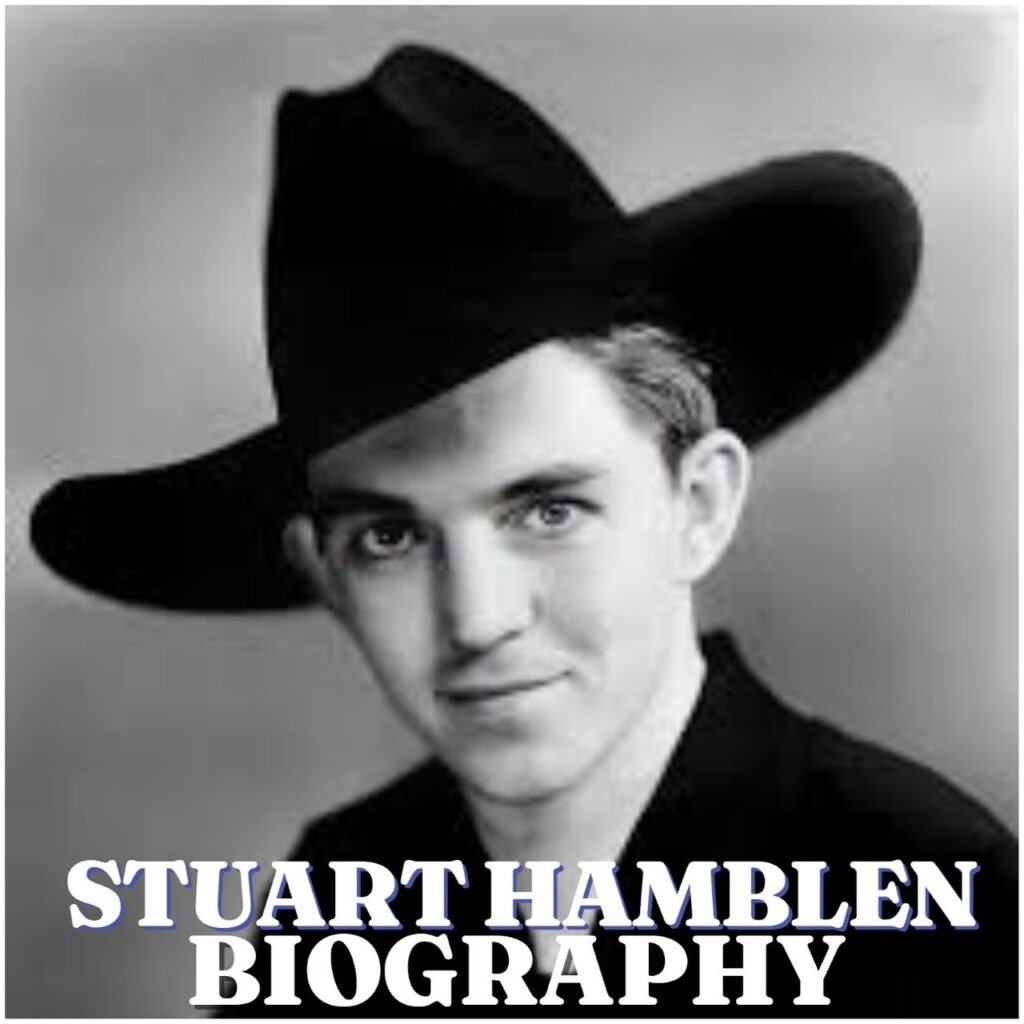
In photographs and film appearances, Hamblen was recognisable for his traditional Western presentation, which often included cowboy hats, Western shirts, jackets, and other clothing associated with country performers of his era. His stage image reflected the singing-cowboy tradition and reinforced the themes of rural life and Western storytelling that appeared in his entertainment work. As he grew older, his appearance changed naturally, while his public image increasingly reflected his Christian broadcasting career. His exact height has not been reliably established in the major biographical sources reviewed, so a precise measurement should not be published as fact. His appearance is best described through his documented photographs and performances rather than unsupported physical measurements.
10. Stuart Hamblen’s Death and Cause of Death
Stuart Hamblen died on March 8, 1989, at the age of 80, in Santa Monica, California. According to the Texas State Historical Association, he had been admitted to St. John’s Hospital and Health Center in Santa Monica in late February 1989 for surgery to remove a malignant brain tumour. Following the operation, he lapsed into a coma and died several days later. The historical record therefore identifies complications following surgery for a malignant brain tumour as the circumstances surrounding his death.
His passing brought to a close a career that had extended across radio broadcasting, country and Western music, film, songwriting, and Christian ministry. Hamblen had spent decades entertaining audiences before becoming known for his gospel compositions and religious outreach. His songs continued to be performed and recorded by other artists, allowing his work to reach listeners beyond the period in which he was personally active. His death was followed by continued recognition of his influence on country and gospel music, including later inductions into music halls of fame.
Hamblen was survived by his wife, Suzy, and their two daughters, as well as grandchildren and great-grandchildren. A memorial service was held at Hollywood Presbyterian Church, where evangelist Billy Graham participated as a speaker. Hamblen was buried at Forest Lawn Memorial Park in the Hollywood Hills, California. His wife continued to live until June 2, 2008, according to the Hamblen Music Company’s biography. Although his life ended in 1989, his songs, recordings, and contribution to American Christian entertainment have remained part of his enduring musical history.
11. Stuart Hamblen’s Social Media Presence and Online Legacy
Stuart Hamblen lived long before the emergence of modern social media platforms such as Instagram, TikTok, and X. As a result, he did not have personal accounts on these platforms during his lifetime, and no verified personal social media handles have been established in the sources reviewed. His public presence was built through radio broadcasts, music recordings, film appearances, interviews, and Christian outreach rather than online profiles. During his most active years, radio was one of the principal ways entertainers reached large audiences, and Hamblen used it to develop a loyal following through his music, humour, and Western storytelling.
Today, people researching Hamblen can find information about his life and work through music archives, historical organisations, record collections, and official websites connected with country and gospel music. The Hamblen Music Company maintains a biographical page documenting his career and musical achievements, while the Country Music Hall of Fame and Museum preserves an oral-history interview recorded with him on May 30, 1986. These resources offer useful information about his experiences in radio, songwriting, film, and Christian broadcasting. They are particularly valuable for readers who want to understand his career through historical accounts rather than relying solely on short social media posts.
Hamblen’s online legacy is therefore centred on the continued availability of his songs, historical recordings, photographs, and biographical material. His compositions have been recorded by numerous artists, and his best-known works remain accessible through music platforms and gospel music collections. People searching for him online are most likely to encounter his name in connection with “It Is No Secret (What God Can Do),” “This Ole House,” his 1952 presidential campaign, or his conversion to Christianity. Anyone wishing to share information about him should use reputable historical and music sources to ensure that the details are accurate, particularly when discussing his family, religious life, and professional achievements.
12. Stuart Hamblen’s Net Worth and Sources of Wealth
Stuart Hamblen’s exact net worth at the time of his death has not been reliably established in the major historical biographies reviewed. There is no independently verified financial statement that provides a complete valuation of his assets, property, investments, savings, and music royalties. For this reason, assigning him a precise net worth in dollars would risk presenting speculation as fact. Although online celebrity-biography websites sometimes publish estimates for historical entertainers, such figures should not be treated as reliable without supporting financial evidence. His professional achievements and documented sources of income provide a more defensible basis for discussing his financial life than an unverified numerical estimate.
Hamblen had several potential sources of income throughout his long career. He earned money through radio broadcasting, recording contracts, songwriting, music publishing, film appearances, and other entertainment activities. His compositions became commercially successful, and his songs were recorded by performers including Elvis Presley, Rosemary Clooney, Johnny Cash, and other country, gospel, and popular artists. The Nashville Songwriters Hall of Fame also records that royalties from his songwriting enabled him to purchase a Hollywood mansion formerly owned by actor Errol Flynn. This indicates that his songwriting success contributed to his ability to acquire substantial property, although it does not establish the total value of his estate.
His financial position was also connected to his long involvement in the entertainment industry and his later activities in Christian broadcasting. As a recognised radio personality and songwriter, he worked across several areas of the music business, while the continued recording and performance of his songs created opportunities for ongoing royalties. However, the available sources do not provide sufficient details about his lifetime earnings, royalty agreements, property holdings at the time of his death, or estate distribution to support a credible net-worth figure. The most accurate conclusion is therefore that Stuart Hamblen’s net worth remains publicly unverified, even though his songwriting and broadcasting career brought him considerable professional success.
13. Stuart Hamblen’s Legacy: Awards, Achievements and Influence on Gospel Music
Stuart Hamblen’s legacy rests on his contributions to early radio entertainment, country and Western music, songwriting, and Christian gospel broadcasting. As one of radio’s pioneering singing cowboys, he helped establish a style of entertainment that combined music with storytelling and the imagery of rural Western life. His radio programmes attracted large audiences, while his recordings and film appearances extended his popularity beyond broadcasting. He subsequently demonstrated that a performer could move between secular entertainment and religious music, using many of the same songwriting and storytelling skills to reach different audiences. His career remains a useful example of the relationship between popular culture, personal conviction, and religious expression in twentieth-century America.
Hamblen received significant recognition for his songwriting and contributions to music. He was inducted into the Nashville Songwriters Hall of Fame in 1970 and received the Academy of Country and Western Music’s Pioneer Award in 1972 for his place in the history of singing cowboys on radio. He also received a star on the Hollywood Walk of Fame in 1976 and a Golden Boot Award in 1988 for his work in motion pictures. Following his death, his influence was further recognised through inductions into the Gospel Music Association Hall of Fame in 1994, the Western Music Association Hall of Fame in 1999, and the Texas Country Music Hall of Fame in 2001. These honours reflect the breadth of his contribution to entertainment, from country songwriting and broadcasting to Western films and gospel music.
Perhaps the most enduring part of Hamblen’s legacy is the continued popularity of songs such as “It Is No Secret (What God Can Do),” “This Ole House,” and “Remember Me (I’m the One Who Loves You).” His gospel compositions have been performed by artists across generations, allowing his work to remain relevant beyond the period in which he originally wrote and recorded it. His personal transformation also became an important part of his public story, particularly for audiences interested in the relationship between Christian faith and music. Although his career began in the world of cowboy entertainment, he ultimately became widely recognised for songs that explored spiritual hope, redemption, and human experience. His influence therefore extends beyond his own performances to the artists who recorded his songs and the listeners who continue to find meaning in them.
14. Conclusion: Remembering Stuart Hamblen’s Remarkable Journey
Stuart Hamblen was a multifaceted American entertainer whose life brought together country music, Western films, radio broadcasting, songwriting, Christian ministry, and political involvement. From his early years in Texas to his rise as a singing cowboy and his later success as a gospel songwriter, he built a career marked by creativity and significant personal change. His conversion to Christianity in 1949 reshaped his lifestyle and musical direction, producing enduring songs such as “It Is No Secret (What God Can Do)” and “This Ole House.” His marriage to Suzy, his role as a father, his presidential campaign, and his numerous music honours further illustrate the variety of experiences that shaped his life. Although he died in 1989, his songs and recordings continue to connect audiences with the traditions of American country and gospel music, ensuring that his contribution remains an important part of both genres’ histories.
Frequently Asked Questions About Stuart Hamblen
1. Who was Stuart Hamblen?
Stuart Hamblen was an American country and gospel singer, songwriter, radio broadcaster, actor, and Christian entertainer. He became famous as one of radio’s early singing cowboys and later wrote celebrated songs, including “It Is No Secret (What God Can Do)” and “This Ole House.”
2. What was Stuart Hamblen’s real name?
His full name was Carl Stuart Hamblen. He was professionally known as Stuart Hamblen throughout his career in music, radio, film, and Christian broadcasting.
3. When and where was Stuart Hamblen born?
Stuart Hamblen was born on October 20, 1908, in Kellyville, Texas, United States. He grew up in a religious family and developed an early interest in music and Western culture.
4. How old was Stuart Hamblen when he died?
Stuart Hamblen was 80 years old when he died on March 8, 1989, in Santa Monica, California.
5. What was Stuart Hamblen famous for?
Hamblen was famous for his early career as a singing cowboy on American radio, his appearances in Western films, and his songwriting. His most celebrated compositions include “It Is No Secret (What God Can Do),” “This Ole House,” and “Remember Me (I’m the One Who Loves You).”
6. What were Stuart Hamblen’s most famous songs?
His best-known songs include:
– “It Is No Secret (What God Can Do)”
– “This Ole House”
– “Remember Me (I’m the One Who Loves You)”
– “Texas Plains”
– “Until Then”
– “His Hands”
– “Teach Me, Lord, to Wait”
– “Open Up Your Heart (And Let the Sunshine In)”
These songs helped establish his reputation across country, Western, popular, and gospel music.
7. Was Stuart Hamblen a Christian?
Yes. Hamblen experienced a major Christian conversion during Billy Graham’s Los Angeles crusade in 1949. Following this experience, he changed his lifestyle, devoted much of his songwriting to Christian themes, and became involved in gospel broadcasting and religious outreach.
8. Who was Stuart Hamblen’s wife?
Stuart Hamblen’s wife was Veeva Ellen Daniels, popularly known as Suzy Hamblen. They married in 1933 and remained together for more than 55 years. She played an important role in encouraging him to attend Billy Graham’s crusade, which became a turning point in his life.
9. How many children did Stuart Hamblen have?
Stuart Hamblen and his wife, Suzy, had two daughters: Veeva Suzanne Hamblen and Lisa Obee Jane Hamblen. The family also included grandchildren and great-grandchildren.
10. What was Stuart Hamblen’s religion?
Hamblen was a Christian who grew up in a Methodist family. His father, James Henry Hamblen, was a Methodist preacher. Following his conversion in 1949, Stuart became particularly known for his Christian gospel songs and radio ministry.
11. Did Stuart Hamblen run for president?
Yes. Stuart Hamblen ran for President of the United States in 1952 as the Prohibition Party candidate. His campaign was closely associated with his opposition to alcohol, which reflected the convictions he adopted following his Christian conversion. He finished fourth in the election.
12. Why did Stuart Hamblen leave his radio programme?
Hamblen’s nationally syndicated radio programme lost its sponsorship after he refused to broadcast a beer commercial. Following his Christian conversion, he no longer wanted to promote alcohol. His decision became a prominent example of his commitment to his religious convictions.
13. What was Stuart Hamblen’s net worth?
Stuart Hamblen’s exact net worth has not been reliably established. He earned income through radio broadcasting, recordings, songwriting, music publishing, and film appearances. His songwriting royalties reportedly enabled him to purchase a Hollywood mansion formerly owned by Errol Flynn, but a verified total valuation of his estate is not publicly available.
14. What was the cause of Stuart Hamblen’s death?
Stuart Hamblen died following surgery for a malignant brain tumour. Historical accounts report that he underwent surgery at St. John’s Hospital and Health Center in Santa Monica, California, in late February 1989, lapsed into a coma, and died on March 8, 1989.
15. What awards did Stuart Hamblen receive?
Hamblen was inducted into the Nashville Songwriters Hall of Fame in 1970, received a Pioneer Award from the Academy of Country and Western Music in 1972, received a star on the Hollywood Walk of Fame in 1976, and earned a Golden Boot Award in 1988. He was later inducted into the Gospel Music Association Hall of Fame, Western Music Association Hall of Fame, and Texas Country Music Hall of Fame.
16. Did Stuart Hamblen have social media accounts?
No verified personal social media accounts are known for Stuart Hamblen. He lived before the modern social media era, and information about his life is available through historical music archives, biographies, and organisations such as the Country Music Hall of Fame and Museum.
17. What is Stuart Hamblen’s legacy?
Stuart Hamblen is remembered for pioneering singing-cowboy radio entertainment, writing influential country and gospel songs, and using his broadcasting career to share Christian messages. His music has been recorded by artists across several genres, and his life story remains associated with artistic creativity, religious transformation, and the history of American country and gospel music.