
Introduction
Few artists in history have changed the way the world sees art as profoundly as Pablo Picasso. Born on October 25, 1881, in Málaga, Spain, Picasso became one of the most influential and recognizable artists of the 20th century. He was not only a painter but also a sculptor, printmaker, ceramicist, draftsman, and experimental artist whose career lasted for more than seven decades. From his earliest artistic experiments in Spain to his internationally celebrated career in France, Picasso demonstrated an extraordinary ability to reinvent himself and challenge established ideas about creativity, beauty, perspective, and artistic expression.
Pablo Picasso became particularly famous for helping develop Cubism alongside Georges Braque, a revolutionary artistic movement that changed the traditional approach to representing people, objects, and space. His famous works, including Les Demoiselles d’Avignon, Guernica, The Weeping Woman, and Girl Before a Mirror, demonstrate his remarkable ability to explore different styles and subjects. Throughout his career, Picasso’s art reflected themes such as love, identity, suffering, politics, war, human relationships, and the changing nature of society. Rather than remaining committed to a single artistic style, he constantly experimented and developed new approaches to visual expression.
Pablo Picasso died on April 8, 1973, in Mougins, France, at the age of 91, but his influence did not end with his death. His paintings and sculptures remain among the most studied, exhibited, and discussed works in modern art history. More than five decades after his death, Picasso continues to attract international attention through museum exhibitions, academic research, cultural debates, and new interpretations of his work. His artistic legacy remains particularly relevant in 2026 as museums and cultural institutions continue to examine the meaning and influence of masterpieces such as Guernica.
Pablo Picasso Early Life and Childhood
Pablo Picasso was born Pablo Ruiz Picasso on October 25, 1881, in Málaga, Spain. He was the son of José Ruiz Blasco and María Picasso López. His father was a painter, art teacher, and curator who had a significant influence on Picasso’s early development as an artist. Growing up in an artistic environment gave Picasso access to drawing materials, artistic instruction, and a family atmosphere in which creativity was encouraged. His remarkable artistic ability became apparent at a very young age, and his father recognized that his son possessed an exceptional natural talent for drawing and painting.
In 1891, Picasso’s family moved to La Coruña, where his father obtained a teaching position. During this period, the young Picasso continued developing his artistic abilities while receiving guidance from his father. His childhood education and exposure to art played an important role in shaping his understanding of drawing, composition, and traditional artistic techniques. The family later moved to Barcelona, an important cultural center where Picasso encountered a much wider artistic community. His experiences in Barcelona helped expose him to new artistic ideas and encouraged him to move beyond the strict conventions of academic art.
By his teenage years, Picasso was already demonstrating artistic abilities far beyond those expected of a young student. In the late 1890s, he began producing increasingly ambitious paintings and participating in the artistic environment of Barcelona and Madrid. His early works showed a strong understanding of academic techniques, but they also revealed his growing desire to experiment. This combination of traditional training and youthful experimentation became an important foundation for the extraordinary artistic career that followed.
Pablo Picasso Education and Artistic Training
Pablo Picasso’s artistic education began largely through his family, particularly under the guidance of his father, José Ruiz Blasco. As an art teacher and painter, his father introduced him to fundamental drawing and painting techniques and helped him develop the discipline required for serious artistic study. Picasso’s natural talent was so strong that his father reportedly recognized very early that his son possessed unusual artistic potential. This early training gave Picasso a solid foundation in academic drawing while allowing him to develop his own creative abilities.
After the family moved to La Coruña, Picasso continued his formal artistic education. He began studying at the School of Fine Arts in La Coruña and later moved to Barcelona, where he was admitted to the School of Fine Arts of La Lonja in 1895. Barcelona provided him with a stimulating artistic environment and access to museums, artists, exhibitions, and intellectual circles. His education during this period was based partly on traditional academic principles, including drawing, composition, anatomy, and observation, but Picasso increasingly became interested in exploring ideas beyond conventional academic expectations.
Picasso also studied at the Royal Academy of San Fernando in Madrid, although he became increasingly dissatisfied with conventional academic instruction. Rather than relying exclusively on classroom teaching, he explored museums and studied the works of earlier masters independently. This willingness to learn from different sources became one of the defining characteristics of his career. His formal education gave him technical skill, while his independent exploration gave him the freedom to challenge artistic traditions and eventually contribute to the development of modern art.
Pablo Picasso Career and Artistic Journey
Pablo Picasso’s professional career developed during a period of enormous cultural and artistic change in Europe. After his early years in Barcelona and Madrid, he increasingly became connected with the artistic world of Paris, which was then one of the most important centers of modern art. Picasso moved between Spain and France during the early years of his career before establishing himself more firmly in Paris. His exposure to different artists, writers, intellectuals, and artistic movements helped him develop a distinctive approach to art and encouraged him to experiment with new forms of expression.
One of the most important stages of Picasso’s early career was his Blue Period, which lasted approximately from 1901 to 1904. During this period, his paintings were dominated by blue and other cool tones and frequently depicted poverty, loneliness, sadness, and human suffering. His subsequent Rose Period, generally associated with the years around 1904 to 1906, introduced warmer colors and subjects such as circus performers, acrobats, and entertainers. These periods demonstrated Picasso’s ability to use color and subject matter to communicate different emotional experiences.
In 1907, Picasso created Les Demoiselles d’Avignon, a groundbreaking painting that challenged traditional ideas of perspective, beauty, and representation. The work became an important precursor to Cubism, which Picasso later developed alongside Georges Braque. Cubism fragmented traditional forms and presented subjects from multiple viewpoints, fundamentally changing how artists approached space and perspective. Picasso’s contribution to Cubism established him as one of the leading innovators of modern art and helped influence generations of artists who followed.
Picasso’s career extended far beyond painting. He worked extensively in sculpture, drawing, printmaking, ceramics, collage, and other artistic forms. He also became involved with theatrical design and experimented with ideas associated with Surrealism and other modern artistic movements. In 1937, he created Guernica, one of his most politically significant works, in response to the destruction and suffering associated with the Spanish Civil War. The painting eventually became an international symbol of the horrors of war and one of the most recognizable anti-war artworks in modern history.
During the later decades of his life, Picasso continued to experiment and produce art at an extraordinary pace. He did not allow himself to remain confined to the styles that had already made him famous. Instead, he repeatedly revisited earlier ideas, transformed familiar subjects, and explored new materials and techniques. His ability to remain creatively active well into old age became another important aspect of his reputation. By the time of his death in 1973, Picasso had created an enormous body of work and had fundamentally changed the direction of modern art.
Pablo Picasso Cause of Death and Death
Pablo Picasso died on April 8, 1973, at the age of 91, at Notre-Dame-de-Vie in Mougins, France. His death marked the end of one of the longest and most influential artistic careers of the modern era. Picasso had spent much of his adult life in France, where he continued creating and exhibiting artwork while remaining an influential figure within international art circles.
The commonly reported cause of Picasso’s death was heart failure, with some accounts describing heart failure following pulmonary complications. He reportedly became ill after spending time with his wife Jacqueline Roque and friends. At the time of his death, Picasso had already achieved worldwide recognition, but he had remained remarkably productive throughout his later years.
Picasso was buried at the Château of Vauvenargues in southern France, a property he had purchased in the 1950s. His death did not diminish interest in his work. Instead, his paintings, sculptures, drawings, prints, and ceramics continued to be collected, exhibited, studied, and debated around the world, ensuring that his influence would remain an important part of modern art history.
Pablo Picasso Personal Life and Family
Pablo Picasso’s personal life was marked by several significant relationships that attracted considerable attention throughout his career. His parents were José Ruiz Blasco and María Picasso López, and his family played an important role in his early artistic development. Among the women who had important relationships with Picasso were Fernande Olivier, Olga Khokhlova, Marie-Thérèse Walter, Dora Maar, Françoise Gilot, and Jacqueline Roque. Picasso married Olga Khokhlova in 1918, and although their relationship eventually deteriorated, they remained legally married until her death in 1955.
Picasso had four children: Paulo Picasso, born in 1921 to Olga Khokhlova; Maya Ruiz-Picasso, born in 1935 to Marie-Thérèse Walter; and Claude Picasso and Paloma Picasso, born in 1947 and 1949 respectively to Françoise Gilot. His relationships and family experiences frequently intersected with his artistic life, and several of the women close to him became subjects of his paintings and drawings. Their portraits provide an important record of the changing artistic styles and personal experiences that characterized different periods of his career.
In the later years of his life, Jacqueline Roque became Picasso’s final wife and remained his partner until his death in 1973. They married in 1961 and lived together during the final period of his career. Picasso’s relationships have continued to attract scholarly and public attention because of the way they intersected with his art and because of ongoing discussions about his treatment of the people close to him. His personal life therefore remains an important but complex part of understanding the broader story of Pablo Picasso.
Pablo Picasso Age, Religion, Nationality, Tribe, Height and Physical Appearance
Pablo Picasso was born on October 25, 1881, in Málaga, Spain, and died on April 8, 1973, in Mougins, France, at the age of 91. He was Spanish by birth and nationality and spent a substantial portion of his adult life in France. Picasso was born into a Roman Catholic family, although as an adult he was often described as non-religious or atheist. Rather than describing him according to a modern concept of tribal identity, it is more accurate to refer to his Spanish and Andalusian roots, as he was born in Málaga in the Andalusia region of Spain.
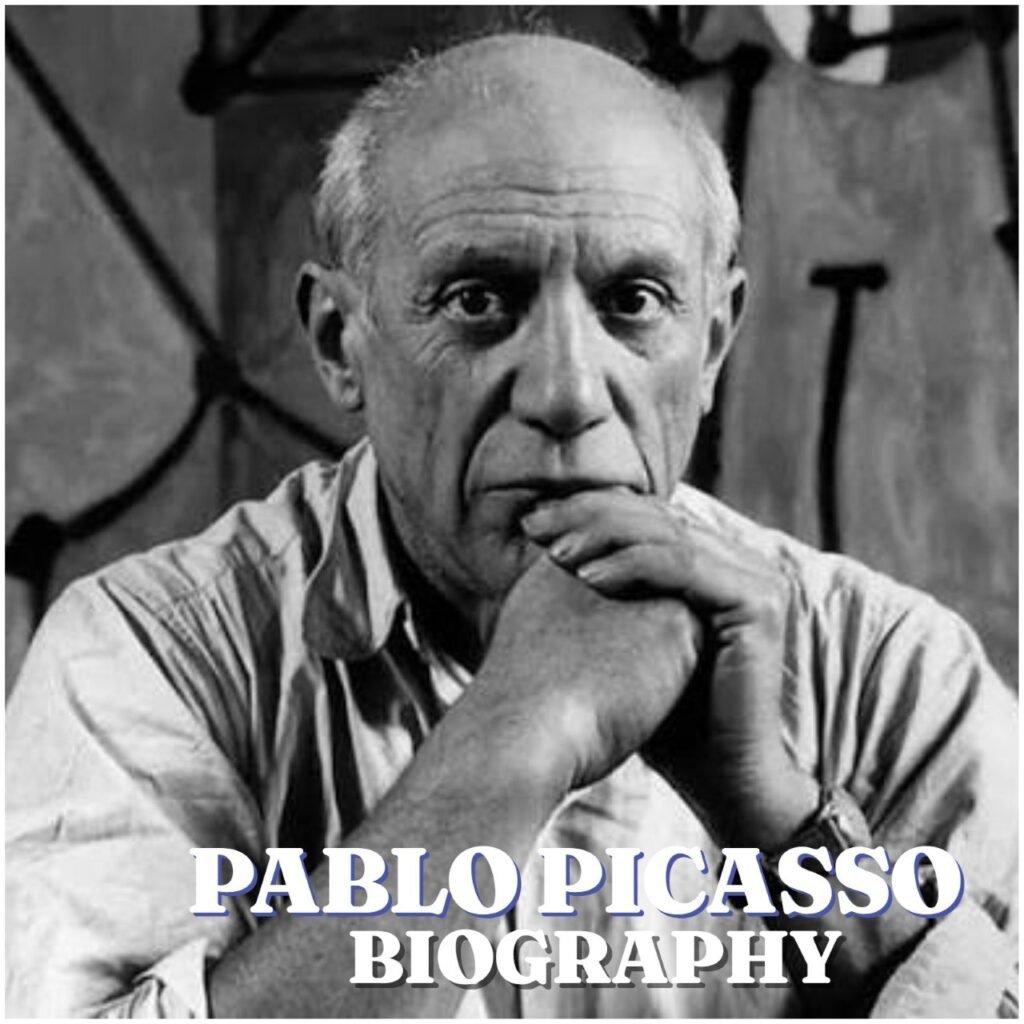
There is no consistently reliable historical record establishing Picasso’s exact height, so it is safer not to assign him a precise measurement without a trustworthy source. Historical photographs show him with dark hair, expressive eyes, distinctive facial features, and an intense gaze. During his younger years, he was often photographed with a clean-shaven face or a small moustache, while photographs from his later years show changes associated with aging, including thinning hair and facial hair. His distinctive appearance eventually became familiar through the many photographs taken of him throughout his exceptionally long career.
In his later years, Picasso maintained a recognizable appearance that reflected his age and his status as one of the world’s most famous living artists. Although physical measurements such as his exact height and weight are not reliably established, photographs and portraits provide extensive visual documentation of his appearance across different stages of his life. His Spanish identity, French residence, distinctive personality, and extraordinary artistic reputation all contributed to the public image that surrounds Pablo Picasso today.
Pablo Picasso Social Media Presence
Pablo Picasso himself did not have a personal social media account because he died in 1973, decades before platforms such as Instagram, Facebook, and TikTok became part of everyday life. Therefore, social media profiles claiming to personally represent Picasso should not automatically be considered official accounts belonging to the artist. His digital presence today is instead maintained largely by museums, cultural organizations, exhibitions, and institutions dedicated to preserving and promoting his work.
One of the most important institutions associated with Picasso’s legacy is Musée national Picasso-Paris, which maintains official social media accounts dedicated to his artwork, exhibitions, collections, and cultural legacy. Its Instagram handle is @museepicassoparis, while its Facebook presence is associated with @MuseePicassoParis and its TikTok account uses @museepicassoparis. These institutional accounts provide modern audiences with information about Picasso’s work and ongoing exhibitions while helping introduce his art to people who may never have encountered it in person.
The wider international celebration of Picasso’s work has also included social media initiatives connected with museums and cultural organizations. During the international Picasso celebrations associated with the 50th anniversary of his death, the official Celebration Picasso 1973–2023 initiative used the Instagram handle @celebrapicasso. These digital platforms demonstrate how Picasso’s legacy has moved beyond museums and books into the modern online environment, allowing his work to continue reaching new generations around the world.
Pablo Picasso Legacy
Pablo Picasso’s legacy extends far beyond the paintings and sculptures he created during his lifetime. He is widely regarded as one of the most influential artists of the 20th century because he fundamentally changed how artists approached form, perspective, color, and visual storytelling. Alongside Georges Braque, Picasso helped develop Cubism, an artistic movement that challenged traditional ideas about how objects and people should be represented. His willingness to break established artistic rules encouraged generations of painters, sculptors, designers, and other creative professionals to experiment with new techniques and perspectives. Works such as Les Demoiselles d’Avignon and Guernica remain powerful examples of his ability to transform complex ideas, emotions, and social realities into unforgettable visual experiences.
Picasso’s influence also came from the extraordinary variety of his artistic career. Rather than limiting himself to painting, he worked extensively in sculpture, drawing, printmaking, ceramics, collage, and other forms of creative expression. His artistic development passed through several recognizable periods, including the Blue Period and Rose Period, before moving into Cubism and later forms of experimentation. This constant reinvention became an important part of his legacy, demonstrating that an artist could continue evolving rather than remaining tied to one recognizable style. His enormous body of work has continued to attract researchers, museums, collectors, students, and art lovers around the world, while major institutions such as Musée national Picasso-Paris continue to preserve and present his work to new audiences.
More than five decades after his death, Picasso remains a major figure in global art and cultural discussions. His works continue to be exhibited internationally, studied in schools and universities, and interpreted through changing social, political, and historical perspectives. In 2026, his legacy remains especially relevant through exhibitions and museum programs that revisit Guernica and examine its continuing significance in relation to war, politics, suffering, and artistic resistance. His name has become almost synonymous with artistic innovation, and his influence can still be seen in modern painting, sculpture, design, and popular culture. Although Picasso’s life and some aspects of his personal conduct continue to generate debate, his lasting impact on modern art is undeniable, making Pablo Picasso one of the most important and enduring artists in history.
Conclusion
Pablo Picasso remains one of the most influential and unforgettable artists in modern history, whose groundbreaking approach to painting, sculpture, and visual expression transformed the world of art. From his early years in Spain to his extraordinary career in France, Picasso constantly challenged artistic conventions and introduced new ways of seeing the world. His masterpieces, including Guernica and Les Demoiselles d’Avignon, continue to inspire artists and audiences decades after his death. Despite ongoing debates surrounding aspects of his personal life, his artistic achievements and lasting influence remain undeniable, ensuring that Pablo Picasso’s name and legacy will continue to shape the history of art for generations to come.
Frequently Asked Questions About Pablo Picasso
Who was Pablo Picasso?
Pablo Picasso was a Spanish artist, painter, sculptor, printmaker, and ceramicist who became one of the most influential figures in modern art. He is best known for co-developing Cubism with Georges Braque and creating major works such as Guernica and Les Demoiselles d’Avignon.
When and where was Pablo Picasso born?
Pablo Picasso was born on October 25, 1881, in Málaga, Spain. He was born into a family with strong artistic connections, and his father, José Ruiz Blasco, was a painter and art teacher who played an important role in his early artistic development.
When did Pablo Picasso die?
Pablo Picasso died on April 8, 1973, in Mougins, France, at the age of 91. He had spent much of his adult life working and living in France, where he continued producing art until his later years.
What was Pablo Picasso famous for?
Pablo Picasso was famous for revolutionizing modern art and helping develop Cubism. He was also known for his Blue Period, Rose Period, innovative paintings, sculptures, drawings, prints, ceramics, and politically significant artworks, particularly Guernica.
What is Pablo Picasso’s most famous painting?
Guernica is widely regarded as one of Pablo Picasso’s most famous and important paintings. Created in 1937, the monumental work became a powerful artistic response to the suffering and destruction associated with the Spanish Civil War and has since become an international symbol of the horrors of war.
Did Pablo Picasso invent Cubism?
Pablo Picasso did not create Cubism alone. He developed the movement alongside French artist Georges Braque in the early 20th century. Cubism rejected conventional single-point perspective and presented subjects through fragmented geometric forms and multiple viewpoints.
What were Pablo Picasso’s artistic periods?
Some of Picasso’s best-known artistic periods include the Blue Period, Rose Period, African-influenced period, and Cubist period. Throughout his long career, he repeatedly changed his artistic style and experimented with different materials and forms of expression.
How many children did Pablo Picasso have?
Pablo Picasso had four children: Paulo Picasso, Maya Ruiz-Picasso, Claude Picasso, and Paloma Picasso. They were born from his relationships with Olga Khokhlova, Marie-Thérèse Walter, and Françoise Gilot.
Who were Pablo Picasso’s wives and partners?
Pablo Picasso was married twice. His wives were Olga Khokhlova and Jacqueline Roque. He also had important relationships with Fernande Olivier, Marie-Thérèse Walter, Dora Maar, and Françoise Gilot, several of whom influenced different periods of his artistic career.
What was Pablo Picasso’s religion?
Picasso was born into a Roman Catholic family, but as an adult he was often described as non-religious or atheist. His personal views on religion were complex, and religious themes occasionally appeared in his artistic work.
What was Pablo Picasso’s nationality?
Pablo Picasso was Spanish by birth and nationality. He was born in Málaga, Spain, and spent a significant part of his artistic career in France, where he became a central figure in the European modern-art scene.
How old was Pablo Picasso when he died?
Pablo Picasso was 91 years old when he died on April 8, 1973. His exceptionally long career allowed him to experience and contribute to several major developments in modern art.
What is Pablo Picasso’s legacy?
Pablo Picasso’s legacy is his enormous influence on modern art and his role in transforming traditional ideas about painting and visual representation. His work continues to be exhibited, studied, collected, and discussed by museums, artists, researchers, and art lovers around the world.
Is Pablo Picasso still relevant today?
Yes. Pablo Picasso remains highly relevant because his artworks continue to influence contemporary artists and generate discussion about art, politics, war, identity, and society. His legacy is also maintained through major museums and exhibitions, including continuing presentations of his work and interpretations of Guernica.
ΤDoes Pablo Picasso have an official social media account?
No. Pablo Picasso himself did not have social media accounts because he died in 1973, decades before social media became widely available. However, institutions dedicated to his work, including Musée national Picasso-Paris, maintain official social media accounts that share information about his art, exhibitions, and legacy.