
Introduction
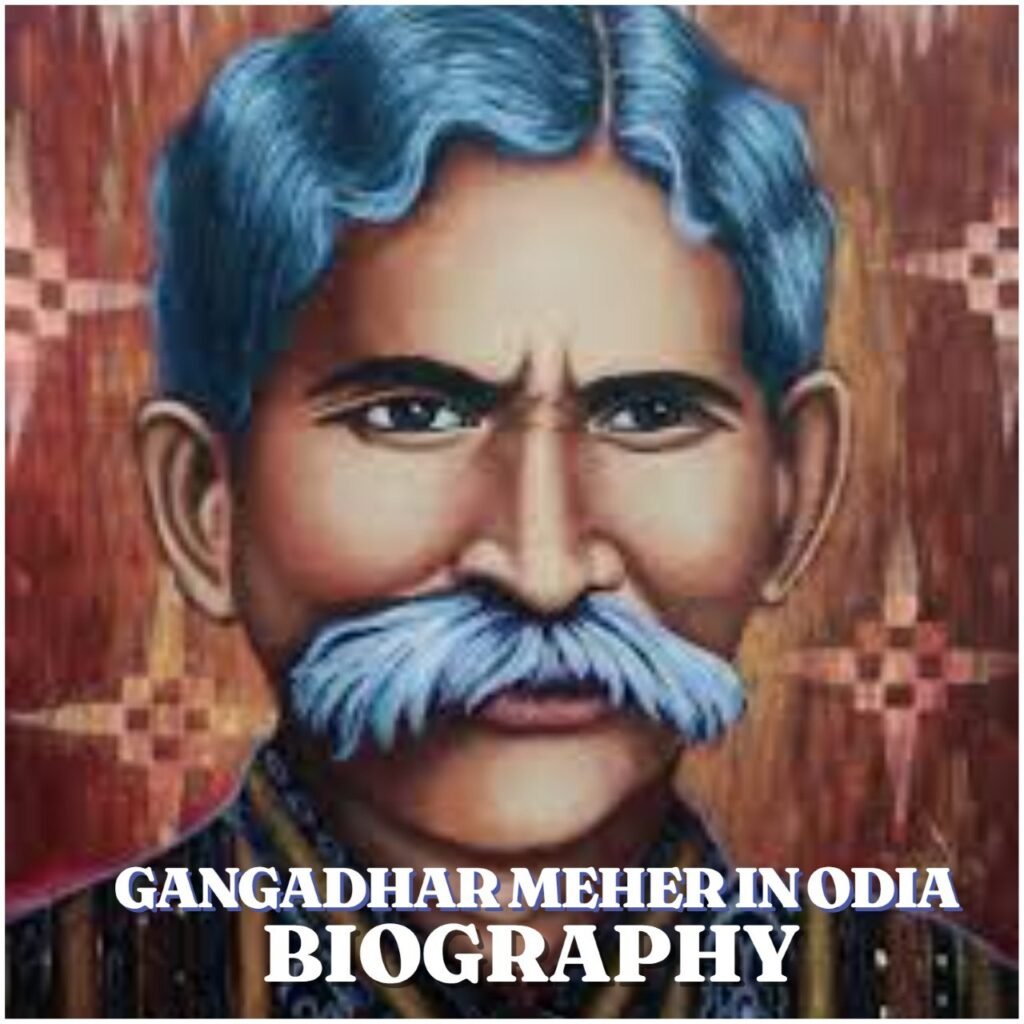
Gangadhar Meher was one of the most celebrated poets and literary figures in the history of Odia literature. Born on 9 August 1862 in Barpali, Odisha, he became widely known by the title “Swabhaba Kabi,” meaning “Natural Poet,” because of his exceptional ability to describe nature, human emotions, society and everyday life through poetry. Although he came from a modest weaving family and had limited formal education, his remarkable talent, self-learning and dedication to literature helped him rise to prominence as one of Odisha’s most respected literary personalities.
Throughout his literary career, Gangadhar Meher produced numerous poems and literary works that addressed themes such as nature, love, devotion, patriotism, morality, social reform and the struggles of ordinary people. Among his best-known works is Tapaswini, while other notable writings include Rasa-Ratnakara, Pranaya Ballari, Kichaka Badha, Indumati, Padmini and Krushaka Sangeeta. His writing combined traditional Odia literary influences with his own distinctive poetic style, allowing him to connect deeply with readers and establish a lasting influence on Odia culture and literature.
Gangadhar Meher’s life story is also remembered as an example of determination and intellectual achievement despite limited opportunities. He worked in administrative positions while continuing to develop his literary career and also showed concern for education and social improvement within his community. He died on 4 April 1924, but his contribution to Odia literature has continued to be remembered through his writings, cultural institutions and educational initiatives. Today, his name remains closely associated with Odisha’s literary heritage, and his enduring title, Swabhaba Kabi Gangadhar Meher, reflects the lasting respect he earned during and after his lifetime.
Early Life of Gangadhar Meher
Gangadhar Meher was born on 9 August 1862 in Barpali, a town in the present-day Bargarh district of Odisha, India. He was born into a modest Bhulia/Meher weaving family, with his father, Chaitanya Meher, associated with the traditional weaving profession and also known for his knowledge of Ayurveda and teaching. His mother was Sevati Devi. Growing up in a family with limited financial resources exposed Gangadhar to the everyday experiences of rural society, including the lives and struggles of working families. These early surroundings later became an important source of inspiration for his poetry and his understanding of ordinary human life.
Gangadhar Meher received only limited formal education, reportedly studying up to around Standard V. However, his lack of extensive schooling did not prevent him from developing into a highly accomplished literary figure. He had a strong desire to learn and educated himself through reading, studying important works of Odia and Sanskrit literature. He became familiar with texts such as the Odia versions of the Ramayana and Mahabharata, as well as other classical works. His dedication to self-education allowed him to develop a strong command of language and literature despite the educational limitations of his time.
From an early age, Gangadhar showed a particular interest in poetry, nature and observation. The natural surroundings of Barpali, together with his experiences of village life, influenced the themes and imagery that later became prominent in his writing. His early exposure to traditional literature provided him with a strong literary foundation, while his own experiences gave his poetry a distinctive and realistic quality. The combination of self-education, natural talent and close observation of society eventually helped Gangadhar Meher emerge as one of the most respected poets in Odia literature and earned him the enduring title “Swabhaba Kabi,” or “Natural Poet.”
Education of Gangadhar Meher
Gangadhar Meher received his early formal education in Barpali, Odisha, but his schooling was limited because of his family’s modest financial circumstances and the responsibilities he had from a young age. Biographical accounts generally state that he studied only up to Standard V. Despite receiving little formal education compared with many other literary figures of his era, Gangadhar developed a strong intellectual curiosity and a deep passion for reading and learning.
After leaving formal schooling, Gangadhar Meher continued his education largely through self-study. He read widely in both Odia and Sanskrit literature, studying important religious and literary texts, including the Odia versions of the Ramayana and Mahabharata. His independent study helped him acquire knowledge of classical literature, poetry, language and philosophy. Rather than allowing his limited schooling to restrict his ambitions, he used reading and personal observation as important tools for expanding his knowledge.
Gangadhar Meher’s educational journey is therefore an important part of his biography because it demonstrates his determination, self-discipline and natural literary ability. His achievements were not the result of advanced university education; instead, he developed his literary skills through continuous learning, reading and practical experience. This unusual educational background makes his later success particularly remarkable and is one reason he is remembered as an influential figure in Odia literature and as the “Swabhaba Kabi,” or Natural Poet.
Career of Gangadhar Meher
Gangadhar Meher began his working life while still facing the financial limitations of his family background. After receiving only a limited formal education, he entered employment and worked in administrative positions connected with the local zamindari system in Barpali. He initially served as an Amin/Patwari, a role that gave him practical experience in land and administrative matters. He later became a Judicial Moharir, or court-related clerk/accountant. His professional responsibilities brought him into close contact with different sections of society and gave him a broader understanding of rural life, poverty, social customs and the difficulties faced by ordinary people.
Alongside his professional career, Gangadhar Meher steadily developed his reputation as a poet and literary writer in the Odia language. He began composing poetry at a relatively young age and continued writing while fulfilling his professional and family responsibilities. His literary works covered a wide range of subjects, including nature, love, devotion, patriotism, morality, agriculture and social reform. His ability to combine traditional literary influences with vivid descriptions of everyday life helped distinguish his writing from that of many of his contemporaries. Works such as Rasa-Ratnakara, Tapaswini, Pranaya Ballari, Kichaka Badha, Indumati, Padmini and Krushaka Sangeeta contributed significantly to his reputation.
Gangadhar Meher’s career also extended beyond his occupation and literary achievements into social and community reform. He was concerned about the education and social progress of the Meher weaving community and encouraged people to improve their educational and social conditions. His commitment to literature and social development eventually made him one of the most respected cultural figures of Odisha. Although he lived during a period when opportunities for education and literary recognition were limited for people from modest backgrounds, his persistence and talent enabled him to establish a lasting career as a poet. He became widely celebrated as “Swabhaba Kabi,” meaning “Natural Poet,” a title that remains strongly associated with his name today.
Why Gangadhar Meher Is Trending in 2026
Gangadhar Meher has recently been in the spotlight in Odisha because the state officially commemorated his birth anniversary on 9 August 2026. Odisha Chief Minister Mohan Charan Majhi paid floral tribute to the celebrated poet at his statue near the Odisha Legislative Assembly in Bhubaneswar. The Chief Minister described Meher as an immortal figure of Odia literature and highlighted the continuing importance of his writings to Odisha’s cultural identity and national consciousness.
The renewed attention has also focused on Gangadhar Meher’s enduring literary legacy, particularly works such as Tapaswini and Indumati. During the birth-anniversary tribute, CM Majhi emphasized Meher’s love of nature and humanistic writing, noting that his works continue to inspire younger generations. This latest official recognition has brought the 19th-century poet back into public discussion as people revisit his contribution to Odia language, literature, culture and social thought.
Gangadhar Meher’s name also remains strongly connected with Gangadhar Meher University in Sambalpur, an institution named in his honour. The university continues to preserve and promote his legacy while remaining an active educational institution in Odisha. His name therefore remains relevant not only because of his historical importance but also because of the continuing efforts to preserve and celebrate his contribution to Odia literature and culture.
Cause of Death and Death of Gangadhar Meher
Gangadhar Meher, the renowned Odia poet popularly known as “Swabhaba Kabi,” died on 4 April 1924 at the age of 61. His death is recorded by official biographical sources, including Gangadhar Meher University, which confirms the date of his passing. His death brought to an end the life of a poet who had risen from a modest background to become one of the enduring figures of Odia literary culture.
The specific cause of Gangadhar Meher’s death has not been reliably documented in the major official biographical sources available today. Therefore, it would be inaccurate to claim that he died from a particular illness or medical condition without credible historical evidence. For this reason, the most responsible way to describe his death is to state that he died on 4 April 1924 at the age of 61, while noting that the precise medical cause remains undocumented or unclear in reliable sources.
His death marked the end of the life of one of Odisha’s most influential literary figures, but his contribution to Odia poetry, nature writing, social reform and cultural identity continued long after his passing. More than a century later, Gangadhar Meher remains remembered through his celebrated works, including Tapaswini, Rasa-Ratnakara, Pranaya Ballari, Kichaka Badha and Indumati.
Personal Life and Family of Gangadhar Meher
Gangadhar Meher was born into a Bhulia/Meher family in Barpali, Odisha, and his early family life was shaped by modest economic circumstances. His father, Chaitanya Meher, was a traditional weaver who also worked as a village Ayurvedic practitioner and later taught children in a small village school. His mother was Sevati Devi. Gangadhar grew up helping his family with weaving while also pursuing his studies and developing his passion for literature. His family background remained an important part of his identity and influenced his understanding of the lives of ordinary people.
Gangadhar Meher married at a very young age, reportedly at around 10 years old, which was consistent with social customs in his community during that period. His first wife was Shanta Devi. After Shanta Devi’s death, Gangadhar married Champa Devi, who became his second wife. His family life therefore included two marriages, although historical sources provide limited details about his wives and their personal lives.
Gangadhar Meher and his family had four children: Arjun Meher, Bhagaban Meher, Basumati Meher and Laxmi Meher. Arjun reportedly died at the age of 12, while Bhagaban Meher was also associated with literature and was known as Kabi-Putra, meaning “poet’s son.” His family and humble upbringing remained an important part of his life story, particularly because he achieved extraordinary literary recognition despite limited formal education and financial difficulties.
Age, Religion, Nationality, Height and Physical Appearance of Gangadhar Meher
Age: Gangadhar Meher was born on 9 August 1862 in Barpali, in present-day Bargarh district of Odisha, India. He died on 4 April 1924, making him 61 years old at the time of his death. His birth and death dates are documented in biographical records about the poet.
Religion: Gangadhar Meher’s writings and philosophy show strong influences from Hindu religious and classical traditions, including the Ramayana, Mahabharata and Sanskrit literature. However, historical sources do not consistently provide a formal biographical statement specifying his personal religious affiliation. He was also known for a broad humanistic outlook and for emphasizing the unity of humanity rather than narrow religious divisions.
Nationality: Gangadhar Meher was Indian and belonged to the Odia-speaking cultural tradition of Odisha. He was born in Barpali, which was historically associated with the Sambalpur region and is now located in Bargarh district, Odisha. His literary career played an important role in the development and promotion of Odia language and literature, and his works continue to be regarded as an important part of Odisha’s cultural heritage.
Height and Physical Appearance: There does not appear to be a reliable historical record documenting Gangadhar Meher’s exact height, weight or detailed physical measurements. Because he lived from 1862 to 1924, modern biographical details such as height were generally not systematically recorded. Available photographs and portraits show him in the traditional clothing and appearance associated with his period, but an exact height should not be stated as fact without a reliable historical source. His most enduring description is therefore connected to his intellectual and literary achievements rather than measurable physical characteristics.
Gangadhar Meher Net Worth
There is no reliable historical record of Gangadhar Meher’s net worth. Since he lived from 1862 to 1924, modern concepts such as celebrity net worth were not documented in the way they are today. Official biographical information identifies him primarily as a poet and Judicial Moharir, or accountant, and describes his background as humble, with financial difficulties affecting his family during his early life.
Based on the available historical information, Gangadhar Meher was not known to have accumulated substantial personal wealth. His documented career involved administrative and judicial-related employment, and historical accounts indicate that he earned a modest salary. He also came from a traditional weaving family and continued to live a relatively modest life despite becoming a highly respected literary figure.
Therefore, assigning a specific modern figure to Gangadhar Meher’s net worth would be speculative and potentially misleading. For a biography, it is more accurate to state that his exact net worth is unknown and cannot be reliably estimated from available historical records. His greatest legacy was not financial wealth but his enormous contribution to Odia literature, poetry, social reform and the cultural heritage of Odisha.
Literary Works of Gangadhar Meher
Gangadhar Meher’s literary career produced several important works that contributed to the development and popularity of Odia poetry. His writings addressed a wide range of subjects, including nature, love, devotion, patriotism, morality, agriculture and social concerns. His poetic style was influenced by classical Odia and Sanskrit traditions, while his own observations of rural life and nature gave his work a distinctive voice.
Among his best-known works are Tapaswini, Rasa-Ratnakara, Pranaya Ballari, Kichaka Badha, Indumati, Padmini, Kavita Kallola, Utkala Laxmi, Arghyathali and Krushaka Sangeeta. Tapaswini is particularly regarded as one of his most important literary creations. Through these works, he demonstrated his ability to explore both traditional themes and contemporary social concerns.
His poetry also helped make literature more closely connected with ordinary people and the natural environment around them. His vivid descriptions of nature and human experiences contributed to the title Swabhaba Kabi, while his treatment of social and moral subjects demonstrated that his literary interests extended beyond romantic and natural poetry.
Legacy of Gangadhar Meher
Gangadhar Meher left an enduring legacy as one of the most influential poets in Odia literature. Popularly known as “Swabhaba Kabi,” or “Natural Poet,” he earned this title through his remarkable ability to portray nature, human emotions and everyday life in expressive and memorable language. His major works, including Tapaswini, Rasa-Ratnakara, Pranaya Ballari, Kichaka Badha, Indumati and Krushaka Sangeeta, continue to be studied and remembered for their literary and cultural importance. His poetry helped strengthen the place of Odia as a language of sophisticated literary expression while maintaining connections with Odisha’s classical traditions.
His influence also extended beyond poetry into social awareness and reform. Gangadhar Meher was concerned about education, social progress and the welfare of the Meher weaving community from which he came. His own life demonstrated the importance of self-education, as he achieved considerable literary recognition despite receiving only limited formal schooling. Through his writings, he addressed subjects such as nature, agriculture, morality, patriotism, devotion and the difficulties experienced by ordinary people, giving his work a strong connection with the society around him.
Today, Gangadhar Meher remains an important symbol of Odisha’s literary and cultural heritage. His name has been preserved through educational and cultural institutions, most notably Gangadhar Meher University in Sambalpur, which honours his contribution to Odia literature. More than a century after his death in 1924, his poems continue to be read, discussed and celebrated, while his journey from a humble background to becoming one of Odisha’s most respected literary figures continues to inspire students, writers and lovers of Odia literature.
Conclusion
Gangadhar Meher remains one of the most respected figures in Odia literature, remembered for his exceptional poetry, love of nature, social awareness and commitment to the cultural development of Odisha. Despite limited formal education and a humble family background, he became widely celebrated as “Swabhaba Kabi,” or “Natural Poet,” through works such as Tapaswini, Rasa-Ratnakara, Indumati and Krushaka Sangeeta. His life demonstrates the power of self-education, determination and literary talent, while his writings continue to preserve important aspects of Odisha’s culture, traditions and social values. Although he died in 1924, Gangadhar Meher’s literary influence remains alive, making his name an enduring part of India’s rich literary heritage.
Frequently Asked Questions About Gangadhar Meher
Who was Gangadhar Meher?
Gangadhar Meher was a renowned Odia poet and literary figure from Odisha, India. He is popularly known as “Swabhaba Kabi,” meaning “Natural Poet,” because of his celebrated poetry about nature, human emotions, society and culture.
When and where was Gangadhar Meher born?
Gangadhar Meher was born on 9 August 1862 in Barpali, in present-day Bargarh district of Odisha, India.
How old was Gangadhar Meher when he died?
Gangadhar Meher was 61 years old when he died on 4 April 1924.
What was Gangadhar Meher famous for?
Gangadhar Meher was famous for his contribution to Odia poetry and literature. His writings explored nature, love, devotion, patriotism, morality, agriculture and social issues.
Why is Gangadhar Meher called Swabhaba Kabi?
Gangadhar Meher is called Swabhaba Kabi, which means “Natural Poet,” because of his exceptional ability to describe nature and human life in an expressive and emotionally engaging way.
What are the famous works of Gangadhar Meher?
Some of Gangadhar Meher’s best-known works include Tapaswini, Rasa-Ratnakara, Pranaya Ballari, Kichaka Badha, Indumati, Padmini, Utkala Laxmi and Krushaka Sangeeta.
What was Gangadhar Meher’s educational qualification?
Gangadhar Meher received limited formal education and is generally reported to have studied up to Standard V. He later continued learning through extensive self-study and reading of Odia and Sanskrit literature.
Who were Gangadhar Meher’s parents?
Gangadhar Meher’s father was Chaitanya Meher, while his mother was Sevati Devi. His father was associated with traditional weaving and was also known for his knowledge of Ayurveda and teaching.
Who was Gangadhar Meher’s wife?
Gangadhar Meher’s first wife was Shanta Devi. After her death, he married Champa Devi, according to biographical accounts.
How many children did Gangadhar Meher have?
Gangadhar Meher had four children: Arjun Meher, Bhagaban Meher, Basumati Meher and Laxmi Meher.
What was Gangadhar Meher’s occupation?
Apart from being a poet, Gangadhar Meher worked in administrative and judicial-related positions. He initially worked as an Amin/Patwari and later served as a Judicial Moharir.
What was Gangadhar Meher’s religion?
Gangadhar Meher’s literary works were strongly influenced by Hindu religious and classical traditions, including the Ramayana and Mahabharata. However, detailed historical information about his personal religious identity is limited.
What was Gangadhar Meher’s nationality?
Gangadhar Meher was Indian, and he belonged to the rich Odia literary and cultural tradition of Odisha.
What was the cause of Gangadhar Meher’s death?
The specific cause of Gangadhar Meher’s death is not reliably documented in the major historical and official biographical sources. He died on 4 April 1924 at the age of 61.
What is Gangadhar Meher’s net worth?
There is no reliable record of Gangadhar Meher’s net worth. As a historical poet who lived between 1862 and 1924, his personal wealth was not documented using modern net-worth estimates.
What is Gangadhar Meher’s legacy?
Gangadhar Meher’s legacy lies in his lasting contribution to Odia poetry, literature, culture and social thought. His works continue to be studied and remembered, and Gangadhar Meher University in Sambalpur was named in his honour.