
Robert Frost Biography Introduction
Robert Frost was one of the most influential American poets of the 20th century, widely remembered for his powerful poems about nature, rural life, human choices, relationships and the complexities of everyday existence. Born on March 26, 1874, in San Francisco, California, Frost later became closely associated with the landscapes and communities of New England. His accessible language often made his poetry appear simple at first reading, but beneath that simplicity were deeper questions about loneliness, mortality, responsibility, uncertainty and the choices people make throughout their lives.
Frost’s literary career developed gradually rather than through immediate success. He worked as a teacher, farmer and writer before gaining wider recognition, and his decision to move to England with his family in 1912 proved important to his development as a published poet. His early collections, including A Boy’s Will and North of Boston, established his reputation and helped introduce readers to poems that combined conversational speech with sophisticated literary techniques. After returning to the United States, Frost continued publishing and eventually became one of America’s most celebrated literary figures.
Today, Robert Frost remains widely studied and quoted, with poems such as The Road Not Taken, Stopping by Woods on a Snowy Evening, Mending Wall, Birches and Fire and Ice continuing to attract new generations of readers. He received the Pulitzer Prize for Poetry four times and became an important figure in American literary history. Although Frost died on January 29, 1963, at the age of 88, his work has remained relevant because it addresses universal experiences and questions that continue to shape human life. His enduring reputation makes his biography, personal experiences and literary legacy subjects of continued interest.
Robert Frost Early Life and Childhood
Robert Lee Frost was born on March 26, 1874, in San Francisco, California, to William Prescott Frost Jr. and Isabelle Moodie Frost. His father was a journalist and teacher who served as the editor of the San Francisco Evening Bulletin, while his mother was a teacher who had immigrated from Scotland. Frost spent his earliest years in California, but his childhood changed dramatically after his father died of tuberculosis in 1885, when Frost was only 11 years old. Following his father’s death, his mother moved him and his younger sister, Jeanie, to Lawrence, Massachusetts, where they lived with their paternal grandparents.
In Massachusetts, Frost developed an early interest in reading, writing and poetry. He attended Lawrence High School, where he became interested in literature and was involved in school activities. He graduated as co-valedictorian of his class in 1892, sharing the honor with Elinor Miriam White, who would later become his wife. Frost briefly attended Dartmouth College in New Hampshire but left after less than a year, choosing instead to pursue different forms of employment and independent study. His early adulthood included teaching, working in mills and writing, experiences that exposed him to ordinary working life and later influenced the realistic settings and conversational style of much of his poetry.
Frost’s relationship with Elinor White became one of the most important parts of his early personal life. The two had been classmates, and after a period apart, they married in December 1895. The couple eventually had six children, although their family life was marked by both happiness and profound tragedy. During these years, Frost continued writing poetry while working to support his growing family. He and Elinor eventually moved to a farm in New Hampshire, where Frost’s experiences with farming, rural communities and the New England landscape became central influences on his developing literary identity. These early experiences helped lay the foundation for the distinctive poetic voice that would later make him one of America’s most recognized poets.
Robert Frost Education and Academic Background
Robert Frost began his formal education in California before his family moved to Massachusetts following his father’s death. After settling in Lawrence, Massachusetts, Frost attended Lawrence High School, where he developed a strong interest in literature, reading and writing. He became particularly interested in poetry and began composing his own work while still a student. Frost graduated from Lawrence High School in 1892 as co-valedictorian, sharing the distinction with Elinor Miriam White, who would later become his wife.
After high school, Frost briefly attended Dartmouth College in Hanover, New Hampshire. However, he did not remain at the institution long and left without completing a degree. His decision to leave Dartmouth reflected the unconventional educational path he would follow throughout his life. Rather than relying entirely on formal university education, Frost continued learning independently while working in different occupations and developing his writing. He later attended Harvard University beginning in 1897, but once again he did not graduate, leaving the institution in 1900 because of health and financial circumstances.
Although Frost never earned a university degree, his lack of a completed formal education did not prevent him from becoming one of America’s most respected literary figures. Much of his intellectual development came through extensive reading, teaching, farming, personal experience and independent study. His encounters with rural communities, nature and ordinary working people provided important material for his poetry. Over time, his self-directed education and life experiences helped him develop the distinctive conversational style and philosophical depth that became hallmarks of his work.
Robert Frost Career and Professional Life
Robert Frost’s professional career developed gradually as he balanced writing with teaching, farming and other forms of employment. In his early years, he worked as a teacher and took on various jobs while writing poetry in his spare time. He and his wife, Elinor, later moved to a farm in New Hampshire, where Frost’s experiences with rural life became an important source of inspiration. During this period, he continued submitting poems and articles to magazines, although recognition came slowly. His early struggles helped shape the realistic settings, conversational language and observations of ordinary people that became characteristic of his poetry.
A major turning point in Frost’s career came in 1912 when he moved with his family to England. The move gave him greater access to the British literary community and provided an environment in which he could concentrate more seriously on his writing. His first poetry collection, A Boy’s Will, was published in 1913, followed by North of Boston in 1914. The success of these books quickly established Frost as an important emerging poet. He returned to the United States in 1915 and found that his growing reputation had already attracted considerable attention among American readers and publishers.
After returning to America, Frost’s literary career expanded rapidly. He published numerous collections, including Mountain Interval, New Hampshire, West-Running Brook and A Further Range, while also teaching and giving lectures at universities and literary institutions. His poetry explored subjects such as nature, human relationships, isolation, work, death and difficult personal choices, often using rural New England settings as a backdrop. His ability to combine accessible language with complex ideas made him particularly influential among American readers.
Frost received four Pulitzer Prizes for Poetry during his career, winning for New Hampshire in 1924, Collected Poems in 1931, A Further Range in 1937 and A Witness Tree in 1943. He also became an important public literary figure, receiving numerous honorary degrees and awards. In 1961, at the age of 86, Frost was invited to recite a poem at the inauguration of U.S. President John F. Kennedy, becoming one of the most recognizable literary figures associated with American public life. By the end of his career, he had established a reputation as one of the defining poets of modern American literature.
Why Robert Frost Is Trending in 2026
Robert Frost remains in the spotlight in 2026 because his poetry continues to inspire literary events, competitions and discussions about traditional poetic forms. One of the most notable recent developments is the 2026 Frost Farm Poetry Conference, held from August 14 to 16 in New Hampshire. The event brought poets together for workshops, readings and discussions focused particularly on metrical poetry, reflecting the continuing influence of the tradition associated with Frost.
Another reason Frost is receiving renewed attention is the continued activity surrounding the Frost Farm Prize for Metrical Poetry, an award named in his honor. The 2026 competition attracted more than 600 anonymous entries, with Carla Galdo of Lovettsville, Virginia, winning for her poem The Absences Are Different. The prize demonstrates how Frost’s influence extends beyond his own published work and continues to encourage contemporary poets to explore meter, form and disciplined poetic composition.
Frost’s poetry has also been receiving fresh literary analysis in 2026. Recent publications have revisited his literary philosophy, his relationship with poetic tradition and the deeper meanings behind poems that are often treated as simple works about nature. In July, Literary Hub revisited the history of “The Road Not Taken,” highlighting the long-standing tendency of readers to interpret the poem differently from Frost’s original intention. In August, Modern Age published a new essay examining Frost’s classical influences, further demonstrating that his work remains a subject of serious literary discussion more than six decades after his death.
Frost’s influence is also visible through awards that carry his name. In January 2026, the Poetry Society of America announced Mei-mei Berssenbrugge as the recipient of the 2026 Frost Medal for distinguished lifetime achievement in poetry. The medal, named after Robert Frost, has been awarded since 1930 and remains one of America’s longstanding poetry honors.
Robert Frost Personal Life and Family
Robert Frost married his high-school sweetheart, Elinor Miriam White, in December 1895 after a period of courtship. Elinor was also a talented and educated woman who shared Frost’s interest in literature, and their relationship remained one of the most important influences on his personal and creative life. The couple initially lived in Massachusetts before moving to a farm in Derry, New Hampshire, where Frost worked as a farmer and teacher while developing his poetry. Frost’s relationship with Elinor was deeply important to him, and she remained his wife and closest companion until her death in 1938.
Frost and Elinor had six children: Elliott, Lesley, Carol, Irma, Marjorie and Elinor Bettina, known as Bettina. Their family life, however, was marked by significant tragedy. Their son Elliott died of cholera at the age of four, while their daughter Elinor Bettina died only a few days after birth. Their daughter Marjorie later died following childbirth complications, and their son Carol died by suicide in 1940. Another daughter, Irma, was committed to a mental institution in 1947 and was the only one of Frost’s six children who was not buried with him and Elinor. These painful experiences of loss and grief became important context for understanding the darker emotional themes that appear throughout Frost’s poetry.
Frost’s family experiences strongly influenced his understanding of love, grief, parenthood and human relationships. His marriage to Elinor provided stability during the difficult years when he struggled financially as a farmer and writer, while the deaths and personal difficulties within the family left a lasting emotional impact on him. Frost died in 1963, more than two decades after Elinor’s death, and he was buried beside her at Old Bennington Cemetery in Bennington, Vermont, together with five of their six children. Their family grave remains an important part of Frost’s personal legacy, while his surviving descendants and the continuing study of his family history provide additional insight into the life behind his poetry.
Robert Frost Age, Religion, Nationality, Height and Physical Appearance
Robert Frost’s age: Robert Frost was born on March 26, 1874, and died on January 29, 1963, at the age of 88. He spent most of his adult life in the United States, although an important period of his early literary career took place in England. His long life covered a major period of change in American literature, and he remained an active writer, lecturer and public literary figure well into his later years.
Robert Frost’s religion: Frost was raised in a Christian household and was familiar with religious ideas from an early age. His mother, Isabelle, was a member of the Swedenborgian Church, and religious and philosophical themes appeared at various points in Frost’s life and poetry. However, Frost’s personal beliefs were complex and he did not always fit neatly into a single religious category. His poems frequently explored questions about God, faith, morality, death and humanity’s relationship with the natural world, making spirituality an important but nuanced aspect of his literary work.
Robert Frost’s nationality: Robert Frost was American by nationality. He was born in San Francisco, California, and later became strongly associated with New England, particularly New Hampshire and Vermont. Although he lived in England from 1912 to 1915 and developed important literary connections there, he returned to the United States and built the majority of his celebrated career as an American poet.
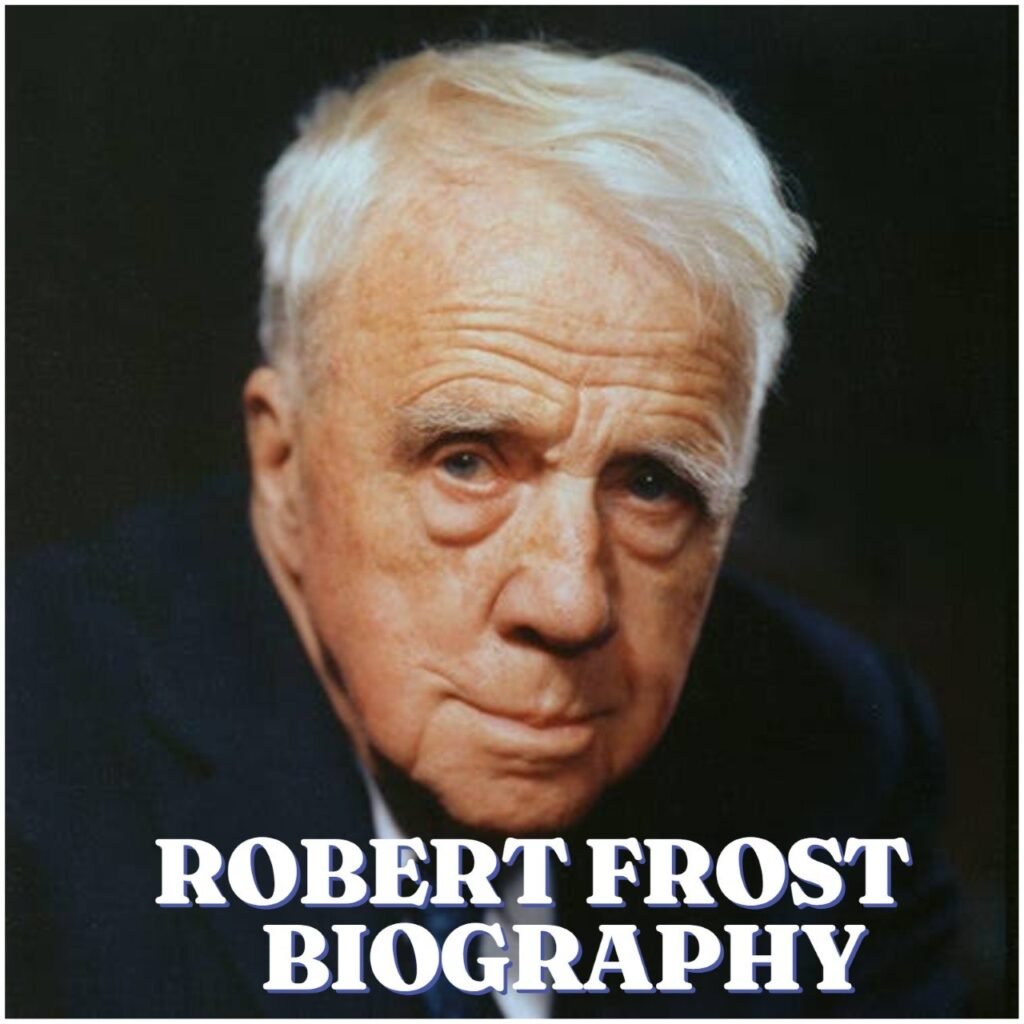
Robert Frost’s height and physical appearance: There is no reliably documented official measurement of Frost’s height in major biographical sources, so claims giving an exact height should be treated cautiously. Photographs from his adult and later years show Frost as a tall, slender-to-medium-built man with light-colored hair that became white with age, prominent facial features and a distinctive mustache. He was frequently photographed wearing formal suits, coats and hats, particularly during his later years when he became a prominent public literary figure. His recognizable appearance became closely associated with the image of the distinguished American poet.
Robert Frost Net Worth
Robert Frost’s exact net worth at the time of his death in 1963 is not reliably documented in publicly available sources. Unlike modern celebrities, Frost did not have a publicly reported personal fortune, and historical records tend to focus more on his literary estate, publishing contracts, royalties and teaching income than on a single net-worth figure. Records from the University of Michigan note that even after gaining considerable attention, Frost initially struggled to support his family through poetry and farming alone.
Over the course of his career, however, Frost developed several sources of income, including book royalties, poetry readings, teaching positions, fellowships and speaking engagements. As his reputation grew, his publishing arrangements became considerably more favorable. His 1928 contract with Henry Holt reportedly included substantial royalties, an advance and a monthly stipend, illustrating how commercially successful his poetry had become by that period. He also held teaching positions at institutions including Amherst College, Harvard and the University of Michigan.
Because there is no dependable historical figure for Frost’s personal wealth, a precise modern net-worth number would be speculative. A reasonable biography should therefore describe him as a financially successful and highly established poet during his later decades rather than assign an unsupported dollar amount. After his death, his literary estate continued to generate royalties and licensing income; Dartmouth’s archives confirm that Frost’s will established a trust responsible for managing copyrights, royalties and publication permissions for his writings.
Robert Frost Death and Cause of Death
Robert Frost died on January 29, 1963, in Boston, Massachusetts, at the age of 88. In the final months of his life, he experienced serious health problems. In December 1962, doctors discovered prostate and bladder cancer, and he underwent prostate surgery on December 10. He subsequently suffered a pulmonary embolism on December 23 and another on January 7, 1963.
Frost’s death is commonly described as resulting from complications following prostate surgery, including pulmonary embolisms. A pulmonary embolism occurs when a blood clot blocks an artery in the lungs and can be life-threatening. His declining health during the final weeks of his life brought an end to a career that had made him one of America’s most respected literary figures.
Following his death, Frost was honored with memorial services attended by friends, family and members of the literary community. His ashes were eventually buried beside those of his wife, Elinor Frost, in the Frost family plot at Old Bennington Cemetery in Bennington, Vermont. His gravestone carries the memorable inscription, “I had a lover’s quarrel with the world.”
Robert Frost Literary Legacy
Robert Frost left an enduring mark on American literature and is widely regarded as one of the most important poets of the 20th century. His poetry brought together ordinary speech, rural settings and profound philosophical questions, allowing readers to connect with subjects such as nature, love, loneliness, death, responsibility and human choices. Poems including The Road Not Taken, Stopping by Woods on a Snowy Evening, Mending Wall, Birches and Fire and Ice have become enduring works of American literature and continue to be widely read and studied.
Frost’s influence is also reflected in the numerous honors he received during his lifetime. He won the Pulitzer Prize for Poetry four times, and more than six decades after his death his work continues to be taught in schools and universities around the world. He also became an important public figure in American cultural life, particularly after being invited to participate in President John F. Kennedy’s 1961 inauguration. His ability to write about ordinary rural experiences while addressing complex questions about human existence helped establish a distinctive tradition within American poetry.
Beyond his individual poems, Frost’s name has become associated with the continuing preservation and promotion of poetry. Literary institutions, archives, academic programs, poetry prizes and events continue to study and celebrate his work. His former homes and associated sites, including the Robert Frost Farm in Derry, New Hampshire, and the Frost Place in Franconia, New Hampshire, help preserve aspects of his life and career. Frost’s lasting legacy ultimately comes from the way his apparently simple poems invite deeper interpretation, ensuring that new generations of readers continue to discover different meanings in his work.
Conclusion
Robert Frost remains one of the most celebrated figures in American poetry, remembered for transforming ordinary observations of nature, rural life and human relationships into thoughtful reflections on choice, responsibility, love, loss and mortality. From his challenging early years and unconventional educational journey to his international literary breakthrough and later recognition as a four-time Pulitzer Prize winner, Frost built a remarkable career through persistence and creative independence. Although he died in 1963 at the age of 88, his poems continue to be read, studied and interpreted around the world, ensuring that his distinctive voice and literary legacy remain influential in 2026 and beyond.
Frequently Asked Questions About Robert Frost
Who was Robert Frost?
Robert Frost was an American poet best known for his poems about nature, rural life, human choices and the complexities of everyday existence. He became one of the most influential American poets of the 20th century and won the Pulitzer Prize for Poetry four times.
When was Robert Frost born?
Robert Frost was born on March 26, 1874, in San Francisco, California, United States.
When did Robert Frost die?
Robert Frost died on January 29, 1963, in Boston, Massachusetts, at the age of 88.
What was the cause of Robert Frost’s death?
Robert Frost died from complications following prostate surgery, including pulmonary embolisms. He had been experiencing serious health problems during the final months of his life.
Who was Robert Frost’s wife?
Robert Frost’s wife was Elinor Miriam White, his high-school sweetheart. They married in 1895 and remained together until Elinor’s death in 1938.
How many children did Robert Frost have?
Robert Frost and Elinor had six children: Elliott, Lesley, Carol, Irma, Marjorie and Elinor Bettina. Several of their children died during their lifetimes, leaving Frost and his family to experience significant personal tragedies.
What are Robert Frost’s most famous poems?
Some of Robert Frost’s most famous poems include “The Road Not Taken,” “Stopping by Woods on a Snowy Evening,” “Mending Wall,” “Birches,” “Fire and Ice” and “The Gift Outright.”
How many Pulitzer Prizes did Robert Frost win?
Robert Frost won the Pulitzer Prize for Poetry four times. He received the award for New Hampshire in 1924, Collected Poems in 1931, A Further Range in 1937 and A Witness Tree in 1943.
What was Robert Frost’s nationality?
Robert Frost was American. Although he spent several years living in England, he was born in the United States and became one of the country’s most prominent poets.
What was Robert Frost’s religion?
Frost was raised in a Christian environment, and his mother was associated with the Swedenborgian Church. His personal religious views were complex, however, and his poetry often explored questions about faith, God, morality, nature and mortality.
Did Robert Frost attend college?
Yes. Frost briefly attended Dartmouth College and later Harvard University, but he did not graduate from either institution. He continued much of his education independently through reading, teaching, writing and life experience.
What is Robert Frost’s most famous poem?
“The Road Not Taken” is generally considered Robert Frost’s most famous and widely recognized poem. Published in 1916, it is frequently interpreted as a poem about individual choice, although its meaning is more complex and has often been misunderstood.
Why is Robert Frost important?
Robert Frost is important because he combined accessible, conversational language with complex ideas about human life. His poems made rural American settings and ordinary experiences vehicles for exploring universal themes such as choice, isolation, relationships, death and responsibility.
What was Robert Frost’s net worth?
Robert Frost’s exact net worth is not reliably documented. He earned money through poetry publications, royalties, teaching, lectures and speaking engagements, but assigning a precise modern dollar figure to his wealth would be speculative.
Where is Robert Frost buried?
Robert Frost is buried at Old Bennington Cemetery in Bennington, Vermont, alongside his wife, Elinor. His gravestone bears the famous inscription, “I had a lover’s quarrel with the world.” :::