
Introduction
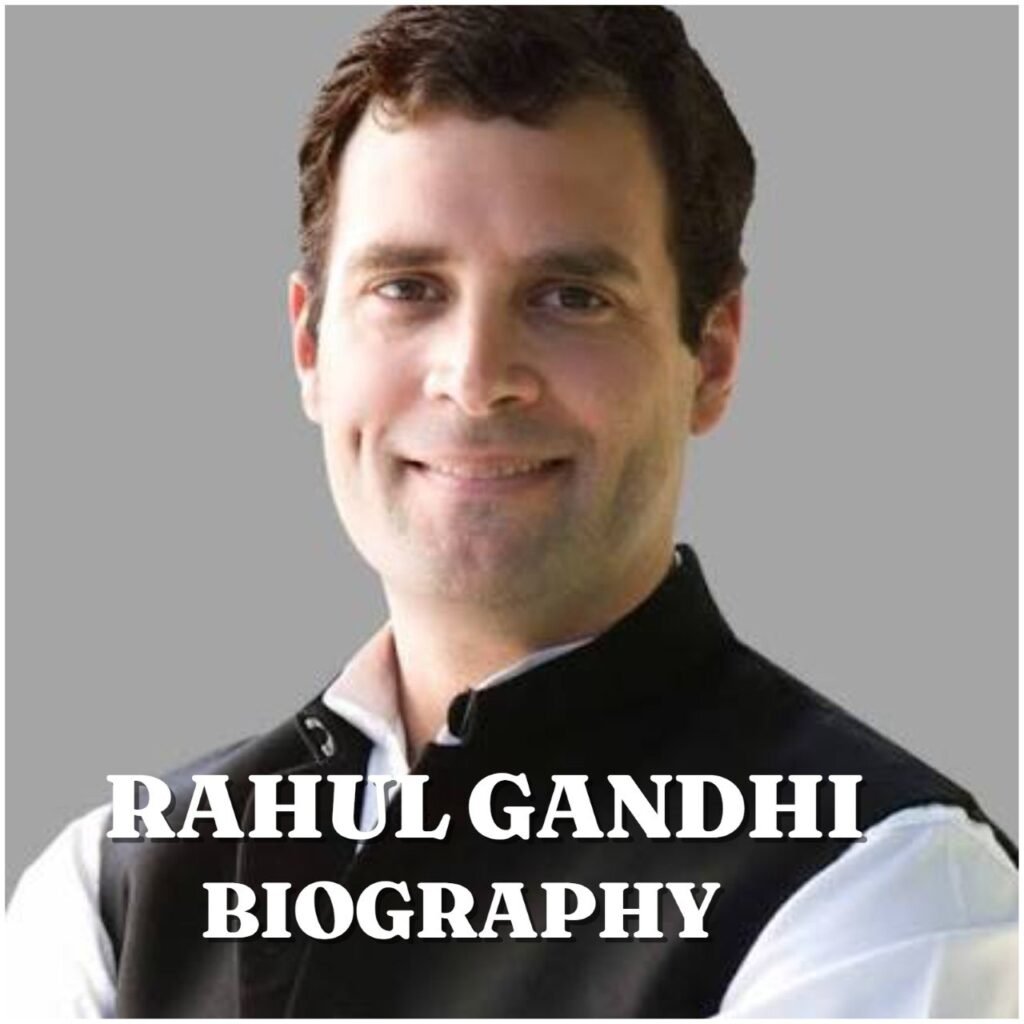
Rahul Gandhi is a prominent Indian politician and senior leader of the Indian National Congress, widely recognised as one of the country’s leading opposition figures. Born on June 19, 1970, in New Delhi, he comes from the influential Nehru–Gandhi political family. He is the son of former Indian Prime Minister Rajiv Gandhi and Congress leader Sonia Gandhi, the grandson of former Prime Minister Indira Gandhi, and the great-grandson of India’s first Prime Minister, Jawaharlal Nehru. As of August 2026, Rahul Gandhi is 56 years old and serves as the Leader of the Opposition in the Lok Sabha.
Rahul Gandhi entered national politics after winning the Amethi constituency in the 2004 Lok Sabha election and gradually became one of the most recognisable figures within the Congress party. Over the years, he has held several important responsibilities, including serving as president of the Indian National Congress from 2017 to 2019. His political career has included electoral victories, periods of criticism, major political campaigns and nationwide outreach efforts such as the Bharat Jodo Yatra and Bharat Jodo Nyay Yatra. In the 2024 general election, he won from both Rae Bareli and Wayanad before retaining Rae Bareli as his parliamentary constituency.
In 2026, Rahul Gandhi continues to play a central role in Indian national politics as Leader of the Opposition, challenging the policies and decisions of the BJP-led government while raising issues that he says affect India’s democracy, economy and ordinary citizens. His speeches, parliamentary interventions, public campaigns and political statements regularly attract significant national attention. This biography explores Rahul Gandhi’s early life, education, family background, political career, personal life, achievements, controversies, current political activities, net worth and lasting influence on Indian politics.
Rahul Gandhi Early Life and Childhood
Rahul Rajiv Gandhi was born on June 19, 1970, in New Delhi, India, into one of the country’s most prominent political families. He is the elder child of Rajiv Gandhi and Sonia Gandhi. His paternal grandmother was Indira Gandhi, India’s first and, at the time, only female Prime Minister, while his great-grandfather was Jawaharlal Nehru, India’s first Prime Minister. Growing up in the Nehru–Gandhi family meant that politics, public service and national affairs were a significant part of Rahul Gandhi’s childhood.
His early years were shaped by both privilege and considerable security concerns because of his family’s political prominence. His father, Rajiv Gandhi, entered national politics and eventually became Prime Minister of India in 1984 following the assassination of Indira Gandhi. Rahul and his younger sister, Priyanka Gandhi Vadra, were raised largely under close security protection. The assassination of his grandmother in 1984 and later the assassination of his father in 1991 profoundly affected his family and became important events in Rahul Gandhi’s personal history.
Rahul Gandhi began his education in New Delhi before continuing his studies abroad. He attended St. Columba’s School in Delhi and later The Doon School in Dehradun, although security concerns affected the course of his schooling. He subsequently studied at Rollins College in Florida, United States, where he earned a bachelor’s degree in 1994. He later attended the University of Cambridge, where he completed postgraduate studies in Development Studies in 1995. Before entering Indian politics full-time, he worked in the corporate and consulting sectors, gaining professional experience outside the political environment in which he had grown up.
Rahul Gandhi Education and Academic Background
Rahul Gandhi began his early education in New Delhi, where he attended St. Columba’s School. He later studied at The Doon School in Dehradun, one of India’s well-known boarding schools. Because of the security risks associated with his family’s political prominence, however, his schooling was not always conventional, and he eventually continued his education under more private arrangements. These circumstances meant that his childhood and teenage years were shaped not only by academic studies but also by the security concerns surrounding the Nehru–Gandhi family.
After completing his schooling, Rahul Gandhi moved abroad for higher education. He attended Rollins College in Winter Park, Florida, where he studied under a relatively private profile and graduated with a Bachelor of Arts degree in 1994. His time in the United States gave him exposure to a different academic and cultural environment away from the intense political spotlight surrounding his family in India.
Rahul Gandhi later continued his postgraduate studies at Trinity College, University of Cambridge, in the United Kingdom. He completed a Master of Philosophy (M.Phil.) in Development Studies in 1995. His academic background in development and his later professional experience outside politics provided him with exposure to economics, development issues and international perspectives, subjects that have subsequently featured in his political speeches and public policy discussions. After completing his studies, he worked in the private sector before eventually making a full-time transition into Indian politics.
Rahul Gandhi Political Career
Rahul Gandhi formally entered Indian electoral politics in 2004, when he contested the Lok Sabha election from the Amethi constituency in Uttar Pradesh. He won the seat and became a Member of Parliament at the age of 34, marking the beginning of his long career in national politics. During his early years in Parliament, he focused on issues involving young people, rural development, education and the organisation of the Indian National Congress. He also became increasingly involved in strengthening the party’s youth and student organisations, including the Indian Youth Congress and the National Students’ Union of India.
Over the following years, Rahul Gandhi became one of the Congress party’s most prominent national leaders. He served as Congress Vice-President from 2013 to 2017 and subsequently became President of the Indian National Congress in December 2017. During his presidency, he led the party in the 2019 general election, after which he resigned as Congress president following the party’s disappointing electoral performance. Despite stepping down from the leadership position, he remained an important parliamentary and campaign figure for the Congress. His political profile later received renewed attention through the Bharat Jodo Yatra, launched in 2022, followed by the Bharat Jodo Nyay Yatra in 2024, which took him across large parts of India and focused on issues such as economic inequality, unemployment, social justice and political participation.
The 2024 Lok Sabha election became an important turning point in Rahul Gandhi’s career. He won the Rae Bareli constituency in Uttar Pradesh and also won from Wayanad in Kerala. He subsequently retained Rae Bareli and vacated the Wayanad seat, which was later won by his sister, Priyanka Gandhi Vadra, in a by-election. Following the 2024 election, Rahul Gandhi was appointed Leader of the Opposition in the Lok Sabha on June 9, 2024, giving him an official constitutional parliamentary role and making him the principal opposition leader in India’s lower house. As of August 2026, he continues to hold this position and remains one of the central figures in Indian national politics, regularly challenging the policies of the BJP-led government and participating in parliamentary debates and major political campaigns.
Why Rahul Gandhi Is Trending Today
Rahul Gandhi is trending on August 13, 2026, largely because he has approached the Supreme Court challenging Allahabad High Court orders connected to allegations of disproportionate assets. The matter originated from a petition by Karnataka-based BJP worker S. Vignesh Shishir, who sought an inquiry into allegations concerning Gandhi’s assets. The Allahabad High Court had directed the Central Bureau of Investigation (CBI) and Enforcement Directorate (ED) to examine and verify the allegations. Gandhi has challenged those orders in the Supreme Court and has also sought to transfer the proceedings from the Allahabad High Court to the Delhi High Court.
The Supreme Court is expected to consider Rahul Gandhi’s petitions on August 17, 2026, before a bench headed by Chief Justice of India Surya Kant, along with Justices Joymalya Bagchi and V. Mohana. It is important to note that the allegations are the subject of legal proceedings and should not be presented as established wrongdoing. Gandhi’s move to challenge the High Court orders has nevertheless generated considerable national attention because of his position as Leader of the Opposition in the Lok Sabha.
Rahul Gandhi has also been in the headlines because of his political statements at the Rachnatmak Congress National Convention in New Delhi. On August 13, he criticised Prime Minister Narendra Modi’s foreign-policy approach, arguing that India’s international relations should be based on national interests rather than personal friendships with foreign leaders. He also launched strong attacks on the BJP and RSS during his address, while discussing India’s political direction and the role of the opposition. These remarks, together with the Supreme Court case, have made Rahul Gandhi one of the major political figures in India’s news cycle today.
Rahul Gandhi Personal Life and Family
Rahul Gandhi was born into the influential Nehru–Gandhi family, one of India’s most prominent political families. He is the son of former Prime Minister Rajiv Gandhi and Sonia Gandhi, who served as president of the Indian National Congress for many years. His paternal grandmother was former Prime Minister Indira Gandhi, while his great-grandfather was India’s first Prime Minister, Jawaharlal Nehru. Rahul has one younger sister, Priyanka Gandhi Vadra, who is also an active Congress politician and has served as a Member of Parliament. The family’s long history in Indian public life has had a major influence on Rahul Gandhi’s personal identity and political career.
Rahul Gandhi is not married and has no publicly confirmed wife or fiancée. Over the years, there have been occasional rumours and speculation about his relationships, but he has generally kept his romantic life private and has not publicly announced a marriage or engagement. He has frequently stated that his main focus has been his political responsibilities and public life. His private lifestyle is generally more low-profile than that of many other prominent political figures, although his family background and political activities ensure considerable public interest in his personal affairs.
Family has remained an important part of Rahul Gandhi’s life, particularly because he experienced major personal losses at a young age. His grandmother Indira Gandhi was assassinated in 1984, when Rahul was 14, and his father Rajiv Gandhi was assassinated in 1991, when Rahul was 20. These events deeply affected the Gandhi family. Rahul maintains a close public association with his mother Sonia and sister Priyanka, with whom he has appeared together at major political and family occasions. Priyanka’s entry into Parliament has also strengthened the family’s continuing presence in Indian national politics, although Rahul and Priyanka have pursued their political responsibilities in their respective roles.
Rahul Gandhi Age, Religion, Nationality, Height and Physical Appearance
As of August 13, 2026, Rahul Gandhi is 56 years old, having been born on June 19, 1970, in New Delhi, India. He is Indian by nationality and comes from the Hindu Brahmin Nehru–Gandhi family. Rahul Gandhi has generally been publicly associated with Hinduism, although he has also spoken about India’s religious diversity and the importance of respecting people of different faiths. He is widely described as having a relatively tall and athletic appearance, with a reported height of around 5 feet 9 inches (175 cm). His physical appearance is characterised by his medium-to-tall build, short grey-and-black hair, brown eyes and a clean-shaven or lightly stubbled look. Over the years, his appearance has changed naturally with age, but his simple dressing style, often consisting of a plain shirt, trousers or traditional Indian clothing, has become familiar to the Indian public.
Rahul Gandhi Net Worth
Rahul Gandhi’s officially declared assets were approximately ₹20.40 crore in his 2024 Lok Sabha election affidavit. This figure represents his declared assets rather than a speculative celebrity net-worth estimate. His declaration listed approximately ₹9.25 crore in movable assets and ₹11.15 crore in immovable assets, including jointly held agricultural land and a commercial property in Gurugram.
A substantial portion of Rahul Gandhi’s declared wealth is held through investments and property. His movable assets included bank deposits, shares and other investments, a Public Provident Fund (PPF), sovereign gold bonds and jewellery. His declared immovable assets included agricultural land jointly owned with his sister Priyanka Gandhi Vadra and commercial office space in Gurugram valued at about ₹9.05 crore in the affidavit. He also reported liabilities of roughly ₹49.79 lakh, meaning his declared assets exceed his listed liabilities by a significant margin.
There is no reliable publicly verified figure showing Rahul Gandhi’s exact 2026 net worth, so it would be misleading to present an invented number as fact. For a current biography, a reasonable evidence-based description is that Rahul Gandhi’s publicly declared wealth is around ₹20 crore or more, based on his latest available election affidavit. His income has also historically been substantial; his 2022–23 income-tax return showed total income of about ₹1.03 crore. Because property and investment values can change after an election affidavit is filed, his actual financial position in August 2026 may differ from the 2024 declared figure.
Rahul Gandhi’s Legacy
Rahul Gandhi’s political legacy is closely connected to the continuing history of the Nehru–Gandhi family in Indian public life, but his own career has developed through a mixture of electoral politics, parliamentary opposition and nationwide political campaigns. Since entering Parliament in 2004, he has remained one of the most recognisable figures in the Indian National Congress. His transition from a younger member of the Gandhi family into the Leader of the Opposition in the Lok Sabha represents one of the most significant stages of his political career.
One of the defining features of Rahul Gandhi’s more recent political legacy has been his emphasis on direct public engagement and issues such as unemployment, economic inequality, social justice, farmers’ concerns and the protection of democratic institutions. The Bharat Jodo Yatra and Bharat Jodo Nyay Yatra significantly expanded his interaction with people across different parts of India and helped reshape his public image. Supporters view these campaigns as evidence of his commitment to challenging political and social divisions, while critics continue to question his political strategy, leadership record and effectiveness as an opposition politician.
Rahul Gandhi’s long-term legacy will ultimately depend on how his political career develops and how historians assess his role in India’s evolving democracy. His supporters see him as an important voice for the opposition and an advocate for constitutional values, pluralism and social justice, while his critics point to electoral setbacks and controversies that have accompanied his career. As of 2026, however, his position as Leader of the Opposition, his continued leadership within Congress politics and his prominent role in national political debates ensure that Rahul Gandhi remains an important figure in contemporary Indian political history.
Conclusion
Rahul Gandhi’s life and career reflect the experiences of a politician who grew up within one of India’s most influential political families before developing his own identity in public life. From his education and early years to his entry into Parliament in 2004, leadership of the Indian National Congress, nationwide political campaigns and current position as Leader of the Opposition in the Lok Sabha, he has remained a major figure in Indian politics. Despite electoral successes, setbacks, controversies and continuing political challenges, Rahul Gandhi continues to play a prominent role in shaping India’s opposition politics. As he moves forward in 2026, his future political decisions, leadership and ability to connect with voters will be important in determining the lasting legacy he leaves in Indian political history.
Frequently Asked Questions About Rahul Gandhi
Who is Rahul Gandhi?
Rahul Gandhi is an Indian politician and senior leader of the Indian National Congress. He is currently the Leader of the Opposition in the Lok Sabha and represents the Rae Bareli constituency in Uttar Pradesh.
How old is Rahul Gandhi?
Rahul Gandhi was born on June 19, 1970, so he is 56 years old as of August 13, 2026.
Who are Rahul Gandhi’s parents?
Rahul Gandhi’s parents are Rajiv Gandhi, former Prime Minister of India, and Sonia Gandhi, former president of the Indian National Congress.
Who is Rahul Gandhi’s sister?
Rahul Gandhi’s younger sister is Priyanka Gandhi Vadra, an Indian National Congress politician and Member of Parliament.
Is Rahul Gandhi married?
No. Rahul Gandhi is not married and has no publicly confirmed wife or fiancée as of August 2026.
What is Rahul Gandhi’s educational qualification?
Rahul Gandhi studied at Rollins College in Florida, where he earned a bachelor’s degree, and later attended Trinity College, University of Cambridge, where he completed an M.Phil. in Development Studies.
When did Rahul Gandhi enter politics?
Rahul Gandhi entered electoral politics in 2004, when he contested and won the Lok Sabha election from Amethi in Uttar Pradesh.
Which constituency does Rahul Gandhi represent?
Rahul Gandhi currently represents Rae Bareli in Uttar Pradesh in the Lok Sabha. He won Rae Bareli and Wayanad in the 2024 general election but retained Rae Bareli after vacating the Wayanad seat.
When did Rahul Gandhi become Leader of the Opposition?
Rahul Gandhi became the Leader of the Opposition in the Lok Sabha on June 9, 2024, following the 2024 general election.
What is Rahul Gandhi’s net worth?
Rahul Gandhi’s latest publicly declared assets were approximately ₹20.40 crore, according to his 2024 Lok Sabha election affidavit. There is no independently verified official figure for his exact net worth in 2026.
What is Rahul Gandhi’s political party?
Rahul Gandhi is a senior leader of the Indian National Congress (INC), one of India’s major national political parties.
Why is Rahul Gandhi trending today?
As of August 13, 2026, Rahul Gandhi is in the news because he has approached the Supreme Court challenging Allahabad High Court orders connected to a disproportionate-assets case. He has also attracted attention for political remarks made at a Congress national convention in New Delhi.
What are Rahul Gandhi’s major political campaigns?
Two of Rahul Gandhi’s most prominent recent nationwide campaigns are the Bharat Jodo Yatra, which began in 2022, and the Bharat Jodo Nyay Yatra, which took place in 2024. Both campaigns focused on issues including social justice, economic concerns, unemployment and political unity.
What is Rahul Gandhi’s height?
Rahul Gandhi is commonly reported to be approximately 5 feet 9 inches (175 cm) tall. However, his exact height has not been independently confirmed through an official government profile.
What is Rahul Gandhi’s nationality?
Rahul Gandhi is Indian. He was born in New Delhi, India, on June 19, 1970.
What is Rahul Gandhi’s religion?
Rahul Gandhi is generally associated with Hinduism and comes from the Nehru–Gandhi family. He has also frequently spoken publicly about religious pluralism and India’s diversity.
What is Rahul Gandhi’s legacy?
Rahul Gandhi’s political legacy is still developing. He is particularly associated with the Indian National Congress, opposition politics, the Bharat Jodo campaigns and his role as Leader of the Opposition, while his career has also included significant electoral successes, setbacks and political controversies.