
Introduction
Some scientists change the way we understand the world. Others introduce ideas that open entirely new doors to discovery. Satyendra Nath Bose did both. His work helped transform modern physics and gave the world a scientific term that remains important today: boson.
Bose was an Indian physicist whose research changed how scientists explain the behaviour of tiny particles. His groundbreaking work on light and energy helped establish the foundation of what is now known as Bose-Einstein statistics. This theory later contributed to major discoveries in quantum physics.
Although Bose never received a Nobel Prize, his influence on science remains remarkable. His name lives on through bosons, Bose-Einstein statistics and Bose-Einstein condensates. His story is also one of determination, intellectual curiosity and a lasting contribution to global scientific knowledge.
Who Was Satyendra Nath Bose?
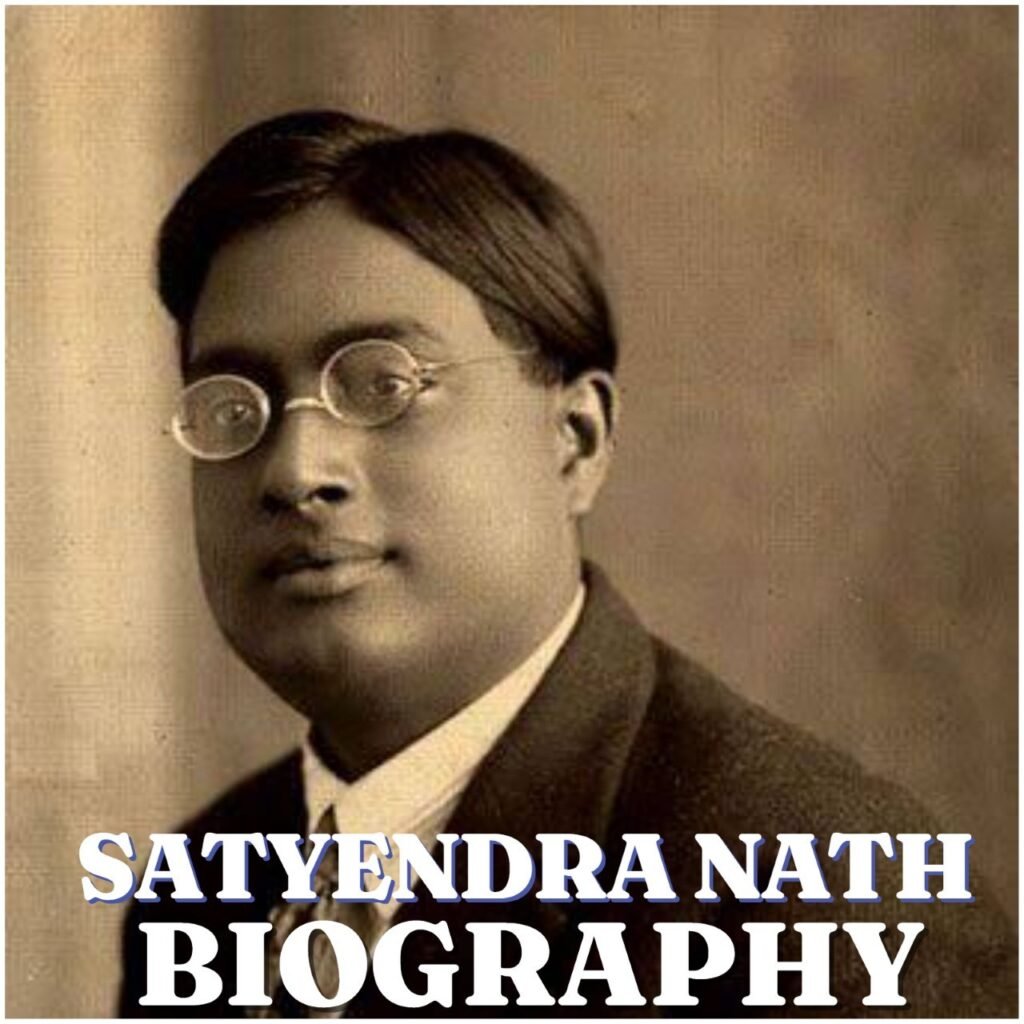
Satyendra Nath Bose was an Indian physicist and mathematician best known for developing a new way to explain the behaviour of particles. His work became a major part of quantum mechanics, the branch of physics that studies matter and energy at very small scales.
He became internationally recognised after publishing an important paper on the behaviour of light particles in 1924. Albert Einstein recognised the value of his ideas, translated the paper into German and helped secure its publication.
Bose’s research later became the basis of Bose-Einstein statistics. This achievement placed him among the most influential scientists in the development of modern physics.
Early Life and Family Background
Satyendra Nath Bose was born on January 1, 1894, in Calcutta, British India, now known as Kolkata, India. His father, Surendranath Bose, worked in the railway industry, while his mother was Amodini Devi. He was the eldest of seven children.
Bose grew up in a family that valued education. His father’s interest in mathematics and practical problem-solving helped create an environment where learning was encouraged. From an early age, Bose showed a strong interest in numbers, science and logical thinking.
His academic ability soon became clear. He performed exceptionally well in school and developed a reputation as a gifted student. These early experiences helped prepare him for a career that would eventually influence the direction of modern physics.
Education and Academic Development
Bose attended Hindu School in Calcutta, where he developed a strong foundation in mathematics and science. He later entered Presidency College, one of the leading educational institutions in India at the time.
At Presidency College, he studied under respected teachers and worked alongside other talented students. He earned his Bachelor of Science degree in 1913 and completed his Master of Science degree in mixed mathematics in 1915.
His education gave him the mathematical knowledge needed to explore complex scientific questions. It also strengthened his interest in theoretical physics, a field that was changing rapidly during the early twentieth century.
Satyendra Nath Bose’s Career in Physics
Bose began his academic career at the University of Calcutta in 1917. He worked as a lecturer and became involved in teaching and research. During this period, he studied important developments in physics and helped introduce modern scientific ideas to students.
In 1921, he joined the University of Dhaka as a Reader in Physics. The institution provided an environment where he could focus on research and teaching. He later became a professor and head of the physics department.
Bose returned to Calcutta in 1945 and continued his academic work at the University of Calcutta. He retired from active university service in 1956, but remained involved in education and scientific activities. He also served as Vice-Chancellor of Visva-Bharati University and later received the title of National Professor.
His career was not built on laboratory discoveries alone. Bose also worked to improve science education and make scientific knowledge more accessible to the public.
The 1924 Paper That Changed Physics
One of the most important moments in Bose’s career came in 1924. He was studying how light behaves and developed a new mathematical approach to explain the distribution of light particles, known as photons.
Bose submitted his paper, Planck’s Law and the Hypothesis of Light Quanta, to a scientific journal. It was rejected. Rather than abandon his work, he sent the paper directly to Albert Einstein, explaining why he believed the approach was important.
Einstein recognised the value of Bose’s ideas. He translated the paper into German and arranged for it to be published in the journal Zeitschrift für Physik.
Einstein then extended Bose’s method to material particles. This work helped establish the statistical theory now known as Bose-Einstein statistics.
The episode marked a turning point in Bose’s career. It also showed how a scientific idea developed in India could influence research across the world.
What Is Bose-Einstein Statistics?
Bose-Einstein statistics is a mathematical method used to describe how certain particles behave when they occupy the same quantum state.
In simple terms, it explains how particles known as bosons can share identical energy states. This behaviour differs from that of another major group of particles called fermions, which follow a different set of quantum rules.
The theory became an important part of quantum mechanics. It helps scientists understand the behaviour of particles such as photons and other bosons.
Bose’s original work focused on photons. Einstein later extended the approach to material particles, creating a wider framework that became central to modern physics.
Why Are Particles Called Bosons?
The word boson was introduced by physicist Paul Dirac in honour of Satyendra Nath Bose.
Bosons are particles that follow Bose-Einstein statistics. They include photons, which carry light, and other particles that play important roles in the forces and structure of the universe.
The name is a lasting tribute to Bose’s contribution. It also reflects how deeply his work became connected to the foundations of modern physics.
Today, the term appears in textbooks, scientific research and discussions about the fundamental building blocks of matter.
The Bose-Einstein Condensate
Another major development connected to Bose’s work is the Bose-Einstein condensate.
A Bose-Einstein condensate is a special state of matter that can form when certain particles are cooled to temperatures extremely close to absolute zero. Under these conditions, many particles behave as though they are part of one shared quantum system.
Einstein predicted this phenomenon using the statistical approach developed from Bose’s work. However, scientists did not create a Bose-Einstein condensate in a laboratory until 1995.
The experimental achievement was made by researchers Eric Cornell, Carl Wieman and Wolfgang Ketterle. Their work earned them the 2001 Nobel Prize in Physics.
Although Bose did not live to see the laboratory creation of the condensate, his earlier ideas helped make the discovery possible.
Contributions Beyond Quantum Statistics
Bose’s scientific interests extended beyond the research that made him famous. He also worked in areas such as X-ray crystallography and electromagnetic theory.
He believed that scientific knowledge should reach ordinary people, not remain limited to universities and research institutions. This belief influenced his work in science education and public communication.
In 1948, he helped establish the Bangiya Bijnan Parishad, an organisation created to promote science in Bengali. He also supported the publication of Gyan-o-Bigyan, a Bengali science magazine.
Through these activities, Bose helped encourage scientific learning and make complex ideas easier for a wider audience to understand.
Awards and Recognition
Bose received several honours for his contributions to science and education. In 1954, the Government of India awarded him the Padma Vibhushan, one of the country’s highest civilian honours.
He was elected a Fellow of the Royal Society in 1958. That same year, he received the title of National Professor of India, recognising his outstanding contribution to academic and scientific life.
Despite these honours, Bose never received the Nobel Prize. However, the absence of a Nobel award does not reduce the importance of his work. His ideas remain part of the foundation of modern physics, and scientists continue to use the concepts associated with his name.
Personal Life and Interests
Bose married Ushabala Ghosh in 1915. They built a family together while he continued his academic and scientific work.
Away from physics, Bose had a wide range of interests. He enjoyed literature, music, languages and the arts. He also played the esraj, a traditional Indian string instrument.
His interests reflected a broad intellectual curiosity. He did not see science as separate from culture, education or everyday life. Instead, he valued learning in many forms.
Death and Lasting Legacy
Satyendra Nath Bose died on February 4, 1974, in Calcutta, at the age of 80. His death marked the end of a remarkable life, but his influence on science continued.
His greatest legacy is the statistical framework that bears his name. Bose-Einstein statistics remains essential to the study of quantum physics, while bosons are central to scientists’ understanding of the universe.
His work also helped inspire later research into unusual states of matter, including Bose-Einstein condensates. These discoveries show how a mathematical idea developed decades earlier can continue to shape modern science.
Beyond his scientific achievements, Bose remains an important figure in India’s academic history. He demonstrated that groundbreaking research could emerge from institutions outside the traditional centres of Western science.
Satyendra Nath Bose Net Worth
There is no reliable public record of Satyendra Nath Bose’s personal net worth. He lived primarily as an academic and scientist, and financial wealth was not the focus of his public life.
His achievements are better measured through his influence on physics, education and scientific research. The concepts named after him remain valuable contributions to human knowledge.
Rather than leaving behind a financial fortune, Bose left a scientific legacy that continues to benefit researchers and students around the world.
Conclusion
Satyendra Nath Bose was a scientist whose ideas changed the way humanity understands the physical world. His work on light particles helped establish Bose-Einstein statistics, while the term boson continues to honour his contribution.
His influence reaches far beyond the scientific paper he published in 1924. It can be seen in modern quantum physics, research into unusual states of matter and the work of scientists who continue to explore the smallest building blocks of the universe.
Bose’s life offers an important lesson: a powerful idea can travel far beyond the place where it began. Though he never received a Nobel Prize, his name remains firmly written into the history of science.
Frequently Asked Questions About Satyendra Nath Bose
Who was Satyendra Nath Bose?
Satyendra Nath Bose was an Indian physicist and mathematician best known for developing the statistical method that led to Bose-Einstein statistics.
When was Satyendra Nath Bose born?
He was born on January 1, 1894, in Calcutta, British India, now Kolkata, India.
What is Satyendra Nath Bose famous for?
He is famous for his work on quantum statistics, particularly the mathematical description of photons that helped establish Bose-Einstein statistics.
Did Satyendra Nath Bose work with Albert Einstein?
Bose and Einstein did not work together as direct research partners. However, Einstein recognised Bose’s 1924 paper, translated it into German and extended Bose’s method to material particles.
Why are particles called bosons?
The physicist Paul Dirac introduced the term boson in honour of Satyendra Nath Bose and his contribution to quantum statistics.
Did Satyendra Nath Bose win a Nobel Prize?
No. Bose never received a Nobel Prize, although his work helped lay the foundation for discoveries that later received Nobel recognition.
What is a Bose-Einstein condensate?
It is a state of matter that can form when certain particles are cooled to temperatures extremely close to absolute zero. Many particles then behave as one shared quantum system.
When did Satyendra Nath Bose die?
He died on February 4, 1974, in Calcutta, India, at the age of 80.
What awards did Satyendra Nath Bose receive?
His honours included the Padma Vibhushan in 1954, Fellowship of the Royal Society in 1958 and the title of National Professor of India in 1958.