
Introduction
Atiku Abubakar is one of Nigeria’s most famous politicians and successful businessmen. For decades, he has played an important role in the country’s politics. From his humble beginnings in Adamawa State to becoming Nigeria’s vice president, his life is a story of hard work, ambition and determination.
Many Nigerians know Atiku as a former vice president and a regular presidential candidate. However, his story goes far beyond politics. He started his career as a customs officer, built several business interests and founded a university in his home state. These experiences helped him become one of the most influential figures in Nigeria.
Atiku served as vice president from 1999 to 2007 under President Olusegun Obasanjo. Since leaving office, he has remained active in politics and has contested several presidential elections. Although he has not yet become president, he continues to attract attention whenever Nigeria’s political future is discussed.
His personal life is equally interesting. He has a large family, several business interests and a long history of political alliances. His journey has also included disagreements, election defeats and public controversies.
So, who is Atiku Abubakar? How did he build his wealth? Who are his wives and children? And why has he remained relevant in Nigerian politics for so long? This biography answers these questions and explores the major events that have shaped his life.
Early Life and Family Background
Atiku Abubakar was born on November 25, 1946, in Jada, a town in present-day Adamawa State, northeastern Nigeria. His parents were Garba Abubakar and Aisha Kande. He grew up in a modest family and faced some difficulties during his childhood.
One of the biggest challenges came from his father’s opposition to Western education. His father did not initially support his decision to attend school. However, his mother encouraged him to learn and helped him pursue his education.
Atiku lost his father in 1957 while he was still young. This experience became an important part of his childhood story. He later spoke about the difficulties he faced and how his early experiences shaped his views on education.
His upbringing in Adamawa exposed him to the challenges faced by ordinary Nigerian families. It also helped shape his interest in public service and social development.
Education and Academic Qualifications
Atiku began his education at Jada Primary School in Adamawa State. After completing his primary education in 1960, he proceeded to Adamawa Provincial Secondary School in Yola.
He completed secondary school in 1965. He briefly attended the Nigeria Police College in Kaduna but later left to pursue other academic opportunities.
In 1966, he gained admission to the School of Hygiene in Kano. He completed his studies in 1967 and obtained a diploma in Hygiene.
He later attended Ahmadu Bello University in Zaria, where he studied Law and obtained a diploma in 1969. His education helped prepare him for a career in public service and administration.
Career Before Politics
Before becoming a major political figure, Atiku worked in the Nigeria Customs Service. He joined the organisation in 1969, shortly after completing his studies.
During his 20 years in service, he worked in different parts of Nigeria. His duties included customs administration, revenue collection and border operations.
He gradually rose through the ranks and became a Deputy Director. His work gave him valuable experience in public administration and financial management.
In 1989, Atiku retired from the Customs Service. He then turned his attention to business and politics. This decision marked the beginning of a new chapter in his life.
Atiku Abubakar’s Business Career and Investments
Atiku Abubakar is not only a politician. He is also a businessman with interests in several sectors of the Nigerian economy.
One of his best-known business ventures was Intels Nigeria Limited, an oil and gas logistics company he co-founded with Italian businessman Gabriele Volpi. The company provided support services to businesses in Nigeria’s petroleum industry. Atiku later sold his remaining interest in the company in 2020.
He also developed interests in agriculture, property, media and education. These investments helped establish his reputation as a businessman with experience outside government.
However, his most recognised contribution to education is the establishment of the American University of Nigeria (AUN) in Yola, Adamawa State. The institution reflects his interest in education and his belief that young people need better opportunities to succeed.
His business activities have attracted public attention over the years, especially because of his financial status and political influence.
Political Career: How Atiku Abubakar Became a National Figure
His Early Political Activities
Atiku’s political journey began in the late 1980s. He became involved in the Peoples Front of Nigeria, a political movement associated with former military vice president Shehu Musa Yar’Adua.
He later joined the Social Democratic Party (SDP), where he developed relationships with influential politicians.
In 1993, he contested the party’s presidential primary. Although he did not win, the experience introduced him to national political competition and strengthened his ambition to lead Nigeria.
These early activities helped prepare him for a much bigger role in Nigerian politics.
His Governorship Ambition in Adamawa State
During the transition to democratic government in 1999, Atiku contested the governorship election in Adamawa State under the Peoples Democratic Party (PDP).
He won the election and was preparing to become governor. However, his political future changed when he accepted an offer to become the running mate to Olusegun Obasanjo.
The decision took him beyond state politics. Instead of becoming governor, he joined the presidential race and eventually became Nigeria’s vice president.
Vice President of Nigeria (1999–2007)
Atiku became vice president in 1999 after Olusegun Obasanjo won the presidential election. They were sworn into office on May 29, marking the beginning of Nigeria’s Fourth Republic.
As vice president, Atiku played an important role in government administration. One of his major responsibilities was chairing the National Council on Privatisation.
He helped oversee discussions about the government’s privatisation programme. The policy aimed to encourage private investment and reduce direct government involvement in some businesses.
He also participated in national discussions about economic development and public administration.
Atiku served two terms as vice president and left office in May 2007. His eight years in government remain a major part of his political career.
His Political Disagreement With Olusegun Obasanjo
Atiku and Obasanjo initially worked closely together. However, their relationship became strained during their second term.
The disagreement became more serious in 2006 when Nigeria faced a debate over a proposed constitutional amendment that could have allowed Obasanjo to seek a third presidential term.
Atiku opposed the proposal. This created a major political disagreement between the two leaders.
He eventually left the PDP and joined the Action Congress (AC). His decision marked a turning point in his career. The former vice president had become an opposition politician preparing to challenge the government he once served.
The 2007 Presidential Election
Atiku contested the 2007 presidential election under the Action Congress. However, his candidacy faced a legal challenge after electoral authorities attempted to exclude him from the race.
He challenged the decision in court, and the Supreme Court ruled in his favour. This allowed him to participate in the election.
Despite this victory, he lost to Umaru Musa Yar’Adua of the PDP. Muhammadu Buhari finished third.
Although Atiku did not win, the election strengthened his position as one of Nigeria’s leading opposition politicians.
His Return to the PDP and the 2011 Election
After the 2007 election, Atiku returned to the PDP. He continued his presidential ambition and contested the party’s primary in 2011.
He faced President Goodluck Jonathan, who eventually won the party’s nomination.
Atiku lost the primary but remained active in national politics. He continued building political relationships and preparing for future opportunities.
His Role in the Formation of the APC
In 2013, Atiku joined other prominent politicians in the political movement that led to the formation of the All Progressives Congress (APC).
The new party brought together several opposition groups. These included the Action Congress of Nigeria, the Congress for Progressive Change and the All Nigeria Peoples Party.
The alliance created a stronger opposition against the PDP, which had controlled the presidency since 1999.
In 2015, the APC defeated the PDP in the presidential election, bringing Muhammadu Buhari to power.
Atiku’s involvement in the political realignment demonstrated his ability to build alliances and influence national politics. However, he later left the APC and returned to the PDP.
The 2019 Presidential Election
In 2018, Atiku returned to the PDP and contested its presidential primary. He defeated several aspirants and became the party’s candidate for the 2019 general election.
He selected Peter Obi, the former governor of Anambra State, as his running mate.
The election became a major contest between Atiku and the incumbent president, Muhammadu Buhari. Despite an extensive campaign, Atiku lost.
He challenged the result in court, arguing that the election process had been flawed. However, the Supreme Court dismissed his appeal and upheld Buhari’s victory.
The 2023 Presidential Election
Atiku’s ambition to become president continued. In May 2022, he won the PDP presidential primary and became the party’s candidate for the 2023 election.
He selected Ifeanyi Okowa, the former governor of Delta State, as his running mate.
The election took place on February 25, 2023. His major opponents included Bola Ahmed Tinubu of the APC and Peter Obi of the Labour Party.
INEC declared Tinubu the winner with 8,794,726 votes. Atiku came second with 6,984,520 votes, while Peter Obi finished third.
Atiku challenged the result in court, but the Presidential Election Petition Court dismissed his petition. The Supreme Court later upheld Tinubu’s victory.
Although he lost another presidential election, Atiku remained one of the country’s most prominent opposition figures.
His 2027 Presidential Ambition and Move to ADC
As discussions about the 2027 general election gained momentum, Atiku became involved in efforts to build a stronger opposition alliance.
He later joined the African Democratic Congress (ADC) and emerged as the party’s presidential candidate in May 2026.
His move attracted attention because he had spent many years as a leading PDP member. It also raised questions about the future of opposition politics in Nigeria.
However, his nomination faced a major legal challenge in November 2026. A Federal High Court in Abuja nullified the leadership process connected to the ADC primary that produced his presidential ticket.
The party rejected the judgment and announced plans to appeal. The legal dispute created uncertainty around Atiku’s 2027 ambition.
American University of Nigeria: Atiku’s Contribution to Education
One of Atiku’s most important achievements outside politics is the establishment of the American University of Nigeria (AUN) in Yola, Adamawa State.
He founded the institution to provide quality education based on an American-style learning system. The university received its licence in 2003 and admitted its first students in 2005.
AUN focuses on technology, entrepreneurship, academic development and practical learning. It aims to prepare students for professional opportunities and help them contribute to society.
Before establishing the university, Atiku had invested in private education through ABTI Academy.
His interest in education is closely connected to his childhood. Having faced difficulties while trying to attend school, he understands the importance of giving children access to quality learning.
Today, the university remains one of his most recognised contributions to Nigerian society.
Why Is Atiku Abubakar Trending?
Atiku Abubakar continues to attract attention because of his political activities and ambition to become Nigeria’s president.
His move from the PDP to the ADC has generated considerable discussion. Many Nigerians see it as part of a wider effort to unite opposition politicians ahead of the 2027 general election.
His presidential nomination also became a major topic following the November 2026 court judgment involving the ADC leadership process.
The party has challenged the ruling, leaving questions about its preparations for the election.
Beyond party politics, Atiku remains vocal about Nigeria’s economy, education, security and governance. His comments on government policies often attract reactions from supporters, critics and political opponents.
His political future is likely to remain a major topic as the 2027 election approaches.
Personal Life: Atiku Abubakar’s Wives and Marriages
Atiku Abubakar has a large family and has been married several times. His marriages have attracted public interest because of the size of his family and his long personal history.
His first wife was Titilayo Albert, whom he married in 1971. Their marriage produced four children: Fatima, Adamu, Halima and Aminu.
He later married Ladi Yakubu in 1979. His other reported marriages include those to Princess Rukaiyatu and Fatima Shettima.
He was also married to Jennifer Iwenjiora Douglas, a lawyer. Some accounts of his marital history differ, partly because some marriages ended in divorce.
Atiku is widely reported to have between 27 and 28 children. His children have grown up and pursued different careers and interests.
Despite his busy political life, he has often spoken about the importance of family, education and personal development.
Atiku Abubakar’s Children and Family
Atiku’s children have followed different paths. Some are involved in business, while others have pursued professional careers.
His publicly known children include Adamu, Aminu, Fatima, Halima, Abba, Atiku, Aliyu, Aisha and Maryam, among others.
His family has attracted attention because of its size and the public activities of some members.
Atiku has consistently emphasised the importance of education. His investment in the American University of Nigeria reflects his belief that education can create opportunities and improve lives.
Atiku Abubakar’s Age, Religion, Tribe and Nationality
Atiku Abubakar was born on November 25, 1946, in Jada, Adamawa State. As of November 24, 2026, he is 79 years old and will celebrate his 80th birthday the following day.
He is Nigerian by nationality and belongs to the Fulani ethnic group. He practises Islam and is from northeastern Nigeria.
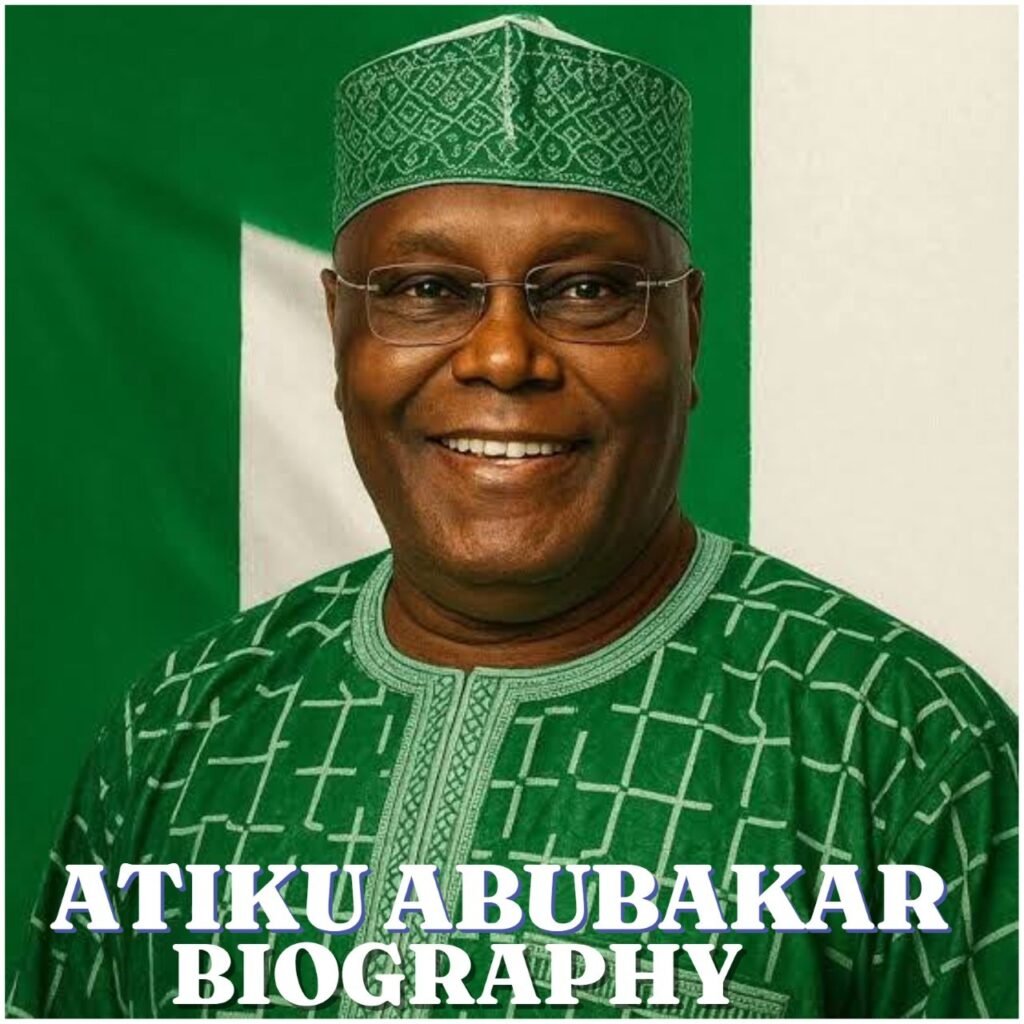
Atiku is often seen wearing traditional northern Nigerian clothing. His outfits usually include flowing robes and traditional caps, especially during political gatherings and official events.
His exact height has not been reliably confirmed in public records.
Quick Facts About Atiku Abubakar
- Full name: Atiku Abubakar
- Date of birth: November 25, 1946
- Age: 79 years old
- Birthplace: Jada, Adamawa State, Nigeria
- Nationality: Nigerian
- Ethnicity: Fulani
- Religion: Islam
- Profession: Politician and businessman
- Political party: African Democratic Congress (ADC), amid an ongoing leadership dispute
- Former position: Vice President of Nigeria
- Years as vice president: 1999–2007
- Education: School of Hygiene, Kano, and Ahmadu Bello University
- Wives: Several, including Titilayo Albert, Ladi Yakubu, Rukaiyatu and Fatima Shettima
- Children: Widely reported as 27 or 28
- University founded: American University of Nigeria
- Traditional title: Waziri Adamawa
Atiku Abubakar’s Net Worth and Sources of Wealth
Atiku Abubakar is widely regarded as one of Nigeria’s wealthier politicians and businessmen. His wealth is associated with decades of business activities, investments and professional experience.
One of his most recognised business ventures was Intels Nigeria Limited, an oil and gas logistics company. He has also been involved in agriculture, property, media and education.
His investment in the American University of Nigeria further strengthened his reputation as a businessman with interests beyond politics.
Several websites have published estimates of his net worth. However, these figures vary widely, and there is no independently verified assessment of his complete current wealth.
It is therefore difficult to give an exact figure. Nevertheless, his long business career has made him one of the most financially prominent figures in Nigerian politics.
Social Media Presence
Atiku Abubakar maintains an active presence on social media. He uses digital platforms to share his views, discuss national issues and communicate with supporters.
His posts often focus on democracy, education, economic development, security and government policies. He also comments on important political events and developments.
As a leading opposition figure, his online activities regularly attract attention from Nigerians across different political groups.
Controversies and Public Criticism
Atiku’s long political career has not been free from controversy. His political decisions, business interests and relationships with former allies have attracted public debate.
One of the biggest controversies involved his disagreement with Olusegun Obasanjo over the proposed third-term agenda. Their disagreement eventually led to a political split and Atiku’s departure from the PDP in 2006.
His business interests have also attracted questions about the relationship between private investments and public responsibilities. Critics have raised concerns about his financial background and business connections. However, political allegations should not be treated as proven facts without supporting evidence.
His repeated presidential campaigns have also generated debate. Some critics question his political strategy and ability to attract support across the country. His supporters, however, see him as an experienced politician with a strong understanding of Nigeria’s challenges.
His legal battles following the 2023 presidential election and the 2026 ADC leadership dispute have added further attention to his political career.
Despite these challenges, Atiku remains an important figure in Nigerian politics.
Legacy and Influence on Nigerian Politics
Atiku Abubakar’s influence on Nigerian politics goes beyond his eight years as vice president. He has participated in major political movements and helped shape the country’s opposition politics.
His time in government under Obasanjo remains one of the most important periods of his career. During those years, he participated in economic policy discussions and chaired the National Council on Privatisation.
He is also remembered for his involvement in political alliances and party changes. His role in the formation of the APC and later return to the PDP show how deeply he has been involved in Nigeria’s political development.
Outside politics, the American University of Nigeria remains an important part of his legacy. The institution has created educational opportunities for students from Nigeria and other countries.
Ultimately, his place in Nigerian history will depend on how future generations assess his contributions to democracy, education, business and national development.
Conclusion
Atiku Abubakar’s journey from a young boy in Adamawa State to Nigeria’s vice president is a story of ambition, hard work and determination.
His early experiences, career in the Customs Service and success in business helped shape his rise to national prominence. His eight years as vice president and repeated presidential campaigns have made him one of the most recognised figures in Nigerian politics.
Beyond government, his business interests and the establishment of the American University of Nigeria have added another important dimension to his public life.
Although his ambition to become president has faced repeated setbacks, Atiku remains active in national politics. His involvement in the ADC and the legal challenges surrounding his 2027 ambition show that his political story is still unfolding.
Whether remembered as a politician, businessman or education advocate, his influence on Nigeria’s development is already significant.
Frequently Asked Questions About Atiku Abubakar
1. Who is Atiku Abubakar?
Atiku Abubakar is a Nigerian politician and businessman who served as vice president from 1999 to 2007 under President Olusegun Obasanjo.
2. How old is Atiku Abubakar?
He is 79 years old as of November 24, 2026. He was born on November 25, 1946.
3. Where was Atiku Abubakar born?
He was born in Jada, Adamawa State, northeastern Nigeria.
4. Who are Atiku Abubakar’s wives?
His reported marriages include those to Titilayo Albert, Ladi Yakubu, Princess Rukaiyatu, Fatima Shettima and Jennifer Iwenjiora Douglas.
5. How many children does Atiku Abubakar have?
He is widely reported to have between 27 and 28 children, although public accounts differ.
6. What is Atiku Abubakar’s tribe?
He belongs to the Fulani ethnic group of northern Nigeria.
7. What religion does Atiku Abubakar practise?
He practises Islam.
8. What did Atiku Abubakar study?
He obtained a diploma from the School of Hygiene in Kano and a diploma in Law from Ahmadu Bello University, Zaria.
9. When was Atiku Abubakar vice president of Nigeria?
He served as vice president from May 29, 1999, to May 29, 2007.
10. Who was Atiku Abubakar’s president?
He served under President Olusegun Obasanjo.
11. Which political party does Atiku Abubakar belong to?
He joined the African Democratic Congress in 2026, but his presidential nomination became part of a legal dispute in November 2026.
12. What is Atiku Abubakar’s net worth?
His exact net worth has not been independently verified. He is widely regarded as a wealthy businessman with investments in several sectors.
13. What businesses is Atiku Abubakar involved in?
His business interests have included oil and gas logistics, agriculture, property, media and education.
14. Does Atiku Abubakar own a university?
He founded the American University of Nigeria in Yola, Adamawa State. The institution admitted its first students in 2005.
15. How many times has Atiku Abubakar contested for president?
He has participated in several presidential primaries and elections. His 2023 campaign was his sixth attempt at the presidency. His 2027 ambition would represent another attempt if his nomination is legally upheld.