
 Introduction
 Introduction
Sir Isaac Newton was one of the most influential scientists in human history, widely recognised for his groundbreaking contributions to physics, mathematics, astronomy and the study of light. Born in Woolsthorpe, Lincolnshire, England, in 1642, Newton transformed humanity’s understanding of the natural world through his discoveries and mathematical theories. His formulation of the three laws of motion and the law of universal gravitation established important foundations for classical physics, influencing generations of scientists, engineers and researchers. Even centuries after his death, Newton remains a central figure in the history of scientific discovery, and his ideas continue to be taught in schools and universities worldwide.
Isaac Newton’s remarkable career extended beyond his famous theories of gravity and motion. He made significant contributions to calculus, optics and astronomical research, demonstrating how mathematics and experimentation could be combined to explain complex natural phenomena. His influential book, *Philosophiæ Naturalis Principia Mathematica*, published in 1687, presented his laws of motion and theory of universal gravitation, becoming one of the most important scientific publications ever written. Newton also served as president of the Royal Society and worked as Master of the Royal Mint in England, showing that his influence extended beyond academic research into public service and national institutions.
Today, Isaac Newton’s name continues to attract attention through historical studies, scientific education and awards that celebrate outstanding achievements in physics. Although he died in 1727, his intellectual legacy remains relevant to modern scientific discussions, including research into gravity, mechanics and the mathematical principles governing the universe. In October 2026, the continuing recognition of his contributions is reflected in the Isaac Newton Medal, an award associated with excellence in physics. Newton’s life story remains an enduring example of curiosity, determination and intellectual achievement, securing his place among the most important thinkers in the history of science.
Early Life of Isaac Newton
Isaac Newton was born on 25 December 1642 in Woolsthorpe, Lincolnshire, England, according to the calendar used in England at the time. His birth corresponds to 4 January 1643 on the modern Gregorian calendar. He was born prematurely, and historical accounts suggest that he was a small and fragile baby. His father, Isaac Newton Sr., was a prosperous farmer who died several months before his son’s birth, leaving Newton to grow up without knowing his father. His mother, Hannah Ayscough, managed the family estate and later remarried, an event that significantly influenced Newton’s childhood and early emotional development.
When Newton was about three years old, his mother married Barnabas Smith, a clergyman, and left young Isaac in the care of his maternal grandmother. Newton subsequently grew up largely apart from his mother during his early childhood, and historians have suggested that this experience may have contributed to his reserved personality. He attended the King’s School in Grantham, where he studied Latin, mathematics and other subjects that formed the foundation of his education. During his school years, Newton demonstrated an interest in practical experiments, mechanical devices and problem-solving. He reportedly constructed models, including a small windmill and other ingenious devices, reflecting his early curiosity about how things worked.
Newton’s early years were also shaped by his family’s expectations and the agricultural environment in which he was raised. At one stage, his mother expected him to manage the family farm, but he showed considerably greater interest in intellectual pursuits than in farming. Recognising his academic abilities, relatives and teachers supported his return to formal education. He eventually entered Trinity College, Cambridge, in 1661, where he began studying subjects that would lead him towards mathematics and natural philosophy. When the Great Plague forced Cambridge to close temporarily in 1665, Newton returned to Woolsthorpe. During this period, he developed important ideas concerning calculus, optics and gravity, laying the groundwork for the scientific achievements that would later make him internationally famous.
Education of Isaac Newton
Isaac Newton began his formal education at the King’s School in Grantham, Lincolnshire, England, where he studied subjects including Latin, mathematics and classical literature. During his school years, he demonstrated a strong interest in practical experiments, mechanical inventions and mathematical problems. Although his family initially expected him to become involved in farming, his teachers and relatives recognised his intellectual abilities and encouraged him to continue his studies. Newton’s experiences at school helped develop his analytical thinking and curiosity about the natural world, preparing him for the advanced academic education that would later shape his scientific career.
In 1661, Newton enrolled at Trinity College, University of Cambridge, where he studied subjects including mathematics, philosophy and natural science. His early university education was influenced by traditional Aristotelian teachings, but he also explored newer scientific ideas associated with thinkers such as René Descartes, Galileo Galilei and Johannes Kepler. Newton became particularly interested in mathematics, mechanics and the behaviour of light. He earned his Bachelor of Arts degree in 1665 and subsequently completed a Master of Arts degree in 1668. His time at Cambridge provided the intellectual foundation for his later discoveries, although many of his most important ideas developed through independent study and experimentation.
Newton’s education was interrupted in 1665 when the Great Plague forced Cambridge University to close temporarily. He returned to his family home in Woolsthorpe, where he continued studying mathematics, gravity, motion and optics. This highly productive period helped him develop early ideas that contributed to his later work on calculus and universal gravitation. After returning to Cambridge, Newton advanced rapidly in academic life and became Lucasian Professor of Mathematics in 1669. His educational journey illustrates how formal university instruction, independent investigation and persistent intellectual curiosity combined to shape one of history’s most influential scientists.
Isaac Newton’s Career
Isaac Newton’s career was marked by extraordinary achievements in mathematics, physics, astronomy and public service. After completing his studies at the University of Cambridge, Newton began developing ideas that would transform the scientific understanding of the natural world. His early research focused on mathematical problems, the movement of objects and the behaviour of light. In 1669, he became Lucasian Professor of Mathematics at Cambridge, a prestigious academic position that allowed him to pursue his interests in mathematics and natural philosophy. During this period, Newton developed important mathematical methods associated with calculus and conducted experiments that helped explain how white light could be separated into different colours. His work established him as one of the leading scientific thinkers of his generation, although many of his discoveries were published only after years of private research.
One of the most important achievements of Newton’s career was the publication of *Philosophiæ Naturalis Principia Mathematica* in 1687, commonly known as *Principia Mathematica*. The book presented his three laws of motion and the law of universal gravitation, providing a mathematical explanation for the movement of objects on Earth and the motion of planets in space. These principles helped unite terrestrial and celestial mechanics within a single scientific framework and influenced the development of physics for centuries. Newton also made important contributions to optics, demonstrating through experiments with prisms that white light contains a spectrum of colours. He later presented many of his findings about light and vision in *Opticks*, published in 1704. In addition, he developed an early reflecting telescope that used mirrors to reduce the colour distortions associated with conventional refracting telescopes, demonstrating his ability to combine theoretical knowledge with practical experimentation.
Beyond his academic achievements, Newton held several influential positions in British scientific and public life. He was elected a fellow of the Royal Society in 1672 and became its president in 1703, a position he held until his death. In 1696, he was appointed Warden of the Royal Mint and later became Master of the Royal Mint in 1699, where he helped oversee the production of British currency and efforts to combat counterfeiting. His work at the Mint demonstrated his administrative abilities and commitment to public service alongside his scientific interests. Newton was knighted by Queen Anne in 1705, becoming Sir Isaac Newton, and his reputation grew throughout Europe as his theories gained recognition. He remained an influential figure in mathematics and science until his death in London in 1727. His career continues to be remembered for its extraordinary combination of scientific discovery, mathematical innovation and public responsibility, securing his place among the most important figures in the history of modern science.
Why Isaac Newton Is Trending in 2026
Isaac Newton continues to attract attention in 2026 because of his lasting influence on physics, mathematics and humanity’s understanding of the universe. Although he died in 1727, his discoveries remain fundamental to scientific education and research. His three laws of motion and theory of universal gravitation are still taught worldwide, while his work provides historical foundations for modern investigations into planetary movement, mechanical systems and gravitational phenomena. Renewed interest in the history of science also encourages readers to explore Newton’s personal life, education, major discoveries and the circumstances that helped shape his extraordinary career.
A particularly important reason for the renewed attention is the 2026 Isaac Newton Medal awarded to Professor Ignacio Cirac, announced by the Institute of Physics on 12 October 2026. Cirac was recognised for pioneering contributions to quantum information science, including theoretical work underpinning quantum computing, quantum simulation and quantum communications. The award highlights how Newton’s name continues to represent scientific excellence and how modern physicists are extending humanity’s understanding of nature through new research.
Another reason Newton remains a popular subject is the continuing interest in his personal history and scientific achievements. His early work on gravity, motion and calculus, along with his experiments in optics, continues to inspire biographies, educational articles and historical investigations. For readers exploring his life in October 2026, Newton’s story offers an opportunity to understand how curiosity, careful observation and mathematical reasoning helped transform science and laid foundations for discoveries that continue to influence the modern world.
Major Scientific Discoveries of Isaac Newton
The Law of Universal Gravitation
Newton showed that the same gravitational principle could explain falling objects on Earth and the motion of celestial bodies. His theory provided a mathematical explanation for the attraction between masses and helped scientists understand how planets move around the Sun. The familiar story of an apple falling from a tree is associated with Newton’s thinking about gravity, although his complete theory developed through years of mathematical reasoning and scientific investigation.
The Three Laws of Motion
Newton’s three laws of motion explain how forces affect the movement of objects. The first law describes inertia, the second explains the relationship between force, mass and acceleration, and the third states that forces occur in equal and opposite pairs. Together, these principles established a foundation for classical mechanics and remain important in physics, engineering and the study of everyday motion.
Research into Light and Colour
Newton made important contributions to optics through experiments involving prisms and white light. He demonstrated that white light can be separated into a spectrum of colours, challenging earlier explanations of colour and light. His findings helped advance the scientific study of vision and the behaviour of light. Newton presented many of his optical discoveries in *Opticks*, published in 1704, which became an influential work in experimental science.
The Reflecting Telescope
Newton developed a practical reflecting telescope that used mirrors rather than relying entirely on lenses. This design helped reduce colour distortions associated with refracting telescopes and represented an important development in astronomical instrumentation. His invention demonstrated how scientific understanding could be applied to improve observation and helped influence later telescope designs.
Contributions to Calculus
Newton independently developed mathematical methods that became part of calculus, a branch of mathematics used to study change, motion and accumulation. His work provided powerful tools for describing physical processes mathematically. Although Newton and German mathematician Gottfried Wilhelm Leibniz developed calculus independently, disputes over priority later became a significant controversy in the history of mathematics. Calculus remains essential in physics, engineering, economics and many other fields.
Personal Life and Family of Isaac Newton
Isaac Newton was born to Isaac Newton Sr. and Hannah Ayscough in Woolsthorpe, Lincolnshire, England, in 1642. His father died before he was born, and his mother later married Reverend Barnabas Smith when Newton was still a young child. Following his mother’s remarriage, Newton was raised largely by his maternal grandmother, Margery Ayscough. This separation from his mother during his early childhood is an important part of his family history and has been discussed by biographers seeking to understand his reserved personality. In 1653, after Barnabas Smith died, Hannah returned to the Woolsthorpe area with her three children from her second marriage. Newton therefore had three maternal half-siblings: Benjamin, Mary and Hannah Smith.
Newton’s relationship with his family was complicated, particularly during his childhood and adolescence. His mother hoped he would manage the family farm, but he showed little interest in agricultural work and preferred reading, studying and investigating scientific questions. His uncle, William Ayscough, helped persuade the family to allow Newton to continue his education, eventually leading him to the University of Cambridge. As an adult, Newton became intensely dedicated to his scientific investigations and guarded his private life. Historical accounts describe him as highly intelligent, private and sometimes difficult in disputes with colleagues, although he could also show generosity and hospitality. Archaeological discoveries reported in 2025 near Woolsthorpe Manor, including pottery, buttons and other household objects associated with his mother’s former home, have provided additional insight into the domestic environment surrounding his family.
Unlike many prominent historical figures, Isaac Newton never married and had no known children. There is no reliably documented wife, fiancée or romantic partner associated with him, so it would be inaccurate to assign him a spouse or engagement. Much of his adult life was devoted to mathematics, physics, astronomy, religious studies and public service. He became an influential figure in the Royal Society and later served as Master of the Royal Mint, while maintaining a relatively private personal existence. Newton died in London in 1727. His family background, solitary lifestyle and lifelong commitment to intellectual work remain important aspects of biographies exploring the man behind his extraordinary scientific achievements.
Isaac Newton’s Age, Religion, Nationality, Health and Physical Appearance
Age
Sir Isaac Newton was born on 25 December 1642 according to the Julian calendar used in England at the time, equivalent to 4 January 1643 in the modern Gregorian calendar. He died on 20 March 1727 under the old calendar, equivalent to 31 March 1727 today. He was approximately 84 years old when he died. Newton’s long life spanned a period of remarkable scientific and intellectual change, during which he became one of the most influential mathematicians and physicists in history.
Religion
Newton was a deeply religious Christian who devoted considerable time to studying the Bible, theology and biblical prophecy, alongside his scientific investigations. Although he was raised within the Protestant tradition in England, his theological beliefs differed from the established teachings of the Church of England, particularly concerning the doctrine of the Trinity. He generally kept these unconventional religious views private. Newton believed that studying the natural world and studying Scripture were both ways of exploring God’s creation. His religious writings formed a substantial part of his intellectual life, demonstrating that his interests extended far beyond mathematics, gravity and physics.
Nationality
Isaac Newton was English by birth. He was born at Woolsthorpe Manor in Lincolnshire, England, and spent much of his early life studying and working at the University of Cambridge. Later, he moved to London, where he served as Master of the Royal Mint and became a prominent figure in British public life. Newton was knighted by Queen Anne in 1705 and became widely known as Sir Isaac Newton. His scientific achievements established his international reputation, and his work helped shape the development of modern physics and mathematics throughout Europe and beyond.
Health
Historical accounts indicate that Newton was born prematurely and was considered a physically fragile infant. He nevertheless lived into his eighties, an unusually long life for his era. Biographical sources also describe a serious period of psychological and physical difficulties around 1693, although the precise causes remain debated by historians. In his later years, Newton experienced digestive problems and declining mobility. Some researchers have also investigated whether his extensive alchemical experiments exposed him to hazardous substances, but the extent to which such exposure affected his health is uncertain. He died in 1727 following illness in his later years. Modern medical diagnoses should not be assigned to him without sufficient historical evidence.
Physical Appearance
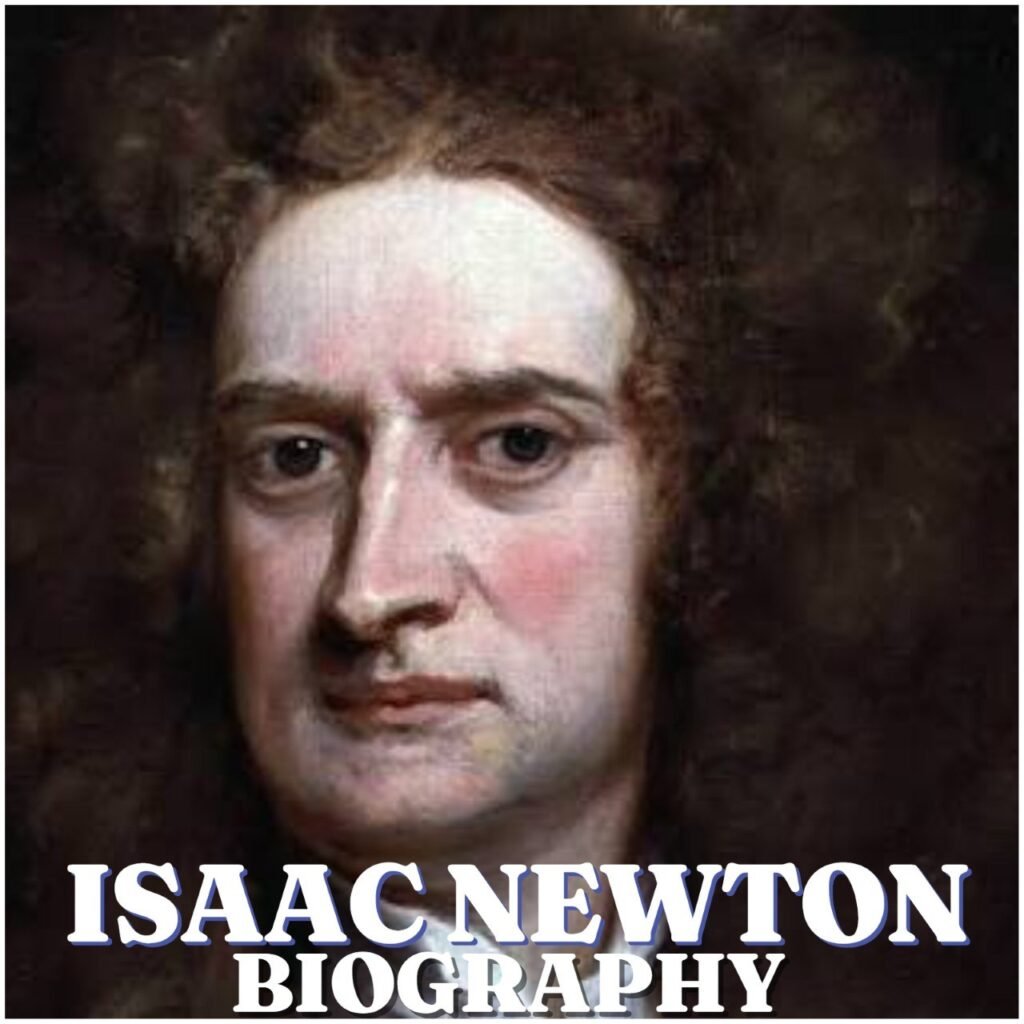
Historical descriptions portray Newton as a man of average height, with a lively, penetrating gaze and a dignified appearance. As he grew older, his hair became white, and portraits frequently depict him wearing long, flowing hair and formal clothing characteristic of the period. Accounts from people who knew him suggest that he sometimes appeared untidy when deeply absorbed in his work. Although no universally reliable record establishes his exact height, surviving portraits and historical descriptions provide an impression of his appearance. Today, these portraits remain important visual records of the scientist whose discoveries transformed humanity’s understanding of the physical universe.
Isaac Newton’s Age, Religion, Tribe, Height and Physical Appearance
Age
Sir Isaac Newton was born on 25 December 1642 according to the Julian calendar used in England at the time, equivalent to 4 January 1643 in the modern Gregorian calendar. He died on 20 March 1727 under the old calendar, equivalent to 31 March 1727 today, at approximately 84 years of age. Newton lived through a period of significant scientific and intellectual change, establishing himself as one of the most influential mathematicians and physicists in history. His discoveries in gravity, motion, mathematics and optics continue to influence scientific education and research worldwide.
Religion
Newton was a deeply religious Christian who devoted considerable time to studying the Bible, theology and biblical prophecy. He grew up in a Protestant English society and was associated publicly with the Church of England, although his private theological beliefs differed from established church teachings, particularly concerning the Trinity. He kept many of his religious views private during his lifetime. Newton believed that investigating the natural world could help reveal the order of God’s creation, and his surviving theological writings demonstrate that religion was a major part of his intellectual life alongside his scientific investigations.
Tribe
Isaac Newton was English and belonged to a family with roots in rural Lincolnshire. The modern concept of tribe does not accurately describe his historical background, because English society in the seventeenth century was generally organised around family, locality, social class and religious affiliation rather than tribal identity in the contemporary sense. His father, Isaac Newton Sr., was a landowning farmer, while his mother, Hannah Ayscough, came from a local family. Newton is therefore best described by his English nationality and family heritage rather than assigned to a particular tribe.
Height
Newton’s exact height has not been reliably established in the surviving historical records. Accounts from people who knew him describe him as being of medium or moderate stature and relatively lean. Because there is no dependable measurement available, assigning him a precise height in feet, inches or centimetres would be speculative. Historical descriptions provide a general impression of his build rather than an exact physical measurement.
Physical Appearance
Historical descriptions portray Newton as a relatively lean man of medium stature, with lively, penetrating eyes and a dignified facial appearance. In his later years, he was known for his abundant white hair, which was often worn long and sometimes covered by a formal wig. Accounts also suggest that he did not always pay much attention to his clothing or personal presentation when deeply absorbed in his intellectual work. Several portraits painted during his lifetime preserve his appearance for later generations. These historical images and written descriptions help readers picture the scientist whose discoveries transformed the understanding of gravity, motion and the natural world.
Isaac Newton’s Social Media Presence
Isaac Newton lived from 1642 to 1727, long before social media platforms existed. Therefore, he did not have personal accounts on Instagram, Facebook, TikTok, YouTube or X (formerly Twitter). Any modern account using his name should not automatically be considered an official account belonging to the historical scientist.
For SEO purposes, the important point is that Isaac Newton has no verified personal social media handle. His scientific discoveries and historical legacy continue to be discussed online by educators, historians, museums and science enthusiasts. Readers interested in his original writings and scientific achievements can explore the Newton Project at https://newtonproject.ox.ac.uk/, which publishes his surviving manuscripts and writings, and the Royal Society’s historical resources, which provide information about his life and career.
Isaac Newton’s Net Worth
Isaac Newton was a wealthy scientist by the standards of seventeenth- and eighteenth-century England. His wealth came primarily from his academic salary, his senior positions at the Royal Mint, investment income and property. As Lucasian Professor of Mathematics at the University of Cambridge, he earned an annual salary of approximately £100. His financial circumstances improved considerably after he became Warden of the Royal Mint in 1696 and Master of the Royal Mint in 1699, positions that provided substantially higher earnings. By the later years of his life, Newton had accumulated considerable savings and investments.
Historical accounts estimate that Newton’s personal estate was worth approximately £32,000 at the time of his death in 1727. He also earned substantial income from investments, although he lost a considerable amount during the South Sea Bubble financial crisis of 1720. Despite these investment losses, he remained wealthy and left much of his estate to members of his extended family. Translating his eighteenth-century fortune into modern money is difficult because different methods of comparison produce very different results. Some calculations based on ordinary inflation suggest a value in the millions of pounds today, while comparisons with historical income or economic output can produce much larger figures.
Although Isaac Newton has no conventional modern net-worth figure, his historical estate provides a reasonable basis for describing his financial standing. For a biography, it is more accurate to state that Newton left an estate valued at approximately £32,000 in 1727, rather than present an unsupported contemporary dollar figure as fact. His wealth reflected decades of academic achievement, government service and financial investment. Nevertheless, Newton’s greatest legacy is not his personal fortune but his revolutionary contributions to mathematics, physics and astronomy, which continue to influence science around the world.
Legacy of Isaac Newton
Isaac Newton’s legacy is deeply embedded in the history of science, mathematics and human understanding of the natural world. He is widely regarded as one of the most influential scientists of all time because his discoveries transformed the way people explain motion, gravity and the behaviour of physical objects. His three laws of motion and law of universal gravitation provided a mathematical framework for understanding phenomena ranging from falling objects to planetary orbits. Published in 1687, his landmark work, *Philosophiæ Naturalis Principia Mathematica*, became one of the most important scientific books ever written. Newton’s achievements helped establish classical mechanics as a foundation of physics and influenced generations of scientists, including researchers who later expanded or revised aspects of his theories.
Beyond physics, Newton left a lasting mark on mathematics, optics and scientific experimentation. His contributions to the development of calculus provided powerful mathematical methods for analysing change and motion, while his experiments with prisms demonstrated that white light contains a spectrum of colours. His book *Opticks*, published in 1704, helped advance the scientific study of light and vision. Newton also developed a reflecting telescope design that influenced later astronomical instruments. His career demonstrated the importance of combining mathematical reasoning with observation and experimentation. Although modern theories such as Einstein’s general relativity have expanded our understanding of gravity, Newtonian mechanics remains highly useful in engineering, astronomy and everyday physical calculations.
Newton’s influence continues to be recognised through universities, museums, scientific institutions and awards bearing his name. The Institute of Physics’ Isaac Newton Medal honours outstanding contributions to physics, connecting his historical achievements with continuing scientific progress. His life also remains a subject of historical research, with scholars studying his manuscripts, religious writings, experiments and public service. Newton’s achievements at the University of Cambridge, the Royal Society and the Royal Mint further demonstrate the breadth of his influence beyond the laboratory and classroom. Nearly three centuries after his death in 1727, Isaac Newton remains a symbol of intellectual curiosity, perseverance and scientific innovation, and his work continues to inspire students, researchers and educators around the world.
Conclusion
Sir Isaac Newton remains one of the most influential figures in the history of science, celebrated for his groundbreaking discoveries in physics, mathematics, astronomy and optics. From his early life in Woolsthorpe, England, to his education at the University of Cambridge and his distinguished career at the Royal Society and the Royal Mint, Newton demonstrated exceptional intellectual curiosity and determination. His three laws of motion, law of universal gravitation and contributions to calculus transformed humanity’s understanding of the natural world and established foundations for generations of scientific research. Although he died in 1727, his discoveries continue to shape modern education, engineering and scientific investigation. His personal life, religious studies and remarkable professional achievements also provide valuable insights into the man behind these revolutionary ideas. Ultimately, Isaac Newton’s enduring legacy extends far beyond his historical wealth or reputation, securing his place as a pioneering scientist whose work continues to inspire curiosity, innovation and the pursuit of knowledge worldwide.
Frequently Asked Questions About Isaac Newton
1. Who was Isaac Newton?
Isaac Newton was an English mathematician, physicist, astronomer and author best known for his laws of motion and law of universal gravitation. He is widely regarded as one of the most influential scientists in history.
2. When was Isaac Newton born?
Isaac Newton was born on 25 December 1642 according to the Julian calendar used in England at the time, equivalent to 4 January 1643 in the modern Gregorian calendar. He was born at Woolsthorpe Manor in Lincolnshire, England.
3. When did Isaac Newton die?
Isaac Newton died in London on 20 March 1727 according to the calendar then used in England, equivalent to 31 March 1727 in the modern Gregorian calendar. He was approximately 84 years old.
4. What was Isaac Newton famous for?
Newton was famous for formulating the three laws of motion, developing the law of universal gravitation, advancing calculus, conducting experiments on light and colour, and developing a reflecting telescope.
5. What were Isaac Newton’s three laws of motion?
Newton’s three laws describe inertia, the relationship between force and acceleration, and the principle that every action has an equal and opposite reaction. These laws remain fundamental to classical mechanics.
6. Did Isaac Newton discover gravity because of an apple?
The famous apple story is associated with Newton’s reflections on gravity. Historical accounts suggest that seeing an apple fall helped prompt his thinking, but the complete theory of universal gravitation developed through extensive mathematical reasoning and scientific investigation.
7. Where did Isaac Newton study?
Newton attended the King’s School in Grantham before enrolling at Trinity College, University of Cambridge, in 1661. He later became Lucasian Professor of Mathematics at Cambridge.
8. Was Isaac Newton married?
No. Isaac Newton never married and had no known children. There is no reliably documented wife or fiancée associated with him.
9. What was Isaac Newton’s religion?
Newton was a Christian who devoted considerable time to biblical study and theology. However, some of his private theological beliefs differed from the established doctrines of the Church of England.
10. What was Isaac Newton’s nationality and tribe?
Newton was English, born in Lincolnshire, England. Describing him by his English nationality and family background is more historically appropriate than assigning him to a modern tribal category.
11. What was Isaac Newton’s net worth?
Historical accounts estimate that Newton’s estate was worth approximately £32,000 at the time of his death in 1727. Its modern equivalent varies considerably depending on the method used to calculate historical wealth.
12. What was Isaac Newton’s most famous book?
His most famous scientific book was *Philosophiæ Naturalis Principia Mathematica*, published in 1687. Commonly known as *Principia Mathematica*, it presented his laws of motion and theory of universal gravitation.
13. Did Isaac Newton have social media accounts?
No. Newton died centuries before social media existed and had no personal Instagram, Facebook, TikTok or X account. Modern accounts using his name should not automatically be considered official.
14. What is Isaac Newton’s greatest contribution to science?
One of Newton’s greatest contributions was establishing a mathematical framework that connected motion on Earth with the movement of celestial bodies. His laws of motion and universal gravitation profoundly influenced physics and astronomy.
15. Why is Isaac Newton still important today?
Newton remains important because his discoveries underpin much of classical physics, engineering and astronomy. His scientific methods, mathematical insights and influential publications continue to shape education and research worldwide.
16. What is the latest news connected to Isaac Newton in October 2026?
A notable recent development is the announcement that physicist Ignacio Cirac received the 2026 Isaac Newton Medal for contributions to quantum information science. The award honours Newton’s continuing influence on physics rather than a new discovery by Newton himself.